


WILD THINGS EDITED BY STEVE J. SHAW
2/12/2015
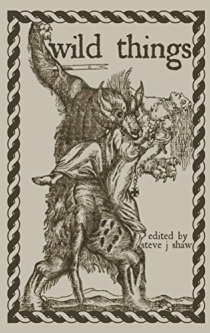 Wild Things, is the first anthology from Black Shuck Books, edited by BSB's owner, Steve Shaw - who also provides the intro (and I think this is also Steve's first gig as editor, though I'm sure he'll correct me otherwise). The theme of the anthology is shapeshifters, various and varied stories of humans changing into some kind of animal, and as it's a slim volume - only thirteen stories housed within a lovely cover and solid book design - I'm going to give a rundown of each one. 1. Fish by Anna Taborska. Kicking off the book is this watery tale of mistaken identity, bumbling gangsters and revenge. After a freak encounter with a poisonous scorpion fish, Harry Tomlinson returns from seeming death as the more freakish cousin of The Creature From The Black Lagoon to exact vengeance on those who mistakenly dispatched him. It's short, pacy and full of vibrant fun, and while it's nothing especially new or mind-blowing, it's a decent story to open the anthology. 2. Confession by Christopher Law. Slowing things down a bit, we have this confessional detailing a young man's discovery of his ability to transform into a huge eagle, and how it affects the course of his life. As it's set out almost from the off that he's in a jail cell of some kind, you know it's not going to end well. Now, though the premise isn't a bad idea and has touches of inspiration, I felt the overall presentation suffered by being written passively. I can understand that it's supposed to be like a diary entry or similar, but I felt there wasn't enough dialogue or descriptive paragraphs to break up the sense of it being an historical account, which makes it somewhat dry. Having said that, there are a few standout scenes of the eagle hunting, one in particular that was extremely wince-inducing. 3. Scruffy Dog by D. S. Ullery. Nanette takes a mongrel stray dog into her house one night, after spending a few evenings feeding and stroking him. It's a decision that will lead to some interesting events... I loved this story. It's wonderfully written with some great passages and descriptive prose. Such a simple premise is elevated above its plot by the skill on display. I also loved the fact that I never saw the ending coming, imagining the story going off in a completely different direction. I'll leave you to find out which direction it goes. It's definitely one of the stand out tales for me, and I'll be keen to read more of this author's work. 4. Hunting by Rachel Halsall. Taking the Scottish myth of the Selkie as its inspiration, Rachel Halsall weaves a beautifully tragic tale full of emotion and heartfelt horror. By far the best story for me in this collection, I was mesmerised by the poetic writing, the perfect descriptions, the mature confidence and the through-line of melancholy, longing and brief, fragile hope. Deeply emotional and full of confidence. And then I find out the writer is twenty. Twenty! I weep at the talent on display. Seriously, though, it's a wonderful tale with some really distressing scenes that had me in despair; notably, the skinning of the Selkies. Loved it. 5. A Little Knowledge Is A Dangerous Thing by Darrell Duckworth. Another reasonably short, short story, which has the young heir to a rich family empire being held hostage in a magic circle by a rival family's outcast son. It's a story composed mostly of dialogue - the interaction entirely between the two main characters - yet it races along to its conclusion with much to entertain and interest. I don't want to say too much about this one, but I loved the concept of it, the idea of family dynasties with historical roots in magic and I'd love to see more of this mythology explored. Very entertaining stuff, despite the apparent lack of 'action'. 6. The Shape Of Nothingness by Scott Shoyer. This one concerns a creature who is essentially immortal, having lived the entire breadth of human history. His one disadvantage to such a long existence is that when someone falls in love with him, he turns into their worst fear and kills them. It's an interesting concept and one that offers a good jumping off point. However, I struggled with a lot of the writing in this. It felt awkward in places and a little forced, artificial. I also thought the twist was telegraphed about halfway through, which robbed the ending of much of its potential impact. Shame, as it is a very interesting idea. 7. The Fragility Of Flesh by Laura Mauro. My second favourite story in this anthology - surprising me as, though I've only read one other story by Laura, she's one of my favourite writers; though it was a close thing with Hunting - follows teenager Carol, who suffers awful bullying at school and a miserable existence at home. Her days comprise vicious name-calling, vile pranks being played and even physical abuse. An incident of the latter instigates a profound, physical change in Carol which may offer her the escape she desperately needs and wants. As I'd expected, the story is wonderfully written, really allowing you to feel all of Carol's pain, misery and isolation. Having been subject to bullying at school myself, I could absolutely relate to this one, and it's spot on with the casual cruelty of some school kids and the loneliness those who suffer can experience. The story resolves itself in a very open, yet satisfying way, and perhaps not quite as one might expect. A very strong mid-point tale, and of a quality I'm coming to expect from Laura. 8. Golden Moments by James Park. Another short tale, this one concerns a champion boxer who is musing, during sex, on how little his achievements in life matter leading up to orgasm, following which these events do matter. It's an interesting stylistic device that allows us to receive a lot of exposition without it feeling awkward, forced or boring. It also ends with a double twist, the first of which made me think it was a bit too similar to The Shape Of Nothingness, while the second absolutely blew me away. It turned it from a competent, well-written, mildly interesting story into something with huge scope and potential for a bigger outing. I'd love to see the writer take this concept further, the last few paragraphs definitely raised this one up for me. 9. Leydra's Maiden by Kelda Crouch. Set in some distant, mediaeval land, Matilda is working for her Master and looking after the Master's wife, while secretly plotting to her and subsequently become the new Master's wife. She does so through her corrupted use of Leydra's magic, a goddess or other mythical figure in this world. Now, it's an interesting idea with some potential complex dynamics, yet I found much of the writing to be awkward and clunky. I also felt that new situations are introduced in a way that feels intrusive instead of organic. I get that it's trying to show an evolution of Matilda, and an almost justification for why she's doing what she's doing. However, there are some nicely drawn scenes and the ending was very satisfying, offering some hope and redemption. 10. Santa Marimbondo by G. H. Finn. Set in South America, and concerning the legend of the titular character - a much-feared and barely talked about 'Wasp' demon - the story follows a Scottish female anthropologist who is in search of interesting legends and the like from the region. When she hears of Santa Marimbondo, she wants to know more and luckily, she meets a fellow who seems to be the only one willing to talk about the legend but clearly has romantic designs on her. She also meets a young American woman and the two strike up a friendship that had the potential to be more. I did like this story. It's a neat idea and cultural myths are always fertile ground for stories. I did find some of the writing to be less than perfect and I get the sense that there is a deep streak of humour going on; I only wish it had been more. There are little nods to wasps (and other similar insects) throughout - the man wearing a black and yellow striped jumper, the girl whose name is Helstrom, probably more that I missed - but it felt like it should have been more grandiose, more humorous. I also felt the framing device - the main character is recalling the last few days while trying to work out both who might be in bed beside her, and wondering what that buzzing sound is - was too laboured, too much. For me, it would have worked better coming naturally towards the end. Still, nice little story with a sting in its tale (sorry!). 11. Centipede by Helen Cattan-Prugl. Channelling both Franz Kafka and Roald Dahl i a madcap bizarro tale, here we are presented with the misadventures of Alan, who suddenly gains the ability to turn into a poisonous centipede and hopes to somehow use this ability to woo the focus of his unrequited love Yuki. Sadly, Yuki is as shallow as can be and both hates and uses Alan for her own ends. This is a nasty little story, but nasty in a good way. No redeemable characters but with a strong sense of the sardonic and some offbeat humour, my only complaint is, again, the writing needing a bit of tightening up in places. If gross-out tales - and there are some pretty graphic descriptions of people being consumed from the inside out by the centipede - with a dose of humour are your thing, you'll probably love this. 12. The Change by Calum Chalmers. A change of pace now, and here we follow the main character as he tells us of his young life coping with his change into...something. In his early years, his mother would sing to him on the nights of the change, keeping him calm and comforted. After her death, he still hears the memory of her voice which keeps him small company. I really loved this story, probably my third favourite in the book. There's a deep line of emotion cutting through it and aside from the odd run on sentence here and there, the occasional out of place word, it really makes you feel for the young man and what he goes through; the preparations he has to make on the night of the change, the necessity of eschewing a social life, the ridicule he faces from his boss who obviously thinks he's mad. It's quite a powerful piece, not at all blood and guts and just shows how much scope there can be in shapeshifter stories. If you don't have tears running down your face by the final line, I'd be surprised. 13. The Were-Dwarf by Johnny Mains. Vinny is a person of short stature, who also enjoys a modicum of shallow celebrity status following his appearance on a minor TV show, then subsequently gaining massive sympathy from the UK public following the tragic death of his wife. He is also a celebrity DJ and following a night of performing in a local pub, he has an encounter with a mysterious creature which leaves him hospitalised and changed. By far the longest story in the anthology - easily twice as long as the next longest - I did struggle with this one. The writing is peppered with run on sentences, awkward phrasing and heavy use of the passive voice. I also felt that it was intended to be an amusing anecdote, perhaps somehow lampooning celebrity lifestyle, but it failed to make me laugh. I think if it had been cut to a smaller size, had some judicial editing to tighten up the writing and the humour had been ramped up, this could have worked for me. As it is, it seems to merely meander its way along and though it's not a bad idea - even if it does borrow heavily from the likes of An American Werewolf In London, especially at the start - the story feels far too long for what it's about. So, all in all, a bit of a mixed bag for me. Some great stories, some that perhaps needed a bit more work. As I said though, your mileage may vary, and hopefully I've given you enough of an idea to know which stories you're likely to enjoy. Thanks for reading. Purchase a copy here Authors and fans please follow this link and give the review a helpful vote on Amazon. PAUL M. FEENEYTHE HEART AND SOUL OF HORROR FICTION REVIEWS2/12/2015 06:33:48
Thanks Paul... it is indeed my first go around as editor. Thanks for the kind words. Comments are closed.
|


Archives
May 2023
|

|

|
 RSS Feed