


|
"It was dirty, physical work, but it was second nature to Alce by now. She still marvelled at the complacency of the oblivious public she dealt with. The ludicrous way they could remain blind to the nature of the wider world until the unpleasant realities of it impinged on their own. She remembered wishing she could feel so immune. She wished she could leave the house one morning and see only the world as it pretended to be. It must be so easy to be ignorant. So happy to not know." - 'We All Need Somewhere To Hide' 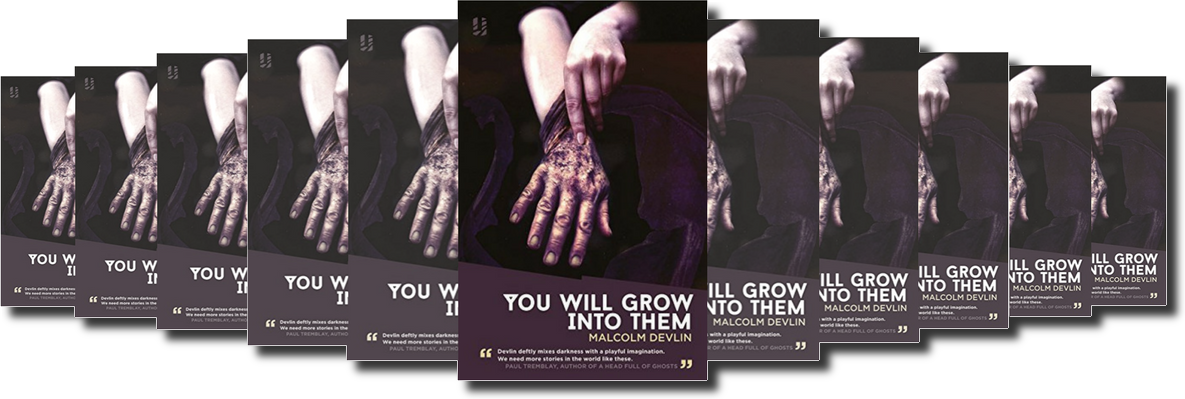 "Tom imagined his life as a transplant operation. The fictional world he’d lived in was being cut out of him and a weighty reality was being wired into the hole it had left behind. But transplants were dangerous, and Tom found himself living at one remove, convinced his body would rebel at any arbitrary moment, rejecting the reality he had been forced to accept." - 'Songs Like They Used To Play' Malcolm Devlin's debut short story collection You Will Grow Into Them marks the debut of an exciting new talent. Over the course of ten stories, Devlin shows just how varied Horror and Weird fiction can be, effortlessly fusing elements from folklore, science fiction, regency comedy of manners and urban fantasy into a cohesive and compelling whole. Each story demonstrates Devlin's mastery of prose; his writing is beautiful and clear, and his characterisation deft. The stories are thematically linked through the idea of the coming of age tale. With each story, Devlin uses Horror and the Weird to remind us of the gap between our perception or reality and reality itself, and to explore what lurks in the shadows in between. His writing is fascinated with transitory states and the liminal, the space that exists between the rigidly defined strictures of the world around us. In this his work echoes the philosophical approach of Philip K. Dick and Thomas Ligotti, reminding us of the power of genre fiction to ask profound questions about our relationship to reality. Each of Devlin's stories in the collection is a coming of age tale, roughly arranged in chronological age order of the protagonists. Thus while the earlier stories reflect the essential moment of a child's realisation that the world is a stranger and more frightening place than they had known, the stories featuring young adults and couples with children themselves remind us that our understanding of the world as we mature still remains incomplete, something to be challenged. The stories celebrate the idea of transition from one state to another, the moment of metamorphosis, terrible or wonderful. Devlin is an adept explorer of these liminal states, his stories gaining their power to thrill and frighten from the vividness with which he inhabits them. Rather than relying on jump scares or explicit violence, his stories frequently use the power of suggestion and implication to open up and explore these spaces, an engagement with the reader's own subconscious. 'Dogsbody' is a werewolf story set years after the transformations have taken place, whilst the cross hatch man in 'Passion Play' never makes a physical appearance. This gives his stories their own particular unusual flavour, and allows him to exploit the uncanny to its full effect. In keeping with the theme of liminal states, Devlin's stories frequently play surprising games with genre and form, finding common ground between seemingly disparate genres or novel uses for familiar tropes or motifs. The new is mixed atavistically with the old, as a method of defamiliarising both, and creating a sense of echoing or recapitulation. Thus 'Breadcrumbs' spirals out from fairy tale motifs into surrealism and the New Weird, imagining a city blossoming into a riot of nature. 'Her First Harvest' effortlessly mixes Regency period comedy of manners with science fiction, portraying a young girl's first ball on a planet in which the colonists harvest edible fungi from their own backs. 'Passion Play' conflates the Stations of the Cross with a police reenactment of the last journey of a missing schoolgirl. The idea of doubles or reflections recurs throughout the stories. This is demonstrated in the way in which Devlin undermines the sense of realities. 'The Bridge' is a beautifully subtle story in which a couple moving into a house find a model replica of the town in the attic which tells the tragic story of the previous owner through its deviations from the real town. 'Two Brothers' explores the gap that grows between siblings as their experiences differ, the protagonist unable to process the change in his older brother after his first term at school. 'The Last Meal He Ate Before She Killed Him' features a restaurant in which a woman who killed a general is punished by being forced to replay the events of his final evening as a form of dinner entertainment for high ranking members of the militia. The story explores the way oppressive regimes codify the behaviour of their citizens into routines of paranoia and treachery; the routine proves no less dangerous for being rote. 'Songs Like They Used To Play' is a powerful exploration of the distorting effect of memory and toxic nostalgia. Its protagonist grew up on a reality show that mimics life in Britain in previous decades; he can never be sure which of his memories are genuine or which are shaped by rewatching the show, in much the same way that the nostalgia industry warps our perception of the past with its airbrushed sepia-toned cosiness. Devlin's stories frequently tap into British social class anxieties, a subject that provides a continuous source of tension throughout the collection. 'Dogsbody' is a powerful exploration of social stigma; the werewolves are treated as second class citizens because of their condition, and it is this which drives the story rather than any sense of threat from the werewolves themselves. 'Two Brothers' invokes the sneering sense of entitlement fostered by the British public school system. His most powerful exploration of these themes is in the final story of the collection, 'The End Of Hope Street'. Devlin dissects the petty neighbourhood rivalries and relationships on Hope Street as one by one the houses become unliveable, and the remaining tenants have to choose between welcoming their now homeless neighbours or selfishly driving them away. The story shows both how tragedy can bring people together and bring out the best in them but also how it can bring out hatred and paranoia. As an exploration of Britain shutting its doors on its neighbours it could not be more relevant or timely. Though his stories are frequently unsettling and disturbing, Devlin's empathy for his characters shines through. The stories in this collection are peopled by a diverse cast of differing backgrounds, sexualities and world views. Devlin is able to bring them all to life and give them all distinct voices. His strong character work helps to anchor his stories. The familiarity and humanity of his characters makes their exploration of the uncanny and the stripping away of our complacent understanding of reality all the more powerful. For all that the stories frequently do not feature traditional ghosts or monsters, they are very much part of the Weird. Throughout the collection Devlin shows us how our perspectives cheat us; the reality we experience is only a window on to the world, and there is always some vital piece of information hovering just outside our perception. The stories in You Will Grow Into Them force us to confront this information. The end experience can be uplifting or terrifying or both, but in every case they force us to change and grow as people.  Malcolm Devlin's You Will Grow Into Them is a collection of immaculately written tales that deftly mix darkness with a playful imagination. The results are stories that are as entertaining and humane as they are deeply unsettling. We need more stories in the world like these. Paul Tremblay, author of A Head Full of Ghosts Devlin's collection, like Andrew Michael Hurley's The Loney before it, is set to become one of the decade's landmarks of English weird. Nina Allan, author of The Race and The Rift  Comments are closed.
|


Archives
May 2023
|

|

|
 RSS Feed