


 If Camp Ghoul Mountain Part VI: The Official Novelization presented “only” the narrative of a nonexistent slasher movie, that itself would be a hell of a hook. The fact that it turns out to be something more complex elevates author Jonathan Raab’s latest work beyond what might appear at first glance to be just a gimmick. Indeed, for genre fans with a taste for tongue-in-cheek metafiction, this may well be the first must-read small-press horror novel of 2019. Taking a footnote-flooded page out of Mark Z. Danielewski’s House of Leaves, Camp Ghoul Mountain interweaves multiple independent narratives, each one taking place within its own separate, but not entirely self-contained, reality. To wit, what appears to be the main plot of the book (at least at first) is the story of the titular slasher flick itself: despite a long history of tragedy and violence, Camp Goose Mountain (known to locals by a decidedly more lurid nickname) is all set to reopen for the summer with a new batch of teenage counsellors, including good girl Penny, her hard-partying BFF Rhonda, and dreamboat jock Terry. They’ve all heard the legend of Henry the Horror, the bloodthirsty bogeyman who prowls the forest in search of victims, but only when the bodies start piling up do they realize there’s more to Henry than just whispers around a campfire. That’s just part of the larger story, however, and one that exists in a completely different reality from that occupied by Raab himself. Yes, even the book’s own author becomes a character within it, addressing the reader directly via both copious annotations appearing throughout and full-fledged chapters which periodically interrupt Henry the Horror’s stalk-and-slash antics to provide a “non-fictional” (wink, wink) behind-the-scenes look into the film’s troubled production, as well as into the conspiracy theories regarding secret messages encoded into the picture by director/stoner Monty Blackwood (shades of Stanley Kubrick’s The Shining and its attendant documentary, Room 237). Both narratives only get stranger the longer they go on. It turns out the Henry the Horror’s seventh outing is the black sheep of the Ghoul Mountain franchise, a puzzling retcon of previously established series lore similar to Halloween 6: The Curse of Michael Myers or Texas Chainsaw Massacre: The Next Generation. What starts out as a straightforward Friday the 13th clone quickly spirals out into a chaotic, hallucinatory mindfuck full of faceless black-robed zealots, flying saucers, police cover-ups, and talking animal heads. What’s more, the protagonists occasionally seem dimly aware that they are fictional characters and that many of their actions are not choices of their own, but rather necessitated by genre tropes (if Camp Ghoul Mountain VI was a real movie, it would’ve beaten Wes Craven’s New Nightmare, Scream, The Cabin in the Woods, and Behind the Mask: The Rise of Leslie Vernon to the punch by more than a decade). Meanwhile, in the “real world,” Raab uncovers obscure newspaper clippings, magazine interviews, censored YouTube videos, transcripts of convention Q&A panels, pages from a hand-scribbled New Age pamphlet, and even a Satanic Panic religious tract (all lovingly recreated within the book’s pages). Through these, he gradually pieces together the full scope of Henry the Horror’s cinematic legacy. Maybe not everything Blackwood filmed was special effects. Maybe he just happened to be pointing his camera in the right place at the right time. Maybe Camp Ghoul Mountain VI, or at least some of it, was real. Granted, Raab’s style might come off as too heavy-handed for some, even outright campy (no pun intended). He eschews the more straight-faced and subtle approach to horror that Danielewski employed in House of Leaves for something far more gleeful and pulpy. This is, however, perfectly in keeping with the subject matter; aside from a few notable exceptions, a large part of the charm of most slasher films comes from their utter disregard for restraint, elegance, or good taste. This is not the kind of humorless horror that quietly creeps under your skin after lulling you into a false sense of security. This is HORROR in all caps, one million-point font, blazing red neon lights, visible from space. Likewise, Raab’s choice to insert himself into the narrative might be off-putting to certain readers, especially as he delves deeper into the book’s more esoteric themes, not to mention their political implications. How much, one wonders, does the Raab on the page accurately represent the Raab of real life? This blurring of the lines is arguably Camp Ghoul Mountain’s most enticing element, but it may also be its most divisive. Even with the novel’s winking tone, one may begin to question how seriously audiences are meant to take it. The best answer may be “As seriously as you want to.” To quote Raab himself at the start of chapter 7, “Horror is fun.” Indeed, Camp Ghoul Mountain is a lot of things: a slasher film love letter, a paranoid conspiracy meta-thriller, a personal manifesto about the power of the horror genre as a whole. But what it is above and beyond all else is fun. Where House of Leaves sought to convey the dread and confusion that comes with slowly losing one’s grip on reality, Camp Ghoul Mountain Part VI captures the liberating joy that comes with willingly letting go, with rejecting consensus reality (if only temporarily) in favor of something more outrageous, more imaginative. If the horror genre can be compared to a roller coaster ride, as it often is, then this book is the equivalent of that moment when you put your hands in the air; a thrilling flirtation with the danger of being thrown to certain death, even as the safety bar holds you firmly in place. camp ghoul mountain part vi Camp Ghoul Mountain Part VI is one of the most infamous slasher-movie sequels of the 1980s. Known for its over-the-top gore effects, bizarre and psychedelic campground killer plot—and its legacy as a lightning rod for conspiracy theories concerning everything from UFOs and alien abductions to 9/11 and a secret cabal at the heart of world power. This book contains a complete, authorized adaptation of the infamous cult slasher movie as well as the secret history of the behind-the-scenes drama and high-strange events that inspired the filmmakers, complete with footnotes and autobiographical anecdotes. Camp Ghoul Mountain Part VI: The Official Novelization is a love letter to the horror movie boom of the 1980s and conspiracy theories of the 1990s—and, perhaps, a dire warning of the dark future to come. Who wants to go camping?    Genuinely captivating memoir of fifty years working as an indie filmmaker Even if you’ve never heard of Don Coscarelli, anyone with a serious interest in independent and low budget filmmaking will be captivated by his charming, informative, and good-natured autobiography. As the book moves through his life Don does provide some background family material, but the book does focus more heavily on his filmmaking than personal life. Covering key areas such as the problems in raising money and financing, how to retain artistic control when a big studio is involved and the importance of film distribution are all fascinating topics for discussion. As Coscarelli has been making films since the mid-1970s it is a truly wide-reaching account which takes us through the films he made before he turned to horror, the videotape boom and the eventual importance of the internet in discovering the genuine love for his cult horror series “Phantasm” for which he is probably best known. If you’ve never watched a “Phantasm” film (or watched and hated!) be rest assured you can still enjoy this book. It is presented with very short chapters and had a superb balance of film observations, reflective lookbacks, coupled with a real sense of humour and honest “what might have been” moments. For example, it turned out Brad Pitt auditioned for one of the major parts in “Phantasm 2” but nobody could remember it until Brad did indeed confirm it! It was also lovely to read of instances where the filmmaker admits, “you know what? I probably got that wrong” a particularly funny one was when Coscarelli suggested to Quentin Tarantino that he cut the iconic opening scene in “Reservoir Dogs” when they’re all sitting in the restaurant talking about Madonna amongst other things. How wrong Don was, but at least he admitted it! The voice throughout the memoir comes across as honest, endearing and both totally down to earth and totally at ease with himself. There were so many lovely anecdotes they are far too many to mention, but the sequence when he was involved in “Silver Bullet” (based on Stephen King’s “Cycle of the Werewolf”) was particularly entertaining, a project he was eventually fired from. However, he did get to meet Stephen King, Coscarelli notes that when he was about to bumble a self-conscious compliment to King on his work but Stephen skilfully turned the conversation around, saying how much he enjoyed the “Phantasm” films instead. It was refreshing to read an autobiography where the author did not bitch about anyone, when things did not go his way, he simply accepted it as part of the job. Don and Marc Singer did not particularly see eye-to-eye when they were making “Beast Master” and even though there was friction, Don does not criticise Singer in the book. I found this all very refreshing. The blurb of “True Indie” has very kind words from JJ Abrams who was involved in the recent restoration of the “Phantasm” films, Rob Zombie, David Wong and the cult film actor Bruce Campbell. “Bubba Ho-Tep” famously starred Campbell as an aging Elvis Presley, living in a retirement home who has to fight a demon. The sequences involving Campbell are truly fascinating and if you ever thought b-movie actors were only in it for the money, think again. Have you ever asked yourself why there was no sequel to “Bubba Ho-Tep 2” even though Coscarelli wrote a script which also involved original author Joe Lansdale? Campbell refused to make another film, mainly because he thought a sequel might tarnish the reputation of the original which has built a cult following in the years since it was released. Initially this film might have been a failure, it was rejected by many film festivals, had distribution problems and Bruce Campbell helped save it by appearing all over the place until it picked up momentum and positive press. This maverick and hands-on attitude to filmmaking permeates throughout the entire book and was lovely to read about. In some ways “True Indie” was reminiscent of Bruce Campbell’s own superb autobiography “If Chins Could Kill: Confessions of a B-movie Actor” or if we go even further back it recalled Roger Corman’s “How I Made a Hundred Movies in Hollywood and Never Lost a Dime” which are written with the same happy go lucky spirit and also full of insightful film observations. Coscarelli makes excellent use of hindsight in regard to his filmmaking and how he might do things differently these days. Because of the advances in technology in filmmaking he reckons an indie film can easily be made for $100,000 and turn a profit whereas in previous decades the sum would have been much higher, he himself quoted $1,000,000 as a ballpark figure. The trials of dangerous filming basic scenes and stunts with the clunky 1970s equipment in the original “Phantasm” were testament to that, which a couple of decades later the same special effects could be achieved on a laptop for peanuts. His battles with special effects, with minimal budgets, particularly the deadly flying “Phantasm” spheres, was a fascinating read. As a filmmaker Coscarelli has probably revisited the “Phantasm” films too many times for my personal tate, although it was still wonderful to read about them. I am old enough to recall the glory-days of “Phantasm 2” having a big release on home-video in the UK and at the time $3,000,000 was a huge budget for what was effectively a low-budget horror film. In subsequent sequels the budget has dwindled, and to be frank, it showed in the final product. But whatever your opinion on the “Phantasm” films they have earned their place in horror film folklore. Although Angus Scrimm was in lots of television and films he will forever be known as ‘The Tall Man’ from the “Phantasm” films. He and Don Coscarelli had a friendship that lasted many decades and even when he was elderly and too infirm to travel Angus would deliberately phone Don whilst he was at fan conventions and put on his ‘Tall Man’ voice. The audience loved it and the men remained very close until his death in 2016 which is sensitively covered in the book. “True Indie” is full of lovely stories such as this and if you ever wondered why a director might only make twelve or thirteen films in a forty-year career Don Coscarelli explains it perfectly: in indie filmmaking you have to do everything yourself. From writing and selling your script, then getting the film made and edited, before eventual distribution. Amazingly, Don even turned down some very big directing gigs down the years including “Conan the Destroyer” starring Arnold Schwarzenegger. One must applaud Don Coscarelli for his fighting spirit, which really shines through in the book, plenty of others would have given up the dream and got an office job. Why? His first two films were released by different studios who ultimately ignored their product mainly because they found they had bigger fish to fry. Firstly “Jaws” arrived and then lightning really did strike twice with “Star Wars”. This was an energetic, thoughtful and uplifting look inside the cut-throat indie film business and his many brushes with Hollywood. Don Coscarelli almost makes it sound like fun! If you ever see him, just don’t imply “Beast Master” is a “Conan” rip-off. You’ll piss him off. Finally, when you next watch Spielberg’s “Ready Player One” watch out for the “Phantasm” Easter Egg film joke! I saw that flick on the cinema with my daughter and I’m damned if I can remember it… 5/5 Tony Jones 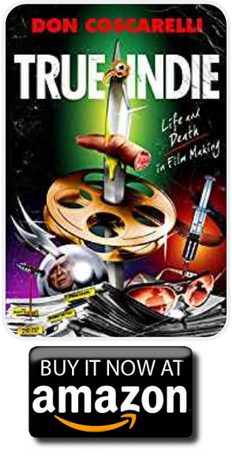 Best known for his horror/sci-fi/fantasy films including Phantasm, The Beastmaster, Bubba Ho-tep and John Dies at the End, now Don Coscarelli's taking you on a white-knuckle ride through the rough and tumble world of indie film. Join Coscarelli as he sells his first feature film to Universal Pictures and gets his own office on the studio lot while still in his teens. Travel with him as he chaperones three out-of-control child actors as they barnstorm Japan, almost drowns actress Catherine Keener in her first film role, and transforms a short story about Elvis Presley battling a four thousand year-old Egyptian mummy into a beloved cult classic film. Witness the incredible cast of characters he meets along the way from heavy metal god Ronnie James Dio to first-time filmmakers Quentin Tarantino and Roger Avary. Learn how breaking bread with genre icons Tobe Hooper, John Carpenter and Guillermo Del Toro leads to a major cable series and watch as he and zombie king George A. Romero together take over an unprepared national network television show with their tales of blood and horror. This memoir fits an entire film school education into a single book. It's loaded with behind-the-scenes stories: like setting his face on fire during the making of Phantasm, hearing Bruce Campbell's most important question before agreeing to star in Bubba Ho-tep, and crafting a horror thriller into a franchise phenomenon spanning four decades. Find out how Coscarelli managed to retain creative and financial control of his artistic works in an industry ruled by power-hungry predators, and all without going insane or bankrupt. True Indie will prove indispensable for fans of Coscarelli's movies, aspiring filmmakers, and anyone who loves a story of an underdog who prevails while not betraying what he believes. 
 One of the "Holy Grails" of reading a horror book is finding one that not only scares and entertains you, but one that provides a reader with that added extra value of being able to connect with either one of the characters or the story itself. It allows the reader to become fully immersed in the story, almost to the point where you feel as though you have drawn into the story by some magical narrative force. Willie Meikle's The Auld Mither (translated for those not fluent in Scots as The Old Mother), is probably the most immersed I have ever been in the story due to the way that I could connect with the narrative. Dave Duncan makes a trip back to his old family home after the mysterious death of his overbearing stoic father, the owner of a slaughterhouse specialising in the production of venison. Obviously, my family was never targeted by a Hag / Crone from Scottish folklore, but having one side of my family originating from the area in which The Auld Mither is set, as well as having a Grandfather who owned a slaughterhouse, where I spent many of my summer school holidays helping out, gave the book a more intense creep and scare factor, that will be experienced by the average reader. To put it mildly, this book scared the living crap out of me. I usually can finish a novella of this size and this quality in one comfortable sitting, but I found myself having to put the book down as the mounting sense of dread and the mind tricks that had me hearing the sound of cloven hooves clacking across our hall floor. The Auld Mither is a tightly constructed novella, with a breakneck narrative that manages to successfully combine Scottish folklore, with police procedural, and small-town life. Meikle has crafted a tale that is genuinely creepy, riffing on the plentiful myths of the Scottish Hag, ancestor deities who were generally ambivalent with regards to their interactions with human, but who were tasked with the protection of their chosen wards. The Auld Mither is best described as a rather angry version of Herne the Hunter. The The Auld Mither has decided to target the Duncan family; the reasons aren't made entirely clear as to why she has suddenly decided to do this, as the family business has been going on for decades. Meikle's depiction of her is a first class example of how to create a truly terrifying monster. He doesn't give her much in the way of motivation for her actions, other than being a protector of deer, but this adds to her power, to scare. She is a force of the wild and untamed nature of Scottish folklore. Sometimes the best monsters are just monsters. Meikle also makes good use of the fish out of water scenario for the main protagonist of the story. Dave Duncan's return to his old home, and the confrontation he feels at returning home and being reminded of a father who he had nothing in common with his handle with a sensitive hand, and links into the story perfectly. Is Dave his own man, is he a herdsman or a butcher, those questions play a critical role in the story. Setting a story in Scotland can be a difficult task, and setting one in Aberdeenshire is an even harder one. Getting that sense of a real place can be filled with pitfalls, especially where dialogue is concerned, in the hands of a lesser writer this can become a severe problem, I still looking at you Steve Alten, even after ten years of reading The Loch I haven't forgiven you. Meikle cleverly gets around this by limiting the number of characters who come from Aberdeenshire, Dave Duncan is essentially an incomer, having lived away from the are for so long, and even the DI in charge of the investigation is a new arrival to the town. Meikle gives the books a sense of place by an innovative line about how the taxi driver talks, it's subtle but it gets around the problem of filling the dialogue lines with phrases like AUCH EYE THE NOO, something which Mr Alten failed to understand. The AULD MITHER has a lean narrative. Meikle has always been a master of getting the balance between narrative economy and descriptive passages, and this book is no exception. Tightly plotted, and filled with mystery and terror this is a fantastic introduction to Meikle's brand of storytelling. My only gripe is the story ends just a little too abruptly; the story could have benefited from having a stronger sense of consequence and conclusion. But this is a minor gripe. The Auld Mither is a chilling tale of auld world clashing with the new world, with an interesting monster, and a great sense of storytelling it only serves to cement Meikle's reputation as Scotland's best horror writer THE AULD MITHER The Auld Mither, a crone-like hag with razor sharp bones for fingers, is killing off the proponents of a new abattoir in a deer farming community. And Dave Duncan seems to be next on the list. Can he figure out how to stop her? Or will he have to pay for the sins of his father?   |


Archives
May 2023
|

|

|
 RSS Feed