


 Cannibalism is the new norm in brutal tale of ‘special meat’ Tender is the Flesh was first published in Argentina (Cadaver Exquisito) back in 2017 but did not arrive in translation under earlier this year, but it was worth the wait, as it completely blew me away. Without doubt this grim tale was one of the most striking novels I have ever read and will not be easily forgotten. Considering the theme of the story is cannibalism it does not read like a traditional horror novel and has strong literary fiction elements. Cannibalism is one of those ‘yuck’ taboo subjects and rarely have I come across a book which is 100% based around this unpleasant concept, dealing with it in such an objective and matter-of-fact manner. There are plenty of very violent horror novels which feature this sort of thing, such as Jack Ketchum’s Off Season, but Tender is the Flesh is a different kettle of fish in that even though it is not particularly violent, it is more shocking that Extreme Horror titles which carry the scary ‘warning’ stickers. The concept behind the story was incredibly clever; a virus (GGB) makes consuming animals dangerous as their flesh has become deadly to humans. As a result, international governments pass a law which, under certain conditions, allows the harvesting of human flesh and after this ‘Transition’ it becomes common place and the taboo is conveniently forgotten. This basic concept, and the world Agustine Bazterrica builds around it is the bloody beating heart of the novel (‘I wonder what a human heart tastes like?’ and other such thoughts are common-place amongst the characters?) When I read Kim Stanley Robinson’s Red Mars in the 1990s it was so realistic (about the colonisation of Mars) that reviewers commented that the author had transported far into the future and then documented what really happened. Tender is the Flesh is identical, if our future holds cannibalism as a means of survival, the ‘civilised’ way of achieving the goal is in this book. Like Cody T Luff’s Ration (2019) this is a terrifying, but totally believable dystopian vision of the future. However, it is only dystopian if you are the ‘special meat’. I must also applaud Sarah Moses for a truly outstanding translation which was so seamlessly smooth I would never have imagined it was not originally in English, with the only giveaway being the South American sounding names. As I said, cannibalism is a taboo subject which is rarely tackled head on, although if you read Joseph D’Lacey’s cult classic Meat, then you are on the right track. There are numerous similarities regarding the dehumanisation of the ‘meat’ which is called ‘special meat’ in this story with different parts of the anatomy being called ‘special tenderloin’, ‘special cutlets’ and lots of other fancy names. Also, in the quite stunning D’Lacey story there are studs (called bulls) and both novels have the vocal chords of the ‘meat’ removed to further dehumanise them. I am not implying Tender of the Flesh has copied Meat, but the similarities continued with the fact that sex with the ‘meat’ was punishable by death, in that the perpetrator ends up being processed as a future meal. Both books were, in that respect, very similar. If you are after a novel to make your skin crawl, then this novel nails it, partially because some of the plot is portrayed something akin to reading non-fiction, especially the sequences within the processing centre where main character Marcos takes potential employees on a tour of the facility. The reader piggybacks on this tour of horrors and we find out that every piece of the human body (including the body hair) has a use with the author repeatedly dropping horrifying bombs which did not get any lighter as the story moved on. In the Breeding Centres the female ‘special meat’ have their arms and legs cut-off to prevent them trying to abort their babies and there is also a new trend in which limbs of ‘special meat’ are removed whilst still alive, as this apparently enhances the flavour (you can find You Tube tutorials on how to do this!) Many of these facts are, almost casually, dropped into the plot in passing, making it even more pulverising effective. The story is made darker (if that is possible) by the fact that the main character Marcos runs a factory that raises and slaughters humans and is intimately involved with every stage of production. However, things take a different turn when he is given a specimen of the finest quality (Generation Pure) and he leaves her tied up in his barn whilst he deals with his father who has dementia and a sister he does not does not see eye-to-eye with. Can he change? Does he want change? Or is he completely desensitised to it all? This is the main thrust of the story. Nothing is what is seems and be prepared for an abrupt, but totally shocking, ending. I guarantee you will not forget it quickly. One imagines the author is making a point about the way animals are treated in battery farms and processing factories and the fact that we are not that far from the chopping block if we continue to waste natural resources, as Marcos says “in the end, meat is meat, it doesn’t matter where it’s from”. Maybe he is right. I hope not. One of the most striking releases of 2020 and although it is not strictly a horror novel or genre fiction it deserves to find an audience. To call this book speculative fiction is a scary thought, but who knows…. Highly recommended and one of the standout novels of 2020 (even if it first came out in 2017). Tony Jones 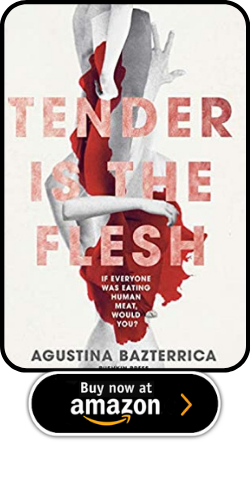 'This book will pull you in, take hold, and not let go until you reach the final page perhaps for longer than that. Without a doubt, my favourite read of this year' Christina Dalcher, author of VOX 'What a compelling, terrible beauty this novel is. My heart was breaking even as my skin was crawling' Lisa McInerney, author of The Glorious Heresies It all happened so quickly. First, animals became infected with the virus and their meat became poisonous. Then, governments initiated the Transition. Now, 'special meat' - human meat - is legal. Marcos is in the business of slaughtering humans only no one calls them that. He works with numbers, consignments, processing. One day, he's given a gift to seal a deal: a specimen of the finest quality. He leaves her in his barn, tied up, a problem to be disposed of later. But the specimen haunts Marcos. Her trembling body, her eyes that watch him, that seem to understand. And soon, he becomes tortured by what has been lost - and what might still be saved...   the heart and soul of horror ficion reviews
Following the 2017 release of Grady Hendrix’s seminal history of the horror boom of the 1980s, Paperbacks From Hell, Valancourt Books set up its Paperbacks From Hell line last year. Curated by Hendrix and Too Much Horror Fiction’s Will Errickson, it brings many of the classics of horror’s heyday back into print, sometimes for the first time, with the original cover art lovingly restored. Given the inflating prices that the originals go for on the internet these days, this is a valuable service, bringing long out of print or hard to find books to a new and enthusiastic audience. This column will go through the series and review each title. Bernard Taylor’s The Reaping (1980) is a more quiet, subdued kind of horror compared to the previous two Paperbacks From Hell, but no less effective for it. Rather than the gore overload of Gregory A. Douglas’ The Nest or the baroque gothic majesty of Elizabeth Engstrom’s When Darkness Loves Us, Taylor goes for a more measured, painstaking approach. The Reaping carefully develops its characters and their concerns, nudging them further and further into the Weird from the mundane English setting, all the more for the novel’s intense climax to hit home. The Reaping makes excellent use of its character dynamics and realistic, lived in setting, its horror slowly emerging from domestic tragedy in a manner reminiscent of classic 70’s horror films such as Nicholas Roeg’s Don’t Look Now (1973). Tom Rigby is a painter who has settled down with his children and his stable job in a shop, and following the death of his wife is trying to make his relationship with the flighty Ilona. However after exhibiting his work in a local exhibition, he finds himself offered a life-changing sum of money to paint the portrait of Catherine, a young woman at Woolvercombe House in the countryside around Bath. The house is full of strange characters – the eccentric ancient Miss Stewart, her assistant Mrs. Weldon, the gruff Dr McIntosh, Carl and Hathaway, the servants, not to mention the nuns stationed on the grounds. Tom starts work on his portrait, only for things to get gradually stranger, until he finds himself unwillingly the tool in Miss Stewart’s sinister plans. With its sinister country house, an old family hiding dangerous secrets, and Catherine as the damsel in distress, The Reaping plays with gothic tropes to great effect. The inhabitants of Woolvercombe House are delightfully creepy, and contrast well with Tom’s groundedness. All this however is part of them playing him. Tom is a seventh son, and with family sizes dwindling, seventh sons of seventh sons are something of a rarity, so Miss Stewart, in order to regain youth and immortality, hatches a sinister plot to breed her own. The Reaping questions the role of sexual repression in the gothic and in English culture – it is Tom’s own repression that allows him to be so easily manipulated into sleeping with Catherine in the first place, and the cult, despite being run by Miss Stewart, is more than willing to reduce women to mere vessels to produce more children, which is contrasted with Ilona’s and Tom’s sister Emma’s relatively increased sexual liberation. However The Reaping is ultimately more interested in delivering effective chills than fully interrogating the genre’s attitude towards sexuality, and in this it succeeds in spades. Taylor captures the allure and the threat of the English countryside, the creepiness of old country mansions, and the cult-like behaviour of particular insular communities, all of which is brought together for a shocking twist ending and an intense climactic sequence that repays Taylor’s careful build up by holding nothing back. The end result is another satisfying ride from the golden age of horror paperbacks. Review by Jonathan Thornton  When Tom Rigby is commissioned to paint a young woman’s portrait at Woolvercombe House, the offer is too lucrative to refuse. But from the moment of his arrival at the secluded country mansion strange and inexplicable events begin to transpire. Soon he is drawn into an impenetrable maze of horror, and by the time he discovers the role he is intended to play in a diabolical design, it will already be too late. For the seeds of evil have been sown, and the time to reap their wicked harvest is nigh! The classic third novel by ’70s and ’80s horror master Bernard Taylor, The Reaping (1980) returns to print at last in this edition featuring a new introduction by Will Errickson and the original cover painting by Oliver Frey. ‘Move over, Stephen King!’ – New York Daily News ‘Draws the reader into a web that grows gradually tighter with each turn of the page!’ – Booklist ‘Taylor works wizardry again!’ – Publishers Weekly   Adam Nevill returns in some style: Following The Reddening, one of the outstanding horror novels of 2019, was never going to be an easy task, so Adam Nevill takes the bull (or should that be a goat?) by the horns and drops the literary equivalent of the dreaded concept album. In the musical world such recordings are controversial beasts, often loved or reviled by fans in equal measure, but invariably gaining a cult following over a long period of time, via constant reappraisal, with fans locking horns over where this particular album ranks in the artist’s back-catalogue. Wyrd and Other Derelictions is such a beast, which will undoubtedly garner similar discussions in the horror world; many fans will love this curiosity, but as the beauty of concept albums is to split the critics, other readers will surely be left cold by its bleak grasp. Personally, I was a massive fan of Wyrd and Other Derelictions and would suggest that those who will enjoy this collection most are long term fans of the author who are accustomed to his descriptive style and slow pace, rather than the newbie who I would strongly advise to start elsewhere in Nevill’s outstanding back-catalogue. Who might not enjoy it? If you were bored by the eerie descriptions of the claustrophobic and encroaching forest in The Ritual, or skimmed over the decrepit descriptions of peeling wallpaper in 82 Edgehill Road from No One Gets Out Alive then this might not be the collection for you, as Wyrd beautifully amplifies these types of scenes, building long and atmospheric descriptions around precise standalone moments in time, which on other occasions might have been snapshots extracted from novels or have the potential to be reworked into longer pieces. You might ask why a collection of short stories is being compared to the concept album? This is not a normal collection in that few of the entries have genuine beginnings, middle sections, or traditional endings. They read, almost as if an unnamed narrator is describing, or walking the reader through, a horrible crime scene in which an undisclosed atrocity has occurred at some point in the past. The stories have no characters, dialogue, or conventional plots and as the literary rulebook is being effectively being thrown out the window Adam Nevill must be congratulated for creating something rather unique. A collection entirely based around mood, atmosphere, and dangerous locations is not something you come across very often. Of course, multi-author anthologies which are thematically linked are dime-a-dozen, and Stephen King occasionally released inter-linked novellas connected by theme, but few authors have the literary skill to release a collection in which all the stories are entirely made up of descriptions and it is the violence of the locations which links them. Detractors could sneer that this is a rather self-indulgent exercise, but I would argue the opposite; this is a very confident writer at the peak of his powers who firmly stamps the short story with his unique brand. Considering the strength of Nevill’s back-catalogue and track record for producing excellent short stories he is one of the very few authors who could pull such a collection off, which he does in some style. Fans may look for similarities to his existing fiction and as all of the tales are set around rural or coastal locations, with none set in cities at all, The Reddening and The Lost Girl are the two novels which spring to mind most readily. No names or locations are ever revealed and if not for the occasional mobile phone or abandoned car many of the stories could be set anywhere in time. I do not yet know if the term ‘Nevillesque’ has yet entered modern horror-speak, if not it should, as all the hallmarks you would expect in his fiction envelope these tales, from the awful descriptions of pain, torture, death, and mutilation, but presented in a manner which is akin to an aftermath, as the atrocities being described are often well in the past, with their impact continue to vibrate and linger through time with the perpetrators of the scene of the crime capering just out of vision. The mood is unrelentingly pitch black from the first page to the last. With this author I would expect nothing less. The opening story Hippocampus featured in Nevill’s debut collection Hasty for the Dark and has since featured in two further top quality anthologies. I have reviewed many of Nevill’s previous work and this is what I said back in 2017: “Hippocampus changes style entirely and is a darkly descriptive story set on an abandoned ship with no visible living beings. This is one of several stories where Nevill changes his style considerable creating an imposing atmosphere and a story which is a jolt in style from the previous one in the book. So where are the crew? Why is their abandoned uneaten food? Who has murdered whom? Death is most certainly in the air. One can almost imagine walking through the after-effects of some horrible crime or event with the reader feeling like he is intruding on something painful and that should be avoided.” Although Hippocampus was not one of my favourite entries in Hasty for the Dark, it was notably striking and an early example of a story with no characters or dialogue which sets the blueprint for all the other tales in Wyrd and Other Derelictions, with the key word being ‘derelict’ which Nevill references in the revealing endnotes. An interest in physical locations (such as Auschwitz) which have seen incredible pain and suffering, crypts, crime scenes, landscapes, ruined buildings, and places connected through a sense of abandonment is at the root of the tales. Such locations are bread and butter for horror authors and fans with an overactive imagination. When I was a kid in the mid-1980s, in the north of Scotland, we lived close to a ruined mansion called Lessendrum House which our dad claimed was haunted, a rarely used road lead to it which was well off the beaten track. At some point this road fell into disuse and when my family revisited five years ago whilst on holiday, you would never have known there was ever a path in the first place, and the house itself was unrecognisable from three decades earlier and it is forever burned into my childhood psyche along with the ghosts my father claimed inhabited the ruin. Hell, it would have made a location for a story in Wyrd! Old derelict buildings certainly do hold onto a certain level of mystique and these stories truly bring such locations to life. I would suggest reading the stories gradually, and not necessarily back-to-back, to allow the varied atmospheres from each tale to permeate fully into your thoughts. Along the way you’ll journey along broken coastlines, beaches, swimming pools, burial sites, abandoned villages, deserted holiday resorts and the final outstanding entry Holding the World in My Arms for Three Days and All Will Be Changed, which was perhaps by favourite, as it features more immediacy than many of the other stories with the reader a helpless bystander to a strange supernatural event. With Wyrd Adam Nevill is leading his readers down a literary sideroad, an experiment which many will enjoy, and more so if they appreciate that these are not traditional short stories. There are no twist endings, characters, or snappy dialogue and that will not be everybody’s cup of tea. If Wyrd and Other Derelictions is indeed Nevill’s concept album, then I am sure long-term fans are going to enjoy it tremendously and then mull over how it compares to his other work and it is sure to split the critics. Ultimately, I thought it was terrific and like all great concept albums is undoubtedly a work the artist felt he needed to get out of his system, and in releasing this Nevill’s already unmatchable back catalogue just got stronger, with many more shades of sinister. Tony Jones  Derelictions are horror stories told in ways you may not have encountered before. Something is missing from the silent places and worlds inside these stories. Something has been removed, taken flight, or been destroyed. Us. Derelictions are weird tales that tell of aftermaths and of new and liminal places. Each location has witnessed catastrophe, infernal visitations, or unearthly transformations. But across these landscapes of murder, genocide and invasion, crucial evidence remains. And it is the task of the reader to sift through ruin and ponder the residual enigma, to behold and wonder at the full horror that was visited upon mankind. Wyrd' contains seven derelictions, original tales of mystery and horror from the author of Hasty for the Dark and Some Will Not Sleep (winner of The British Fantasy Award for Best Collection).   I want to say right up front that I don’t consider myself to be any kind of an authority on the writings of Edgar Allen Poe. I was exposed to his work at a fairly early age, as I remember a particularly great English Lit teacher in junior high school who included it in the curriculum. The Raven was one such work that we were taught, as I suspect many teenagers have studied throughout this country. But the one story he included was one of his lesser known tales, The Cask of Amontillado and that remains to this day to be one of my favorites. It was a powerful moment for me early on to see a story written in a tone that I always associated with prim and proper classic literature taking such a brutal turn. I have always loved the dark and gothic tones of Poe’s work, of the plight of his characters and how he was able to captivate with his stories. For the genre, his name Is sitting at the top of the mountain and it’s one of those examples where, even if you don’t care for his writing, it’s almost guaranteed that most of the writers you do like were probably influenced at least a little by Poe. In recent years, Poe has dropped into my life without me really being on the lookout. Last year, I finally got around to watching the Kevin Bacon series, The Following. The show for most of its run was centered around a serial killer and a cult that was obsessed with the works of Poe and watching it made me want to crack open my own collection and enjoy the writing myself. At the very least, it churned up Edgar Allen Poe in my subconscious and likely put me in the perfect mindset for what was to come. This past month, I managed to get an advance copy of Matt Shaw’s upcoming collection, The Many Deaths of Edgar Allen Poe. As many already know, Poe’s passing was appropriately accompanied by a lion’s share of mystery and intrigue. Dying abruptly after being found disoriented and wandering the streets of Baltimore, there has been no shortage of speculation as to how the author met his end. Matt Shaw and his assorted authors have taken to the task, offering up numerous fictional scenarios that propose circumstances as to how this famous demise might have taken place. Some might see it as distasteful, capitalizing on the death of a famous author but for me, what I was struck by the most was the clear love and admiration the contributors of this book had for Poe’s work and for the place his bibliography had in their careers. I found nothing disrespectful about the book at all. And after all, what better way to pay tribute to such a master of short fiction than with a collection of gripping, dark and disturbing short stories? ALL THINGS CONSIDERED, IT WAS A DISAPPOINTING END, by MATT SHAW Leading off the book is the offering from the author responsible for curating the book, Matt Shaw. I have had probably more history with Shaw's work than any of the other authors and is probably a big part of what drew me to the collection. His story here made me think back quite a lot to “The Book Of Blood”, which is Clive Barker's frame story for his entire Books of Blood series. Shaw accomplishes a similar function with his story. He has penned a tale which functions as its own as a cool story within the premise of the anthology. But it also serves to nicely establish the premise itself, putting the reader into the mindset of pondering Poe's death and to start wheeling around the various stories that are about to be presented. I did take note of a number of passages that felt slightly anachronistic but I'm of the mindest as a reader where I don't really care as much about stuff like that. There are some who might criticize the use of more modern turns of phrase in books that are supposed to be set in a historical time period but I think that's making a bit too much of something that shouldn't be a big deal. And this may seem like a bit of a tangent but I wanted to discuss this issue in more detail here, at the beginning. As we are dealing with an artist who lived in a period of time far removed from ourselves, the language issue is one that all the authors in this book had to tackle. Some were more successful than others but in general, here is how I see the issue. One of the best pieces of advice I received as a writer early on was when I was wringing my hands over getting the technical details correct in a particular scene. What I was told was that I could kill myself getting it right and more than likely one of two things would result. Either the reader would know well enough to see that I clearly didn't know what I was talking about or the reader would be oblivious, and all my work would have been for nothing. What's the point here? I tend to be a little put off by the pretention of writing historical fiction and you get the sense that the author is trying to make it actually read like a historical document. The reality is that while the story might be set in the nineteenth century, we as the readers are very much not in that time period. The language of that time is long since dead and gone and if we tell a story with our own language that happens to be set in the nineteenth century, I see no problem with that. The book is a work of fiction and should be seen that way across all levels. I appreciated that Shaw wrote the story in his own voice and that it didn't feel like he was trying to artificially make it something that it isn't. As for the story itself, in a short span of words, Shaw manages to pull off two twists that are enjoyable. It had a rough and unforgiving ending to which Poe would have likely given his stamp of approval. The story is short, but it still carries enough weight to really kick the book off in the perfect mood and state of mind. Shaw's story does perfectly what any opening story in an anthology should do. It makes me want to shut out the world and get down to reading more. KILL THE RAVEN FIRST, by K. TRAP JONES While it isn't a new notion for an artist to be pulled into the worlds of their own making, Jones executes the device effectively in this. The use of a raven pursuing Poe is a clever way of incorporating Poe's own art into the process of his demise and there was a nice balance of mystery and intrigue as well as forward movement in the story that was satisfying. Another aspect of this I really loved was the visual imagery throughout. There were several scenes depicted that were disturbing to see unfold and it made me feel like we were standing right alongside Poe in this nightmarish landscape. There are moments that truly made me cringe in their brutality and how clearly they are brought to life by Jones’s prose. True and total sympathy is evoked for Poe in the awful pain and torture he experiences, shedding a fictional light on the nature of his demise. Poe certainly carries with him the atmosphere and image of a disturbed life and outlook. Or, at least, it seems like popular interpretation of him falls along these lines. The point of view presented in this story falls nicely in line with those expectations and I think presents a scenario that is somehow at the same time fantastical but also absolutely believable and credible. THE MORBIDITY OF MAIDENS by CHRISTINE MORGAN This story took me a little longer to engage with and I think it could have benefited from a touch more narrative context at the outset. Still, the writing is beautifully compelling and engaging and there was no point where I felt my interest lagging, feeling nicely propelled out of intrigue. There are a number of moments earlier on that are pretty chilling to contemplate and I found that this was enhanced quite a bit from going through and re-reading it, with the knowledge of where everything is going. It certainly casts a dark light upon what possibly could have comprised the internal musings and behavior of one of our country’s most notable literary figures. And the ending. I can't say enough just how powerful and effective it is. The story takes a hard right about two thirds of the way in and drops down into a scenario that I think occupies the heart of most of our nightmares. The story cleverly taps into a specific type of phobia present in some of Poe's work and twists it into a fateful sequence for Poe, himself. As such, this works brilliantly within the context of the anthology and stands on its own as a creepy tale that should end up having a deep and chilling effect as you finally reach the end. What aspects of the story and what Poe thinks he is observing are real and what are imagined? I will leave that all for you to determine for yourself. However you come down, the journey is an enjoyable one. I AM EDGAR by GARY MCMAHON I think that this story suffered from a slight dilution of the impact as it was placed in the anthology right next to another story with similar elements. As a result, I didn't feel the bite of the ending as acutely as I might have liked. I also believe that the story overall could benefit from being stretched out and given some more size to it. In a collection of already short stories, this has almost a feel of flash-fiction to it. There are some fascinating ideas running through this, I guess I would have just liked those ideas to be given some more legs. The story presents a number of different possibilities. Is this the story of a delusional person who has been inhabited by the spirit of Edgar Allen Poe or is he simply delusional? Were Poe's stories the product of dipping into the dark wealth of his imaginings or was he possibly seeing something else and transcribing this to the page? Is the ending of the story something that is really happening or are we seeing a metaphor for the fracturing of a disturbed mind? And while I stand by my statement that the ending could have struck me more powerfully if the story had been placed somewhere else in the book, it was still impactful for me. And even though it struck a similar note as the story that came before it, it still touched on something that I, myself, am horribly terrified of and the poetic execution of the last line was truly amazing. The story was sent off on just the perfectly sculpted, tragic moment. This story leaves you narrative space to ponder and cogitate over. Is this a character having delusions about Edgar Allen Poe? Or is Edgar Allen Poe having delusions about inhabiting some fictional corner of his own psychotic mind? Could all of those things be true? Read some Edgar Allen Poe. Then read this story. Then read some more Poe. Then this story. Rinse and repeat. THE SPACE BETWEEN SPACES by MARK CASSELL As I am writing these reviews in real time as I read the book I am going to declare this my favorite of the bunch so far. I think that Cassell really tapped into what I have loved about Poe’s writing. Stories that seem to have notes of tapping at your fears, nagging at your uncertainties and digging into darker thoughts you might not normally pay much attention to. As such, I felt like this story was a brilliant callback to the Telltale Heart, the ultimate expression of how maddening thoughts and fears can overtake your sanity. And while the whole point here is to dip into the devices of Poe’s stories, I thought it was clever here to have those devices experienced by someone who was close to Poe instead of the author himself. It creates a great amount of tension and mystery around Poe and I was excited to get to the reveal. The ending took things in a direction I did not see coming and while I would have liked to have seen more, I think feeling that way is more a compliment of the work than a criticism. I couldn’t help but wonder if Cassell was throwing a little Lovecraftian flavoring in Poe’s direction with the slightly cosmic tilt to the story and the notion of the two legends of the genre crossing the streams did make me smile. Really well done and a beautifully constructed narrative. THE LAST HORROR OF DEAR EDDIE by PAUL FLEWITT As is probably to be expected, a number of stories in this collection use the device of Poe being pursued in real life by the creations in his writing. This one does so and quite effectively, dropping touchstones from several notable examples of Poe’s bibliography, including my favorite of his, The Cask of Amontillado. This tale was told within the context of a frame story that worked well enough. I don’t know if it was really necessary but it did lend an air of foreboding to the proceedings and it sent the story off at the end with a pretty horrifying moment. I loved the ending but I think the story could have worked just as well by staying in the present and switching perspectives for the brief denouement, as opposed to making the entire tale a retrospective. If I had any constructive comments it would be regarding the dialogue, which I think was attempted to sound like speech of the period. I have already discussed this issue but wanted to bring it up again, here. In this, the speaking parts felt a little awkward when placed alongside the narrative voice which has a more strongly anachronistic tone to it. The story wasn’t critically affected by any means, it just knocked me off kilter a little. In all, it’s an entertaining tale with some deeply unsettling moments. Really well done. ASSASSINATED by JIM GOFORTH To start, I appreciated how this story dealt with Edgar Allen Poe for his work as an editor, something that I did not know as much about and I suspect many others are the same. And I thought it was clever to incorporate a real life antagonist of Poe’s to lend some credibility to this fictional scenario. I had more of a guarded reaction to this one and in all fairness, my reaction had nothing to do with the quality or effectiveness of the writing, as both of those are great and on par with the rest of the book. I think the general thrust of the story was what brought out the mild, almost defensiveness on my part, just due to where we are as a society and how to process the implications of presenting Poe as a much darker figure than history may have recorded, even in the obviously fictional form this takes on. It’s just that we’ve gotten to a point where there is much more of a problem with people looking at horror authors and drawing a false equivalency between their own moral center and the things they write. So whenever I see stories that go in the direction of any kind of artist being pushed into violent acts by the violence of their own art, I’m a little disappointed. This should not be viewed as a takeaway from the work here, though. Take it no more than a discussion point and personal reaction on my part. Horror fiction should challenge you and make you think about things and I think that goal is nicely reached within this story. And Goforth cleverly employs tension created from a rival of Poe’s to craft an ending I didn’t see coming. It’s a dark tale that takes a quick turn at the end, leaving you with a lot to think over. The natural direction to go in while speculating a fictional death for Edgar Allen Poe would be of a supernatural nature, something done quite a bit in this book so I did respect the choice to make his demise more a product of good old fashioned personal rivalry. A WRITTEN ACCOUNT...by KIT POWER There is a lot in this story for me to unpack and try to unravel, no small feat, considering the short length of the tale. Again, we have glancing shots of cosmic horror and moments that place Poe’s less sane sepects into a more extra-terrestrial or maybe intra-dimensional context. There were a number of references that I had to explore on my own and research a bit but it gave me an even greater level of enjoyment for the story, a fantastical creation that really takes the creative mind of Poe and elevates it onto an even higher fictional scale. It goes without saying that Poe has been a huge influence in the horror genre and this story in dramatic fashion manages to propose a direct connection to another elder of the genre in cool style. The story is told in the form of a letter written by a witness to some of Poe’s final moments and it was a special thrill at the end to find out who it was telling the story. I think I’m paying an author and a story high marks and compliments when I admit that reading it sent me fleeing to Google in a mad attempt to improve my own knowledge and to better understand what the story was trying to do. This one was definitely one of my favorites of the collection, if for no other reasons than for the cosmic possibilities that it seems to wink at. THE THIRD STEP by JUSTIN M. WOODWARD This was a fun little thrill of a story that does an excellent job establishing and maintaining tension. To me, while the language was obviously of a modern tilt, the thrust of the story felt like something Poe might have actually written. The repetition of the noise on the third step on the stairs is highly effective at creating unease and the moment which we find out the significance of that creaking sound turns it all into brilliant foreshadowing. Poe’s stories could range from the paranormal to the psychological and I think this story bridged all of that beautifully. And it all works up to a twist of an ending that I suspect Poe himself might have been tickled by. It’s an ending that I thought referenced several stories of Poe’s and of course made me want to immediately read all of them. Really nice work taking aim at the theme of the book while also creating something in classic Poe form. THE END OF POE by ANDREW FREUDENBERG This was a fun little tale that spins some interesting possibilities in terms of Poe’s actual writing process and where his ideas might have come from. I have always seen substance abuse as something which Poe likely suffered from and the nature of this story actually feeds into that nicely. It’s quick but effective and the turn it takes at the end is a perfect little knife twist for Poe, putting him into an ominous and disturbing position. We are all familiar with the crossroads type story or the deal with the devil type – whereby a character is granted great riches and fortune in exchange for something dire on their part. It is a story that can often require a certain amount of setup, backstory and explanation so I have to respect that Freudenberg was able to establish so much of that vibe with so few words expelled in the process. THE HUBRIS OF...by TIM LEBBON This was beautifully written and the personal tone of the narrative was so effective that at first I actually thought that Lebbon was presenting his own personal reflections on Poe through anecdote. I loved the change in approach, dealing not specifically with the event of Poe’s death but coming at it from the perspective of someone paying respect at the site of his grave. I don’t know if Lebbon has been there himself but his description of the grave and the people milling about was quite vivid and effective. I found myself taken in by the story of this widow paying respect to her late husband’s dying wishes in a way that was quite touching and just when I wasn’t sure how this was going to tie in with the theme of the anthology, it did so in brilliant fashion. Stories of a supernatural tilt don’t always have to take a gritty, dark angle and this story was the perfect example. The plot is laid out in fine fashion and I felt like there was just the right balance of information versus leaving room for the reader to speculate on their own. FOUNDATIONS by SHAUN HUTSON I’m going to come clean, despite how much it’s going to shine a light on my tiny little brain but when I first read this story, I was caught off guard by the quick ending, so much so that I thought at first that some of the story had been left off in the printing. So I gave myself some time to reflect on the story which, from the byline states that it was inspired by Poe. Not inspired by the work of Poe, but by Poe himself. And I have to think that the difference in wording has to be significant. I thought back to themes I have seen associated with Poe and what comes to mind most prominently is that of solitude, especially with somewhat supernatural themes and dealing with death. I think it’s also appropriate that so many of the stories in this book touch on Poe’s difficulty in dealing with the death of his wife. The story here from Hutson is on the surface quite simple, of a housewife who brings tea out to the men working around the house that she and her husband had just purchased. There is nothing stated outright and while I certainly would have liked to have things stated a bit more concretely, it is also enjoyable to really ruminate over the story and to try and disentangle the relevance to the book as a whole. There are several moments within that hints at the possibility of darker truths under the surface, that briefly cracks the door open onto a universe of tragic loss that maybe mirrors that of Poe. However it was that Edgar Allen Poe met his death, what we can likely say most definitively is that Poe led a life largely mis-understood, especially by us, sitting here and looking back from a time period far removed from his. We have the superficial understanding of him through his writing which can be the fuel for endless speculation and bloviating about who Poe was without ever really knowing. Perhaps that perspective clicks open the tumblers to this story. Maybe that’s the point I should hold on to in the process of reading this book. The things lurking under the surface that we can’t quite see will always be fodder for speculation, but never verification. What’s the story behind this character and where she is in her life in this moment? A number of possibilities present themselves. Any number of different stories that could read like they came from the pages of a Poe story. Of where this woman came from and what she’s really up to with her casual tea service to some unsuspecting laborers. And maybe the grand joke here is on me and a cup of tea is just a cup of tea. * * * So in the end, what is there left to say about this volume of stories? One aspect that I particularly loved was how often the authors were able to make subtle references to Poe, taking titles of or lines from notable works and seamlessly working them into the prose of their own tales. I’m sure there were plenty that went over my head but the ones I did pick up on made me smile and served to greatly enhance my enjoyment of the book. If I had any critical note, it would be regarding the length of the stories. On one hand, I did appreciate the fact that most of the tales in this were quite short. I will be the first to admit that I am a person of relatively questionable intelligence and attention span. Living with the pathetic amount of rest I get each night, I do appreciate a certain amount of brevity when it comes to the things I read and as I get older, the ability to get to the point has become a valued virtue for me. All of that aside, I think that, while the stories were all entertaining, they could have been made stronger and maybe stood a little better on their own if the authors had expanded on their ideas somewhat and broadened the scope of the narrative moment. As it is, some of the stories ended up feeling a little similar in their devices and subjects, simply due to the fact that they were such quick snapshots. In no way was my enjoyment diminished, this is just one area where I think the book could have been made even stronger. I did manage to learn something new in the process of reading this, which I discussed a bit in my review of Kit Power’s story. I was unaware of the influence Poe had on the writings of HP Lovecraft and this goes back to my point at the beginning. As I already stated, even if any given writer states that they don’t care for the work of Poe, chances are, most of the writers they are fans of likely were influenced by Poe. I think it’s impressive to think of how much of our modern literature can be traced back at least somewhat to Poe and I think the stories in this book manage to cleverly wink at that connection. This is a book that I really enjoyed, so much so that I had to read it a second time before I finished writing this review. And if that isn’t enough, I think the most elevated sign of praise and respect I can pay to these assorted authors is to admit that upon reading this book, one of the first things I did was go straight to my shelves and take down my collection of the writings of Edgar Allen Poe. The Many Deaths Of Edgar Allan Poe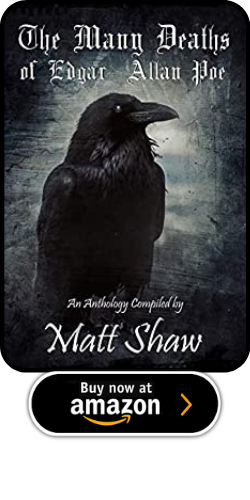 Edgar Allan Poe's death remains a mystery even today. There are many theories as to what killed him. Some people believe Poe's death was caused by suicide, some believe murder, others consider cholera to be the leading factor, or hypoglycaemia, rabies, syphilis and even influenza. Whatever happened to him, Poe was found in a delirious state and wearing clothes believed to be belonging to someone else. In the days before his death, he was heard to be calling out for Reynolds, a man to which no one knew of Poe's connection. This book does not tell you the truth in what happened to Poe. That will remain, forever, a mystery. What this book does is bring together some of the biggest names in horror - from the mind behind the horror anthologies Masters Of Horror and NEXT DOOR - to tell THEIR version of what happened to Poe in his final moments. Expect gore, expect black humour, expect sex, expect violence, double-crossing and murder most foul... Expect pure fiction as we let our imaginations run riot.   Supernatural goings on in a windswept Cornwall cottage In the opening chapter of The Malan Witch recently bereaved secondary school teacher Robyn Crowe is excited to be moving into Malan Cottage for a few weeks over the long summer holiday. She is hoping for quiet recuperation after the death of her husband six months earlier from cancer and is grateful that her sister Holly has given her the opportunity to spend some weeks in her recently renovated cottage in the remote coastal Cornwall countryside. Setting a ghost story in an isolated and windswept cottage is nothing new and although The Malan Witch was an easy and enjoyable enough read it added little to a genre top-heavy with outstanding fiction. One could argue that the quality of novellas being currently published are hard to compete with and The Malan Witch falls well short of the best examples, as it lacks both characters with depth and crucially any sense of chills or fear. For a significant part of the story Robyn is menaced by an aggressive crow, which to be blunt, an angry bird was not enough to carry the story, or give the reader the impression they were in for a rollercoaster ride into the darker reaches of terror. The cottage was located close to the village of St. Oswell, and although the roots of the story lie in the origins of Malan Cottage and the ancestors of St. Oswell I was not convinced enough was made of this location. It lacked atmosphere, did not catch my eye, and failed to intrigue me in the history beyond a few old witchcraft clichés. Ultimately the story was very familiar and although the 114-pages jogged along at a decent pace do not be surprised if you get a sense of déjà vu thinking of other similar stories. Although the sense of loss Robyn feels for her husband does not dominate the story, I liked the way it did play a significant part, especially towards the conclusion. The cottage itself was the perfect location for a supernatural tale; Robyn realises that although the interiors have been completely gutted and rebuilt, the evil spirits which lived there, hundreds of years earlier remain. Although Robyn is in regular contact with her sister Holly, the story does retain a vague sense of isolation as she is unable to get much help from the mostly unfriendly and uncommunicative locals. I felt much of the action was too predictable, for example, whenever Robyn mentions to anybody, she is staying in Malan Cottage there is either a deadly silence or a rather telegraphed look of surprise. But before long somebody spills the beans on the dodgy history of the cottage and Robyn believes she had made a friend in the young woman who works in the local coffee shop and is aware of the legends. You are never quite sure of the motives of the few secondary characters in the story, which was a plus point, and they do throw in a couple of welcome twists. The witch sisters did not play a large part in the story, except via the crow, but I liked the way the (voodoo like) dolls had been used to trap their spirits and the repercussions which followed when one of the dolls was uncovered. Although it was an easy enough read, the characters came across as frustratingly one dimensional and it lacked the substance to really get my blood racing. For example, Robyn had recently lost her husband to cancer and I would have liked to have feel her pain, but it lacked the emotional pull to do this. By way of comparison, Lauren Hightower’s recent novella Crossroads (which was shorter than this) totally nailed a similar type of pain and loss, hammering the fragility home, staying with me long after I had finished it. I doubt The Malan Witch was meant to be a deep and frightening read, so if you like your horror light and breezy, which can be digested in a couple of hours it certainly fits that bill. But if you are after a deeper and more frightening experience then this is not that kind of book and may fade from memory relatively quickly. Tony Jones 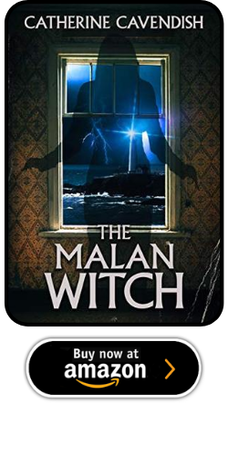 "Naught remained of their bodies to be buried, for the crows took back what was theirs." An idyllic coastal cottage near a sleepy village. What could be more perfect? For Robyn Crowe, borrowing her sister’s recently renovated holiday home for the summer seems just what she needs to deal with the grief of losing her beloved husband. But behind those pretty walls lie many secrets, and legends of a malevolent sisterhood—two witches burned for their evil centuries earlier. Once, both their vile spirits were trapped there. Now, one has been released. One who is determined to find her sister. Only Robyn stands in her way. And the crow has returned.  THE HEART AND SOUL OF HORROR FICTION REVIEWS  Ah, the 80s. When we stick on our rose-tinted nostalgia goggles, it’s usually the 80s we turn to. Despite being an era of cold war tension and the constant threat of nuclear oblivion, there’s something comforting about media from the 80s, especially to those who lived through even a fraction of the decade. And so we turn to it again and again, with remakes and references and homages aplenty. It Came From the Multiplex is one such homage, specifically to the cinemas and video nasties of that halcyon age. Edited by Bret and Jeanni Smith, It Came collects 14 tales of blood and popcorn, of flickering screens and lurking horrors, all set within or related to seedy cinemas and rundown fleapits. No pristine Cineworlds here, only places where your feet stick to the floor and the scratches in the screen only add to the viewing experience. You know, proper old-school cinemas. What’s weird about this collection is that there aren’t any actual duds. There’s almost always a couple of stories that fall flat in an anthology, ones you can confidently say you’ll skip over on your next read. But this doesn’t have any of those. It does, however, have rather too many stories that are merely ok. They get the job done, but leave you turning the page and hoping to be wowed by the next one. Part of the problem is that most of the stories simply aren’t scary. Don’t get me wrong, they’re a lot of fun and they work well as the love letter to 80s cinema that the anthology is aiming for. But there’s few chills here and only minor thrills. The first two stories are this in microcosm – in Warren Hammond’s ‘Alien Parasites from Outer Space’, a film-obsessed nerdy teen suspects the locally-made film he’s catching at a drive-in to be a warning about alien parasites come to take over the Earth. His cold logic and the violent consequence are great as it leaves you wondering if the alien threat was all in his head. But the sequel story (‘Return of the Alien Parasites from Outer Space’, of course, by Angie Hodapp) affirms that the threat was real and then becomes an over-the-top action film. Perhaps that was an intentional dig at diminishing returns in horror sequels, but it set the tone for the rest of the stories. For every interestingly spooky or tense story, there’s two or three fun bombastic ones. They’re not bad, it just seems like they focused way more on the Multiplex part than the It part. The best of the bunch for my money: ‘Negative Creep’ by Alvaro Zinos-Amaro – a creepy story of teens haunted by a mysterious entity that’s drawn to movies and seems to travel through silence. It’s tense stuff as the kids are stalked by the unknowable creature, and it makes you wonder just how unavoidable silence is when you think about it. ‘Rise Ye Vermin!’ by Betty Rocksteady – a lesbian couple keeping their relationship secret find their plans to skip town blocked by a sorcerer bent on raising hell in the cinema they work at. The setting is beautifully laid here, and the grime and nastiness of the place raises hackles. The shock of sudden violence that the story turns on is both jarring and visceral, and it left me wincing. ‘The Cronenberg Concerto’ by Keith Ferrell – brilliant, just brilliant. This is as seedy and nasty a tale as the Herschell Gordon Lewis films that the protagonist reveres, and an interesting take on horror and gore films as a religious entity that deserve tribute and sacrifice. ‘Coming Attractions’ by Stephen Graham Jones – kids sneak into a cinema that’s rumoured to play films to ghosts late at night. Naturally they get more than they bargained for. This one really ups the creep factor, and you really feel sorry for the likeable kids at the end. ‘Special Makeup’ by Kevin J. Anderson – there’s nothing scary at all about this one, but then I don’t think it’s meant to be. It’s an extremely funny take on the movie magic of makeup effects as an egocentric actor finds himself giving an absolutely perfect werewolf performance – but at what cost? It relies on the problematic Romany curse trope, but otherwise it’s great fun to read. The rest of the stories range from ‘fine’ to good. Each author clearly loves the brief and has fond memories of the films and venues of the 80s, it’s just that few of the other stories grab your attention and refuse to let go. I had to keep reminding myself which stories were about what while writing this, which is a real shame. If you’re after something to keep you up at night, this isn’t it. But if you want to relive the sick joys of 80s video covers and the creature features writ large across the silver screen, then this is worth picking up. Just don’t expect to be reading it again and again and again. Review by Sam Kurd  Welcome to tonight's feature presentation, brought to you by an unholy alliance of our spellcasters at Hex Publishers and movie-mages at the Colorado Festival of Horror. Please be advised that all emergency exits have been locked for this special nostalgia-curdled premiere of death. From crinkling celluloid to ferocious flesh—from the silver screen to your hammering heart—behold as a swarm of werewolves, serial killers, Satanists, Elder Gods, aliens, ghosts, and unclassifiable monsters are loosed upon your auditorium. Relax, and allow our ushers to help with your buckets of popcorn—and blood; your ticket stubs—and severed limbs; your comfort candy—and body bags. Kick back and scream as you settle into a fate worse than Hell. Tonight's director's cut is guaranteed to slash you apart.
 Graham Masterton returns with a gripping haunted These days the title ‘master of horror’ is banded around all to easily and social media elevates authors who have written a few decent books to a status they have yet to earn. This is not the case with Graham Masterton whose contribution to the horror genre is staggering and claims the ‘master of horror’ moniker with novels to spare. This fact was rubber stamped in 2019 when Graham was awarded the Lifetime Achievement Award by the HWA at StokerCon 2019. This was both well-deserved and long overdue as there are many life-long horror fanatics who would sit Masterton on the same top table as the giants of King, McCammon and Barker. Since the 1970s Masterton has been incredibly prolific, and is equally good writing crime fiction, but sadly, the high quality of his recent fiction is often overlooked and the stuff he wrote years ago regularly picks up more press and fan coverage. This is a great shame, as his previous horror novel Ghost Virus (which I gave the maximum 5/5 gingernuts) was utterly bonkers and streets ahead of the stuff the ‘cool kids’ of the genre many years his junior, who inhabit the horror social media world, have been churning out. His latest outing The House of a Hundred Whispers continues this fine recent form and if you have read about Masterton before, but never knew where to start, this is as good a place to begin your journey as any. These days haunted house stories are a dime-a-dozen, but in the hands of Masterton you can always expect something slightly different, with an additional twist which gives the book a level of uniqueness. I loved this book, starting it on a Friday evening and finishing it on Sunday morning. Page-turners do not come much better. In many ways the setting is a classic location for a haunted house novel; All Hallows Hall is a rundown Tudor mansion set on a rural part of windswept Dartmoor and its owner, the former Governor of Dartmoor Prison is murdered in the opening chapter. The story then jumps forward to the reading of the will which throws a few unexpected curveballs at the three siblings who are expecting to split the near two million the house will generate when sold. The three were on very poor terms with their father at the time of his death and we find out more about him as the story develops. The very compact and skilfully told tale is set over a few brief days after the siblings and their partners arrive for the reading of the will, at the same time they know the murder of their father remains unsolved. None of the three have fond memories of living in the house, with one of the brothers having unpleasant flashbacks to his childhood and an obsession that another boy, very like him, was living under his bed. All Hallows Hall is set close to the real-life village of Sampford Spiney, which helps give the novel an excellent sense of time and place, using local dialect and integrating very clever examples of local folklore and witchcraft. The whole pictured painted by Graham Masterton was incredibly convincing and skilfully crafted. Near the start of the novel, during the reading of the will, the five-year-old child Timmy disappears whilst out playing. His parents, Rob and Vicky, are besides themselves with worry but the search parties are unable to locate the boy. Strangely, even the search dogs will not go near the house and the tracking experts are unable to pick up any trace of him. Where did Timmy go? Is he dead? Or is he lost somewhere within the house? What follows, at first glance, appears to be a deceptively simply mystery story, which slowly turns supernatural, and ultimately morphs into a fiendishly well plotted page-turner. For the sake of spoilers, I do not want to dwell on the plot any longer but will give you an indication of what types of delights and scares lie ahead. First up, The House of a Hundred Whispers has a sly sense of humour, there is a superb exorcism scene where the priest in question claims that he has been involved in the famous Exorcist film he would have “exorcised that petty demon in minutes”. That is mighty big talk and things do not exactly go to plan! There is also a ghost which is repeatedly described as a Charles Bronson lookalike. That also made me chuckle, as I do not think old ‘Stone Face’ appeared in many horror films! In the early stages of the novel I felt the characters might have been one of the weak links; they shouted a lot, were not particularly likeable, and were very sluggish in appreciating the seriousness of the situation in the disappearance of the boy. However, Rob grew on me considerably as the story gets darker, as did his brother Martin, who finds himself in an even stickier situation. The novel also has an outstanding and very convincing connection with history which might have you checking Wikipedia to see what is based on fact and what is not. You will be quickly sucked into the world of architect Nicholas Owen, hidden priest holes and witching rooms which are crucial to the plot. The supernatural connects to the folklore of the Dartmoor area was also fascinating, with ‘Gleaners’, ‘Charmers’ and ‘Old Dewar’ all added to the entertaining spin. I am not going to say too much about the ghosts, other than the fact that they are outstanding and play an increasingly significant part in proceedings as the novel develops with the story also being told from their point of view. Also, have you ever given a thought to whether ghosts breathe? A fascinating thought, which this book considers, breathing your last breath repeatedly for eternity. The House of a Hundred Whispers is a suspenseful ghost story rather than a violent one and compared to the previous Ghost Virus it is rather tame on the gore stakes. This is no criticism though, as it does feature a couple of standout scenes of violence, including a kill scene I do not think I have ever seen before. A guy’s bones are pulled through a wall, but his flesh and entrails are left behind as a puddle of mush on the carpet. Not something you read every day! This was an outstanding horror novel which I thoroughly enjoyed. Masterton takes the skeleton of what you might expect to find in a genre based haunted house novel but adds several extra dimensions and quirks. This was an expertly plotted horror and on the outset the reader would never imagine how the murder of the prison governor ties into the wider plot. Great stuff. 5/5 Tony Jones 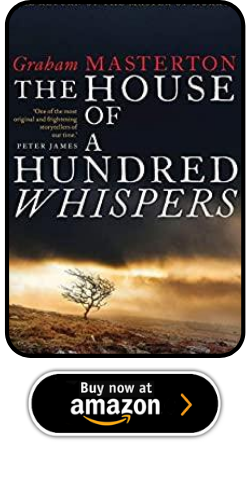 On a windswept moor, an old house guards its secrets... The new standalone horror novel from 'a true master of horror.' All Hallows Hall is a rambling Tudor mansion on the edge of the bleak and misty Dartmoor. It is not a place many would choose to live. Yet the former Governer of Dartmoor Prison did just that. Now he's dead, and his children – long estranged – are set to inherit his estate. But when the dead man's family come to stay, the atmosphere of the moors seems to drift into every room. Floorboards creak, secret passageways echo, and wind whistles in the house's famous priest hole. And then, on the same morning the family decide to leave All Hallows Hall and never come back, their young son Timmy disappears – from inside the house. Does evil linger in the walls? Or is evil only ever found inside the minds of men? Praise for Graham Masterton: 'A true master of horror' James Herbert 'One of the most original and frightening storytellers of our time' Peter James 'A natural storyteller with a unique gift for turning the mundane into the terrifyingly real' New York Journal of Books 'This is a first-class thriller with some juicy horror touches. Mystery readers who don't know the Maguire novels should change that right now' Booklist 'One of Britain's finest horror writers' Daily Mail About the Author Graham Masterton is mainly recognized for his horror novels but he has also been a prolific writer of thrillers, disaster novels and historical epics, as well as one of the world’s most influential series of sex instruction books. He became a newspaper reporter at the age of 17 and was appointed editor of Penthouse magazine at only 24. His first horror novel The Manitou was filmed with Tony Curtis playing the lead, and three of his short horror stories were filmed by Tony Scott for The Hunger TV series. Ten years ago Graham turned his hand to crime novels and White Bones, set in Ireland, was a Kindle phenomenon, selling over 100,000 copies in a month. This has been followed by ten more bestselling crime novels featuring Detective Superintendent Katie Maguire, the latest of which is The Last Drop of Blood. In 2019 Graham was given a Lifetime Achievement Award by the Horror Writers Association. The Prix Graham Masterton for the best horror fiction in French has been awarded annually for the past ten years, and four years ago he established an annual award for short stories written by inmates in Polish prisons, Nagroda Grahama Mastertona “W Więzieniu Pisane.” He is currently working on new horror and crime novels. Buy links: Amazon: https://amzn.to/2DejwGk iBooks: https://apple.co/2P3pcFX Kobo: https://bit.ly/338461g Google Play: https://bit.ly/332yzxP Follow Graham Masterton: Twitter: @GrahamMasterton Wesbite: www.grahammasterton.co.uk. Follow Head of Zeus: Twitter: @HoZ_Books Facebook: @headofzeus Instagram: @headofzeus Website: www.headofzeus.com 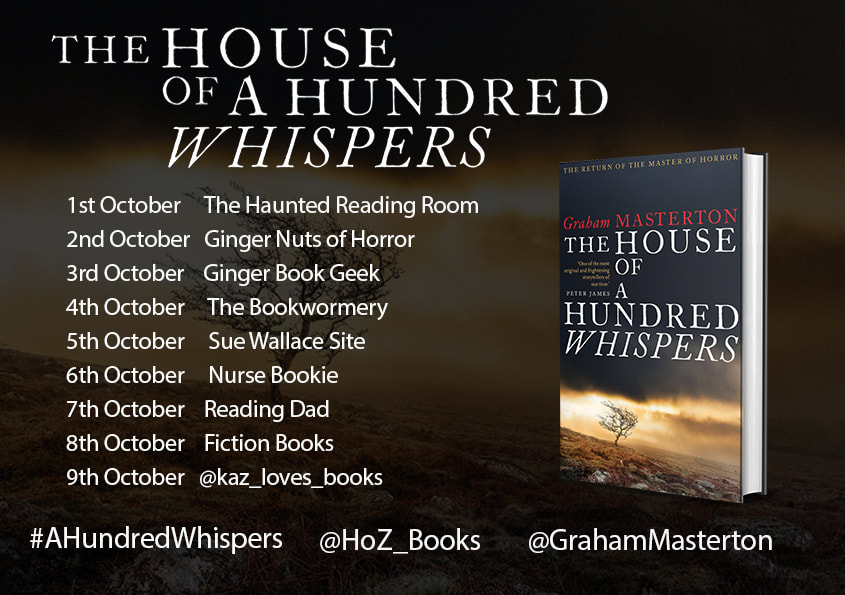  the heart and soul of horror fiction review websites |


Archives
May 2023
|

|

|
 RSS Feed