


BOOK REVIEW: MOTHLIGHT BY ADAM SCOVELL
17/1/2019
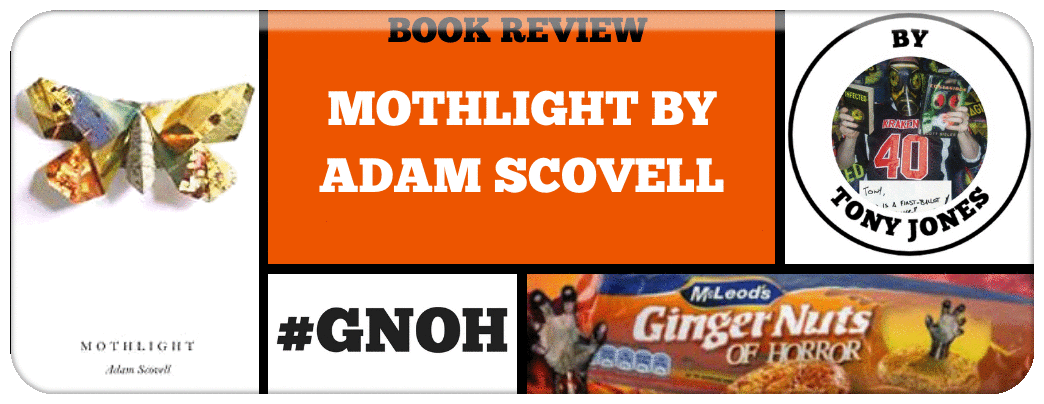
“A childhood obsession with moths shapes the life of a
troubled young man in startling debut novel”
“Mothlight” is the highly entertaining debut novel of Adam Scovell who is widely published in an impressive range of magazines and newspapers including “The Times”, “Sight and Sound”, “The Quiutus” and “Little White Lies”. Scovell’s writing covers an impressive range of subjects straddling horror and many other cinematic topics. In 2016 Scovell also wrote the critically acclaimed “Folk Horror: Hours Dreadful and Things Strange” but don’t expect to see any “Wicker Man” influences in this novel, it’s perplexing, but a different breed of horror heavy with ambiguity and atmosphere.
This is also a challenging book to review, although it has a lot of positives, it may test the patience of others. “Mothlight” really needs to find the right audience, which may not necessarily be in the horror crowd, as it leans towards literary rather than genre fiction. It all depends on what type of ‘horror’ any individual likes to read and you could argue that this very thoughtful and psychological is not horror at all. Don’t expect any big scares, creatures, blood or death, it is not that kind of book. And that’s not any kind of criticism; there’s plenty of space in the wide world of dark fiction for thought-provoking literary fiction which “Mothlight” most certainly is. A few months ago, I reviewedBartholomew Bennett’s “The Pale Ones” for the Ginger Nuts of Horror which subsequently picked up superb reviews across the board, including major newspapers. This beguiling little book may do the same. “Mothlight” is told entirely in the first person by a young man called Thomas, who develops a friendship with a much older woman, Phyllis Ewans. Thomas gets to know Phyllis when he visits her house with his grandfather, who sells groceries in his mobile van, and is instantly attracted to her huge collection of moths which are mounted on the walls. Phyllis is a prominent researcher in lepidoptera (study of moths) and due to his growing fascination with moths the adult Thomas then studies science at university and ultimately ends up researching the same subject as Phyllis. At a certain point Phyllis leaves for London and they fall out of touch for many years, only to be reacquainted much later through professional circles. The setting of the novel plays a crucial part of the story; an area of Cheshire called the Wirral, close to the Welsh border, walking also plays a significant part. Copying Phyllis, Thomas also takes up walking, and whilst he walks he catches moths or tries to retrace her steps. Along the course of the novel you’ll read quite a bit about moths, but this is never dull, and Thomas’s obsession with these small creatures really brings them to life. It also got my thinking to novels in which insects have prominent roles; Kafka’s “Metamorphosis” springs to mind, as does “The Wasp Factory” by Iain Banks and Susan Hill’s “I’m the King of the Castle” the latter two with characters fascinated by insects. Much of “Mothlight” comes from inside head and inner-thoughts of Thomas. He may believe what he reveals, but that does not necessarily mean it is true, and there is definitely an unreliable narrator aspect to the story. As the tale is only seen from this single point of view, if he believes it, perhaps then that is all that matters? This is a convincing aspect of the novel. There is a lot of atmospheric black and white photography in the book, mainly of Phyllis when she was a young woman, but a number of these also feature another woman which help form an intriguing mystery strand to the novel. Thomas becomes obsessed with discovering who this other person in the photograph is and this becomes key to the story. At this stage you might be wondering where the horror aspect of “Mothlight” is? After all, the publisher promises us: “A disturbing and literary ghost story in the tradition of M.R. James, W.G. Sebald and Thomas Berhnard”. It is vaguely unsettling and very ambiguous, mainly due to the unreliable narration, but ultimately could be too mild for some tastes. After a while Thomas is increasingly possessed by thoughts that he is becoming Phyllis Ewans, or that she is in some way haunting him. Looking for answers, he begins to search into her past. However, you may be frustrated by what he finds as there are as many questions as answers. This is a read which can be interpreted in a couple of ways and if there is a correct way then it’s not obvious or open to argument. I think I know what happened in the end, but then again, I would not be surprised to find out I was incorrect. You’ve been warned; psychological or supernatural? Take your pick. It’s enjoyable either way. It was not a long book, I found it pleasant company, and there was much to enjoy in the dreamy prose. An acquired taste would be the best way of describing it and I’m cool with that. The descriptions were terrific, it was moody, meditative, and questioned the reliability of memory. It ended a bit abruptly, but nevertheless, was a unique reading experience which I am happy to recommend. FInd out more about Adam’s writing and films here: https://celluloidwickerman.com Tony Jones 

Comments are closed.
|


Archives
May 2023
|

|

|

 RSS Feed