


BOOK REVIEW: NETHERWOOD BY STEPHEN VOLK
16/10/2018
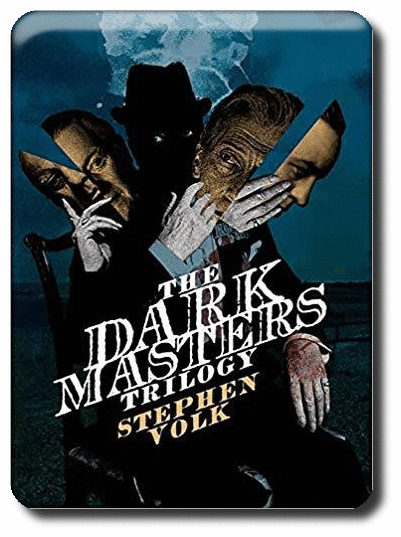
 Netherwood is the third book in Stephen Volk’s Dark Masters trilogy. The first two volumes were novellas - Whitstable, a story starring Peter Cushing, wrestling with the crushing grief of the recent loss of his wife, whose chance encounter with a child leads him into a confrontation with evil, and Leytonstone, which concerns the childhood of Alfred Hitchcock, an unpleasant encounter with a policeman, and a spiraling series of events. In addition to the above reviews, we’ve been fortunate enough to speak to Stephen about the writing of all three stories. You can find the interview on Whitstable here, Leytonstone here, and Netherwood here. Given the quality of the first two books in this series, I’ve been keenly anticipating the final book in the trilogy. The identity of the third Dark Master was a closely guarded secret until recently, which fed both anticipation and speculation. With the arrival of Netherwood - a novel length work, in contrast to the previous volumes - we have the answer. We’re going to be spending some quality time with Aleister Crowley. That’s almost the first twist in the book, though, actually. Although Crowley could be argued to be the subject of the novel, the point of view character is actually Dennis Wheatley, who as the novel opens has been summoned by a mysterious letter to meet Crowley. A life is at stake, he is told, and not that of Crowley. What follows is an absolute masterpiece. A strength of the series has been an incredibly evocative sense of time and place - here, Volk outdoes himself, bringing to life 1947 England with an incredible eye for detail and atmosphere. The entire story is suffused with a feeling of griminess, suffering, near-collapse; the war may have been won, but the enormous cost, in terms of human life and economics, is still being powerfully felt throughout. That sense of fragility, of the shellshocked emerging from the dust, still blinking and unsure if it’s really over, is reflected both in the world Volk describes and the internal landscape of Wheatley’s own thoughts, as his path brings him face to face with The Great Beast. For me, it’s that evocation of time and place that is the connective tissue between these otherwise discrete narratives, and Netherwood sees the most accomplished and complete execution of that evocation so far - high praise, considering how integral that approach was to the considerable success of its predecessors. Similarly, Wheatley is brought to life in a loving yet unsentimental portrait that rings with psychological authenticity, bringing this much-loved-in-his-day author into sharp relief, as he contemplates his contribution to the war effort and what the uncertain future must hold. It’s another masterstroke from Volk, as Wheatley proves to be the perfect lens through which to view this time and place, as well as a quietly riveting subject in his own right. And then, of course, there is Crowley. Again, deciding to make Wheatley the point of view character is a canny choice by Volk. His own opinions and perceptions of Crowley colour things just enough to keep the reader guessing as to the true motives of the magician, as well as sensibly keeping him at arms length, unknowable. The conversations and confrontations between the two men - which make up much of the meat of what follows - are as a result utterly compelling, pulling the reader through a gamut of emotions alongside Wheatley. I’m being intentionally vague about the plot, here (though beware clearly flagged spoilers in the interview that accompanies this review), because I strongly feel this book is best experienced as cold as possible - I found a large amount of the joy on first read came from the discovery of the nature of Crowley's proposition, and wrestling with it as Wheatley must - but I do want to assure you that in addition to the above, this is a belting story, worthy of Wheatley’s own narrative drive and obsessions (though I must say, based on my understanding, rather better written than his work). Like many of the finest works of the genre, the narrative walks a fine line between the supernatural and the psychological. Volk's footwork in navigating this tightrope is the smooth, assured step of a master, leading us every step with hearts in mouths. This novel is simply a tour de force, and the crowning achievement of a quite remarkable trilogy of tales. With it, I think Volk has given us a collection that, like the men he writes about, will stand the test of time, and bring joy (and discomfort) for generations to come.Unconditionally recommended. KP 8/10/18

Comments are closed.
|


Archives
May 2023
|

|

|


 RSS Feed