


BOOK REVIEW: TRIBUNAL BY DAVE JEFFERY
12/7/2022
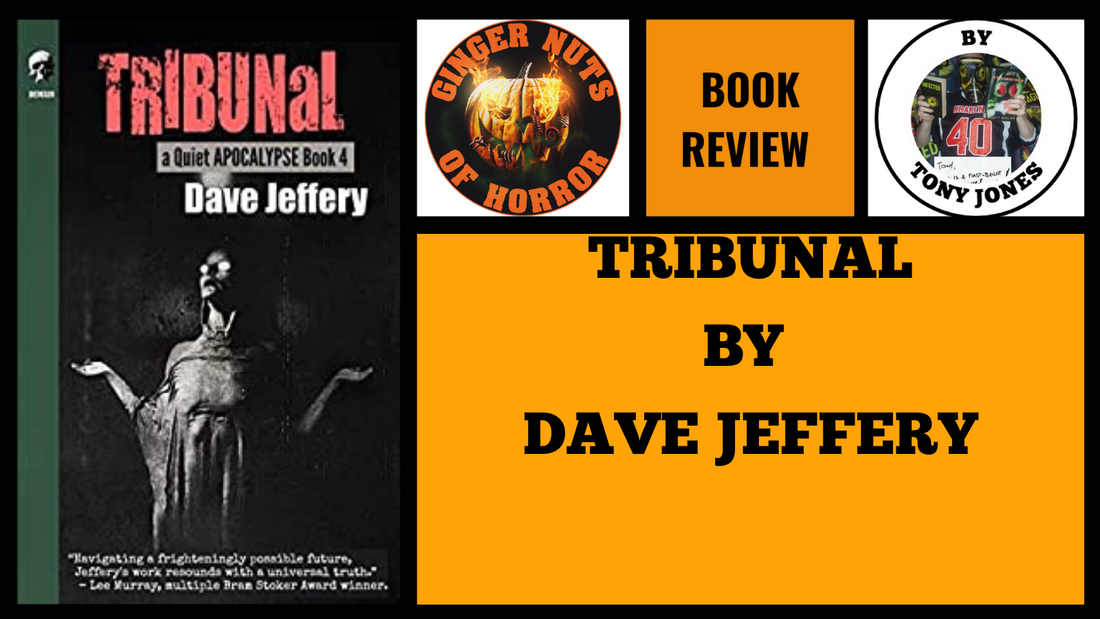 The ‘A Quiet Apocalypse’ quartet bows out with a reflective and satisfying endgame played out in a courtroom Dave Jeffery’s A Quiet Apocalypse quartet of novellas, which began back in 2019, concludes in some style with the riveting Tribunal. The final instalment is a clever change of direction and pace from its predecessors, which brings the series to a reflective and satisfying end. I would recommend reading all the other books before tackling Tribunal as it references many previous events, ties up loose ends, fleshes out previous plotlines and reintroduces notable characters, particularly from Cathedral (2021) and The Samaritan (2021). Bringing back major characters in this final instalment in support roles enhanced that feeling of closure and hope beyond the misery and hopelessness of what went before. I previously reviewed all three books for the Ginger Nuts of Horror, by way of a brief recap: A Quiet Apocalypse https://gingernutsofhorror.com/fiction-reviews/book-review-a-quiet-apocalypse-by-dave-jeffery Set in a grim post-apocalyptic world where a mutant strain of meningitis (MNG-U) wipes out most of mankind, the few who survived the pandemic were left deaf, an even smaller percentage retained their hearing. The focus of the book concerns the horrible relationship which develops between those with hearing and those deprived of it, who vastly outnumber the former. Not to mention the biggest scapegoats: those who were always deaf. Cathedral https://www.gingernutsofhorror.com/fiction-reviews/book-review-cathedral-by-dave-jeffery Book two is set entirely in the town of ‘Cathedral’ (an area of Birmingham) which is mentioned briefly in its predecessor and there is some brief character overlap. The story concerns the brutal system of law and order which the inhabitants of the town follow in order to exist and live whilst hunting for other survivors to either join their cult, enslave or ritually murder. The Samaritan https://gingernutsofhorror.com/fiction-reviews/the-samaritan-by-dave-jeffery-book-review The third entry focusses upon a Samaritan, the equivalent of Cathedral’s police or enforcers, who go beyond the town scouting and hunting for food or other survivors. Whilst in the wilderness the Samaritan becomes detached from his group and meets a family with unexpected consequences. Tribunal opens with an academic from a Birmingham university presenting the foreword of a book (written in 2095) which discusses the period in history from over fifty years previously which is now referred to as The Quiet Apocalypse, reflecting upon humanity’s brush with extinction, noting that this period was amongst the darkest in humanity’s history. The professor hopes that by documenting these events in the book it acts as a warning that such barbaric acts can never be repeated and need to be remembered in the same way that we reflect upon The Holocaust from the Second World War. Tribunal is entirely and convincingly presented as a court trial in which there are both victims and perpetrators from The Quiet Apocalypse era, many of which appeared in the previous three books. Much of this revolves around the goings on in Cathedral (book two) and Samaritan (book three) with those charged effectively being tried for crimes against humanity for which the death penalty exists, similar to what happened to the Nazi’s in the Nuremberg Trials after the war. The events of those books took place around 2025 and the trial around 2039, with the Cathedral and Samaritan way of life collapsing in the years between. I was surprised how quickly and easily I was sucked into reading court transcripts, documents and interviews, with the reader forgetting they are emersed in a historical document. Everything felt very current and realistic, from the statements of the survivors to the six hearings of those on trial for their crimes. The different perspectives were fascinating, particularly those who were in the dock and their reliance on ‘Maslow’s Law’ to justify how they acted. I was interested by the fact that there was little remorse or blame throwing, as has been the way with former members of the Islamic State in recent contemporary trials. It would have been easy for Tribunal to come across as preachy or worthy but it does not fall into that trap, instead it drops clever nuggets regarding the bigger picture of this apocalypse and refuses to portray everything in black and white. When reading the first three books the action is entirely set in the Birmingham area and the trial concentrates upon these events and so the reader can draw their own conclusions as to whether the rest of the country blamed the deaf for the near mass-extinction event which led to the horrific events previously documented. Also, as we are now hopefully entering the ‘post’ COVID period and in reflection did many of us blame the Chinese all too easily? In reality this blame game was only a few short steps away from what went on in A Quiet Apocalypse. Tribunal is a fitting and reflective conclusion to this great series and in the accompanying endnotes Dave Jeffery notes that it was equally important for himself to have the cycle of brutality end. New readers are in for a treat, as the A Quiet Apocalypse sequence can undoubtedly be read back-to-back, providing a rich reading experience with the different perspectives in which a world with perpetual deafness is perceived and the resulting extremism which arises as a terrifying biproduct. Tony Jones TRIBUNAL: A Quiet Apocalypse Book 4 |
 |  |


May 2023
April 2023
March 2023
February 2023
January 2023
December 2022
November 2022
October 2022
September 2022
August 2022
July 2022
June 2022
May 2022
April 2022
March 2022
February 2022
January 2022
December 2021
November 2021
October 2021
September 2021
August 2021
July 2021
June 2021
May 2021
April 2021
March 2021
February 2021
January 2021
December 2020
November 2020
October 2020
September 2020
August 2020
July 2020
June 2020
May 2020
April 2020
March 2020
February 2020
January 2020
December 2019
November 2019
October 2019
September 2019
August 2019
July 2019
June 2019
May 2019
April 2019
March 2019
February 2019
January 2019
December 2018
November 2018
October 2018
September 2018
August 2018
July 2018
June 2018
May 2018
April 2018
March 2018
February 2018
January 2018
December 2017
November 2017
October 2017
September 2017
August 2017
July 2017
June 2017
May 2017
April 2017
March 2017
February 2017
January 2017
December 2016
November 2016
October 2016
September 2016
August 2016
July 2016
June 2016
May 2016
April 2016
March 2016
February 2016
January 2016
December 2015
November 2015
October 2015
September 2015
August 2015
July 2015
June 2015
May 2015
April 2015
March 2015
February 2015
January 2015
December 2014
November 2014
October 2014
September 2014
August 2014
July 2014
June 2014
May 2014
April 2014
March 2014
February 2014
January 2014
December 2013
November 2013
October 2013
September 2013
August 2013
July 2013
June 2013
May 2013
April 2013
March 2013
February 2013
December 2012

|

|
 RSS Feed