


STUDIO OF SCREAMS - BOOK REVIEW
6/1/2021
 I must tip my hat to the genius idea of casting real players, an audacious idea that for my money paid off perfectly), and a metanarrative that lands a decidedly uncozy punch, this book was exactly what I was craving. Four superb novella-length yarns by four world-class horror writers, Studio Of Screams is a themed 4 novella collection by Mark Morris, Christopher Golden, Tim Lebbon, and Stephen volk, with a bridging metanarrative by Stephen R Bissette. The concept is that the novellas represent the official ‘novelization’ of four horror movies that were made in the 70’s by now-defunct Blythewood horror studio. The studio was making movies around the time of the Amicus and Hammer heyday, but had a reputation of being a bit nastier than either; a reputation somewhat enhanced by the subsequent vanishing act the studio performed after folding, with the films themselves apparently evaporating into thin air, and even reference to the studio in official film histories thin on the ground. As the book opens, a film historian and academic, who is researching a wider project about movies that have either been banned or otherwise suppressed, is contacted by one of the studio's founder members, with the offer of a lifetime; come and see four of the studio’s output at a private screening, after which he will be gifted a novelization of the movie and the chance to interview the elusive filmmaker about what he’s just seen. It’s an absolutely superb conceit, mixing alt-history with a canny nostalgia for a golden age of pulp horror cinema, and adding in that extra kick from the notion that there’s something dangerous, even forbidden, about the films themselves. And not to jump to the end, but the framing leads to a denouement that I found genuinely disquieting, as the weaving of fiction with history reaches a surprising yet plausible twist that did a great job in recreating/invoking a real-life sinking feeling. The first novella in the book is Sword Of The Demon by Mark Morris; an on-the-surface pretty classic Mummy style creature feature, complete with treasures raided from an ‘exotic’ tomb (China rather than Egypt, but still), and a pleasingly visceral creature of vengeance. In some ways, it’s a risky type of tale to take on; the anxieties of empire such stories represent (along with, in the original incarnations, often more than a dash of good old fashioned racism) have often not aged terribly well, to put it mildly. And what’s going on here has an extra layer of trickiness, in that it’s written as a homage to a specific type of 70’s horror movie, a genre with many of its own issues when it comes to matters of gender and race relations. Here, Morris deftly sets the tone for the entire book; avoiding racial stereotypes for the characters of colour in the tale, but allowing the adventuring party to cover a range of positions; from the petty disinterested greed of Sir Clyde, the party leader, to the anxieties of the younger Richard Frye, and from the character of Sir Winston (instantly recognisable as being played by Peter Cushing, yet another delight of the framing conceit) an apologia, though not an excuse, for the honestly-held if morally-suspect-to-modern-minds beliefs that would allow otherwise decent men to commit such acts of cultural vandalism (and, you know, theft). Most importantly, he delivers all the above with a deft lightness of touch, weaving it seamlessly into a compact narrative, which quickly allowed me to mentally unclench at the potential pitfalls and instead just enjoy the romp. And a romp it is; from the ancient temple, with echos of the opening to Indiana Jones, through to a bloody, muscular action-horror set-piece attack on a horse-drawn carriage, culminating in a pulse-pounding finale in (where else?) The British Museum, the narrative zips along at a pleasingly page-turning pace (a property common to all four stories in the volume). Like the good real-life novelisations the piece echos, Morris does a superb job fleshing out the characters interiority, while still giving precedence to plot and spectacle; again, a common theme to all four stories is I frequently found myself visualising the ‘source material’ movie in my mind’s eye as I read the story, and Morris delivers that experience in spades. As a fan of pulp horror in general, and as someone who has a great fondness for the 70’s British Horror Cinema aesthetic, this novella was the perfect opening to the book and just pure joy from start to finish. Next up is Christopher Golden’s The Devil's Circus, a macabre piece that keeps the 70’s aesthetic, but also invokes previous cinema exploits in the setting of the circus (indeed, in the post ‘movie’ interview, the filmmaker confirms the influence of Browning’s Freaks, and it’s just this kind of playful, in-plain-sight evocation of the influences at work that makes the whole piece such a delight to read). Again, I found myself able to picture the 70’s-horror-movie-does-vaguely-historical-Europe setting with spooky ease, thanks to Golden’s crisp and confident prose. As with the other tales, he does incredible work playing with broad strokes characterizations - in this case, the strangers flung together by a common cause to find the Circus, but whose divergent goals when they arrive introduce tension where there had been a growing sense of unity of purpose - in a way that manages to feel enjoyable rather than offputting, enlivening rather than reductive. I think the framing helps with this; it really was a stroke of genius to prime the reader to be expecting the novelisations of 70’s slightly-seedy horror. It made me approach the text with a certain mindset, for sure; that said, it’s easy to overlook the pressure that puts on the authors, I think, in that any misstep from that atmosphere would not just be jarring, but actually damaging to the whole pursuit. As with Morris, Golden simply does not put a single foot wrong, and the novella-length telling produces a narrative without an ounce of fat that builds relentlessly to a glorious pulp horror climax - one you suspect looks better on the page than the 70’s effects budget would have allowed for. Next up is Tim Lebbon’s Castle Of The Lost, which takes on the absolute classic tropes of a cursed inheritance, a dark family past, and the city family transplanted to rural ways, weaving another superbly paced tale that ratchets up the tension scene by scene. The story makes deft use of flashbacks, evoking cinematic flash cuts whilst also making good use of the novelist's toolkit to build interiority of character. This story simply drips with atmosphere, building an ever-escalating sense of dread from the first page to a genuinely horrific set-piece finale. The bridging narrative makes it clear that the movie studio was pushing the boundaries of the film censorship board harder and harder as their productions progressed (again, a delightful conceit that I found working on my sense of anticipation, almost recreating the feeling of being a kid and sneaking a viewing of a late-night Hammer rerun on TV), and Lebbon certainly takes the brief to heart, serving up sexpoltiation horror scenes that uncomfortably recall that 70’s milieu. It’s another superb, fast read that recreates the movie-that-never-was in the mind's eye with disturbing clarity. The collection rounds out with The Squeamish by Stephen Volk. In a hint at what’s to come in the framing story, things start to get meta here; in the prior ‘interview with the studio head’, we’ve been informed that there were increased levels of interference in their productions from the BBFC, with one particular woman causing significant issues for Blythewood by this stage, demanding cuts that the creators regarded as vindictive interference in the process. Indeed, we’re informed that the filmmakers waited until that board member was taking a leave of absence before submitting the script for this film. So it’s not a surprise to find this tale concerns a film censor, who is drawn into an escalating confrontation with a maverick young filmmaker (who, both the poster art and the author’s clear description confirm, is played by Oliver Reed). That said, there’s a different quality to this tale; in addition to the further escalation of sex and violence, the narrative develops an increasingly hallucinatory quality, as the movie-within-a-movie that is the source of the censors' ire appears to start bleeding into her reality - or is it her psyche that’s becoming infected, somehow? Again, I found myself visualising what the movie version of the story must look like, even as Volk effortlessly evoked the 70’s setting with his trademark attention to the telling detail. There’s an incredible fluidity to Volk’s period work; his ability to call forth the essence and atmosphere of a previous era may be unparalleled, and certainly, that rare talent is on full display here yet again. Add in the feeling of reality becoming increasingly slippery and unmoored in the back half, and I was left with a brilliant double whammy of an uneasy nostalgia coupled with a genuine fear that the entire narrative rulebook was on the bonfire, and really anything could happen. Again, the nervous thrill of realising you’d reached reel three of a video nasty and you had no idea where - or how far - it was ultimately going to go. I strongly suspect I’d have enjoyed this superb book in any year I’d encountered it; but I have to say, in 2020, it was a particular delight. A heady mix of escapism, fake film history blended with fact (and again, I must tip my hat to the genius idea of casting real players, an audacious idea that for my money paid off perfectly), and a metanarrative that lands a decidedly uncozy punch, this book was exactly what I was craving. Four superb novella-length yarns by four world-class horror writers, each giving their own loving tribute to a very particular moment in British cinema history. Add in PS Publishing’s usual outstanding production values on the hardback, including gorgeous artwork for the cover of each ‘novelization’, and you have what was hands-down one of my straight up happiest reading experiences of the year. KP 9/12/20 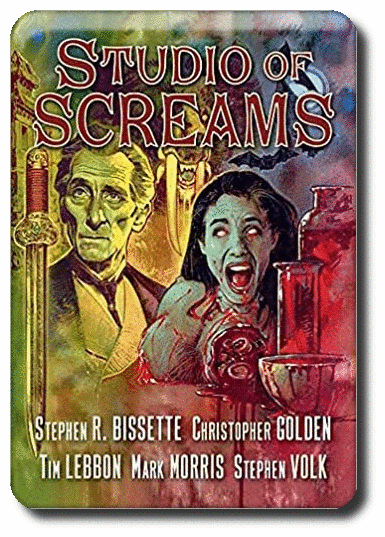 “I think it’s true to say,” says horror wunderkind Stephen Volk, “that many of us horror writers of a certain generation have treasured memories of Hammer Films, Amicus Productions and their ilk. In fact, their output of genre classics is so important that some of us have secretly longed for a way to relive and recapture the excitement we had when we first experienced them. "That was my exact impulse when I first talked to Mark Morris about a book proposal entitled The Blythewood Horror Film Omnibus—an unashamed homage to John Burke’s Hammer Horror Film Omnibus, a fat paperback that came out in the sixties, comprising four novellas based on upcoming horror films. The difference being that our “Blythewood” would be a studio that never existed. Our four films would be movies that we’d invent from scratch. Movies we wished we could have seen as feature films when we were growing up. And now we can – in book form – thanks to PS." CONTENTS * Prologue (by Stephen R. Bissette) * Sword of the Demon (by Mark Morris) * Interview the First (by Stephen R. Bissette) * The Devil's Circus (by Christopher Golden) * Interview the Second (by Stephen R. Bissette) * Castle of the Lost (by Tim Lebbon) * Interview the Third (by Stephen R. Bissette) * The Squeamish (by Stephen Volk) * Interview the Fourth & Epilogue (by Stephen R. Bissette)   Comments are closed.
|


Archives
May 2023
|

|

|
 RSS Feed