
BY KIT POWER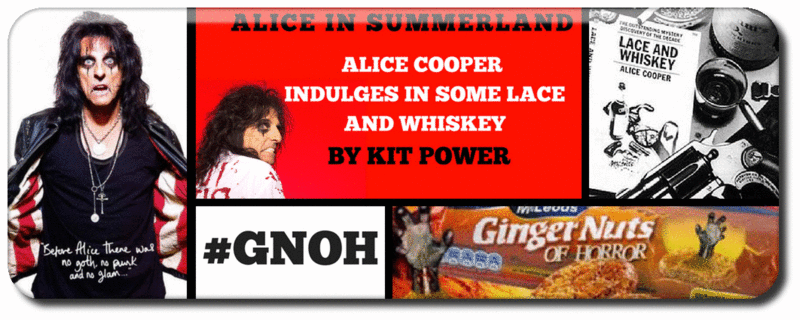 So, I like Alice Cooper, but I think I’d have to fairly describe myself as a greatest hits fan. The first Alice Cooper song I remember hearing was "Poison" - almost certainly on Top Of The Pops - and as a budding metal head, I dug it a lot. I also remember reading reviews of his live show in Raw magazine that made it sound awesome - part gig, part live horror show. Later, there was "Hey Stoopid", "Feed My Frankenstein" and eventually I picked up an actual greatest hits, and discovered "Eighteen", "Elected", "Under my Wheels", "Only Women Bleed", "Billion Dollar Babies", and of course that ultimate youth anthem, "School’s Out." Still and all, I’d have to say my overriding impression, at first, was of an artist that took themselves very seriously. "Poison" gives no impression of having a sense of humor, and "Hey Stoopid" was a pretty stone faced anti-drugs song. "Feed My Frankenstein" was a different barrel of monkeys of course, but it was for a comedy movie, so I figured maybe that had given a license to goof a bit. That image I’d built got more nuanced as I really absorbed the hits album, of course. There’s a lot of humor there, much of it very pointed, and some superb storytelling, character songs… I started to get a sense of a range, of depth. Eventually, in November 2007, I got to see the man perform at Wembley Arena (Motorhead and Joan Jett in support). It was a great show - the band was amazingly tight, Cooper’s voice was in great shape, and the staging itself was as spectacular as I’d always been led to believe. And it was a relentlessly crowd pleasing set, all the hits present and correct. That said, as I filed out, ears ringing, I was happy that I’d done it, and felt no desire to ever go again. The show had been slick, well oiled, note perfect… and, I felt, like it ran exactly the same, every night, in every city. That’s not a criticism, to be clear; it takes a lot of skill and talent to be that on the money night after night, and it’s a level or professionalism not many bands can meet. But such an approach does, by design, boil out spontaneity - and that’s what I find I most enjoy in a live show; a feeling of edge, of danger; a sense that the performer are pushing themselves outside of their comfort zone, and that anything might happen. This show wasn’t that. And I was very happy to have gone and seen, and figured if I wanted to see it again, I’d pick up the DVD. I give this lengthy preamble because when John Boden announced this project, I was excited to be a part of it, but I also knew that I didn’t know what to go for. I didn’t want to pick a classic someone was in love with, but equally I didn’t want to get lumbered with some obscure album that another writer might have a relationship with that I couldn’t touch. And eventually, I threw myself on his mercy. You pick me something out, John - pick me something that’ll give me a sense of the Alice beyond the hits. Sure, said John. Do Lace and Whiskey, said John. So here we are. And true to his word, there’s not a single greatest hits track on here, so I came to it fresh. I’ve listened to little else for the last fortnight, trying to absorb the album into my mind, make sense of what it’s offering and trying to say. Here’s what I’ve got. Opener "It’s Hot Tonight" sets the stall out well; a funky hard rock riff with a bluesy edge. The rest of the band swiftly joins is, some tight soloing dropping neatly into the verse lyric. The vocal is well delivered - a little cleaner than the Alice growl I am used to, and delivered here with some kind of slight delay effect on the mic, but it’s still a powerful, sleazy voice. The song itself is superbly atmospheric, musically invoking a close summer evening that feels simultaneously energizing and oppressive. Already, I feel like I’m getting a wider sense of Alice as a writer and performer. That feeling continues as "Lace and Whiskey" begins, the intro on guitar and strings evoking almost a movie score, before the guitar lick leads down to the verse. The verse riff itself is a rolling, staggering affair, matching the vocal content, Alice describing staggering through the dark. The cover art evokes hardboiled crime fiction, and the lyric could apply to that, of course, but given Alice’s full blown alcoholism, which by ‘77 was in full effect, let’s just say the metaphor works on more than one level. There’s some lovely piano work on this one too, low in the mix but there. Like the previous track, it ends suddenly, simply closing on a chorus line. "Road Rats" is a peon to the roadies that keep a tour on the road, literally and metaphorically. The subject matter is similar to Motorhead’s "We Are The Roadcrew", and while Alice’s take is somewhat slower, it’s by some measure the loudest track on the album so far, with a crunching low guitar riff driving the song forward. This is a pounding, straight ahead rocker, and it’s superbly played by all involved. Three songs in, and while I’ve been enjoying hearing new-to-me songs, I’d have to say I’m not hearing anything that I could call a startling surprise - sure, there’s the aforementioned smoother than expected voice, and some interesting musical flourishes on Lace and Whiskey, but overall, I’m not hearing anything that Greatest Hits Alice didn’t gesture at. That changes abruptly with "Damned If You Do", a foot down stomper that wouldn’t have sounded out of place on a Skynyrd B-Side. The lyric is a story of ill advised love on the road with a woman who has prior commitments, with a fair bit in common with "Gimme Three Steps". It’s funny, charming in a sleazy kind of way, but most of all surprising, with some banging honky tonk guitar driving along, and some nifty slide guitar underneath. It’s a cracking tune, for sure, but Alice Cooper? Really? And then "You And Me" starts playing, and I’m just lost. It’s… well, it’s a ballad, in form at least. Acoustic guitar, slowly played, high harmonies in the choruses, and yeah, the subject is love; specifically, the love of a long term blue collar marriage, complete with watching TV under a blanket, sharing popcorn, in place of a night of passion. It’s tender, and delicate, and quite unlike anything I’ve ever heard from Cooper. I don’t especially like it - in fact, it’s one of my least favourite tracks on the album. I think that’s mainly down to me struggling to see how Alice Cooper in ‘77 can have the first clue what normal life looks like. A song like this stands or falls on if it connects with you emotionally, and it left me cold. But that said, it certainly expanded my view of what an Alice Cooper song could possibly be. "King Of The Silver Screen" is next, and the weirdness continues. It starts out simple enough, a grand intro leading into a bobbing staccato guitar riff, lyric extolling the virtue of the golden age of Hollywood, refrain that matches the title. The second time through, there’s a new lyric following the refrain, before the riff drops into a creeping piece of music that’s been used often in movies and cartoons, but that I was unable to find the name of. On the third time through, the pattern repeats, but this time, as it draws to a halt, "The Battle Hymn Of The Republic" comes crashing in, before Alice sings ‘I could have been a star’, at which point a piano and delicate vocal pick up the verse… and then the guitar comes growling back in for an extended (and pretty superb) solo. It’s a profoundly odd moment, but I think it works - even when he does it again at the end of the last refrain, where he declares himself the Queen of the silver screen, and the Battle Hymn crashes back in as he rants and raves over the top of it, sounding like he’s using a megaphone, and the hymn itself crashes to a stop mid-line, an out of place cymbal crash bringing the song to a halt. It’s nuts, and mildly disturbing, and I really, really dug it. "Ubangi Stomp" is a two minute 50’s rock and roll stomper (literally, it’s a cover), and it’s played pretty straight, piano leading the tune, Alice delivering the vocal like a Jerry Lee Lewis fanboy. Around the 1:13 mark, the song drops out for a lovely bit of tom playing, before picking back up for the last verse and chorus. It’s really well nailed down, and again, suprising more for the fact of its existence than anything especially out there with regard to the song itself. And then there’s "(No More) Love At Your Convenience". About which the kindest thing I can say is that apparently literally everyone did a disco tune in the 70’s, and if this one is no better than Kiss’ effort, well, it’s no worse. Still. It’s an unironic Alice Cooper disco tune. Moving swiftly on, "I Never Wrote These Songs" is a melancholic affair, acoustic guitar picked in a minor key, Alice’s vocal high and delicate. Given that the year would end with him placed in a sanitarium, the vocal here feels poignant - though even without knowing that, the vocal is strong and heartfelt throughout, with a stripped, unpolished quality that’s hard to ignore. The song itself is layered with strings and piano, and, at the end, a spiraling bluesy sax solo. The instrumentation is similar to "You and Me" but this feels so much more heartfelt. It’s over in three minutes, fading like a ghost. The album ends with "My God", a song that opens with a lengthy church organ intro, before piano, guitar and drums come in. The piano leads the riff, drums underpinning with a series of tom rolls, Alice’s voice back in a very produced mode, but good and strong. The lyric is… well, it’s a prayer, no other way to read it. Describing the voice of God as the voice of conscience, ‘still and small’, yet strong, guiding, offering a path to redemption. Again, it’s hard to divorce the song from knowledge of Alice’s biography, and where his alcoholism was soon to lead him. This isn’t the sound of rock bottom, but it’s clearly a song about faith, and a belief in its power to heal and save. The album was, relatively speaking, a commercial failure. Following the King Of The Silver Screen tour, none of it was ever played live again, with the exception of opener "It's Hot Tonight". Alice would go into a sanitarium halfway through that tour, and his following early 80’s output he would later describe as his ‘blackout albums’, due to drug and alcohol abuse so sustained he cannot recall much of their recording. For me, it was certainly an eye opener. An album of two halves, that opens strong and closes weak, but also one that greatly expanded my understanding of Alice as an artist, and one where even the weaker elements throw some interesting light on the man and his processes (aside from "Love At Your Convenience", which is flat out bad and wrong). I am glad I got to spend some time with it, and I am really excited to find out else Alice was up to outside the Greatest Hits work. CHECK OUT THE OTHER ARTICLES FROM THIS SERIES   HORROR FILM REVIEW: BLOOD CLOTSComments are closed.
|

 RSS Feed

|

|