|
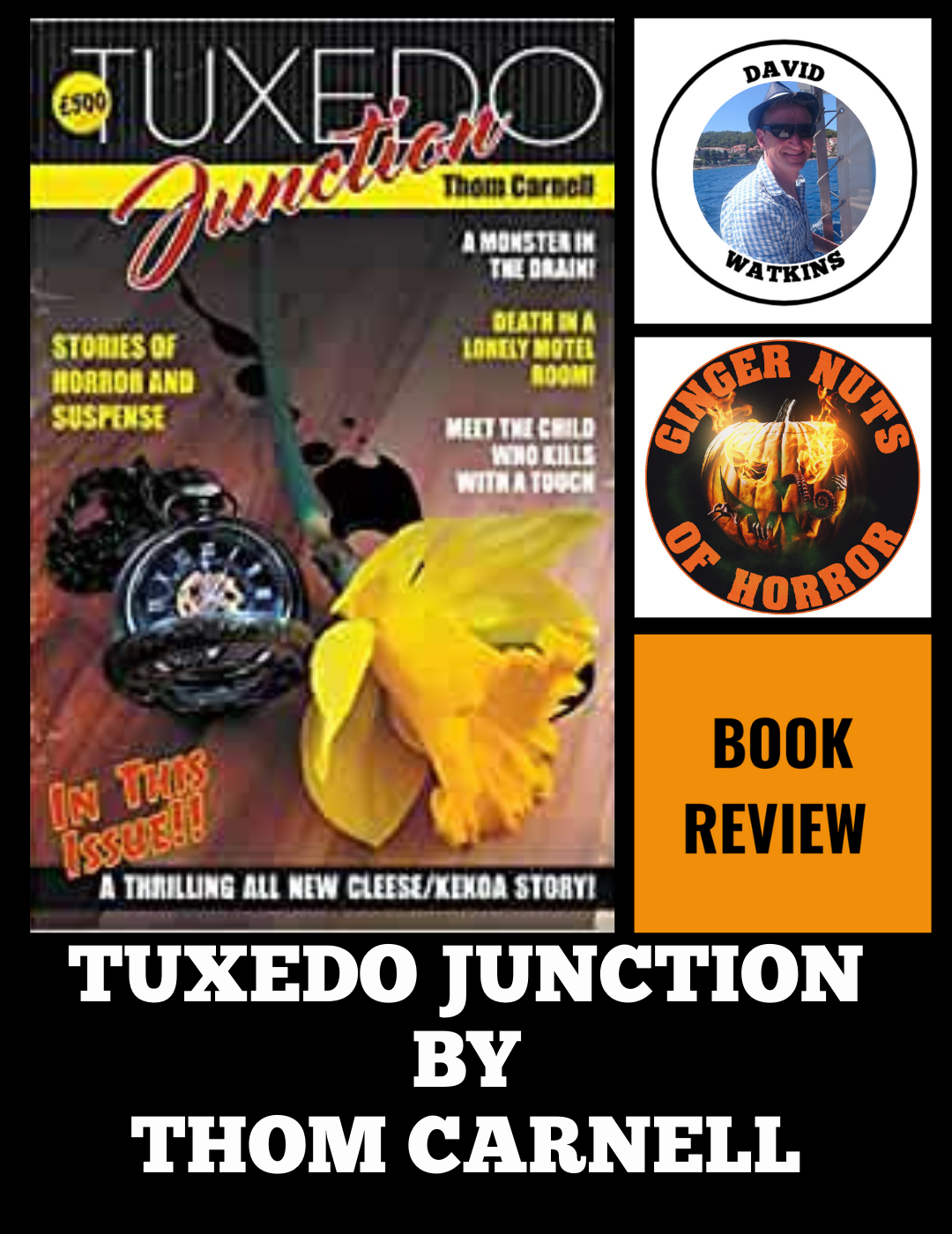
Tuxedo Junction by Thom Carnell Review by David Watkins I have put off writing this review for a while now as I’m finding difficult to put my thoughts on this collection into words. I didn’t especially like the book, but I am sure there is a massive market out there – it just wasn’t for me. However, that said, there is much to admire here and some stories are superb. See? This is going to be hard. Sections of the prose are beautiful and the whole collection is nowhere near as pulpy as the collection suggests. The cover (excellent) suggests we’re about to read ‘stories of horror and suspense’, but actually most of the stories within are actually character pieces. Many of them don’t really go anywhere, but just introduce us to a character and a vignette of their lives. A case in point would be the lovely ‘Standing Still’. This story is about two boys who meet at a football field – one is playing, the other is watching from the touchline in a wheelchair. Their burgeoning relationship is beautifully written, and I had a smile on my face reading it. Jeff – the wheelchair bound boy – moves stuff with his mind, and then the story ends. That’s it. He moves a rock with his mind, but nothing happens beyond that. The story sums up my frustration with this collection: far too many stories read like opening chapters of longer pieces rather than being self-contained stories. Personally, I hate that, no matter how well written the work is. You, however, might think it’s great, which is why there’s definitely a market for this book. When Carnell tells a whole story, it is absolutely superb. I really enjoyed Domicillary, a sf story with a really sweet ending, The Honey-Do (just leave the sink alone) and the best of the bunch – The Midas Gift. The last story about a girl and her relationship with a priest (no, not like that) and is full of emotion with a very sad ending. There’s a story that shows a scene from a Romero film from a different point of view. This didn’t work for me as I don’t know the scene in question – it’s been a while since I watched the Romero zombie films! Again, long term fans will love the references. We also have a Cleese/Kekoa story which is nothing more than a teaser for another book in the No Flesh Shall Be Spared series. I haven’t read that, but given the quality of Carnell’s writing, I intend to. The one misstep in the collection is Dogwatch. The police find a video tape and start watching a man show you how to butcher a human being. It is absolutely horrific and does not fit the tone of the rest of the collection. Most of the stories are about grief and loss and the whole thing has been put together as a homage to Carnell’s mother who died in 2011. The best stories here tap into that grief that he clearly still feels, and I really wanted to like the collection more. So, to sum up, excellent writing elevates this collection throughout, but there is a frustrating lack of ‘complete’ stories within. Please feel free to tell me how wrong I am in the comments, as Carnell is clearly a really talented bloke. Tuxedo Junction |

but there is often plenty of human interest and storytelling power beneath the glitz. The best stories in the collection provide a reading experience like being punched with a fist covered in expensive rings. And taking a punch is pretty much the only thing the ‘Useless Heroes’ who form the book’s second part are good for. |

Publisher : British Library Publishing (19 Aug. 2021)
Language : English
Paperback : 320 pages
ISBN-10 : 071235400X
ISBN-13 : 978-0712354004
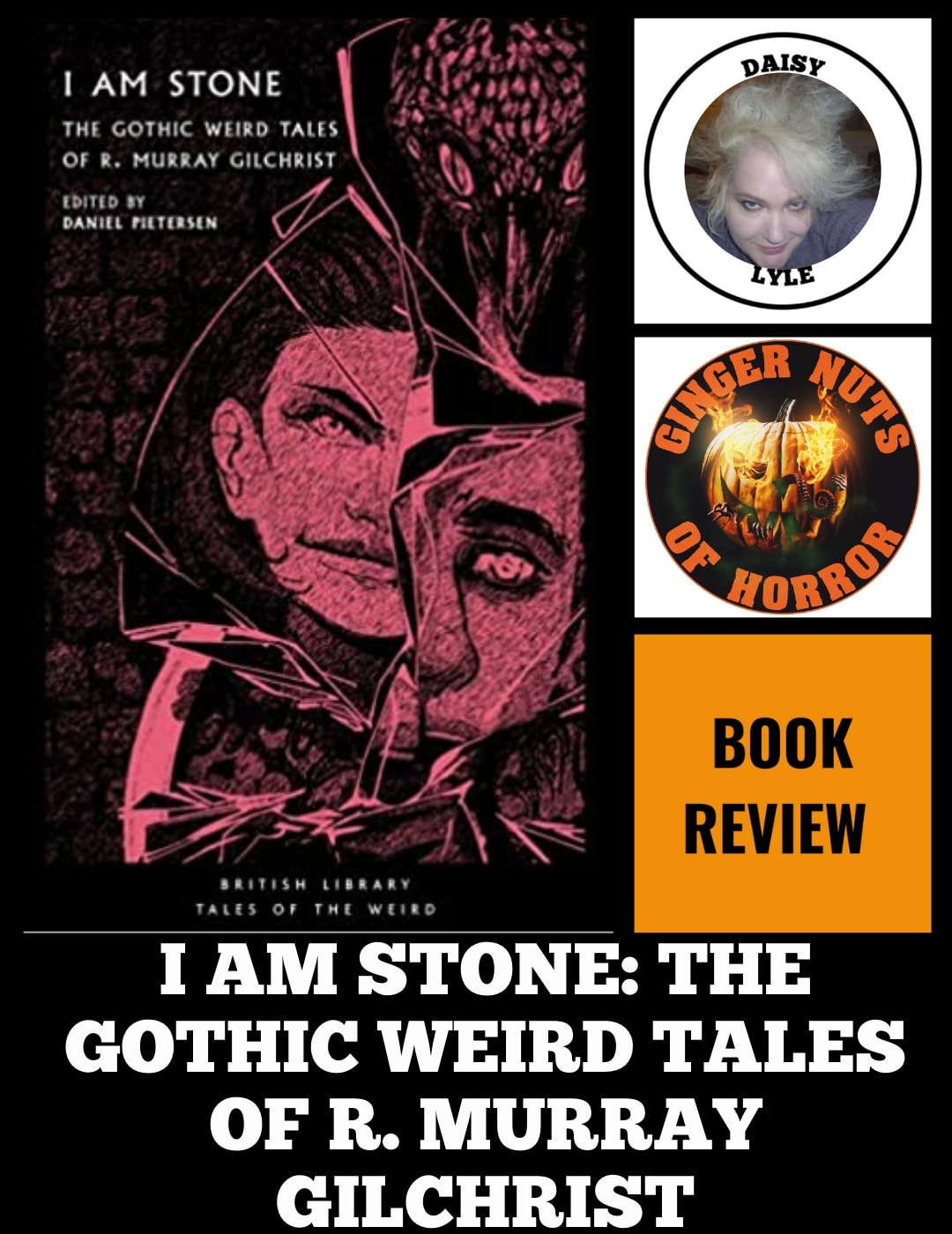
A book review by Daisy Lyle
On first glance it is the gothic that most stands out. He might have been ahead of his time, but Gilchrist didn’t give a tinker’s damn about the modern world. Most of his stories are set in Ye Olden Days, a time when people dressed fancy and men went on long quests while their wives and girlfriends stayed at home, scheming their heaving bosoms off. “The Crimson Weaver” is a particularly chivalric opener, with its two reasonably pure-hearted heroes journeying through an enchanted forest in search of a woman of occult power. But it’s more like Clarke Ashton Smith’s forest of Averoigne than anything from a sanitized fairy tale, and the oddness of what the seekers eventually find sends the needle scratching right over that Hans Andersen record.
This is something that happens over and over again in this collection, with traditional gothic set-ups dyed outlandish shades of decadent or twisted into the bizarre. His vampires and revenants are unconventional, and in “Night On The Moor” where a lost wanderer is given shelter from the storm by the master and lady of a very uneasy house, the perverse splendour of said lady (and her pet white deer Crystalla) makes what could have been a routine jealousy melodrama into something odder and more unsettling.
And Gilchrist is very big on splendour. There may be rot and decay at the heart of it all, but that doesn’t mean you can’t enjoy it. Swathed in velvet and sable and a ton of other materials you’re unlikely to find on the racks at Top Shop like paduasoy and kerseymere, dripping with chrysolites and opals the size of kidney stones, the heroes and heroines of the stories in the first part of this collection (Dead Yet Living) are dressed to kill, and on occasion do. One story, “The Pageant of Ghosts”, is pretty much just an excuse for a fashion show with dead people on the catwalk. “The excess of beauty and perfume drugged me” he writes, and the reader should expect a considerable contact high.
Gilchrist also shares the musical fascination of Decadent-inspired writers like Vernon Lee, as seen in “The Priest’s Pavan” (a charming look at the magical powers of an old score). Jewellery and music even meet in the oneiric “Dame Inowslad” when a character plays his piano with jewels placed across the strings. Barry Andrews from Shriekback once identified the piano as the apotheosis of civilized society, and so perhaps we shouldn’t be surprised by the huge amount of keyboard instruments in this collection, though most of them are harpsichords and spinnets.
This might all be a bit heady for some, but there is often plenty of human interest and storytelling power beneath the glitz. The best stories in the collection provide a reading experience like being punched with a fist covered in expensive rings. And taking a punch is pretty much the only thing the ‘Useless Heroes’ who form the book’s second part are good for. Fate is ineluctable, and the chivalry of many of Gilchrist’s menfolk only goes skin deep. “The Manuscript of Francis Shackerley”, probably the best story, is a romantic but exceedingly dark tale of star-crossed lovers that is also a damning indictment of domestic violence, with a very modern feel.
In fact several of the stories here are very pro-woman. It would be a stretch to call Gilchrist a feminist; many of his heroines are quite samey, a long procession of neurotic young beauties only occasionally interrupted by a mournful crone or unsavoury old witch. But as can be seen in part three (‘Of Passion and Death’) his heroines have a degree of sexual agency not common in writing of the time, and aren’t always punished for it either (as in “Dryas and Lady Greenleaf” in which the heroine gets it on with a statue while her husband is away). In tales like “The Writings of Althea Swarthmoor” and “Noble Courtesan” sex is treated with greater frankness than one would expect, and in the former story Gilchrist’s loathing of sexual hypocrisy and double standards is manifest. One of my favourites, “Sir Toby’s Wife”, can also be seen as a wry critique of arranged marriage, and I also enjoyed its more modern tone (definitely at the “weird” end of things and reminiscent of a good Edith Nesbit or Margaret Irwin chiller.) This ability to see women as complex beings serves Gilchrist well in stories of tragic love such as “The Stone Dragon” and “The Lost Mistress”, which are psychologically realistic and affecting. The sombre moorland musings of “My Friend” even offer a queer love story.
The collection winds up with something a bit different. In his lifetime Gilchrist got much more traction for his slice-of-life Peak District stories than his more byzantine material, and ‘Peak Weird’ presents three little-known examples of this. “The Panicle” is a weird little two-hander based on a piece of Peak District folklore and “A Witch In The Peak” is a slightly more comic tale. These mainly serve as quaint vignettes, and there’s far too much ‘authentic’ local dialect, but you do notice that the heroines in these stories are very different from the hothouse cuties in the other material, more downhome, street-smart and bareknuckle tough. And the final story, “A Strolling Player”, is lovely. It’s quite Hardy-esque in its account of a man who, on his way to bring home his child’s coffin, gives a lift to a wandering actress who has had her life blighted by a burden of shame. The harsh landscape of the Peak District in Winter is brought wonderfully to life, and its stark beauty forms a perfect backdrop for the story. Life, Gilchrist suggests, is horrible, especially for women on the wrong side of the tracks, but love can occasionally take centre stage.
Gilchrist was until now a massively out-of-print writer, and Petersen’s achievements in bringing this body of work back into the spotlight are considerable. Parts of the collection suffer from sameness of tone, and the writer’s style sometimes runs away with him (you’d better be prepared to learn a lot of old words like culver and burse and marplot, though Petersen has provided some help with the terminology.) But there are many stories that richly deserve to be remembered, and with its beautiful cover design and presentation I Am Stone is bound to succeed with lovers of late Victorian and Edwardian fiction.
DAISY LYLE
I Am Stone: The Gothic Weird Tales of R. Murray Gilchrist
by R. Murray Gilchrist & Daniel Pietersen
Through odysseys across dreamlike lands, Gothic love affairs haunted by the shadow of death and uncanny episodes from the Peak country, the portrait of a unique writer of the strange tale emerges. With his florid, illustrative style and powerful imagination, R. Murray Gilchrist’s impact on the weird fiction genre is unmistakable – and yet his name fell into obscurity following his death.
Exploring tales of annihilation and shattered identities, fatalistic romances, bewildering visions of the sublime and mythological evils preying on the innocent, this new anthology is a journey through an entrancing and influential oeuvre essential for any reader of the weird.
TODAY ON THE GINGER NUTS OF HORROR WEBSITE
SOMETHING MORE THAN NIGHT BY KIM NEWMAN [BOOK REVIEW]
LOST SOULS BY BILLY MARTIN (WRITING AS POPPY Z. BRITE) [13 FOR HALLOWEEN]
THE HEART AND SOUL OF HORROR FICTION REVIEWS
Jaws (Peter Benchley) and The Rats (James Herbert) proved that there was an appetite out there for books that weren’t ashamed to be all-out horror. The publishing industry took note and throughout the 1970s and 1980s, companies such as Zebra, Tor and Pinnacle published a seemingly endless supply of books promising unspeakable terrors and sporting covers that had to be seen to be believed. Sometimes the content was great, other times… not so much, but one thing that you could always be guaranteed was a fun and entertaining read.
By the mid-90s, horror paperbacks were seemingly out, and thrillers were in. Gone were the lurid covers of skeletons, evil dolls, creepy kids and flesh hungry critters. The horror was still there, it just wasn’t marketed as such, treated like a shameful secret. As titles fell quickly out of print, many of the horror authors and their work became increasingly forgotten by all but the most avid fans and collectors.
Enter Will Errickson, Grady Hendrix and ‘Paperbacks From Hell’.
In 2017 Hendrix and Errickson released their seminal love letter to the horror paperbacks of a bygone era, shining a light on some long-forgotten classics and renewing interest in the mass market horror paperbacks of the 1970s and 80s. Not content to simply share their passion for these oft maligned but much missed books, thanks to their partnership with Valancourt Books, we are being treated to new reprints of the best of these decades-old, forgotten gems.
To date, thirteen reprints have been published (with a fourteenth on the way), retaining the original cover art and boasting brand new and insightful introductions from Hendrix and Errickson. In this series I’ll be reading each and every one and posting articles at Ginger Nuts of Horror looking back at the best books two decades of horror has to offer.
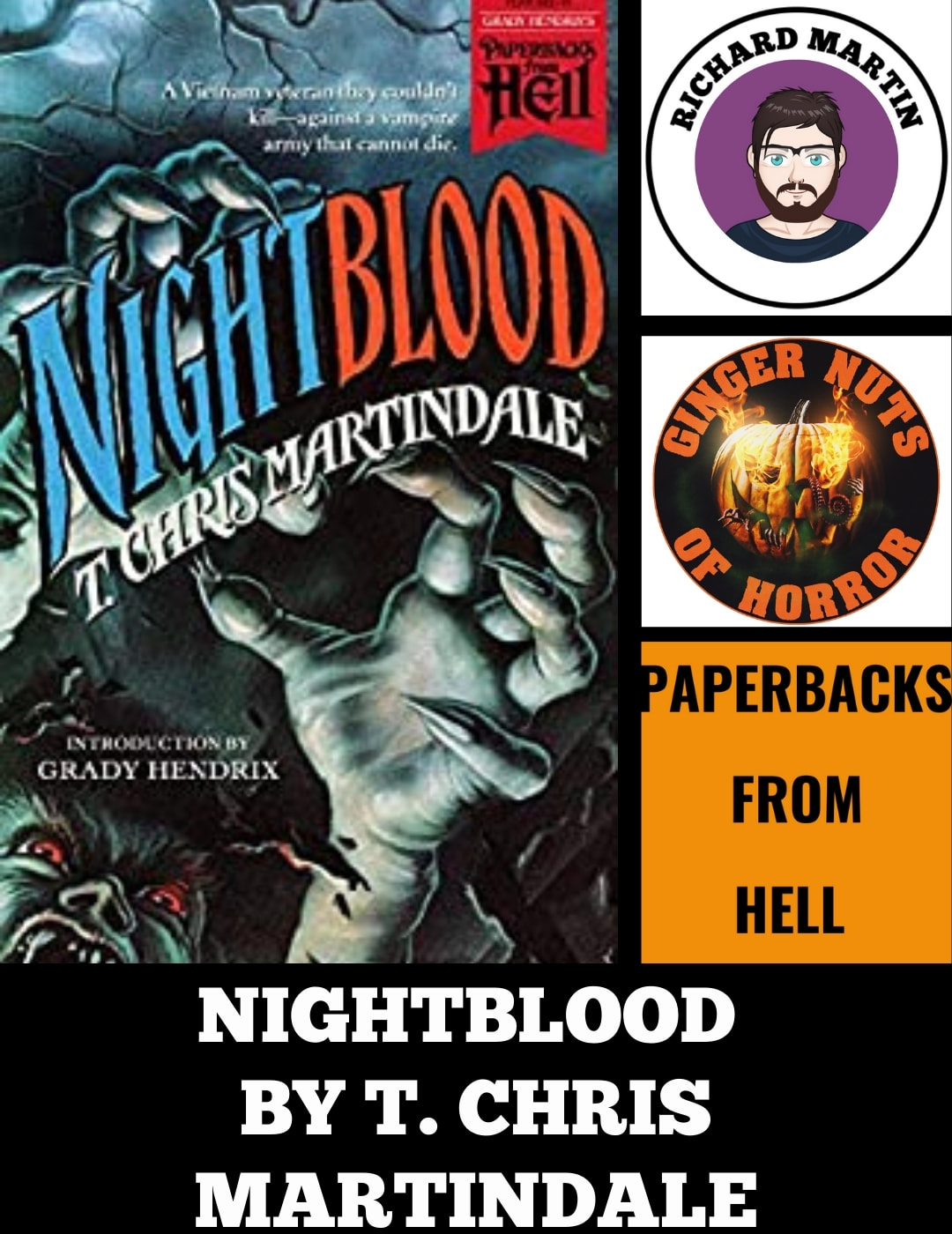
‘Nightblood’ is one of those books whose appeal can be succinctly summarised by a comparison to two other well known properties. ‘Nightblood’ is ‘Salem’s Lot meets Rambo’ and if that appeals (and how can it not) then that’s all you really need to know going in.
The first of four novels written by T. Chris Martindale, ‘Nightblood’ was released in 1989. Nominated at the time for a Bram Stoker award for Best First Novel, it seemed the author was set for a long and notable career as a horror writer. Sadly, the downturn in the horror paperback market of the early 1990s, coupled with lacklustre marketing on his final two books meant that 1993’s haunted house novel, ‘The Voice in the Basement’ proved to be the last book Martindale would write. It’s a shame because ‘Nightblood’ is an immensely fun read.
Telling the story of Chris Stiles, a decorated Vietnam veteran who has returned home to fight an altogether different war. His brother is viciously killed in Central Park, the victim of some unknown monster and returns to Chris as a ghost. Chris and his brother embark on a quest to find the creature that killed him, vanquishing any evil they find along the way.
Their journey takes them to the small town of Isherwood, Indiana, where a malevolent force has rested undisturbed for decades.
‘Nightblood’ is a crazy mash-up of the uber-violent action films and bloody, over the top horror films of the 1980s. It’s a melding of two disparate genres that works incredibly well on the page and ensures there is never a dull moment. Barely a page goes by without some kind of body count (the town has a population of 800 and it’s no spoiler to say that number is significantly lower by the end) and the vampire hunters forgo the traditional stakes and garlic for assault rifles and explosives. A wise choice, and certainly the more entertaining way to go.
The book wears its influences on its sleeves and, on many occasions, overtly references them. I caught mentions of seminal 80s vampire movie, Fright Night, and nods to Anne Rice and Stephen King, but there are probably a ton that I’m forgetting. I mention this as there is a world of difference between pale imitation and loving homage and ‘Nightblood’ is firmly the latter. It reads like a book written by a voracious consumer of movies and comic books, throwing everything into the pot to see what works and, inexplicably, the whole thing does. The action is fast-paced and suitably excessive, the horror is very suspenseful when the need arises and there is an overall sense of fun that pervades proceedings.
The comparison that looms largest is Stephen King’s Salems Lot. The similarities are too numerous to ignore, whether that be the general premise of a small-town invasion of an ageless vampire, a stranger coming to town to save the day (and picking up a love interest along the way). Even the two horror-loving young boys bear more than a passing resemblance to King’s Mark Petrie character. This leads me to two major confessions that will, most likely, lose me whatever sliver of horror cred I have earned from these articles so far…
1. I don’t particularly like Salem’s Lot
2. I think ‘Nightblood’ did it better
If anyone needs to stop reading now out of fanboy rage, I completely understand, and I’m grateful that you stuck around this long. I appreciate I’ll be in the minority here, but hear me out.
Where Salem’s Lot is a slow burn, ‘Nightblood’ is action-packed from start to finish. Where King’s vampire leader Mr Straker remains largely absent for most of the book, Danner is a very physical, hands-on presence, always in the thick of the action and while Ben Mears feels largely in over his head in King’s book, an everyman dealing with overwhelming odds, ‘Nightblood’ gives us a very capable protagonist, one who we know will put up a good fight, even if the actual outcome may not be in his favour.
The ending is so gleefully cinematic that you can practically hear the gunfire and feel the heat of the explosions (and there are a LOT of explosions). The 80s action movie vibe is palpable and the grand finale is suitably violent and completely bonkers. Unlike the 80s action movies that it seeks to imitate, however, Chris Stiles is not an infallible one-man army, and the cost to both him and the town of Isherwood is high, and keenly felt. It gives the book (if you’ll forgive the word choice here) stakes, making you both care about the fate of the characters, and feel like the triumph of good over evil is necessarily a foregone conclusion.
Seven books into my readthrough of Valencourt’s Paperbacks From Hell line and I’ve been surprised to find that most of the offerings to date haven’t been the cheesy pulp fests I went in expecting, but ‘Nightblood’ is pulpy enough to pick up the slack, and then some. Imagine a world where, instead of Tobe Hooper producing an adaptation of ‘Salem’s Lot’, it was picked up by Cannon Films instead, and repurposed as a Sylvester Stallone vehicle. It’s sadly not a world we live in, but ‘Nightblood’ is the next best thing.
Join me next time when I’ll be sharing my thoughts on A Nest of Nightmares by Lisa Tuttle. If you’d like to read along with this series and want to pick up copies of the books, or learn more about Valancourts’ Paperbacks From Hell line, visit their site at www.valancourtbooks.com/paperbacksfromhell
Nightblood (Paperbacks from Hell)
by T. Chris Martindale
This first-ever reissue of T. Chris Martindale's action-packed vampire romp Nightblood (1990) features a reproduction of the original cover art by Greg Winters and a new introduction by Grady Hendrix (Paperbacks from Hell).
TODAY ON THE GINGER NUTS OF HORROR WEBSITE
IN THE HILLS, THE CITIES BY CLIVE BARKER [FEATURE]
SPLASHES OF DARKNESS: REDNECK VOL. 1 – DEEP IN THE HEART [COMIC BOOK REVIEW]
THE HEART AND SOUL OF HORROR FICTION REVIEWS
Welcome back, hombre. Take a pew, no need to stand on ceremony. Hard day, huh? Hard life—I hear you. I’ve got just the thing. Pay no attention to them stains on the label, now; it’s just old blood, long dried. Last fella had a little…trouble letting go of the bottle. Started necking it (heh). Anyways, this is prime stuff: a full-bodied vampire noir, bitter’nuff ta shrivel lips. There’s somethin’ mighty compelling about it, though. Somethin’ redemptive – or trying to be – like darkness seeking the dawn.
The Pitch:
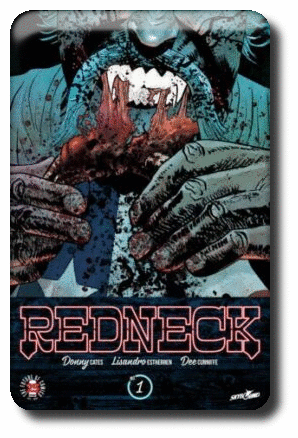
The Bowman family are vampires who have quietly run the local barbecue joint in Sulphur Springs for years, living off cow blood and trying to keep to themselves. Their peaceful coexistence ends as generations of hate and fear bubble to the surface, making it impossible to separate man from monster. Critically acclaimed writer Donny Cates (God Country) and artist Lisandro Estherren serve up the tale of a different kind of family just trying to get by, deep in the heart of Texas.
Thoughts on the Comic:
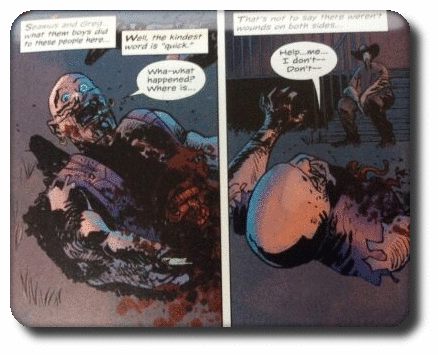
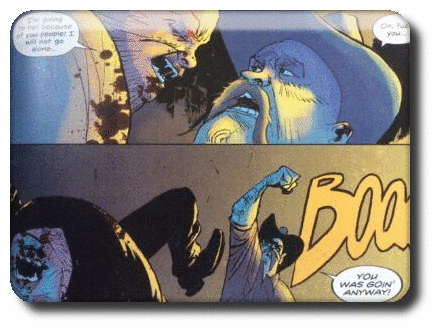
There’s a moment right near the beginning of Redneck that made me sit up and grin like the devil. Old man Bartlett – the grizzled vamp at the centre of this story – is sitting silently on his stoop, supping some Bloodweiser while his niece sits on the floor next to him, playing with her dolls. The boxed-out text acts as narration, introducing us to Bartlett’s personality, his world-view and a little of his back-story – fighting at the Alamo and through the Civil war and—and then his niece interrupts the flow to ask ‘What side?’ It’s a great segue which makes imaginative use of the medium, drawing us right into the scene. The box-outs weren’t just narration; they were Bartlett’s thoughts young Perry ‘heard’ as speech.
Reading experience: 5/5
Illustrated by Lisandro Estherren
Coloured by Dee Cunliffe
Lettered by Joe Sabino
Published by Image Comics
Reporter: Dion Winton-Polak
TODAY ON THE GINGER NUTS OF HORROR WEBSITE
IN THE HILLS, THE CITIES BY CLIVE BARKER [FEATURE]
NIGHTBLOOD BY T. CHRIS MARTINDALE [PAPERBACKS FROM HELL]
THE HEART AND SOUL OF HORROR FICTION REVIEWS
Publisher : Falstaff Books, LLC (14 Oct. 2021)
Language : English
Hardcover : 362 pages
ISBN-10 : 1645541231
ISBN-13 : 978-1645541233
Content warnings: Racism, lynching, murder, rape
A book review by Ben Langley
Following a brief prologue set in Saxon County Courthouse, in which the Dark Man is teased, we hop across the Atlantic to meet Jacob McGinnis, a successful Irish writer who has decided to buy an old plantation in South Carolina after the name ‘Briarwood’ came to him in a dream.
Next we meet Selina, a young widow forced back to Saxon County after the death of her husband, Trey in Vegas. She just so happens to be a huge fan of McGinnis, and when the opportunity to meet him when he arrives to check out the plantation is too much to resist.
The start of the novel moves at a fair pace, as pretty soon Jacob’s in Briarwood, he loves the creepy old plantation with all of its history of multiple homicides, and he puts in an offer. When he meets Selina there’s an instant attraction between the two, but that could be complicated in Saxon County. Selina’s a black woman living with her former mother-and-father-in-law after her husband, Trey, was killed in mysterious circumstances. Jacob’s an older man, and an outsider. When we meet other residents of the area at a card game, we quickly realise that outdated prejudices are very much still in fashion in Saxon County.
‘The Devil Makes Three’ is an odd novel. Often the pace drops (for me this was when the romance between Selina and Jacob was at the forefront of the story) but shortly after something utterly seismic happens on the page. About a third of the way through, I was hit by a discovery so shocking that I sat in open mouthed shock for several minutes. A number of times the novel takes these twists and turns , and sometimes I was utterly with this, but others it took me away from key elements of the story in which I’d become most invested.
When the terrible racist atrocities emerge in the novel, they are brutal and realistically depicted. It can be a little hard to read at times, but it never feels like it’s superfluous to the story or gratuitous. The horrible racist element not only raises its head when things take a turn for the worst, but they do so in a manner that suggests those responsible are used to getting away with it. Blue handles this well. There’s clear criticism of what goes on here, but it’s part of the story. While I’d been expecting something more supernatural in the story, when this thread does emerge, I wasn’t quite ready for it – I wanted more investigation into what had gone on. It’s a shame this aspect wasn’t explored further at the time. Often Blue does dwell in certain parts of the story. The letters that are discovered in the past for example, felt too long and too much of a distraction from the bulk of the story.
History, however, is a key part of what happens at Briarwood, with some ancient evil that first emerged many years ago linked strongly to the events of the present. Some of the most shocking events in the story are what happened in the past, and with every new document this is discovered we get a new twist on this until we head for the conclusion.
There is a wide array of characters in the novel as we see how the events at Briarwood affect a wider community. This expanded cast does allow Blue to explore the nature of small towns and how secrets can hold them together and pull them apart. Some of these characters (okay, a lot of these characters) are downright unpleasant, and there’s some satisfaction that comes from seeing their outcomes. There’s a hint too that redemption is possible. But it does mean some sub-plots run a little too far, some are abruptly brought to an end, and some I was left wanting more of. In one case we’re teased with the reveal of something crucial only for it to be crushed, literally, before our eyes. The ending, however, is bonkers. Whether what goes before was leading up to the chaos of the ending, I’m not quite sure.
There are lots of aspects of this novel with promise, and sometimes it comes together really well in some shocking scenes. For me, though, the romance between Jacob and Selina takes up too much space on the page, including an unnecessary jaunt to Ireland. But if you’re not totally cold-hearted and look for that kind of aspect in a supernatural tale of ancient evil there’s a lot to enjoy. The racial tension is handled well and leads to some of the most shocking moments, and if Blue’s intention was to shine a light on some of the corruption within small towns and how insidious and pervasive is, she does a fine job with that. Overall, a mixed bag… and I am aware that I sound like I’m saying “No one told me this was a kissing book” but if the book’s called ‘The Devil Makes Three’ I want a little more time with The Dark Man!
The Devil Makes Three
by Lucy Blue
A young widow who thinks there is no escape from a life she never imagined.
A plantation house with dark secrets that infect every corner of a small South Carolina town.
Will Jacob McGinnas' dream house become a nightmare for him and everyone he cares about?
In 1837, Briarwood Plantation was abandoned when Ezra Woodbine slaughtered his fianceé's entire family. Now, after nearly two centuries, life returns to Briarwood. But for how long?
Serena Decatur is a thirty-year-old Black woman trapped in a life she never asked for. Widowed, underemployed, drowning in debt, she is living with her in-laws in the small town where she grew up.
Bestselling horror author Jacob McGinnas wants to dig into the secrets of Briarwood and write a new book, perhaps the literary masterwork that will etch his name in the lists of great authors.
But as he enlists Serena's help in bringing Briarwood back to life, they uncover a gruesome history of hatred and evil in Saxon County that extends far beyond the gates of the plantation and through time all the way to the present. Serena learns horrible truths about the town, her family, and their connection to Briarwood. Jacob's writer's block is shattered and he feels a bond with Briarwood and those who lived there. But is that bond imagined, or is it something real, something much darker?
For there is a power long dormant on the grounds of Briarwood, and it seems to be stirring. When it wakes, will anything of the town survive?
TODAY ON THE GINGER NUTS OF HORROR WEBSITE
[AUTHOR INTERVIEW] E.C. HANSON TELLS US ALL ABOUT THE DEADLY THINGS
TELL ME I’M WORTHLESS BY ALISON RUMFITT [BOOK REVIEW]
THE HEART AND SOUL OF HORROR FICTION REVIEWS
Archives
May 2023
April 2023
March 2023
February 2023
January 2023
December 2022
November 2022
October 2022
September 2022
August 2022
July 2022
June 2022
May 2022
April 2022
March 2022
February 2022
January 2022
December 2021
November 2021
October 2021
September 2021
August 2021
July 2021
June 2021
May 2021
April 2021
March 2021
February 2021
January 2021
December 2020
November 2020
October 2020
September 2020
August 2020
July 2020
June 2020
May 2020
April 2020
March 2020
February 2020
January 2020
December 2019
November 2019
October 2019
September 2019
August 2019
July 2019
June 2019
May 2019
April 2019
March 2019
February 2019
January 2019
December 2018
November 2018
October 2018
September 2018
August 2018
July 2018
June 2018
May 2018
April 2018
March 2018
February 2018
January 2018
December 2017
November 2017
October 2017
September 2017
August 2017
July 2017
June 2017
May 2017
April 2017
March 2017
February 2017
January 2017
December 2016
November 2016
October 2016
September 2016
August 2016
July 2016
June 2016
May 2016
April 2016
March 2016
February 2016
January 2016
December 2015
November 2015
October 2015
September 2015
August 2015
July 2015
June 2015
May 2015
April 2015
March 2015
February 2015
January 2015
December 2014
November 2014
October 2014
September 2014
August 2014
July 2014
June 2014
May 2014
April 2014
March 2014
February 2014
January 2014
December 2013
November 2013
October 2013
September 2013
August 2013
July 2013
June 2013
May 2013
April 2013
March 2013
February 2013
December 2012


RSS Feed