• HOME
  • CONTACT / FEATURE
  • FEATURES
  • FICTION REVIEWS
  • FILM REVIEWS
  • INTERVIEWS
  • YOUNG BLOOD
  • MY LIFE IN HORROR
  • FILM GUTTER
  • ARCHIVES
    • SPLASHES OF DARKNESS
    • THE MASTERS OF HORROR
    • THE DEVL'S MUSIC
    • HORROR BOOK REVIEWS
    • Challenge Kayleigh
    • ALICE IN SUMMERLAND
    • 13 FOR HALLOWEEN
    • FILMS THAT MATTER
    • BOOKS THAT MATTER
    • THE SCARLET GOSPELS
GINGER NUTS OF HORROR
  • HOME
  • CONTACT / FEATURE
  • FEATURES
  • FICTION REVIEWS
  • FILM REVIEWS
  • INTERVIEWS
  • YOUNG BLOOD
  • MY LIFE IN HORROR
  • FILM GUTTER
  • ARCHIVES
    • SPLASHES OF DARKNESS
    • THE MASTERS OF HORROR
    • THE DEVL'S MUSIC
    • HORROR BOOK REVIEWS
    • Challenge Kayleigh
    • ALICE IN SUMMERLAND
    • 13 FOR HALLOWEEN
    • FILMS THAT MATTER
    • BOOKS THAT MATTER
    • THE SCARLET GOSPELS
GINGER NUTS OF HORROR
horror review website ginger nuts of horror website
Picture

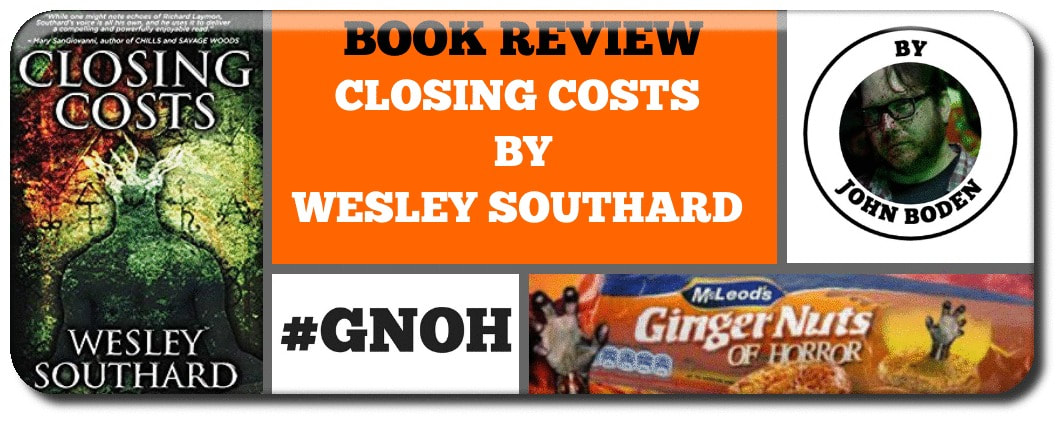
BOOK REVIEW: CLOSING COSTS BY WESLEY SOUTHARD

17/10/2018
Picture

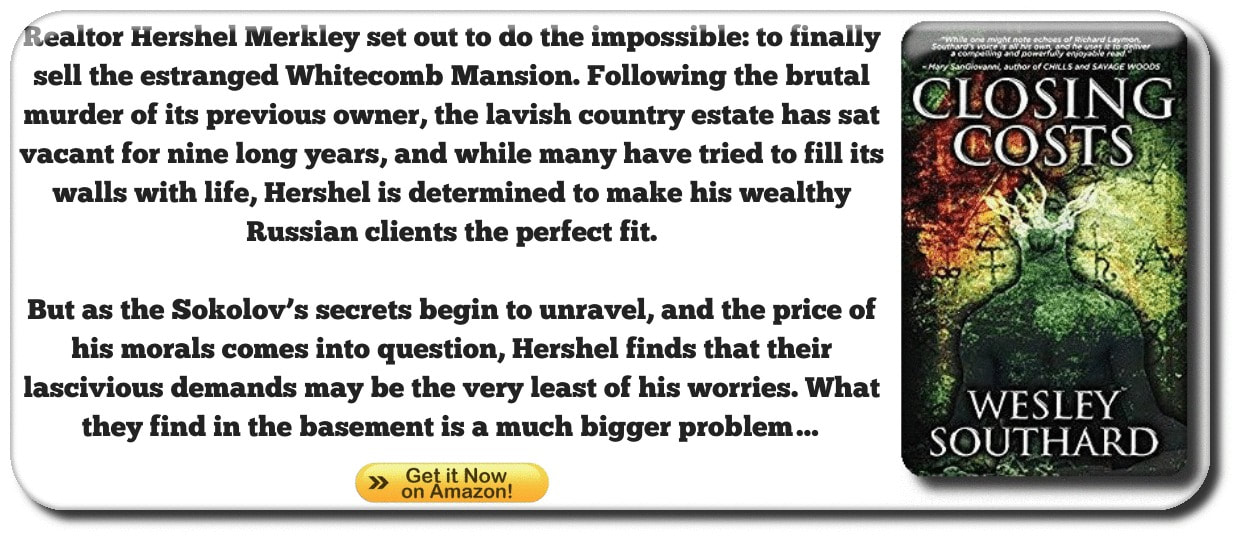
Hershel Merkley is a realtor. All he really wants to do is save enough for the long-overdue vacation he feels his wife deserves.  She still loves and puts up with him even when he can't rise to the occasion.  If he can seal the deal on the Whitecomb mansion, he'd make just enough to take her away for a while.

The Whitecomb mansion was the setting of a horrible murder and has been empty for nearly a decade, but Hershel has been working on his game and is fairly confident he'll be able to sway the clients even after he has to disclose the history of the place. The rich Russian couple who are interested don't seem the type to be bothered by that sort of thing.
The showing starts off on the right foot but quickly stumbles from the path of normalcy, as the Sokolov's begin to show a glimpse into just how offbeat they are and while Hershel is determined to stick the landing and get the sale, he is troubled by the lascivious boldness of the couple...but then things occur that make that all barely notable. Things that scream and cry and bleed and things that reek of Hell.

With this novella, Southard delivers a concise and taut thriller that flows quickly and smoothly from every day normality to blood-soaked insanity.  It plays out like a remake of Indecent Proposal as directed by the team of Clive Barker and Wrath James White.  Fans of extreme and splattery horror will lick this platter clean, I'm sure. While that is not exactly my sub-genre of favor, I did enjoy this  quite a bit. Wesley Southard is a new voice and one that I think we'll be hearing from more frequently and  I'll always be there to listen...
​
Closing Costs is available from Amazon.
Picture

the-best-website-for-horror-news-horror-reviews-horror-interviews-and-horror-promotion-orig_1_orig Picture
FEATURE- HOLY MOTHER OF HORROR! JUST WHO ARE THE NIGHT WORMS Picture
 MY LIFE IN HORROR. IF ONLY THERE IS SOMETHING WE COULD HAVE  Picture

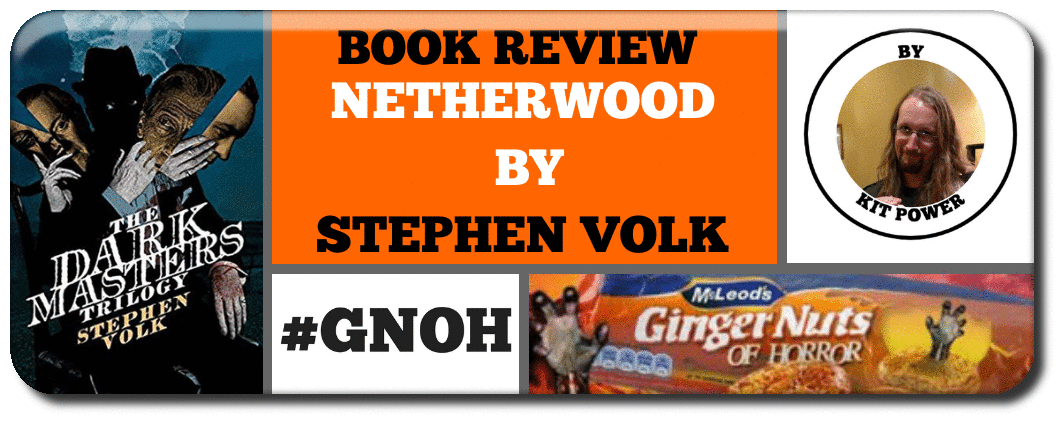
BOOK REVIEW: NETHERWOOD BY STEPHEN VOLK

16/10/2018
Picture
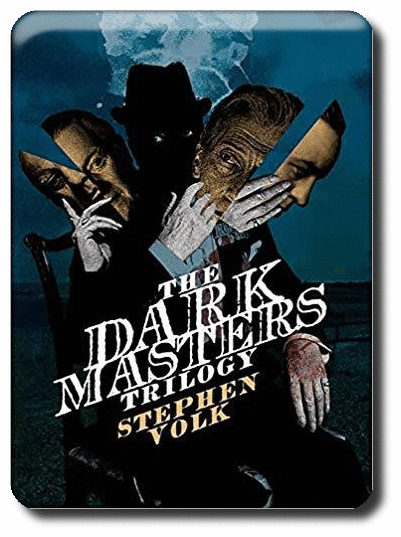
 ​Netherwood is the third book in Stephen Volk’s Dark Masters trilogy. The first two volumes were novellas - Whitstable, a story starring Peter Cushing, wrestling with the crushing grief of the recent loss of his wife, whose chance encounter with a child leads him into a confrontation with evil, and Leytonstone, which concerns the childhood of Alfred Hitchcock, an unpleasant encounter with a policeman, and a spiraling series of events. In addition to the above reviews, we’ve been fortunate enough to speak to Stephen about the writing of all three stories. You can find the interview on Whitstable here, Leytonstone here, and Netherwood here.
 
Given the quality of the first two books in this series, I’ve been keenly anticipating the final book in the trilogy. The identity of the third Dark Master was a closely guarded secret until recently, which fed both anticipation and speculation. With the arrival of Netherwood - a novel length work, in contrast to the previous volumes - we have the answer. We’re going to be spending some quality time with Aleister Crowley.
 
That’s almost the first twist in the book, though, actually. Although Crowley could be argued to be the subject of the novel, the point of view character is actually Dennis Wheatley, who as the novel opens has been summoned by a mysterious letter to meet Crowley. A life is at stake, he is told, and not that of Crowley.
 
What follows is an absolute masterpiece. A strength of the series has been an incredibly evocative sense of time and place - here, Volk outdoes himself, bringing to life 1947 England with an incredible eye for detail and atmosphere. The entire story is suffused with a feeling of griminess, suffering, near-collapse; the war may have been won, but the enormous cost, in terms of human life and economics, is still being powerfully felt throughout. That sense of fragility, of the shellshocked emerging from the dust, still blinking and unsure if it’s really over, is reflected both in the world Volk describes and the internal landscape of Wheatley’s own thoughts, as his path brings him face to face with The Great Beast.
 
For me, it’s that evocation of time and place that is the connective tissue between these otherwise discrete narratives, and Netherwood sees the most accomplished and complete execution of that evocation so far - high praise, considering how integral that approach was to the considerable success of its predecessors. Similarly, Wheatley is brought to life in a loving yet unsentimental portrait that rings with psychological authenticity, bringing this much-loved-in-his-day author into sharp relief, as he contemplates his contribution to the war effort and what the uncertain future must hold. It’s another masterstroke from Volk, as Wheatley proves to be the perfect lens through which to view this time and place, as well as a quietly riveting subject in his own right.
 
And then, of course, there is Crowley.
 
Again, deciding to make Wheatley the point of view character is a canny choice by Volk. His own opinions and perceptions of Crowley colour things just enough to keep the reader guessing as to the true motives of the magician, as well as sensibly keeping him at arms length, unknowable. The conversations and confrontations between the two men - which make up much of the meat of what follows - are as a result utterly compelling, pulling the reader through a gamut of emotions alongside Wheatley.
 
I’m being intentionally vague about the plot, here (though beware clearly flagged spoilers in the interview that accompanies this review), because I strongly feel this book is best experienced as cold as possible - I found a large amount of the joy on first read came from the discovery of the nature of Crowley's proposition, and wrestling with it as Wheatley must - but I do want to assure you that in addition to the above, this is a belting story, worthy of Wheatley’s own narrative drive and obsessions (though I must say, based on my understanding, rather better written than his work). Like many of the finest works of the genre, the narrative walks a fine line between the supernatural and the psychological. Volk's footwork in navigating this tightrope is the smooth, assured step of a master, leading us every step with hearts in mouths.
 
This novel is simply a tour de force, and the crowning achievement of a quite remarkable trilogy of tales. With it, I think Volk has given us a collection that, like the men he writes about, will stand the test of time, and bring joy (and discomfort) for generations to come.Unconditionally recommended.
 
KP
8/10/18

Picture
Picture
Whitstable 1971 
Peter Cushing, grief-stricken over the loss of his wife and soul-mate, is walking along a beach near his home. A little boy approaches him, taking him to be the famous vampire-hunter Van Helsing from the Hammer films, begs for his expert help . . .
Leytonstone 1906 
Young Alfred Hitchcock is taken by his father to visit the local police station. There he suddenly finds himself, inexplicably, locked up for a crime he knows nothing about the catalyst for a series of events that will scar, and create, the world's leading Master of Terror . . .
Netherwood 1947 
Best-selling black magic novelist Dennis Wheatley finds himself summoned mysteriously to the aid of Aleister Crowley mystic, reprobate, The Great Beast 666, and dubbed by the press The Wickedest Man in the World to help combat a force of genuine evil . . .
the-best-website-for-horror-news-horror-reviews-horror-interviews-and-horror-promotion-orig_1_orig Picture
FIVE SCARY BOOKS FOR HALLOWEEN  Picture
film-review-minutes-to-midnight_orig Picture

BOOK REVIEW: ​I Am The River BY Ted E Grau

15/10/2018

BOOK REVIEW I AN THE RIVER BY T.E. GRAU  Picture

"Take a trip into the subconscious of Ted E Grau,
but beware the hidden trapdoor into 1970s Vietnam…”

Being a fan of the short and novella length fiction of Ted E Grau I was anticipating his debut novel “I Am The River” with some interest. How would this terrific exponent of the short horror form transfer to juicy full-length feature was the million-dollar question? Be prepared for a bizarre and off-the-wall treat, which although will not be to all tastes, does not disappoint. Set during the latter stages of the Vietnam War, this uncompromisingly impossible to classify tale must surely enhance his stellar reputation and resonate beyond the horror community. It’s surreal, bleak, discomforting and the powerful ending vertebrates long after completion, in tune with the ghosts which haunt the consciousness of its main character Isreal Broussard.
 
Is “I Am The River” a horror novel? Good question, and I’m not sure what the answer is, but it’s certainly a fine addition to the modern canon of outstanding weird fiction. If you’re looking for a slash-bang-wallop type of horror novel, then look elsewhere. This story is slow, fractured, meandering, descriptive, disjointed, meditative and ultimately an odyssey towards redemption. Even though one of the two-story sequences is set during the Vietnam War it does not read particularly like a war novel and features only one truly violent sequence near its conclusion. However, it does reflect deeply upon the horrors of war and for the survivors who never truly leave it behind.
 
Even though it is not a long novel, it takes its time setting the scene, so I would recommend you read it slowly otherwise it is quite easy to get lost and lose the thread. The disorientation, which is probably deliberate, continues as the plot moves from first to third person narratives, not to mention curious stream-of-consciousnesses which also populate the plot. You’ve probably going to read a few sections more than once, but that’s no bad thing.
 
Five years after the end of the Vietnam War a washed-up, and druggie ex-soldier, Isreal Broussard lives in Bangkok, unable to leave the Far East, bar-hopping and trying to forget the past in an endless cycle of paranoia and intoxication. This guy has skeletons in his closet which are key to the development of the novel. There are elements of the supernatural, but then again, maybe the guy is just wasted? Read it and see what you think, much is deliberately obscure. Unable to leave the past behind, he is seemingly haunted by a giant dog, which may well be the spirit of something else, or perhaps it’s just too much booze? It’s all part of the disjointed and intoxicating atmosphere which permeates the entire novel.
 
The second story key strand takes up back towards the end of the war, in which Isreal is recruited by a CIA operative called Chapel to carry out an unspecified secret operation after being dumped by the regular army. He had been branded a coward after failing to shoot an enemy target. By this stage the USA realises it is losing the war and that repeated aerial bombings will not defeat the Viet-Cong, so instead are looking at weirder and off-the-wall measures to freak the locals out. Chapel is just the man to lead this operation, and his motley crew of rejects, into the jungles of neighbouring Laos, keeping the ultimate goal shrouded from the rest of the team (and the readers) until very late in the novel. And of course, eventually, to confront his demons the stories meet. And it’s totally outlandish when it does.
 
Other reviews have compared this to “Apocalypse Now” and I can see why, it is trippy in the same style as the famous film, however, what it reminded me of more than anything else was Josh Malerman’s “Black Man Wheel” and anyone who reads both books will know why. But there will be no spoilers from me. There are, however, some elements of cosmic horror, as you would expect with this author.
 
The preface has terrific reviews and praise from genre leading lights including Adam Nevill, Victor LaVelle, Paul Tremblay, John Langan and Kealan Patrick Burke. This comes as no surprise, as these authors all produce the same type of thoughtful horror that Ted Grau has created here. Isreal Broussard is a terrific central character, a broken man, who is neither portrayed as a good or bad guy, driven by guilt and the horrific places the war took him. He might not be a hero, but you’ll definitely be rooting for him.
 
I found “I Am The River” a captivating and challenging novel which demanded 110% of my concentration. I got the impression the author went out of his way to create something which would have readers scratching their heads as it is not an easy read. He succeeded and then some. Be prepared for a hypnotic journey, which effortlessly straddles genres, and will surely rank amongst the strongest, curious and most original novels of 2018.
 
Tony Jones

Picture
Picture
During the last desperate days of the Vietnam War, American soldier Israel Broussard is assigned to a secret CIA PSYOP far behind enemy lines meant to drive terror into the heart of the North Vietnamese and end an unwinnable war. When the mission goes sideways, Broussard is plunged into a nightmare that he soon finds he is unable to escape, dragging a remnant of that night in the Laotian wilderness with him no matter how far he runs.
Five years later, too damaged to return home and holed up in the slums of Bangkok, where he battles sleep, guilt, and a creeping sense of madness, Broussard discovers that he must journey back to the jungles of Laos in an attempt to set things right and reclaim what is left of his life. A fever dream with a Benzedrine chaser, I Am The River provides a daring, often surreal examination of the Vietnam War and the days after it, burrowing down past the bullets and battlefields to discover the lingering horror of warfare, the human consequences of organized violence, and the lasting effects of trauma on the psyche, and the soul.
the-best-website-for-horror-news-horror-reviews-horror-interviews-and-horror-promotion-orig_1_orig Picture
Picture

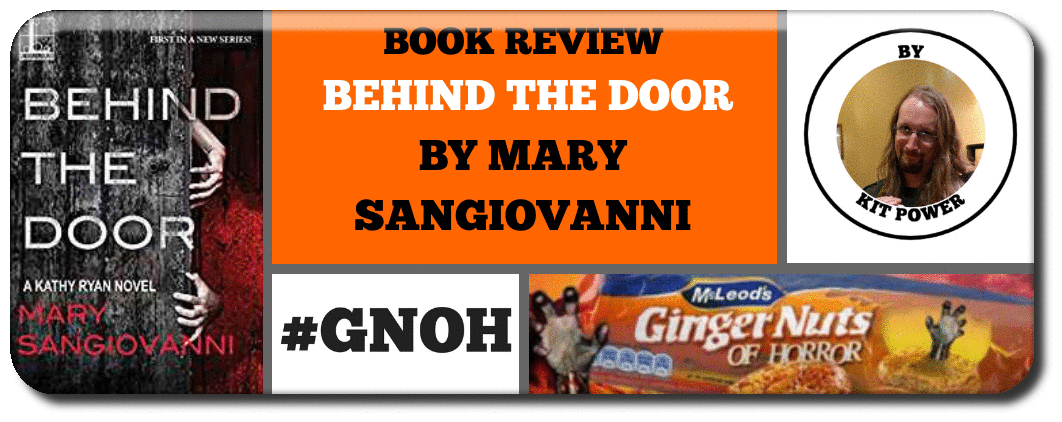
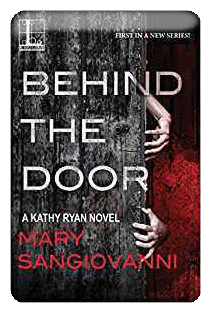
BOOK REVIEW: BEHIND THE DOOR BY MARY SANGIOVANNI

12/10/2018
Picture


Following a very favourable experience with Chills, I was thrilled to learn that Mary SanGiovanni was returning to Kathy Ryan, the police detective with special knowledge and understanding of the occult. As you may have seen from my review, Ryan was a big part of what I’d enjoyed about that novel, and I was eager to see how she’d fare in another outing - she seemed well suited for an extended series, given her interests and MO.


Kathy Ryan is a part of Behind The Door, but as with Chills, the novel is about far more than her, and indeed she doesn’t even show up in the narrative until around the one third mark. Instead, we are introduced to a cast of characters who all live in the town of Zarephath, Pennsylvania - a town with a brilliantly-conceived secret. There is a door, freestanding out in the woods near the town. And if you have something you need to change about your life, you can have it. Just write a note explaining what you want, and slide it under the door, and in three days, you’ll get it. There are rules, of course; word your wish very, very carefully, don’t ask for people back from the dead (you can -  but don’t), never ask for a second wish… and, of course, never, ever open the door.


It’s an obviously brilliant conceit, and SanGiovanni weaves a sharp portrait of small town America, it’s flawed, human inhabitants, and this warping force that keeps them and binds them. There’s shades of King’s Needful Things here, but SanGiovanni is doing something different, in some ways darker; at its core, this is a story about secrets, and guilt. Most of the users of the door want something taking away, not gaining, and the author really digs down into the concept, interrogating what it means to wish a part of yourself dead and gone… and how if feels once you manage it.


Metaphors abound - addiction, self destructive impulses, self image issues, damaging relationships - but SanGiovanni keeps it admirably grounded in the real, letting the characters go through what they go through and reporting it without judgement or pity.


There are some dark characters here, too, and I found some of the portrayals quite challenging. SanGiovanni doesn’t look away from imagining some of the worst things humans are capable of, and some of these characters will stick with me for a good while yet.


Of course, things start to go seriously wrong, and at that point Ryan is called in. Here, SanGiovanni’s familiar style from Chills is once again deployed to great effect, with the cast facing increasingly escellating peril, and some fine horror set pieces - including an escape from a garage that is incredibly cinematic and high energy. The circling of the survivors, and the final race against time, is also an incredibly tense, exciting affair, with the outcome feeling in doubt right up to the final few pages.


Overall, I thoroughly enjoyed my second SanGiovanni novel. Behind The Door contains more of the great writing that made Chills so good - brilliantly drawn characters, escalating horror, a sense of unknowable, malevolent forces gradually pushing the world further and further off kilter - but the central conceit, and the way it lays bare the pyches of the townsfolk of Zarephath, adds a whole new dimension to proceedings, and prevents this being simply a well-written retread. My only really quibble is I could have stood to see more Ryan - though she becomes pivotal to the story in the final act, she felt a bit distant from the narrative for the first half of the book.


But that’s complaining about what the book isn’t, rather than what it is, which I’m not sure is fair. This novel more than delivers on it’s outstanding premise, and will leave you with scenes of horror, and psychological questions, that are complex and memorable.


And anyway, I’m sure Kathy Ryan will be back.


KP
29/8/18
Picture
Occult specialist Kathy Ryan returns in this thrilling novel of paranormal horror from Mary SanGiovanni, the author of Chills . . .

​Some doors should never be opened . . .

In the rural town of Zarepath, deep in the woods on the border of New Jersey and Pennsylvania, stands the Door. No one knows where it came from, and no one knows where it leads. For generations, folks have come to the Door seeking solace or forgiveness. They deliver a handwritten letter asking for some emotional burden to be lifted, sealed with a mixture of wax and their own blood, and slide it beneath the Door. Three days later, their wish is answeredfor better or worse.
Kari is a single mother, grieving over the suicide of her teenage daughter. She made a terrible mistake, asking the powers beyond the Door to erase the memories of her lost child. And when she opened the Door to retrieve her letter, she unleashed every sin, secret, and spirit ever trapped on the other side.
Now, it falls to occultist Kathy Ryan to seal the door before Zarepath becomes hell on earth . . .

Picture

the-best-website-for-horror-news-horror-reviews-horror-interviews-and-horror-promotion_10_orig Picture
Picture
Picture

BOOK REVIEW: MARTIN BY JEZ WINSHIP

10/10/2018

BY KIT POWER 

Picture


So, disclosures first: Martin is the debut book in the Midnight Movie Monographs series, a limited hardback print series from Electric Dreamhouse, a PS Publishing imprint. These novella length books cost £20 each, and four titles are available right now, with more forthcoming - including, I hope, one by me, on the subject of the Ken Russell/The Who movie, Tommy.


That said, I paid for my copy, and read it for research, and would cheerfully have done so and simply said nothing if I’d had little or nothing to say, because that’s basically how I roll when it comes to reviews.


I guess I should also mention that Martin is my favourite Romero movie I’ve os far seen, and I’ve written and podcasted about it. And that there will probably be spoilers in what follows, so please go and see it, because it’s fucking amazing.


Winship’s approach to this work is deceptively simple - the book is a scene by scene discussion of the movie, a kind of commentary track in print form. Going into almost a shot-by-shot level of description, I found that the movie was almost playing out in my minds eye as I read the text. I think it’s a smart approach (*spoilers* though I’ve put my own twist on it for Tommy), but what I found really impressive was how far Winship managed to roam using this high fidelity approach. During the course of the book there are discussions of the decline of industry, and the knock on effect on small town working class life, notions of alienation and cultural identity, the immigrant experience, youth vs. age, and so much more.


One of the core themes of the movie is identity - both Martin’s family identity and his own self identification as a vampire. Winship admirably doesn’t spend much time on the ambiguity of whether or not Martin really is a vampire, instead taking a position on the matter early and proceeding to read the text with that assumption in mind. Whilst the ambiguity of Martin (on many levels) is one of the authentically genius things about the movie, I think Winship made the right call here; given the constrained wordcount, taking a position allowed for a fuller exploration of the text than having to constantly highlight the ambiguity would have done - and indeed he takes a similar approach to the film’s homoerotic subtext.


It’s a smart choice because the focus allows Winship’s obsessions with the film to really take flight - surely a big part of the point of this kind of book in the first place. By feling himself from the weight of trying to produce the definitive article on Martin, Winship instead gives himself license to revel in his own experiences as a viewer.


That’s not to say that the book isn’t meticulously written and thoroughly researched - it’s both - but rather that if feels very much like one superfan’s journey through the film - pointing out a great location or camera setup, theorizing about background, teasing out motifs and themes, and reveling in the acting performances.


As such, I found it to be a delight, and I imagine it would be a similar experience for anyone similarly enamoured of the movie. It is a very personal book - but then, Martin is a very personal movie.


KP
29/6/18
Picture
the-best-horror-book-review-website-in-the-uk-ginger-nuts_Picture
Picture
Picture

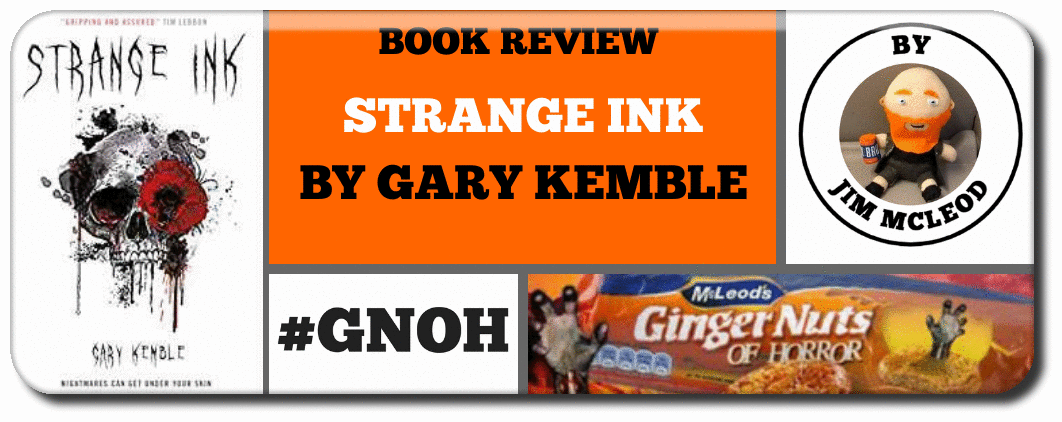
BOOK REVIEW: STRANGE INK BY GARY KEMBLE

8/10/2018
BOOK REVIEW: STRANGE INK BY GARY KEMBLE Picture
When washed-up reporter Harry Hendrick wakes up after a particularly boozed evening, and a very disturbing nightmare with a strange tattoo that he has no memory of getting he is rightly confused and a little concerned.  And who would blame him, it's happened to a lot of us.  However, this tattoo is no regular tattoo, and it turns out that it has a strange occult significance, and when even more tattoos start mysteriously appearing on his body after particularly vivid and disturbing nightmares, Harry must embark on a quest to find out why these tattoos are using him as their canvas.  

Strange Ink is a bold and ambitious novel, one part neo-noir novel, one part thriller and one part visceral ghost story that ditches the typical quiet, and suggestive tropes of the genre for a full-on blood-soaked and violent take on the haunted house/ haunted protagonist story.   Kemble deftly uses these three base genres to create a compelling story that intertwines, political corruption, at an urban level, crazed biker gangs, the horrors of war and the redemption Harry.  

Strange Ink's brilliantly brutal and nasty introduction sets the book up perfectly for what is to come.  The sense of overwhelming tension that this section has is mirrored throughout the book, in particular with regards to the sense of terror and loss of control that Harry feels whenever he suffers from a nightmare and another appearance of a new tattoo.  

Kemble's plotting and pace of the novel is spot on, Harry's investigation into the what is happening to him and how it links to a corrupt political powerhouse reads like some of the best political thrillers.  The use of explosive action sequences to break up the investigation is inspired.  The more action oriented scenes of the book are where Kemble's writing really shines, the fight scene in a local bar with the local biker gang is a highlight of the book.  Kemble's cinematic handling of the fight scene is glorious to the point where you can feel every punch and every broken glass to the face.         

This is one of those books where you could remove the supernatural element and still be left with an effective neo-noir tale.  That's not to say that they feel tacked on, Kemble weaves all the disparate elements of the novel into one cohesive story.  It may seem that the novel is losing its way with regards to delivering a satisfying and logical conclusion. However, everything comes together entirely in the finale of the book.  

Harry Hendrick may seem like a thousand other washed up reporters/detectives, and a lot of his character and personality is very familiar, but don't let that put you off, Kemble uses this well-worn character  very effectively in the realms of the narrative, and imbues him with just enough layers and quirks to keep him feeling more on the fresh side rather than just being a paper thin cypher.  If you look closely enough, you can see the nods and winks to the fictional reporters that have gone before, but a no point does it feel that you have seen him before.  

Strange Ink is a powerful novel that will leave an indelible mark on your soul much like that tattoo you got on holiday from a dirty back street tattoo parlour. 
Picture
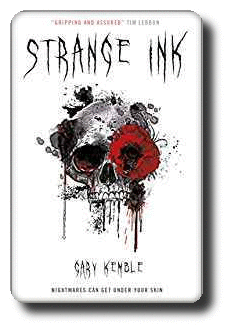
Spine-chilling horror in the vein of Joe Hill. After moving into a new house, journalist Harry Hendrick wakes up with tattoos that aren't his...When washed-up journalist Harry Hendrick wakes one morning with a hangover and a strange symbol tattooed on his neck, he shrugs it off as a bad night out. But soon more tattoos appear: grisly, violent images which come accompanied by horrific nightmares so he begins to dig deeper. Harry's search leads him to a sinister disappearance, torment from beyond the grave, and a web of corruption and violence tangled with his own past. One way or another, he has to right the wrongs.

Picture
the-best-website-for-horror-news-horror-reviews-horror-interviews-and-horror-promotion_10_orig Picture
xtro-lands-on-youtube-amazon-and-googleplay_orig Picture
Picture

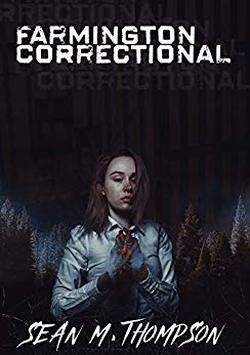
BOOK REVIEW:  FARMINGTON CORRECTIONAL BY SEAN M. THOMPSON

5/10/2018
Picture
It’s not uncommon for the incarcerated to find religion while behind bars. Isolation inspires deep reflection in some and, of course, being in an environment so predicated on ideals of sin and punishment naturally evokes fire and brimstone evangelism. Symbolically, prison is arguably the closest thing we have to the mainstream conception of hell, a place of forced penance for anyone who has been judged wicked in the eyes of those with the power to make such assessments.


What must it be like to rediscover one’s faith, then, only to look around and realize one is alone among devils?


Sean M. Thompson’s latest, Farmington Correctional, answers that question with a whisper of claustrophobic dread that quickly builds to a resounding howl of savage madness. The novella, out now from Planet X Publications, introduces us to Chuck McDougal, an inmate of the titular facility. Chuck is a hulk of a man who, despite his imposing stature, doesn’t seem like someone you’d expect to find in prison. He’s mellow and melancholic; even he doesn’t know what drove him to murder the man who tried to steal his car on that dark day that changed Chuck’s life forever.


Has it always been inside him, such brutal wrath, buried beneath a lifetime of repression? Is this capacity for violence a curse weighing down an otherwise good man, or is it a gift to be put to service for some higher power?


The only person besides Chuck who seems concerned with the answer to that question is Sarah, a social worker at the prison who is all too aware of her status as a young, attractive female separated from a couple hundred rapists, skinheads, and gang members by little more than a few metal doors and the watchful gaze of the guards. Underfunded and overcrowded, the whole place is a powder keg ready to blow. And it may have found just the spark it needs to ignite when Chuck begins hearing the voice of god in his dreams, a voice trying to prepare him for the occult conspiracy concealed behind Farmington Correctional’s altruistic mask.


Thompson’s set-up is brilliant in its simplicity, and for much of its length, Farmington Correctional deftly treads the line between the supernatural and simple delusion in much the same manner as Bill Paxton’s 2001 cult film Frailty. What’s more, the author has a knack of noir-styled description which captures both his setting’s brutality and its banality. The titular prison verges on being a character itself, a gray, callous sentinel which dehumanizes its charges as much through casual indifference as through pitiless cruelty. By splitting the narrative between two perspectives, that of the inmate Chuck and the outsider Sarah, Thompson illuminates the danger Farmington Correctional poses to those on either side of its bars, in essence revealing them both to be prisoners in their own ways and, by story’s end, ultimately turning the dynamic between them on its head.


An even better example of the setting-as-character concept, though, comes in the form of Whispering Pines, the forest which surrounds Farmington Correctional and which asserts an air of mystery and menace even while keeping far enough in the background so as to not overpower the book’s titular locale. Seeds planted throughout the narrative make it clear that Thompson has layers upon layers of mythology he’s not willing to pull back for us just yet. This tendency of Thompson’s to keep his cards close to chest makes Farmington Correctional a genuine page-turner, but it also weakens the book in a few areas.


Being a slim, six-chapter novella means that while Farmington Correctional makes for an engaging, energetic reads, coiling taut rings of suspense into one lean, mean, rocket-powered machine, it also doesn’t give readers many chances to catch their breath. Thompson’s characters are interesting and multidimensional, but granting readers such limited access to their backstories and minimal insight into their lives outside the mechanics of the plot makes it difficult for one to fully grasp the weight of the events they’re going through. In particular, Chuck’s descent into messianic zealotry feels slightly rushed, to the point where one wonders if there were more scenes detailing the character’s gradual transformation from lost soul to angel of death that wound up on the proverbial cutting room floor.


Likewise, the secrets the Whispering Pines forest holds hint at something bigger. That suggestiveness is enticing, but one can’t help wishing for just a few more solid answers (or at least hints that are a bit less vague). As it is, Farmington Correctional feels like just one part of a much larger story, one which whets the appetite for further courses, but when taken by itself may not be enough to satisfy a reader’s hunger. Individual mileage may vary.


Still, as complaints go, a book which leaves readers wanting “more, more, more” is hardly an egregious one. As long as Thompson is willing to further cultivate the seeds he’s planted with Farmington Correctional, readers will likely be more than willing to get lost once again in the shadowy overgrowth of Whispering Pines.

CLICK HERE TO READ OUR INTERVIEW WITH SEAN M. THOMPSON 

Picture
Chuck is new to Farmington Correctional, in for assaulting a man trying to steal his car. He talks with his social worker Sarah once a week, and he's started to get used to life inside. Except, he's starting to hear a voice in his head, and starting to see things. And he can't shake the sense that God wants him to kill.

There's a reason the woods surrounding the prison are called Whispering Pines. Chuck, Sarah, and the rest of the prison are about to find out why.

Picture
the-best-website-for-horror-news-horror-reviews-horror-interviews-and-horror-promotion-orig_1_orig Picture
five-scary-books-for-halloween-by-joseph-vanburen_orig Picture
Picture
Picture

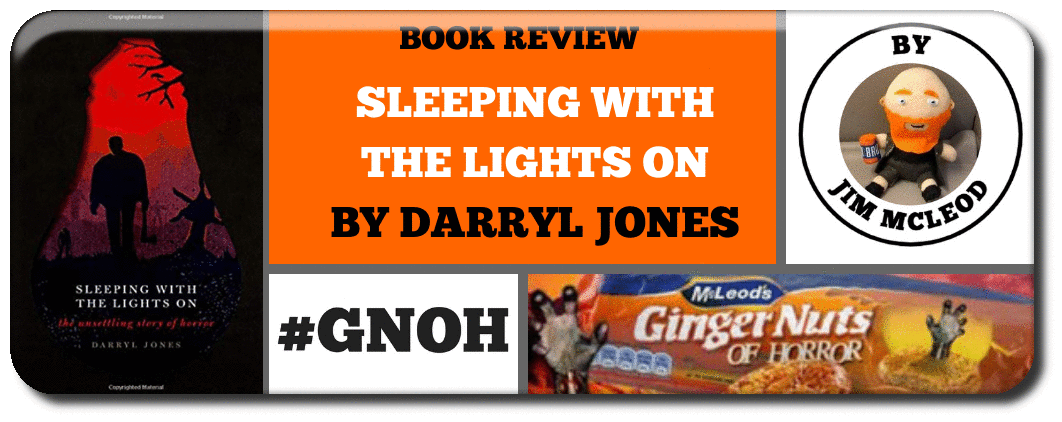
BOOK REVIEW: SLEEPING WITH THE LIGHTS ON BY DARRYL JONES

4/10/2018
BOOK REVIEW  SLEEPING WITH THE LIGHTS ON BY DARRYL JONES Picture
​Sleeping With the Lights on by Darryl Jones is one of those books that after reading the first couple of pages you end up feeling somewhat daunted by the prospect of reading the whole book, and yet you cannot stop yourself from gorging on it.  

There are a multitude of books on the market that take a scholarly approach to horror criticism and history of horror, most of the ones I have read have either been somewhat dry or lacking an in-depth analysis of the subject matter.  Sleeping With the Lights On, bucks this trend to deliver one of the most fascinating and erudite discussions on our most beloved of genres.  

Darryl Jones is an English Literature Professor and Dean of the faculty of Arts, Humanity and Social Sciences at Trinity College Dublin,  (which is just what a dyslexic semi-literate book reviewer needs when writing a review) and it shows throughout the book.  It is clear that Jones is a gifted educator with his ability to disseminate his thoughts and theories on the history of horror and its place in the socio-political landscapes of horror existence is a joy to read.  The complex notions that he puts forward can be challenging,  however, he presents them in a way that it encourages you to think on what you have read, and then deliberate, cogitate and digest, and reach your own conclusions.  Some sections required a few rereadings followed by many periods of faux intellectual chin rubbing before I fully understood some of the passages of this book, but at no point was I made to feel lacking at my comprehension of the text.  

Jone's introduction sets out to map the history of horror in our culture with a look at horror in civilisation. Starting with a list of descriptions of some of the staple shock scenes found in nearly every horror novel or films, such as an eyeball shooting out of its socket, a child returning from the dead, and a mother tearing her son to pieces. These scenes can be found in any of the so-called video nasties from the 80s, but as he rightly points out they can also be found in any bookshop.  "safely inside the respectable covers of canonical literary classics" Straight of the mark  Jones lays his cards on the table, you know that this isn't going to be a hack job on why horror is terrible, you know this is man fighting our corner.  Touching on Euripides' The Bacchae , Pasolini's Medea and Shakespeare,  Jones shows that throughout history the respectable face of literature has always contained elements which when used in the horror genre have always elicited a response of shock and outrage from the chattering classes.  

The section on Gothic, Horror and Terror, is one of the highlights of the book, here Jones gives one of the best comparisons between the three terms that have now become so overused and used in the wrong contexts that they somewhat lost their true meaning.  

"...terror poses existential questions for the nature of reality... often expressed in the supernatural... it is productive of fear." 
"horror might best be thought of as embodied, corporeal, articulated through pain... It can be productive of shock." 

His use of a glass of milk to describe the gross-out is sublime, but I'll et you read that description for yourself. 

To put it in my layman's terms horror brings us face to face with our mortality and our weaknesses brought on by being a barely held together bag of meat, that is so easily broken and subject to decay.  

There is also a fascinating discussion on how horror has always been transgressive, and it always creates its monsters by which we can hold up a mirror to the world we live in.  

 The rest of the book is broken up into sections on the specific monsters and themes from vampires, zombies, shapechangers, the Occult, the horror of science, the mind and body and finally a look at horror since the millennium.   In each chapter Jones delivers a comprehensive and detailed look at the history of these subgenres and how the each of them has changed and morphed to fit the ever-changing sense of morality and political thinking. Some of them you may already know such as the those put forward for zombies, no self-respecting horror fan doesn't know what the apparent metaphor is in Dawn of The Dead, but there is more than enough food for thought presented here to give even the most ardent fan something to chew on.  His thoughts on horror and how it has been used to discusses our fears of outsiders is enlightening to to say the least. 

Sleeping with the Lights On is a book that every fan of the genre should read, it is also a book that every fan of the genre should give to that one person they know who thinks the genre is a just shock for the sake of shock, devoid of all artistic or intellectual merit.  If this book doesn't change their mind, then nothing will.  
​

We all talk about the essential texts and films when it comes to the fiction side of the genre, but very few of us ever discuss the vital books that make up the non-fiction side of the genre with that in mind, Sleeping With The Lights on is to Horror as A Brief History of Time by Stephen Hawking was to popular science.  
Click here to read our interview with Darryl Jones 
Picture
 Ranging from vampires, ghosts, and werewolves to mad scientists, Satanists, and deranged serial killers, the cathartic release of scaring ourselves has made its appearance in everything from Shakespearean tragedies to internet memes. Exploring the key tropes of the genre, including its monsters, its psychological chills, and its love affair with the macabre, Darryl Jones discusses why horror stories disturb us, and how society responds to literary and film representations of the gruesome and taboo. Should the enjoyment of horror be regarded with suspicion? Are there different levels of the horrific, and should we distinguish between the commonly reviled carnage of contemporary torture porn and the culturally acceptable bloodbaths of ancient Greek tragedies? ​

Picture
Picture
Picture
Picture
Previous
Forward
    Picture
    Picture

    RSS Feed

    Archives

    May 2023
    April 2023
    March 2023
    February 2023
    January 2023
    December 2022
    November 2022
    October 2022
    September 2022
    August 2022
    July 2022
    June 2022
    May 2022
    April 2022
    March 2022
    February 2022
    January 2022
    December 2021
    November 2021
    October 2021
    September 2021
    August 2021
    July 2021
    June 2021
    May 2021
    April 2021
    March 2021
    February 2021
    January 2021
    December 2020
    November 2020
    October 2020
    September 2020
    August 2020
    July 2020
    June 2020
    May 2020
    April 2020
    March 2020
    February 2020
    January 2020
    December 2019
    November 2019
    October 2019
    September 2019
    August 2019
    July 2019
    June 2019
    May 2019
    April 2019
    March 2019
    February 2019
    January 2019
    December 2018
    November 2018
    October 2018
    September 2018
    August 2018
    July 2018
    June 2018
    May 2018
    April 2018
    March 2018
    February 2018
    January 2018
    December 2017
    November 2017
    October 2017
    September 2017
    August 2017
    July 2017
    June 2017
    May 2017
    April 2017
    March 2017
    February 2017
    January 2017
    December 2016
    November 2016
    October 2016
    September 2016
    August 2016
    July 2016
    June 2016
    May 2016
    April 2016
    March 2016
    February 2016
    January 2016
    December 2015
    November 2015
    October 2015
    September 2015
    August 2015
    July 2015
    June 2015
    May 2015
    April 2015
    March 2015
    February 2015
    January 2015
    December 2014
    November 2014
    October 2014
    September 2014
    August 2014
    July 2014
    June 2014
    May 2014
    April 2014
    March 2014
    February 2014
    January 2014
    December 2013
    November 2013
    October 2013
    September 2013
    August 2013
    July 2013
    June 2013
    May 2013
    April 2013
    March 2013
    February 2013
    December 2012

https://l.facebook.com/l.php?u=https%3A%2F%2Fmybook.to%2Fdarkandlonelywater%3Ffbclid%3DIwAR1f9y1sr9kcIJyMhYqcFxqB6Cli4rZgfK51zja2Jaj6t62LFlKq-KzWKM8&h=AT0xU_MRoj0eOPAHuX5qasqYqb7vOj4TCfqarfJ7LCaFMS2AhU5E4FVfbtBAIg_dd5L96daFa00eim8KbVHfZe9KXoh-Y7wUeoWNYAEyzzSQ7gY32KxxcOkQdfU2xtPirmNbE33ocPAvPSJJcKcTrQ7j-hg
Picture