

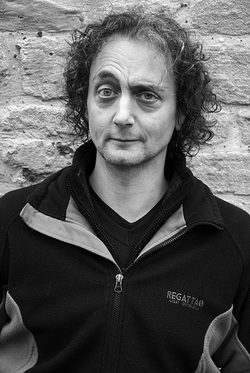
 JASPER BARK JASPER BARK Here at Gingernuts towers we were mightily impressed with Jasper Bark's recent collection of short stories and novellas entitled Stuck On You. In fact, we were so impressed, we asked him if he'd be interested in an in-depth interview discussing the book at length. Mr. Bark very kindly agreed. What follows is part one of this interview, examining the inspiration, craft, and thought processes behind the writing of these tales. Part two will follow, covering the remaining tales in the collection. Enjoy, and many thanks to Mr. Bark for agreeing to such a thorough examination... Note: Every effort has been made to make this conversation spoiler free, but a familiarity with the text will no doubt enhance your reading experience. Plus, it's a great collection. So treat yourself. GNoH: I want to mainly talk about Stuck On You, but I noted in a previous interview you did that you also wrote the novelization for Rebellions Sniper Elite game. As a gamer nerd, I have to ask how you managed to land that gig! also, what is it like writing for a pre-existing IP? What are the challenges and constraints of such an arrangement? Similarly, is there anything about it you particularly enjoyed? JB: I have to confess, and please don't hate me, but I am hopeless at computer games. Even though I've reviewed them professionally, written for them and even novelised one, as you point out. When I used to review them I would have to get friends round to play them for me, so I could take notes. I had to do the same thing with Sniper Elite, I spent a few evenings watching two hard-core programmers, who worked in the industry and were also gamers, charge through the game for me. I got the gig shortly after getting in touch with Jonathan Oliver at Abaddon. We hit it off and he was interested in a few of my ideas for novels, but didn't have a slot for them straight off, so he offered me the novelisation to tide me over. My main brief, from Jason Kingsley who owns Rebellion, was to make it like "The Professionals meets John Le Carre", which is pretty much what I did, though with a touch of The Dirty Dozen thrown into the mix. It was a learning curve for me because I had around 3 months to churn out 90,000 words and it was only the second novel I'd written. The first had been with Steve Lyons and was based on the 2000AD character Strontium Dog. Nobody hated the novel, a few people really loved it. It was part of my apprenticeship as an author. GNoH:Regarding the Stuck On You collection, I noticed that the stories were written over a period of four years, with End of the Line going back to 2010. How did it feel revisiting stories written over that length of time? Did you make any revisions or tweaks for this collection? JB: As I've been selling fiction professionally for a couple of decades, first scripts for radio and the stage, then scripts for comics, then fiction, I have to confess that four years seems like quite a short period for me. Both Joe, the editor, and I were quite definite that the stories all had to be in a similar vein, so my main concern was finding recent stories that would fit the tone and character of the collection as a whole. I think 2009/2010 marks the point at which my work, in horror at least, moved into its current trajectory, so I chose stories, written after this point, that reflected this new trajectory, and discarded those that didn't. With regards revisions, Joe is quite a diligent editor and even though many of the stories had been previously published he still went through the manuscripts tightening them up for me, which was most welcome. The only major revision I did was to the beginning of "Ill Met by Moonlight'. In the originally published version it starts post coitally, however I wanted one other story in the collection that was as erotic/pornographic as 'Stuck On You', the opener. So I added another 1,000 words of pure filth to the beginning, as it seemed like the perfect place to put it, both in terms of the story and the arrangement of tales in the collection. 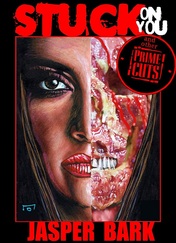 GNoH: Regarding Stuck On You the novella, one of the things that really struck me was that it was an impressive use of a US setting, in that I felt it could have been written by a US author. Did you do a lot of research for that aspect of the story? JB: A huge amount of research. Even though there's a strong element of the supernatural in what I write, I do a heck of a lot of research for everything I put out. I have to confess I've never been to either Arizona, or Nogales in Mexico. However, I did read quite comprehensively about both the regions. I also studied maps of the town and the highways. I followed the whole route they took on Google Maps satellite imagery, I studied lots of first-hand accounts of crossing the border from Mexico to the US and I even traced their journey into the Coronado Forest. I didn't want anyone who was reading it to hit on a detail that wouldn't ring true and break the spell for them. GNoH: Actually, on the topic of research, do you ever get worried as to what the NSA would make of your browsing history?!? I imagine some of the medical research for Stuck On You must have gotten interesting... JB: Hell yeah, if you saw the stuff I Google, as a matter of course, every day, because of my job, you'd consider calling the NSA yourself. Some of the stuff I stumble on can never be unseen. My third novel, Dawn Over Doomsday, a high octane, post-apocalyptic thriller, had a central character who was a militant Muslim, but was also sympathetic. I was Googling radical Islamic sites and Janes Military Defence site, a leading weaponry supplier, all at the same time. I lived in fear of setting off some online alarm and having the security services kick down the door of my study, to find me with several different editions of the Koran open at different places on my desk, alongside a copy of the Anarchist's Cookbook. I'm not sure they'd have accepted: "no, guys listen, it's all just research for a novel", as a legal defence. GNoH: Stuck On You opens with a powerful image/situation. Was it this central concept that came to you first, or did the rest of the plot arrive at the same time (or first)? JB: It was one of those images that grows like a canker in your imagination. I came across the urban myth, that I mention in the story, on line. It wasn't presented as an urban myth but a genuine occurrence. It's even included on the Darwin Awards site, however I've since come to the conclusion it's not actually true. Whatever its fictional status, it wouldn't leave me alone, the image haunted my imagination and realised I was going to have to write it out of my system. I didn't do much with the idea until I was invited to submit to an anthology of erotic horror stories, for which I thought the story would be perfect. This started me thinking about the situation in some depth and the ending came to me pretty much in a flash. If I recall I was walking through the graveyard of a local church at the time, on the way to pick my youngest daughter up from her ballet lesson. So yes, the central concept came first, but it wasn't really something I felt completely impelled to write until the ending hit me. GNoH: One of the things that impressed the hell out of me with Stuck On You is the way that there's not an ounce of fat on the backstory - by which I mean it seems like every element of the tale has relevance beyond just adding colour, and it all feeds into the final payoff. How much of that was either planned or reverse engineered once you had a draft, and how much of it came organically? JB: I would say that the majority of it came organically. I often plan a story out quite heavily in advance, with scene breakdowns and everything. However some stories get a bit impatient with you and demand that you just sit down and write them straight off. Stuck On You was one of those. I didn't have any plan when I began it, I just knew what the central conceit was and how it was going to end. I decided to start right in the middle of the action, so that required the flashbacks to explain how poor Ricardo got into his terrifying little predicament. The flashbacks also serve to lighten the mood and give the reader a little relief before plunging back into the horror. The story grew much larger than the 5,000 words I'd originally planned on, coming in at close to 12,000. At this point I realised it needed another home. I did redraft it quite a bit, mainly just tweaking the language and cutting away the unnecessary verbiage. However I may have tweaked some of the back story at this point, though I couldn't say what, as it would only have been minor changes. GNoH: How often do you find that happening that a story either exceeds your expected word-count or undershoots? Has that kind of thing ever caused problems for you? JB: Weirdly at the moment it is happening ALL the time. The story I'm working on was supposed to be a 10,000 word chapbook and now looks like it's going to 36,000 words long. The last four or five things I've written all ended up at least twice the original length I'd intended, which is a bit of a bugger because they were all commissions. This has meant I've ended up having to find an original work to replace the one that has grown too large and then find a new market for the expanded work. Luckily I currently have more offers of work than I can actually fulfil, so there is usually always somewhere else to place the stories that have outgrown their original word counts. At times I feel a little like one of those B movie scientists who accidentally create a giant rampaging creature out of the most innocuous and tiny things, like a chicken heart, or a tiny amoeba that just won’t stop growing. I suppose this is fitting though, given the genre that we work in. GNoH: Moving on to Taking The Piss, again, there's a really striking central image to this piece, only here it's revealed at the end rather than the beginning. Did that image come first, or did the idea germinate where the story opens? JB: This was definitely one of those stories that grew backwards from the punchline. I got the image from a random blog I chanced upon. The guy writing the blog had been called in to fix a urinal which was backed up in some bar. What he discovered, when he began to investigate, was that someone had built something behind the urinal that was very similar to the punchline of 'Taking the Piss', only he had built it purely for his personal pleasure. They actually caught the person in the act, and when they did he ran out of the place screaming "I've done nothing wrong, I've done nothing wrong! I wasn't hurting anyone!" When they explored the space he'd left, they found he'd rigged himself up a little place to lie down and get comfy and everything. This story, and the photos they took, haunted me for a while and I realised the only way to purge myself of the mental images was to build them into a story (bit of a pattern forming here isn’t there). GNoH: The entire narrative is told through flashback - what are the challenges of working in that format, and why did you pick that approach for this story? JB: The challenges mostly involve making sure you reveal the right information, at the right time, for the story to have the proper impact. I suppose I chose that format so that I could begin the story in the most intriguing and effective way, cutting straight to the part of the narrative that makes you think: 'what the hell is going on here? What is this guy doing and why?' When I had established that, I could track back along the story's time line to fill in all the blanks and slowly reveal the full extent of what he's done and why he did it. It also mirrors the way most people tell stories in a conversational manner. They don't necessarily start at the very beginning and build a coherent narrative, they tell you the part of the story they're most invested in, at that moment, and then, to make sure you understand what they're talking about, they fill in the rest of the details for you as they go along. GNoH: The voice of the narrator of this story is incredibly strong - it's a character study as well as a narrative, though the two are interwoven. Do you have a process for 'getting inside the head' of a character like this, or is it something that comes naturally? JB: I spent 17 years living in South East London rubbing shoulders with many of these violent, criminal types, plus most male members of my family have either done time or been in the forces, usually both. So I know this type of man fairly well. I understand his moral codes, his personal failings and the things that bolster his self-esteem. I know what drives and motivates him and the limits to which he can be pushed before he becomes very dangerous. So when I sat down to write the voice came almost immediately. As a writer I think your fascination with language also extends to a fascination with how other people use it to express themselves and what those choices reveal about their psychology and cultural background. So I'm always listening to that, with everyone to whom I speak, constantly taking mental notes that I will later use when I write. GNoH: Going back to the central image, it occurs to me now that the 'punchline' for the story is told through implication rather than explicit description - I can picture it very clearly, but my mind is doing almost all the work there. Was that a conscious choice you made in the writing? JB: Yes. The reader's imagination is both a tool and a weapon that any good writer can use against them, or at least on their behalf. You know what scares you most about any given situation, much more than I do. If I give you just enough of a prompt you will take yourself there and scare yourself much more than I will. In this story most of the work is done subliminally, through the use of repeated imagery and incidental detail that slowly builds to reveal a full picture as you reach the very final lines. The impact of the ending is that much greater because you as a reader put together all the little things that your mind has flagged up as pertinent, and when you do it hits all in one moment and that only increases the horror of the final image. It's also too late to back out, to put the story down and to block out that image, because you're on the last few words when it hits you and you can't un-read what you've just read. It's a matter of timing, just like comedy. You create interest, build tension to just the right peak and then release that tension at just the right moment. GNoH: With The Castigation Crunch, there’s a real shift in tone. Accepting what you just said about the similarities in comedy and horror, what differences do you take in approach when going more for laughs, and do you think comedy is harder to write than ‘straight’ horror? The approach with humour is the same as horror for me. When I write horror I'm trying to find things that really scare and unsettle me. When I write humour I'm trying to find things that amuse or make me laugh. Comedy is a skill and a technique that you develop both as a writer and a performer. The more you do it, the more you study how it works, and how other people get laughs, the better you become at it. Once you become adept at being funny, writing comedy isn't necessarily hard. I think the same could probably be said of writing something scary, although when you think of the number of things you read or watch that make you laugh, compared to the number of things that have actually scared you, then the scale probably tips very much in favour of humour. So it's probably harder to write something genuinely scary than to write something funny. GNoH: It’s fairly clear this story was inspired by world events – do you find that often happens, or is this story unusual in that regard? I do have something of a social conscience and a sense of outrage at the way those in positions of responsibility are exercising their power at the moment. I've outgrown any particular political philosophy or stance, but I do see a real need for a fundamental change in our society and the way we behave towards one another. I would like to write a lot more about this, but translating my outrage into readable, entertaining fiction that is as provocative and thought provoking as it is readable is not always easy. You run the risk of becoming either preachy or polemic. So world events do have an impact on my fiction but not always as overtly as this piece of very pointed satire. GNoH: Though primarily a comedic piece, there’s a real anger at work underneath the surface of this story – something that actually runs throughout the collection. To what degree does writing serve as a form of exorcism for you? The role of the satirist is not always to exorcise their personal demons, or to take themselves too seriously. If anything you're taking the piss out of your own anger and demons as much as you are attacking your subject matter. To accomplish any kind of social change you don't want your work to exorcise either your anger or your readers' anger, this leads to catharsis and your work can become a palliative rather than an agent of change. If people get rid of the anger they feel around an issue they may not push to change things. So it's more of a way of channelling my anger in the most positive way possible rather than exorcising it. GNoH: Ill Met By Moonlight is a really interesting collision of high literature and erotica – especially with the expanded opening in this collection. To what degree do you engage with or worry about genre when you’re formulating ideas/drafting stories? I think we'd all like to say that genre doesn't matter to us, that all we really want to do is tell a good story. But frankly if you're at all well read, and if you pay any attention to where genre is going, then that's utter bullshit. We're all highly aware of what genre we're writing in, you can't help but be if you decide to be a genre writer. There were quite a few stories which were left out of this collection because they didn't quite fit the tone and the mood, and because they weren't specific to this genre. So I am aware of genre whenever I'm formulating an idea or when I'm writing it. What I do try to avoid is letting the limitations of any one genre affect me. I wouldn't curtail a story because it was straying outside of one genre into the territory of another, nor would I avoid using a particular trope simply because it's associated with another genre. 'Literature' is as much a genre with it's own tropes and traditions as crime or horror are. So I have no problem mixing it up with erotica and doing something horrific with it. GNoH: I particularly enjoyed the nature of the end reveal of this tale, which again is rooted in classicism. Any concern that some people wouldn’t ‘get it’? And what brought this particular ‘classic’ to mind for a story? Until recently, no one seemed to notice when I was being clever and peppering my work with all sorts of allusions, let alone 'get' what I was doing. My initial reaction to that was to try to point out when I was being clever, within the story, but this only detracted from the quality of my writing and made me look like a dick. So I actually gave up caring if people 'got' what I was doing. If you don't get a story I wrote then that's a shame, I'm sorry to hear that, hopefully you'll like something else that I've done. Strangely as soon as I took this attitude and just wrote something into a story because I liked it, then people started spotting all this stuff I'd thought they'd never see. So that seems to have been fortuitous for me. The story started with me writing about one of my biggest fears and that is losing my life partner, the mother of my children and my best friend - Veronica, my wife. That led to me thinking about using a figure from Jewish mythology as a metaphor for the way that many of my female friends approach a relationship. They often see the relationship as a challenge and their partner as something that, with a bit of fixing up, will actually be worth something. This led me to do some serious research into Hebrew and Jewish mysticism where I hit on the dichotomy of the word Met and Emet which mean death and life. The word Met made me think about the phrase 'Ill met by moonlight proud Oberon' from 'A Midsummer's Night Dream' by Shakespeare. I toured the UK and Germany with a production of this back when I was a young actor, playing Lysander, one of the lovers, so I know most of the play off by heart. Once I'd thrown in one quote I'm afraid I couldn't keep out others. End of part 1. Join us soon for Part 2, where we will discuss the remaining stories in the collection, as well as look forward to what 2015 has in store for Jasper Bark. 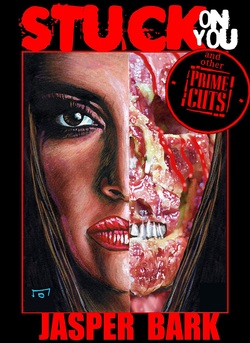 STUCK ON YOU STUCK ON YOU A word of caution gentle reader, these tales will take you places you’ve never been before and may never dare revisit. They’ll whisper truths so twisted you can only face them in the darkest hours of the night. They’ll unlock desires so decadent you’ll never wash their taint from your flesh. All it takes is a single turn of the page and your taste in dark fiction will be transformed forever. So you have to ask yourself: ‘How daring do I feel...?’ Includes: Foreword by Pat Cadigan Stuck On You Taking the Piss The Castigation Crunch ‘Ill Met by Moonlight’ How the Dark Bleeds Mouthful Haunting the Past End of the Line Dead Scalp Afterword by John Llewellyn Probert Acknowledgements 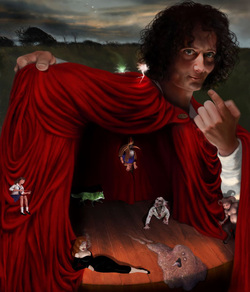 I'm a novelist, children's author and script writer specialising in comics and graphic novels.
I've written four novels: A Fistful of Strontium (Black Flame 2005 with Steve Lyons), Sniper Elite: Spear of Destiny (Abaddon 2006), Dawn Over Doomsday(Abaddon 2008) and Way of the Barefoot Zombie(Abaddon 2009). My all-ages book Inventions, Leonardo Da Vinci has been translated into five different languages and myBattle Cries series of graphic novels are used in schools throughout the UK to improve literacy for 12 to 16 year old readers. I've written comics for just about every publisher in the British comics industry, from 2000ADto The Beano, and an increasing number of American and international publishers. Prior to this I worked as a film journalist and cable TV presenter by day and a stand up poet and playwright by night. In 1993 I released an anthology of poetry and a spoken word album both called Bark Bites. In 1999 I was awarded a Fringe First at the Edinburgh International Festival. 29/1/2015 04:59:50
brilliant, in depth interview and look at this collection. I first heard Taking the Piss two Halloweens ago when Jasper was a guest at a Halloween reading and I bloody loved it. And Stuck on You. What can I say? What a bloody punchline 3/2/2015 03:57:40
Got me a copy of Stuck On You sitting on my desk right now. Looking forward to it. Comments are closed.
|


Archives
May 2023
|

 RSS Feed

|

|