

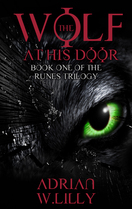
 Wolf at his Door Wolf at his Door Adrian W. Lilly is the author of the novels The Devil You Know, Red Haze, and The Runes Trilogy: The Wolf at His Door, The Wolf in His Arms, and The Wolf at War. His short fiction and poetry have been published in Hello Horror, 69 Flavors of Paranoia, Nervehouse and The Weekly among other publications. He can be found online at www.adrianlilly.com. He is a fan of Gothic suspense movies and novels, which greatly influence his writing. Adrian's writing focuses on strong character development and the nuances of fear that build toward horror. The mansion in his first novel, The Devil You Know, was inspired by the grand mansions in the Victorian neighborhood where he lives. Adrian writes novels, short stories, and poetry and has spent many years as a copywriter in the advertising industry. In addition, Adrian has directed two short films and co-directed a feature-length sci-fi comedy. You can read an exclusive excerpt from his book here Hello Adrian, how are things with you? And in particular how is the blog tour going? Well! I’ve had the pleasure of working with wonderful bloggers like you. It’s hard out there for an independent author, and those like you make it worthwhile. It’s also great to get a chance to meet readers. So, if anyone has any questions they post, I’ll try to be around to answer them. Let’s get the getting to know you questions out of the way first? Go! What is your favourite book, album and film? My favourite book changes every time I read a brilliant new book. While England Sleeps by David Leavitt is always in the top five, however. My favourite album is Bowery Songs by Joan Baez followed closely by Mississauga Goddam by The Hidden Cameras. I still rate Jaws as my favourite film of all time, though The Howling is right up there. I’m a sucker for Somewhere in Time, no matter how sappy it is. What’s the one thing you can’t live without? Daily walks. I use them to get a bit of exercise and clear my head. I find hiking and walking very meditative. As we speak, I’m about to take off on a cross-country hiking and camping trip. Describe yourself in three words. Polite. Determined. Sincere. What is the one thing that annoys you about the genre? I think that it has been pigeonholed, as if horror cannot be meaningful. In many ways, it’s treated like all horror is akin to slasher films, and I disagree. I think horror, traditionally, and still today, is a means to explore the dark side of human nature and our struggle against it. What would be your last meal? Have you ever seen the tiered display tray of desserts at a restaurant? That’s my last meal. Did The Boys From Brazil Live up to expectations? Yes. I enjoyed it. I like challenging the line between nature/nurture and our understanding of psychology. In exploring what creates a sociopath—and realizing it’s much more than just genetics—it showed how crucial society is in that formation . That’s what I liked most. In a previous interview you said “They say the human brain can’t create new faces, that all faces we imagine are faces we’ve seen. I think characters are similar, they’re pieces of people we’ve met. “ Who would say are the faces and characters that pop up in the most in your own work? Did I say that? Wow, that’s not bad. But seriously, I would be lying—or not very self-reflexive at least—if I didn’t say myself. I say that because even when I base a character on someone, I’m basing the character on my perception of that person. That said, I’ve based the look for a character on complete strangers, just because I thought they had an “interesting” look. I also do a lot of what I call “clumping.” An example is I may know a group of people who are friends, and I clump them together, taking traits from each of them to create the personality of one character, and then merge different traits from the same group to form another character. A few years ago you went through a personal tragedy and used writing as a means of therapy. How did writing help you get through this? Was it just a case of something to take you away from it all, or did it have a more profound effect on you? In some ways, writing saved me. I think it helped me process my feelings, and certainly offered escape. The thing I didn’t expect was how, as more time passed, writing became more difficult. I actually suffered from writer’s block for the first time in my life. I think after grief, depression settled in, and then writing came harder. But I just soldiered through it. I faced a blank page, and forced a few sentences, and then forced a few more until I had enough to edit. It was the only thing I could do. You like to use your writing as a means to look upon the human condition, do you ever get the feeling that we as a species are just terminally ill, or is there hope for us? If I’m going to wax philosophical, I’d say what we suffer from is a social disease. I don’t think that humans are inherently corrupt; I think we’ve allowed ourselves to drift from consciousness. We no longer understand where our food comes from or what our bests interests are. In the U.S., in particular, literacy and numeracy scores among millennials show us falling behind. That’s not about anything genetic. That’s something we need to fix as a society. We need to put more emphasis on education, not disinvest. And I mean a broad education. Not just business and engineering, but the ability to think creatively and solve problems in a novel way. You also put a lot of work into characterisation, what makes for a good character? Does the reader have to empathise with a character for the character to be good? When I create a character, I try to do a few things. I imagine his or her background and how that might affect how he or she talks, thinks, acts. I try to give my characters consistent dialogue and actions. I think a reader should be able to guess how a character might react to a situation based on previous experience with the character. As far as empathy—I would say yes. I think that if I am trying to create a complex character, then the reader needs to have some empathy—some level of understanding—for what that character faces, even if the reader disagrees with the character’s choices. What would you say are the three most fundamental rules that a writer should adhere to when creating characters? 1) Know more about your character than you tell in the story. 2) People aren’t perfect and characters shouldn’t be either. Decide what flaws fit your character and use them to your advantage. 3) Don’t create a character based on a bias or stereotype. If you can’t write a complex, honest character that is unlike you, then don’t write that character. Which brings us to your latest series The Runes Trilogy. Am I right in thinking that a previous name for the first book in the series was The Bifurcated Womb. What made you change the title of the book? I felt that the Bifurcated Womb was a bit esoteric and misleading. The Wolf at His Door is a bit more spot-on title wise. I’m sure we are not giving the game away by saying the book concerns werewolves. Why did you choose werewolves over other monsters to write about? I have long been fascinated with werewolves. I used to get folklore books out of the library when I was a kid and just read all of the werewolf tales. For this series, werewolves were ideal because I am exploring the dark side of human nature, and our battle against it. Since I think life is all grey areas, I complicate who is good, and how much control characters have as well. Werewolves, to me, represent that split in our personalities between brutal and humane. I play with that notion a bit, though, as some characters are transformed to bloodlust even as humans. It becomes about battling a dark force, and what sacrifices are worth making to stop it. Do you have a favourite literary or film incarnation of the werewolf? To this day, I still love The Howling. Does the book deal with themes brought up with metamorphosis, transformation and living a hidden life? I think the first two books deal with that the most. Once the stories get rolling, it becomes more about stopping a nefarious plot. The first two books, however, spend a decent amount of time with characters who are losing their battle with their darker nature. It becomes a study of how different characters choose to fight. What can the readers expect from the book? They can expect a convoluted plot, vivid characterization, some brutality, a mystery, and complex human emotions. I use suspense more than blood and guts, though the novel includes a fair amount of gore. And who would you say the book is aimed at? Anyone open-minded who likes a werewolf thrill ride. The first book has two, intertwined plots that are both mysteries, so those who enjoy a solid mystery will enjoy it as well. It is not for those seeking erotica or hard core romance. Horror novels in themselves are often hard to market, do you think that by adding a romance theme to the book has made it easier or more difficult to market? I actually think I made it harder for a couple of reasons, and it’s because of how I handled it, I’d say. So many romance readers want (using their term here) an HEA (Happily Ever After.) I’m not an HEA kind of guy. I write horror. People must die. Many of them. Additionally, the romance is just a part of the story, and it had to feel fluid, er, natural to me. The romance exists without a whole lot of gratuitous sex, which is what certain readers are looking for. This is not erotica. It’s horror and it’s a family drama and it’s a mystery, and then there’s a bit of romance. That said, some authors seem to have a great time writing werewolves who are bare-chested He-men who run around dominating everyone else referring to him or her as a beta. I have nothing against that; it’s just not my interpretation of werewolves. You mention a scene where a werewolf rips into a crowded street, and that the carnage and emotional fallout from this was a favourite part of the book for you. Do you think it is important that a writer balances and grounds the violence in a book with an emotional response? Or can carnage exists for the sake of carnage? The scene is in book two, The Wolf in His Arms. I tend to balance the emotional response with carnage, because the true human drama lies there. Tons of blood and guts might make someone want to hurl, but an emotional punch in the guts will leave him aching for days. If a writer is trying to make a comment on the nature of violence and our relationship and response to that, then I think gratuitous bloodshed and carnage can work to that end. The Wolf at the Dooris the first part in a trilogy, does book one finish like all good trilogies do with a massive hangover? I think the first book leaves a reader wanting more but feeling that they have read a complete novel, and not only part of a serialized novel. So, yes, there’s the sense that there’s more to come, but not a cliff-hanger, per se. Have you planned out what will happen in the next two volumes? Book three is actually about to come out. But, I was not that rigid as I wrote the series. I mapped out the trajectory for the series. I knew that book one would take me so far, book two so far, and book three would tie things up. But other than that, I mapped out the entire book only after the one before it was finished, to allow myself the “a-ha!” moments that can happen while writing. With a plot as complex as the one in this series, I had a number of items I knew had to happen for everything to make sense, so those elements were the most confining. And if you have, how rigid are your plot points? I had the entire “mystery” laid out. How the characters solved the mystery and how they reach the predetermined outcome was up for grabs. For instance, in book two I added a twist I hadn’t planned, just because it felt right as I was writing a scene. How has the critical response been for the book? “The Wolf at His Door features a complex and twisting plot that never loses steam (Boys, Bears and Scares). “Adrian Lilly isn't afraid to take a chance or sacrifice a major character if it’s what the story demands. The imagery is fiercely detailed and creates a clear picture of what’s on the page.” (3 Chicks After Dark ) The Wolf at His Door “oozes brilliance” and “builds to an absolutely epic ending.” (the Gay UK) “...if you want something that's dark and dangerous with bloodshed and horror then this story is a must.” (MM Good Book Reviews) So what’s next for you in terms of writing? I’m working on the first book in a new series called The BlackBird Mysteries. The main characters in the series will battle many creatures from folklore and mythology. The mystery part is solving what the creature is, since they all can take human form, and can only be stopped through the means described in mythology and folklore. Thanks Adrian for taking the time to stop by, do you have any final words for the readers? I love connecting. Feel free to visit my site at www.adrianlilly.com, look me up on Facebook or follow me on Twitter: @AdrianLilly1 Find out more about Adrian by following the links below My website: www.adrianlilly.com Facebook: facebook.com/adrianwlilly Google Plus: https://plus.google.com/u/0/+AdrianLilly Twitter: @AdrianLilly1 Goodreads: https://www.goodreads.com/author/show/6545875.Adrian_Lilly Adrian is currently on a blog tour to support his new book. Please check out these other great sites . As he takes a virtual tour around the cyber world of horror Tuesday, March 17 http://horrorworld.org Thursday, March 19. http://gingernutsofhorror.com Other stops this month: Monday, March 23 http://beauty-in-ruins.blogspot.com/ Wednesday March 25 http://www.blog.boysonthebrink.com/ Tuesday, March 26 HorrorReview Tuesday, March 31 http://www.prismbookalliance.com
Comments are closed.
|


Archives
May 2023
|
 RSS Feed

|

|