

AN INTERVIEW WITH STEPHEN VOLK
16/6/2015
 STEPHEN VOLK STEPHEN VOLK In Part 1 of a new in-depth interview, accomplished screenwriter and author Stephen Volk talks to Gingernuts Of Horror about the art and craft of novella writing. We begin by discussing his stunning novella ‘Whitstable’. Spoilers are flagged where possible, but to be honest, we'd firmly recommend picking up this marvellous book for a read in any case. GNOH: Thanks for agreeing to chat with us, Stephen. I'd like to start by asking about the origins of ‘Whistable’ – can you remember when the idea for this novella first began to formulate in your mind? SV: The idea for it came with an image, to be honest. I woke one morning and said to my wife I’d had a picture in my head (I wouldn’t say a dream, exactly) of Peter Cushing walking along the beach in Whitstable and sitting down looking out to sea, and a little boy comes up to him, mistaking him for the famous movie vampire hunter Van Helsing, and the lad asks for his help to vanquish a vampire who happens to be his step-father. My wife immediately said: “But he isn’t a vampire, though.” And I thought: “You know what? He isn’t. That’s much more interesting!” So, before I’d put my socks on that morning, the vampirism was immediately in my mind a metaphor for child abuse. And that gave the story (yet to be written) a whole deeper level – that of horror in reality and a child turning to a character from fiction to defeat this real-life monster. So horror, which is often seen as a base and sadistic thing by society, is in this story the saviour, the hero if you will. And that is what I feel about the genre – that it’s a benevolent thing through which we can explore unpleasant and fearful subjects. That it saves our souls, in fact. As all fiction does. 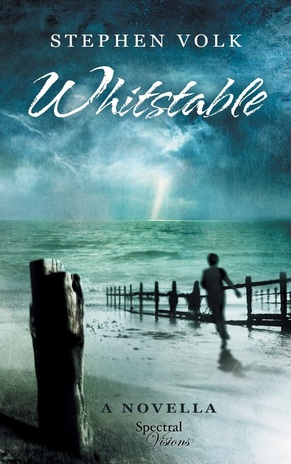 Click to purchase a copy GNOH: Is it common for you to have ideas arrive like that? SV: Not at all! I can only think of this happening once or twice – when the whole “idea” arrives in one go and it is ready to get writing. Mostly it is an accumulation of notions and half-formed thoughts that go on scraps of paper or get stuffed in folders, or the mythical “Ideas File” which most writers have – and they stay there for months, years even. It’s an erroneous notion to believe that story ideas arrive fully formed. My experience is that they don’t – they’re often at least two separate elements that conjoin and becomes the “idea” – mostly an external idea in the world chimes with a memory or a detail in one’s life. I’ve had a subject in mind for a long time, for instance, but no conception how to write it: then I remembered a character from my student days and the way to tell it became suddenly clear. It often happens like that, which is why I save ideas for years, sometimes ten, twenty years, because nothing is wasted and that vital spark is unexpected but might be round the corner. GNOH: The notion that vampirism (which in its usual form is often a fictional substitute for abusive sexuality, especially in the Hammer movies) serves that function ‘for real’ in ‘Whistable’ is really fascinating. When you’re drafting a story like this, how conscious are you of thematic ideas like that, and to what degree are they emergent from the narrative? Or do they inform it? SV: I think I’m aware of the theme, because whether or not I can articulate it, the underlying theme is really what makes the story exciting to me. Not the subtext exactly (which I think of as a dialogue, Pinteresque thing) but the substance under the surface – what the thing is “about” beyond the building blocks of story. Paul Schrader, the master screenwriter, is a great believer that you haven’t got a screenplay unless you have your theme and your metaphor for that theme. For example he says in ‘Taxi Driver’ the theme is loneliness and the metaphor for that theme is the taxi driver. I think that’s an incredibly valuable lesson in thinking about storytelling: what is my theme? What is the metaphor for the theme?... And if you can express that simply you know what your subject is and you can address it in various ways, using nuance, symbolism, opposites, etc. In a sense, ‘Whitstable’ is about loss, but it’s about love. Cushing has lost the love of his life, while the boy is being victimised by a corrupt idea of love – the opposite. The nice thing about that is that vampirism is about love in disguise too. Corrupt love. Knowing the theme helps you work out what the ending needs to be, what the arc of the character is, that kind of thing. Of course you don’t always know at the outset. It can take several drafts. For over twenty years I’ve been writing and rewriting a script called ‘Telepathy’ about two Russian brothers who have ESP, and they are polar opposites and don’t get on, and the story is the arc of their relationship. And one day I was writing a phone call scene and I realised, because it was a phone call: “This is all about communication!” The ESP is communication but the irony it is about the brothers’ lack of communication. Which sounds very clever but it took me ten years to get to that point! But yes, theme is all-important to me, absolutely vital. I’m thinking about it all the time because otherwise what is your story about? It’s sprawling and you are fumbling for meaning. Or not “meaning” – purpose. GNOH: Can you talk a bit about the process by which this story ended up with Spectral Press? SV: I’d actually approached another publisher before Spectral. They liked it very much, but they couldn’t bring it out in 2013, which was important to me, being the centenary of Cushing’s birth. I’d noticed Simon Marshall Jones’s Spectral Press coming to fruition and coming out with very handsome novellas. So I sent him the manuscript in November 2011. He immediately said yes, with the idea of a 2013 publication date intact. The rest, as they say, is history. We got the best possible cover artist in Ben Baldwin, and a wonderful “Afterword” written by my good mate, the fantastic genre novelist Mark Morris, who is a huge fan of Peter Cushing and Hammer Films too. So it became a kind of perfect storm as far as I’m concerned. 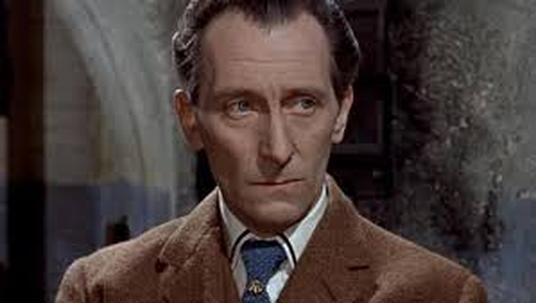 GNOH: ‘Whitstable’ is as much the portrait of a town (and indeed a time) as it is a portrait of a man. What and how did you research to try and put yourself into that time and place? SV: I knew from the outset that the setting was Whitstable. It had to be. And I liked the idea that the name of the town was the title, too. I like the simplicity of that – a label that just says “this story happened in this place” with no inflection of what the subject matter means: you will just have to find out. (I liked the titles ‘Chinatown’ or ‘Philadelphia’ for that reason.) But in terms of research, yes, first of all, the notion of being able to write Peter Cushing effectively might be thought of as extremely daunting. Naturally I read about him as thoroughly as I could – until I was brimming with detail and my preparatory document was bulging with notes and nuances, but I don’t know why, I was never put off by the thought I mightn’t pull it off. First of all, I had in my head a fairly good barometer of how Peter Cushing might behave and think and speak, from both his films and from interviews, and of course his volumes of biography in which his world view and gentlemanly attitudes, though sadly dated, come across very clearly. I’d loved his films all my life, so mainly it was a question of channelling that, and that was one of the appeals of writing it. On the other hand, I knew this wasn’t a documentary, far from it - this was fiction, so I had to feel free (within reason) to treat him as a fictional character. The bottom line is that he is only *my* Peter Cushing in this novella, not *the* Peter Cushing. That would be impossible to achieve. If you look, for instance, at the two recent films about Alfred Hitchcock (Hitchcock and The Girl) starring Anthony Hopkins and Toby Jones respectively, both are excellent and to some extent accurate, but they’re very different portraits of the same man. Researching Whitstable the place was quite easy. The town is near where my daughter lives in Kent and I’d been there a few times, and specifically visited Peter Cushing’s house and talked to the museum and made some other contacts to make sure I had early readers who’d check the manuscript for any gaffes. Similarly I sent it to Hammer experts such as Jonathan Rigby and Wayne Kinsey who were quick to point out errors. (We had great debates about at what point PC wore a hairpiece and when exactly he became a vegetarian!) As for the 1971 setting, I can remember that time quite well, so it wasn’t like I needed a time machine! Generally you don’t want to over-laden your prose with facts gleaned from research – that can be awful – but you have to learn as much as you need so that it comes across as genuine and believable. That’s crucial. For instance, the terminology about oysters was crucial and I got that from a former fisherman. At its best research spills out all these new, exciting ideas along the way, which I enjoy. 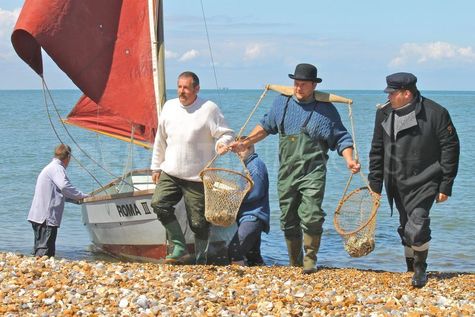 GNOH: One of the central themes of this piece is grief; mourning. How hard is it for you to 'go there' emotionally when writing this kind of work, and how do you approach such emotionally challenging material? SV: Well, starting at the end of your statement, I don’t see the point of writing something that isn’t challenging, that doesn’t push you a bit as a reader or as a writer. If you want to touch the reader and move them emotionally you have to expose yourself. There’s no faking that. So you have to be prepared to dig into your own experience of life: I don’t see how else you can do it. Of course as a starting point I had the material about Peter’s loss of his wife in his memoirs, but also, significantly, it’s about using your own imagination to get into the head of someone in such a pit of loss they want to lock themselves away from the world. To the extent that it is literally painful for him to be in company any more. And sometimes you have to explore your deepest and darkest feelings to get there, but the whole point is it has to be true. And that’s all you know – not what it is to be Peter Cushing, but what it is to be *you*. That is the business of being a writer, in my opinion. Our tool is our skill, but our raw material is our life. The weird thing is, in ‘Whitstable’, even though I am now the same age as Cushing is in the novella, there is probably part of me that is still the terrified little boy whose escape is the world of horror films. Not that I was abused, literally, but I’m equally both of them, in my mind. The other thing, of course, is how do you write the character of the paedophile? Well, you either do or you don’t. Many writers I know would not even want to attempt it. But I think it’s an important subject and the only way I can write it is to firstly avoid the stereotypes (no pebble glasses, no loner who lives with his mother, no “combe-over” as in The Lovely Bones) – and beyond that, try to have some empathy or pity, in that the best monsters evoke pity, and every person comes from somewhere, every behaviour (however abhorrent) has a reason, and nobody believes (even Hitler) that they themselves are a villain. The important thing in terms of any “challenging” theme, though, is that you mustn’t self-censor. You have to be honest, but that doesn’t mean you have to be needlessly explicit. Often the most tender or minimal description can be disturbing for that very reason, and what is left unsaid can be more powerful to the reader because they have to fill in what is implied. But you go to the dark to get to the light. And in the end I think the most uplifting part of this story is when Peter can resume his life as an actor, at the end of the story. So, in fact, the boy comes to Van Helsing to save him from a vampire, but really the boy saves the old man from a kind of life-in-death. Not that Peter escapes it entirely into a sunny future – the loss of Helen will always be there – but he can survive because he understands love: not just the love of his wife but the wider love that fans have for his work. And that was very important to me, though I didn’t realise it during the writing of it. It emerged in talking about it afterwards. Peculiar, that. But I think it was always there as the undercurrent of why I wanted to tell the story set at that time in his life. GNOH: It strikes me as you say that that many of the qualities you describe as being a writers job, concerning drawing out from within and exploring one’s internal emotional landscape, have pretty direct parallels with acting, especially the ‘method’ school. Do you think that’s a fair analogy? Is part of being a writer being an actor, even if only internally? SV: Gosh , I don’t know. When I’m on a film set I always think “I could not do that job for all the tea in china!” And the idea of going on from the wings to be in a stage play is my idea of hell! But in terms of “knowing the character from the inside”, yes. There is always the inevitable moment where an actor says “My character wouldn’t do that!” And you want to say “Yes but he isn’t your character, he is my character!” But by then the actor is in charge and you have to make it work for them, and that’s a whole other kettle of fish. But back to your point. Method writing? All good writing is “method writing” in a way. Is it? Maybe not if you are interested in linguistic high jinks. There are all kinds of writers who are not keen on delving deep inside or revealing themselves, aren’t there? But I think in a genre that is often based on the impossible it’s important to be as plausible as possible, and quite honestly I’m not clever enough to make stuff up on an emotional level and get away with it – so I reckon if I steal stuff from my life or use stuff about human beings that I feel is true or authentic, I might just get away with someone believing my story. To that extent it is just technique rather than “method”. GNOH: I found the dramatic climax to the story to be utterly gripping, and pretty audacious, actually. Again, can you recall when or how it occurred to you to use that setting for the big confrontation? I’m assuming the movie was also carefully selected for juxtaposition... or was that dictated by the time period? SV: Let me see. I think it went like this. I wanted a showdown between Cushing and Gledhill. Where was it going to be? I thought it has to be a cinema. And what’s showing in the cinema in 1971? Oh dear! Would it be too “cute” for it to be one of Cushing’s films? Too much of a coincidence? I wasn’t sure. Then I thought: “Go for it!” So I researched a bit and found out what would be likely to be playing and it was ‘The Vampire Lovers’… with the additional factor that when Peter filmed it, he was suffering from the reality of Helen’s deepening ill-health. So he sees himself twenty feet tall looking haggard and putting a brave face on things – and that must have been immensely shocking on top of everything else going on. So, OK, I thought I might be onto something here. So I re-watched ‘The Vampire Lovers’ (no great burden) and jotted down a description of each scene. I’d already written my dialogue scene between Cushing and Gledhill by then. And what I found by literally cutting and pasting – cutting up one scene and laying out the pieces on the floor, then arranging the scenes from ‘The Vampire Lovers’ – was that I had a delicious cross-cutting between what they were talking about and the symbolic scenes in the film up on the screen. So I went for it and hoped the reader would forgive the coincidence, and it’s proved to be one of the most talked-about scenes in the book, I’m glad to say. Looking back it seems inevitable as a climax, but when I was working on it, it sort of emerged rather than being a given. GNOH: The scene manages to also be incredibly tense, at least in part because of the internal fragility of Peter Cushing. Did you ever get tempted to go ahistorical at any point? How do you generate tension when people in some sense ‘know the ending’ - or at least, have a good grasp of the historical parameters you’re working within? SV: I think the “historical accuracy” is part of the game, really, and what makes it interesting to write. For instance, the easy thing would have been for Peter in his Van Helsing role to stake Gledhill through the heart, or to kill him in some way, to vanquish the evil. But I couldn’t do that. It would have been wrong to say, even in fictional terms, Peter Cushing murdered somebody. It just didn’t feel right tonally and it would have been too easy and nasty. And once you say that to yourself you have to devise a resolution that does feel right. So that was the conversation in the cinema ending in a way that (spoiler) sparks Gledhill’s suicide – and by a method that symbolically refers to a vampire’s death in the Hammer films. That was better and it didn’t violate the memory of Peter as a real person. Not in my mind anyway. I think it’s like Tony Harrison when he was once asked if having to make lines rhyme was a restriction in poetry writing, and he said no, the fact it has to rhyme makes you think of ideas you otherwise wouldn’t. And I think the same about having a historical, real character the facts of whose life are known – you have to make things fit and you can’t break the rules of the task you’ve set for yourself. Equally, while you know Peter won’t die himself when he is threatened and he won’t be accused of those horrid things, it’s incumbent on me to make them feel plausible and tense in the context of the story. Tension is not always about anticipating the ending, it is about how we will get there. Join us soon for part 2, where we discuss Stephen’s Shirley Jackson nominated novella Newspaper Heart, KIT POWERComments are closed.
|


Archives
May 2023
|
 RSS Feed

|

|