

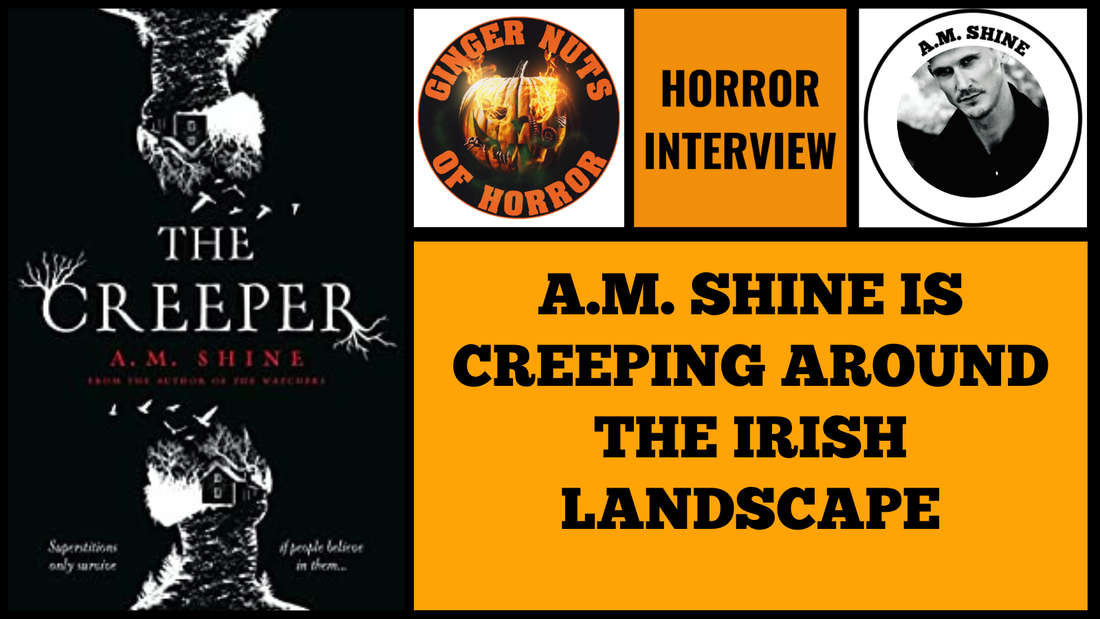
 The Creeper is about to be unleashed; how are you feeling in the lead-up to its release? The excitement is real now. And the nerves, of course. But I’m glad to say that the early reviews coming in have been a great encouragement. Any positive feedback works wonders for the old happiness pre-launch, especially as we’re dealing with the tricky second album here. And Head of Zeus have also organized a blog tour for this book which I’m very privileged to have you opening on the 26th of September. I can’t wait to read what some of my favourite reviewers think of it and then share around all the creepiness. The Creeper is a very different book from The Watchers in many ways, so there’s always the worry that readers will go into it expecting more of the same. But I want every novel to be something unique. And I think this book is just that. Whatever people are expecting, there are definitely more than a few surprises in there. Like your previous novel, The Watchers, The Creeper is firmly based on both the Irish landscape and Irish mythology; what is the draw of writing using these themes? Our landscape and mythology feel tailormade for the genre, and I think the main draw is the sheer amount of potential they give me to play around with. Ireland, as a location, has so much character and history, and there’s a very sombre beauty to it in the autumn and winter that could basically work as a scene from any horror story. It doesn’t require much imagination to make it spooky, which certainly makes my job easier. And our mythology is a subject that I’ve always had an interest in, and as a horror writer I’m lucky that it leans so gracefully into the genre. It’s actually quite concerning when you think about it – so much of Irish folklore is basically horror. Cold dark nights and even darker imaginations, or maybe the whole island is genuinely haunted and infested with mythical creatures. One can only hope. I am trying hard to think of many modern horror authors that use the myths and legends of the Celtic lands as inspiration for their books; why do you think this is? Is it possible that I’ve carved out a private little niche for myself in the market? Maybe they’re unfamiliar with the material or are of the opinion that it doesn’t have a place in the contemporary horror scene. Some of the more popular stories (I’m looking at you, Banshee) are so well known that before the reader even opens the first page, they’ll have a fair idea of what to expect. And this would spell disaster for any horror novel as it diffuses the suspense and mystery. And what’s life worth without suspense and mystery? That’s why there has to be an element of reinvention to keep these stories fresh. If the myths are treated more as an inspiration, then I think they’d become more mainstream. Authors could handpick the ideas that appeal to them and use these as a springboard to create something original that suits their own style. That’s what I do. And it’s fun. I’d highly recommend it. How do you feel about non-Celtic authors using our myths and legends as inspiration? I think it’d be wonderful if more authors explored its possibilities. It could offer some interesting perspectives that we haven’t seen before. The stories are so readily available too. Gone are the days when they’d have to swing by a local library to source out the good stuff. But, in saying that, a few trending Google searches probably won’t cut it. There’d be quite a bit of research involved before they could put pen to paper if it’s to be kept authentic. What is the biggest mistake that they make? I suppose when it comes to borrowing a particular myth or legend, there’s the risk that the author might isolate the idea from its origin and landscape, and in doing so lose a lot of what makes it so unique. It’s important to appreciate how these myths have survived and evolved over the centuries through the lives and history that shaped them. This is especially true of folktales and superstitions which can change between counties and splinter into many different iterations. They aren’t simply old stories that we only encounter when we root out the history books. Instead, they’re one of the most unique parts of our identity. They’re also how I make my living. So they’re ridiculously important. It is hard to talk about The Creeper directly as there are too many excellent twists and turns and some massive reveals, but let's give it a go. It's a book of two halves in terms of style and tone. Was this always the plan when you sat down to write the novel? Absolutely. I wanted to break convention when it came to my protagonist. Usually, the reader experiences the immediacy of the horror through their voice, but Ben is a diehard sceptic who disbelieves what’s happening, even when the events become more and more challenging to explain. I wanted the creeper to slowly chip away at him. What starts off as an adventure and the possible beginnings of something great, steadily darkens as the novel progresses. There’s only so long that Ben can refute the creeper’s existence. And the story does get quite dark by its conclusion. But, come on, this is what happens when you break a superstition’s rules. What did he expect? The Creeper, wow, where do we start? What was the inspiration for this creature, and where did you develop the creature design? I'm picturing a childhood trauma with the Kinda Egg man. The Creeper was originally a short tale I wrote a decade earlier that I’d always kept in the back of my mind. But I never thought that it would someday become a fully-fledged novel. I was lying in bed one night, imagining how terrifying it’d be if someone was just standing at the window, smiling at me. Surely I’m not the only person who’s had this thought? Or at least, hopefully now others will have it too after reading this book. I played with the idea by bringing in the classic superstitious tropes that Irish folklore does so well. By giving the horror simple rules, such as the three sightings, then it echoes all those scary stories that we dismiss as just a bit of fun. Not that I can imagine anyone calling the creeper character fun. But then, maybe the poor thing has just been misunderstood. I can’t really say too much about its design for fear of spoilers. But I can say that the sight of it will be forever burned into my mind. That’s a curse I brought upon myself. I loved the undercurrent of religious themes within the novel, of a society trapped in time by their own religious beliefs. Did you ever consider expanding on this theme? I would have loved to delve a little deeper into the village of Tír Mallacht. But it was more important to respect the mystery surrounding it for the sake of the narrative. I’m such an advocate for keeping the reader guessing. But it’s definitely something that I could explore in a short story as a complement to the novel. Ben, like yourself, is a history major, were you ever tempted to live out any heroic Indiana Jones fantasies through his character? History is far less exciting than Indiana Jones would have us believe. Unless you get a thrill out of taking tombstone etchings on Clare Island in the middle of winter. Or measuring the various dimensions of a ruined church with the wind whipping the briers into your face. University has many means of making you earn that scroll. Ben’s circumstances at the beginning of the novel actually mirrored my own some years ago. I worked a lot of jobs I didn’t particularly enjoy just so I could write every night and at the weekends, hoping to someday be in a position to do this full-time. I even did quite a bit of work on the oral tradition too – interviewing and collecting folklore. And like him, I’d have probably taken Doctor Sparling up on his offer too. The novel cleverly and masterfully mixes Gothic Horror with full-on body horror. In particular, I loved the thread that involved Dr Sparling locking himself away in his mansion. Is it correct that it had a touch of the Masque of the Red Death? I adored writing the Sparling chapters. The slow, steady melancholy that defines his days are the most Gothic aspects of the novel. And yes, there’s definitely a touch of the Red Death in there; cloistered away, hiding in fear. I had so much fun writing in his voice, trying to elicit from the reader the right balance of pity and contempt. And I hold Poe in such high esteem. I learned a lot of my tricks from that man, and any comparison to his work is very much appreciated. Superstitions live by word of mouth. I'll never forget the night I watched my mother dig a hole in the garden during a massive thunderstorm to bury a broken mirror so she could walk around it seven times to break the curse. Are there any superstitions that you still adhere to? Our mothers have a lot to answer for. Thank to mine I spend my days constantly saluting magpies. The old “one for sorrow, two for joy, three for a girl and four for a boy”. I don’t have any offspring so it’s obviously working. And given how easy salt is to spill, I throw more over my left shoulder than I actually use. I didn’t realise there was a way to lift the broken mirror curse. Thanks for that! If ever you see me pacing around a freshly dug pit you’ll know what happened. Oh, and if anyone starts telling you about the creeper, cover your ears. That’s an important one. The Creeper |


 |  |
THE HEART OF HORROR REVIEW WEBSITES
Comments are closed.


 RSS Feed
Archives
May 2023
April 2023
March 2023
February 2023
January 2023
December 2022
November 2022
October 2022
September 2022
August 2022
July 2022
June 2022
May 2022
April 2022
March 2022
February 2022
January 2022
December 2021
November 2021
October 2021
September 2021
August 2021
July 2021
June 2021
May 2021
April 2021
March 2021
February 2021
January 2021
December 2020
November 2020
October 2020
September 2020
August 2020
July 2020
June 2020
May 2020
April 2020
March 2020
February 2020
January 2020
December 2019
November 2019
October 2019
September 2019
August 2019
July 2019
June 2019
May 2019
April 2019
March 2019
February 2019
January 2019
December 2018
November 2018
October 2018
September 2018
August 2018
July 2018
June 2018
May 2018
April 2018
March 2018
February 2018
January 2018
December 2017
November 2017
October 2017
September 2017
June 2017
April 2017
March 2017
February 2017
January 2017
December 2016
November 2016
October 2016
September 2016
August 2016
June 2016
May 2016
April 2016
March 2016
February 2016
January 2016
December 2015
November 2015
September 2015
August 2015
July 2015
June 2015
May 2015
April 2015
March 2015
February 2015
January 2015
December 2014
November 2014
October 2014
September 2014
August 2014
July 2014
June 2014
May 2014
April 2014
March 2014
February 2014
January 2014
December 2013
November 2013
October 2013
September 2013
August 2013
July 2013
June 2013
May 2013
April 2013
March 2013
June 2012

|

|