

AN INTERVIEW WITH ALISON LITTLEWOOD
14/12/2015
 ALISON LITTLEWOOD ALISON LITTLEWOOD One of the great things about the horror community is that we all kind of know each other, and every now then and then you realise that you haven't actually sat down and interviewed on of the authors that you really admire, despite chatting at conventions, social media etc. With that it mind it was a great pleasure to finally sit down and have a chat with the wonderful Alison Littlewood. Alison Littlewood was raised in Penistone, South Yorkshire, and went on to attend the University of Northumbria at Newcastle (now Northumbria University). Originally she planned to study graphic design, but "missed the words too much" and switched to a joint English and History degree. She followed a career in marketing before developing her love of writing fiction. She now lives near Wakefield, West Yorkshire, with her partner Fergus. A Cold Season, from Jo Fletcher Books, is Alison's first novel. It was inspired by her winter commute to snowy Saddleworth. Alison's short stories have appeared in numerous magazines and anthologies, including Black Static, Crimewave and Not One Of Us, as well as the British Fantasy Society's Dark Horizons. Other stories have appeared in the charity anthology Never Again as well as Read by Dawn Volume 3, Festive Fear II and Midnight Lullabies. Her life writing has appeared in The Guardian. Hello Alison, how are things with you? They’re good thanks Jim! I just handed in a novel, so I’m in that weird in-betweeny state of being happy with it but not quite knowing what to do next, which will no doubt take care of itself when the edits land. I’ve been working on some short stories though, which I haven’t been able to do for a while, and I’m really enjoying getting into them again. It was great meeting you at Fcon this year, what was your lasting impression of this years convention. Great to meet you too! I loved it this year actually, I thought it was one of the best yet. I usually go away thinking ‘I wish I’d seen so-and-so,’ but this time I seemed to manage to catch up with loads of people and saw friends old and new, which is really the best thing about it all. I also moderated a panel for the first time, which went pretty well after the first wave of panic. Good times!  FANTASY CON 2015 - PAUL WOODWARD, PHIL SLOMAN, STEPHEN BACON, MARK WEST ME, FRONT ROW - GAVIN WILLIAMS AND JAMES EVERINGTON As a fellow nominee in the BFS awards, how did you feel about getting nominated, and how did you feel about not winning the award. (I took it a lot better than I thought, I was expecting tears from myself) It’s always really nice to be on the list, especially since there have been some cracking novels out this year. I would really like to win for one of my novels some time, obviously, but I won the Shirley Jackson Award for Short Fiction this year so I was really happy about that. Anyway, I just waited outside for that Adam Nevill bloke, kicked him in the shins and ran off screaming, ‘It’s MINE!’ You really need to sort that out next time, Jim! You switched from a graphic design degree to an English and History one, as “you missed the words”. Has reading and writing always been an important part of your life? Can you remember the one book that first ignited your love of the written word? Yes, it always has. My mother loves books and instilled the same thing in me – I remember our weekly trips to the library as being like a big adventure. One of the earliest books I still have is a copy of Hans Christian Andersen’s fairy tales, which I loved as a child. It has gorgeous illustrations by Michael Foreman and an inscription in the front from my mum. I particularly remember The Little Mermaid – it always seemed inexpressibly sad that she sacrificed everything for love, but the prince never loved her back. I used to weep buckets over it and I adored it at the same time. Many of us dream about being a writer, but lack the confidence to make the jump, were there any events or incidents that gave you the confidence to do it? I know what you mean, as I lacked the confidence for years. Reading Stephen King’s On Writing was a turning point for me. I remember buying a notebook and copying some quotes into the front of it – something about ‘you might be beaten, but you must not beat yourself’. And then I proceeded to continue not to write, but I was at least thinking about it, and soon after that I saw an ad for a local creative writing class and I joined up. So that’s where I started. Some people think this is a silly question, but why do you write? I don’t think it’s a silly question, but I do think it’s hard to answer. I never had any logical reasoning behind it. I just had an innate love of books and of stories, of the magic of words, and I guess a secret dream of trying it for myself, albeit one I didn’t even articulate for years.  CLICK TO PURCHASE CLICK TO PURCHASE Your first novel, A Cold Season was picked up by Jo Fletcher books. How did this come about? Well, once again I seem to have managed to get there despite a complete lack of confidence. I’d written several novels before then – the only way I could tackle it was to tell myself ‘this is not actually a novel, it’s just a really long learning exercise.’ A Cold Season was the first one I thought might be worth submitting, so I tried some of the small presses, who wouldn’t even read it. That was the most soul-destroying thing, I think – not getting rejected, but not even getting read. But then I saw Roy Gray of TTA Press at an event, and he asked what I was doing, and the next day he emailed Jo Fletcher and asked if she’d look at my book. I’d never have dared sub to her straight off, but the rest, as they say, is history. It was also picked up by the Richard and Judy Book club, that must have been a very surreal moment. Was it actually featured on their morning TV show? It was completely surreal, and still feels as if it happened to someone else! Fantastic though. I couldn’t have asked for a better start. They didn’t do the Book Club on TV by then, but they have a massive online following and it was all done in conjunction with WH Smiths. So instead of having to battle for shelf space my book was on display stands right by the door and in the shop windows, and in loads of adverts and posters. I have some pictures of me standing next to a poster in a train station and wearing a massive grin. It seems a very odd choice for them, when you look at the swathe of kitchen sink drama and romantic novels that they promote, do you know why they decide to zero in your book? Well Jo Fletcher Books took a punt on something a bit different and submitted it to them, which was a brave move on their part. And I guess the Book Club liked the idea of something a bit different too. The first selection rounds were done by WH Smith and fortunately their readers liked the book. They do mix it up now and then, with a fair few crime novels in the mix, though mine was probably the most out-and-out horror they’d done. Some of the Book Club readership didn’t like it much – the word ‘unpleasant’ got used a fair bit! But I’m grateful to them for taking the chance. Judy did say she loves a good horror novel – she reads Stephen King – and they make the final selection themselves, so maybe her taste had something to do with it! A Cold Season, shares a common landscape with much of your other work, what is it about the Yorkshire Moors and surrounding area that appeals to you? I wrote the book when I was commuting from the Yorkshire side of the moors over the Pennines into Saddleworth, and it wasn’t until it occurred to me to use it as a setting that the book really clicked into place. I’d just had some of the worst winter journeys over the tops in years, and it was beautiful and atmospheric in the snow but there was a sense of danger behind it too, which all found its way into the novel. The worry about making it to the other side definitely influenced the plot. The moors are always atmospheric though. I’ve been up there in thick fogs and you can’t help wondering what’s lying behind it. I’ve roamed around the world in my short stories, but until recently I’d felt it better to set novels closer to home simply because it’s easier to go and stand in a place and breathe it in and check on any details. So that’s why I’ve stuck to Yorkshire – that, and it’s easier to do characters with accents when it’s familiar! The setting of your novels is very strong and landscape at times almost feels like a character in itself, how important is it you that you give your books a sense of time and place? Is this something you look for when reading other authors work? It’s really important, and yes, I do love it when other writers transport me to a specific place. It’s perhaps especially so in horror, where atmosphere counts for so much and being immersed in a setting helps with believability too. I loved Dan Simmons’ The Terror and Song of Kali because the places are so vividly evoked. In part, though, it’s because it was something I did so badly when I started off. I’d write short stories set nowhere in particular, and then read other people’s that were so redolent of a locale it made me realise I needed to try harder! I love those little details that make a setting unique and give you a little start as a reader. They really help draw you in. One of the themes is in the book is the after effect of making a sort of Faustian pact, if you were given the opportunity of making such a pact, what would you make a deal for? God, I wouldn’t mess, not me. I’m not religious but – well, I had a phase, let’s say, when I was younger, but I still wouldn’t mess! In part, that’s what got me started on the idea for A Cold Season. What on earth would make people swap something eternal for something temporary? It really gave birth to the whole premise. On the other hand, it disturbed me no end when I got the first advance cheque for my book deal and it contained the figures ‘666’. How much research did you do for the book? Were you ever tempted to use the most famous of your local witches, The Pendle Witches? I have been tempted to use them, but they seem to have been used an awful lot, so I decided against it. I did a lot of research but not that much of it found its way into the book in the end. I was using a place I was familiar with and Foxdene Mill was based on somewhere I’d lived, so it was more a case of stitching things I knew into the plot. On the other hand my latest book is set in the past and uses a lot of folklore, so there was mountains of research to do for that one. I’ve always tended to do what I need in order to follow the idea, but I really got immersed in it this time. The incident of the bone circle was based on you finding a circle of bones in the woods one day, even though the rational part of your brain must have realized that it was just the remains of something like a fox kill, but the writer part of you must have been going into overtime. Are their any other instances where things like this have worked their way into your fiction? And were you even the slightest bit spooked by it? Yes, I tend to use odd little details. Even if I end up creating a made-up village in a book, it will be an amalgam of places I’ve visited. The Unquiet House was the oddest one. That was a book where I had a general idea of how I wanted it to work but not the nitty gritty of what would actually happen. We were house-hunting at the time and I just kept putting in little things I’d seen – the odd cupboard with nothing but an old suit hanging in it, and the church bench with its ‘My God, my God, why hast thou forsaken me?’ inscription. And somehow those things became important to the plot, and everything just came together. It did feel spooky, but I guess if you give your subconscious something to gnaw on it comes up with the goods. When creating the protagonists for your books, I get the sense that they aren’t always fully formed when you start to tell their story, and that they develop and grow along with the narrative of the story, which, to me, makes them feel more natural than a lot of other protagonists. How far do you go in terms of setting the characters down and the story’s structure before your start writing, and have you ever taken your characters down an unexpected path. Yes you’re right. I don’t do character profiles or anything like that before I start. I used to worry that I should, but I like finding out about them as I go and having them develop along with the story. With the plot itself it varies, but I’m not a great planner. I tend to have a pretty definite idea of the beginning and the end, but I have to work out everything in between as I go. It does mean I hit a wall and the middle can be really hard to write, but I seem to need that uncertainty. I think I’ve worked out now that unless a novel feels like it’s going to be impossible at the outset, I’m not doing it right! And yes, I have taken characters down an unexpected path, although it feels like the other way around sometimes. I can guarantee that when a reader says something in my book surprised them, it’s because it surprised me too. It’s like writing without any kind of safety net – I just don’t know where I’m headed sometimes – but that’s also where magic happens.  CLICK TO PURCHASE CLICK TO PURCHASE And talking of paths, your second novel Path of Needles is a dark crime / fairytale inspired story. Have you always had a fascination with fairytales? I have, always, and my fascination only increases the more I find out about them. Path of Needles was very much about the history of the tales too, the fact that there are older, darker versions of the stories we think we know, and different variants of those tales which sprung out of the oral story-telling tradition. They’re wonderful and mutable and yet constant. My next book, The Hidden People – the one that’s set in the past – came from my fascination with changelings, young women or babies stolen away by the fairies and replaced with their doubles. It’s a magical and yet dangerous and terrifying concept. Why do you think they still have such an impact on us in a digital age? Probably for exactly the same reason as horror does. Possibly even for the same reason we write stories in the first place. Human beings have a spiritual and questing dimension, and yet there are always going to be questions we can’t answer, and so we end up wondering and wondering about the unknown. And there are still circumstances when we step outside our cities and away from our usual lifelines for a while, or at least can imagine doing so, and remember those primal fears. Fairy tales revolve around a lot of the same things, I think – they often concern death or loss and abandonment or the dangers of the wild. There is mystery in them and there’s magic, and perhaps we’ll always yearn for that. Path of Needles was marketed more as a crime novel, what’s your opinion on genre labeling? Do think the Path of Needles had a larger reach because of the genre labeling it received? Ah – well, some shops put it on the crime shelf, and at times it was talked about online as being a crime novel, but mainly it was labelled horror and shelved as horror. I suspect it might have sold more if it hadn’t been, but then I found I didn’t want to go further down the crime route, so it would have just confused people. I don’t think it was strictly a horror novel, though it had horror elements in it, and it had fantasy elements as well as crime, so it was hard to classify. I think I’ve been lucky, actually, that my publishers have let me roll with the ideas instead of wanting me to write the same thing over again. And genre labelling – well, I suppose I see it as a necessary evil. It’s good to know where to find the kind of work you love, but the ‘H’ word does turn a lot of people off who would probably be surprised if they actually gave the genre a try. Horror is too defined in most people’s minds by slasher movies, I think.  CLICK TO PURCHASE CLICK TO PURCHASE Your third novel The Unquiet House reminds me in many ways of the classic Gothic novels. I can’t help but think of Cathy and windy moors and Kate Bush singing in a flowing dress. What was the inspiration behind this book? I knew I wanted to write a ghost story, and I knew I wanted it to hop further back in time as the book went on, with the past revealing more about what was happening in the future. So it all kind of ran backwards. It’s the only book I’ve written where the structure was so prominent in the initial idea. I’ve no idea why I wanted to do that or how I thought it would work, but fortunately it pieced itself together! Like all good gothic thrillers it deals with history and ghosts of a family. How did you go about creating the family and keeping track of their intertwined story? God knows. Not all of the characters were even a part of the family to start with. Fortunately I have a good editor who kicked me into touch about that! Honestly, sometimes it surprises me that I ever got to the end. It’s certainly the first time I’d used a spreadsheet to plot a book, to keep track of how old people would have been in different years, whether they could reasonably have got married and had their children and so on. But the house and the family give it a unity through the different times (I hope). Did you know who was going to play what role in the book? I really didn’t. It was definitely a case of them taking over and telling me what on earth they were up to. The more I think about it, I started The Unquiet House on a wing and a prayer! It’s funny how it came together, and how it took hold of me. After I’d written it and our own house-hunting came to an end, I’ve found myself living in a very old building which backs onto a church with a stream nearby, and honestly, sometimes I walk up by the church and expect to see a ghostly woman sitting there under a yew tree. The book has an historical element as well how did you decide on using the 1970’s and the second world war? To an extent there were only so many moments in time that could work, because of the characters’ ages. I also knew I wanted to play with different voices, which influenced the choices to an extent. My previous books had young women as protagonists but here I got to have a teenager and a young boy as well. I knew I wanted one of the sections to be at the outbreak of the war, and although my first thought was the First World War, I knew that wouldn’t work in terms of people’s ages. I didn’t feel as much affinity with the Second World War because much of what I remember learning about it in school was lists of battles and dates and dry facts, but once I started reading people’s first person accounts it drew me in utterly. I could have gone a bit earlier than the seventies for the second section, but I didn’t want to because I was born in the seventies so at least stood some small chance of remembering bits of it first-hand! The Unquiet House is a classic ghost story, what do you think makes for a good story, and do you have favourite ghost to read? Well, the obvious thing is atmosphere; as a reader I need to feel immersed in the story for any creepiness or scares to work. I loved Dark Matter by Michelle Paver for that. The Arctic setting is so evocative, and the distinctive voices completely drew me in. There has to be a rationale for the ghost; it’s no good having a haunting for the sake of it, and if that rationale can be fresh and different so much the better. Having said that, I often think ghost stories are about haunted people rather than the ghost itself. Burial by Neil Cross isn’t strictly a supernatural tale, but for me it’s a ghost story without a ghost. I love the classics too, Oh, Whistle, And I’ll Come To You, My Lad by M. R. James or The Haunting of Hill House by Shirley Jackson. 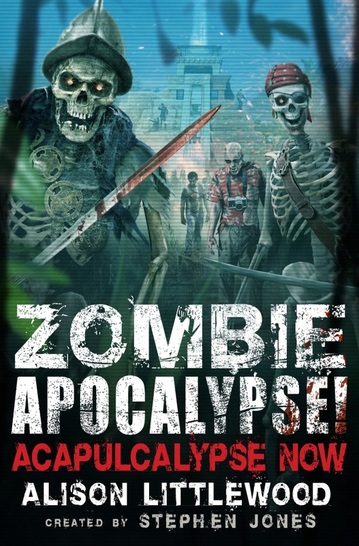 Zombie Apocalypse! Acapulcalypse Now is a bit of departure for you. How did you end up writing a zombie novel? Well it really happened because Stephen Jones, the creator of the Zombie Apocalypse! world, asked me to write it! He’d previously asked me to contribute a short story for the third ZA! mosaic novel, Endgame, so I’d dipped a toe in the water. And Steve had picked up a short story I’d set in Mexico, The Eyes of Water, for the Mammoth Book of Best New Horror a couple of years ago, so he probably had a sense that I’d enjoy writing a novel set there. How did you approach this book, as it feels like nothing else you have written? Well a big part of my motivation for agreeing to do it was that it sounded like a lot of fun, and it was! I would never have thought of writing a zombie novel, but there’s something about zombies that just kind of demanded a wink and a smile. There are scares in it too of course, but I couldn’t resist working in a few gags as well. I’d been thinking for a while that I’d like to try setting a whole novel overseas, so this was a good opportunity to do that. I started off by brainstorming everything I could remember about the place, plus things that were unique about Acapulco, and ideas for scenes that sprang to mind involving holidays and zombies. Some of them made it into the book and some didn’t, but I do remember doing a lot of writing with a big grin on my face. The book is part of the Stephen Jones shared zombie universe, how did it feel working in someone else’s world? The thing about the ZA! world is it’s really our world, just with certain characters pulling strings behind the scenes and certain events taking place within it. I needed to keep that framework in mind and tie in to what was happening in the UK and USA and so on, but other than that it was pretty free. Taking things to Mexico meant that I could bring in new elements of my own too. That’s the beauty of the ZA! world though, the first novels were written mosaic style by several authors, so each of them (within reason) could embroider onto the mythology. Were you put under any restraints with regards to how the story would play out, and the conventions of the zombies? Yes, I was given a broad outline of the Mexican invasion, and I took the conventions of the zombies from the previous books. Again, that raised more possibilities than limitations, because although they have the slow and shambling variety of zombie there is also a faster, more intelligent type that can bring more structure to events and complicate matters for the characters. So it wasn’t really constraining, it just made matters more interesting. Steve was great to work with too, suggesting ways to tie in with other events, but also allowing me plenty of freedom. Quick question, fast or slow zombies? Slow ones! They’re just what I think of when I hear the word ‘zombie’, and for me they better represent the whole zombie tradition. Also, the fact that they’re unthinking and unfeeling has a lot of emotional possibilities. Zombies are us, essentially, so to have someone you once knew coming at you without recognition or mercy is emotionally harrowing as well as scary. Mayan zombies and ancient South American evil, are any of these based on real myths and legends? Yes, I used a lot of actual Mayan mythology in the book. I chose to shape the hotel like a Mayan pyramid and line its halls with artefacts to tie in with it. One of the things I saw when I was in Mexico was a little ruin on the coast, and the wind was said to sing through it when the land was about to be invaded. It was on the other side of the country but in the story I had it removed and placed on top of the hotel – it becomes part of the cultural disrespect that’s also a source of conflict in the book. The death gods were also just too good not to be put to use, but I won’t say too much about that! You get the feeling that you had a lot of fun writing this novel, is it an experience that you would do again? Well yes, I probably would. I did find it quite liberating. I tend to tie myself in knots a bit over my work and this project reminded me that writing should be fun – that it’s a playground, as Stephen King puts it. Having said that, the project I worked on after it couldn’t have been more different, but I still took some lessons with me. That’s the thing about writing I suppose, everything teaches you something, and it’s good to try something different. Plus, I really did have a riot with it! Which brings us to your latest novel A Cold Silence. It takes some of the themes of your debut novel and expands on them, in particular the theme of Faustian Pacts, only this time you have gone for a wider impact. Yes, it took me a few years to write the sequel and I just felt the characters and story would have moved on and developed, perhaps because I’ve developed as a writer. So this time there’s a computer game called Acheron at its heart, but one that works in impossible and mysterious ways. It offers each player their heart’s desire, but the price is equally unique, and can be too much to pay. The young boy from A Cold Season is now an adult and he’s the main character; I somehow knew that if I returned to ACS territory it would become his story. In the first book, his mother Cass is affected by her odd childhood, and it struck me early on that Ben’s childhood had turned out even odder, so there would be ramifications from that. Also, the devil doesn’t like the ones that get away . . . Without giving too much away, is the source of the evil in A Cold Silence a source of your own personal concern? In A Cold Season it was the fear of isolation from technology that was a driving force in the book, and in your latest book it is the proliferation and reliance on technology that is the driving force of fear? It is and it isn’t. It concerns me that technology has taken over from reading so much, and that many kids would rather be plugged into a game than a book, but then I’m a writer and I’m biased! Reading obviously helps with literacy which underpins learning in any subject under the sun, and I do believe it helps develop empathy for others, since it involves spending time in different characters’ heads. Others would argue that kids need to learn about technology in a world increasingly reliant on it, and they’d be right, but it’s like anything: it’s a question of balance. I also used to work for a company that produced technology for kids with special needs, and really, for some of the children with severe disabilities or communication problems, that technology is an absolute lifeline. Also, I do a job that’s pretty isolated, and technology provides a means to keep up with my writer pals and see what they’re all up to, so I’d personally be sorry to be without it. It was fun exploring a more evil side to it, though . . . When you first started writing A Cold Season, did you always have in the back of your mind the possibility of sequel? No I didn’t, not until people started asking me what happened next. And looking back on it, I wasn’t quite content to leave the characters in that place. It took me some time to be ready, though, because I couldn’t be happy just writing a sequel for the sake of it; I had to have an idea that I knew would carry another book in its own right while rounding everything off in a satisfying way. So it took a while, but I hopefully got there in the end. And looking back at your first book, how do you feel you have developed as a writer? Hmm – it’s a hard one to judge from the inside! I’ve had more experience since then obviously, and I think my prose has probably moved on. I’ve kept on learning from each book I’ve written and indeed from working with such a good editor as Jo Fletcher. A Cold Silence is perhaps a little more sophisticated in the character interplay – there are some complex things going on beneath the surface – and I was more assured about how I treated the concepts of good and evil, and the ambiguities that can arise. Can you tell us about any future projects you have lined up? The next novel to be published will be The Hidden People, the one that’s been occupying my every waking thought for the past several months! I only recently handed it in but apparently it’s going to be published around October next year. I’m really excited about this one as it’s something of a departure for me. It’s set in Victorian times and I got completely immersed in the era. I’ll definitely be revisiting it in the future. I’m also working on a short story/art project, with an illustrator friend, Daniele Serra. It’s going to include five themed short stories from me, all beautifully illustrated by Dani, so something across between a mini collection and an art book. I’m really enjoying seeing the images come in and bringing it to life. I should also finally have a full short story collection out next year, which will mean a lot to me as short fiction is still close to my heart. Other than that I have several new short story projects for various anthologies in the pipeline, and what will be my second ever novella. Alison, it has been a pleasure chatting to you, but before we wrap up this interview, I would be amiss if I didn’t cover one topic. I like to call it the Mark West effect. We both have the huge pleasure of being friends with Mark, who is one of the nicest and most generous supporters of writers out there. How important to you is having someone like Mark out there for you? I know for a fact that without his support and encouragement I would have packed this in a long time ago.  MARK WEST AND ALSION Mark is an absolute star, ha ha! You know, I remember how scared I was before my first ever FantasyCon. But I met so many brilliant and friendly and talented people, then and at other events since, and I love them to absolute pieces. I mean we don’t see each other often, not in the flesh anyway, but it means a massive amount to be in a room full of people who love the things you love and who could yak about them endlessly. They’re my tribe! And yes, they’re supportive and generous too. It means an awful lot to have folk who can lend a shoulder to lean on or give you advice when you need it or just cheer you on. I mean the same goes when you get a message from a reader saying they like your work. You find yourself replying with ‘that means a lot,’ and you wonder if they think you’re just saying that. But it absolutely does.
Thank you for doing this Alison, and I hope to see you at Fantasy Con by The Sea in 2016. You will! Thank you very much, Jim! 3/1/2016 12:26:06
A truley local girl from the north west/west yorkshire... Its nice to see some inspiration come from the moors in Saddleworth more so to inspire a great write up like that Alison's first novel...a winter commute to snowy Saddleworth is journey am sure many have done but to get such inspiration out of it is another thing altogether... welldone girl Comments are closed.
|


Archives
May 2023
|
 RSS Feed

|

|