

AUTHOR INTERVIEW: ADAM MILLARD
15/12/2015
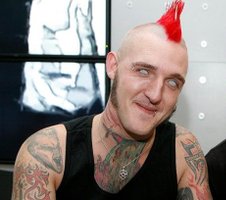 Adam Millard is the author of twenty novels, ten novellas, and more than a hundred short stories, which can be found in various collections and anthologies. Probably best known for his post-apocalyptic fiction, Adam also writes fantasy/horror for children. He created the character Peter Crombie, Teenage Zombie just so he had something decent to read to his son at bedtime. Adam also writes Bizarro fiction for several publishers, who enjoy his tales of flesh-eating clown-beetles and rabies-infected derrieres so much that they keep printing them. His "Dead" series has recently been the filling in a Stephen King/Bram Stoker sandwich on Amazon's bestsellers chart. In part 1, we met Adam Millard, the publisher. Now, we get to grips with Adam Millard, the prolific and multitalented author… GNoH: Let’s start with an easy one - when did you first realise you wanted to be a writer? Can you remember the first story you wrote? AM: I started writing at thirteen. I would churn out these mini space operas on an Olympia typewriter, folded over so that they were like real books. I even drew the covers, and I can’t draw for toffee now, but back then I was even worse. That was when I knew I wanted to be a writer. I was reading a lot of 80s horror, taking books out of the library which I had no right to be reading at that age. Shaun Hutson’s Slugs and King’s The Stand were some of the first horror books I read, and I still love them to this day. After that, I read as much horror as I could. I can’t remember the first story I wrote, but I do recall turning one in at High School about a fog descending on a British seaside town. Yeah, nothing derivative about that at all. At the time, though, I hadn’t read ‘The Mist’ or ‘The Fog’, so it was just a coincidence. GNoH: Where did the sci-fi come from, do you think? Have you done anything in that genre since childhood? AM: I have written a few short stories which could be classed as sci-fi, and one novella called Divided, which was set on a near-future earth. Due to overpopulation, people have to take turns at living, and a set of twins who have never met each other because of this (one in, one out, so to speak) try to break out of this forced existence so that they can finally be together. GNoH: Have you always written genre work? What’s the appeal of genre to you as a writer? AM: I love genre fiction, and I’m more than happy to accept the title ‘Horror Author’. I’ve never been anything but a genre writer, and that’s not a bad thing. There are too many snobs out there trying to distinguish between genre and literary and, you know what? There are well-written books and there are badly written books. There doesn’t have to be this great divide between literary and genre. I love writing about monsters and evil, about occult detectives and Wild West prostitutes, about giant fucking hamsters and pig-faced geriatric serial killers. I can write about whatever the hell I want to, any stupid idea which pops into my head, and not worry about whether I’m going to be taken seriously or whether my next novel is going to be up for a Booker. I write this stuff because I enjoy writing it, and it’s what I, as a reader, would pick up. GNoH: Okay, tell us a bit about your first novel - what was it called/about, and what did you learn from that experience? AM: My first novel was called Only in Whispers (2004), and it was just awful. I was reading a lot of Richard Laymon around that time and wanted to write something extreme. It was about a young boy moving to a new town, where he meets a pretty young busker girl with three uncles, who are molesting her nightly. It was published after fourteen rejections by a now defunct Welsh publisher, and sold a fair few copies before going out of print. I was just glad I had one foot on the ladder back then. It’s a ladder I’m happy to still be climbing. GNoH: What was it like trying to get published in 2004? AM: Nothing like it is today. It was pretty old-school, printing out the manuscript, shipping it out in envelopes, waiting for it to come back six months later with a rejection note paper-clipped to it. It was a lot different, though I actually enjoyed the process. I kept all of my correspondence from publishers. Those letters and rejections are in a folder under the bed. GNoH: Comedy horror is a notoriously tricky genre to pull off. What is it that attracts you to that genre, and what have you learned about writing in that style? 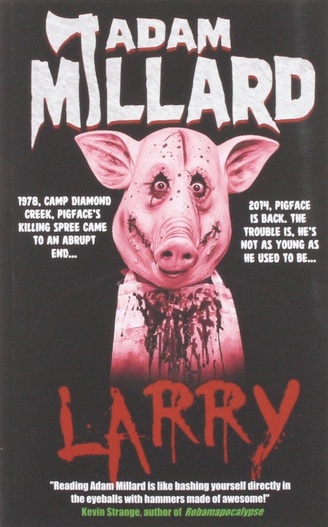 Click to purchase AM: Comedy and horror are bedfellows and, though it is tricky to get right, I’m fortunate to have a decent sense of humour and a twisted mind to go with it. I love writing the comedy-horror stuff. Growing up in the 80s, we would watch Fright Night, The Lost Boys, The Monster Squad, Evil Dead, An American Werewolf in London, all these terrific horror films with humour built-in. I also grew up reading a lot of Terry Pratchett, Tom Holt, and Robert Rankin, whose humorous novels still make me laugh, regardless of how many times I’ve read them. I like the idea that you can creep someone out one minute, and on the next page have them rolling around with laughter. With my comedy-horror stuff I try to have at least two jokes on a page. I think that’s why it does so well. There isn’t really a period where the comedy disappears into the background. Plus I love silly puns, limericks, double entendres, and naughty words. GNoH: Having read a couple of your novels in this style, I’d add pacing to that list, they really zip along… AM: Yeah, I think pacing plays a huge part in those books. They are the kind of book you could easily finish in a sitting, or on a long plane journey. The humour helps, too, because if you’re enjoying yourself, you won’t want to put the book down. If a book becomes a chore, readers are going to lose interest, and as a writer you can’t allow that to happen, not in this day and age where there are more new authors generated per second than actual births. GNoH: How quickly do you write them? What’s a typical time scale from first word to published, or does it vary by project? AM: It varies. Like I said, I’m strict, so a first draft of a novella will take no longer than twelve days. A novel takes between thirty and sixty days, depending on length. For me, the first draft is always pretty rough. I don’t really edit as I go along, though I do read back the previous day’s work to make sure there are no glaring mistakes, and that puts me in a good frame of mind to continue. I have books out there with various publisher and agents which I wrote two years ago, which just goes to show that, although it might seem I am prolific and turning out this vast body of work, there is a very slow and deliberate process to things. Sometimes, two or three books will be scheduled for release in quick succession, and that doesn’t help when you’ve got to market them. It’s just the nature of the business, especially when you have several different publishers. GNoH: Typically, how many drafts does an Adam Millard novel go through before it’s published? AM: I’m a three-draft writer most of the time. The first draft (the vomit draft) comes first, which is always a good place to start, and then that sits for a month or so before I go back and work on the second draft. After that, usually another few weeks pass and I’ll write some short stories or a novella, and then return to finish with a third draft. This final one is usually a grammar/punctuation pass, taking into account adverbs, tense, sentence variety, word choice, so that nothing grates as you’re reading it. Then if I’m not putting it out myself, it goes out to a publisher who, if it is picked up, send back edits and suggested changes, so I guess that counts as four or five drafts. GNoH: You also write in a range of other styles - do you ever struggle with which genre a story idea will fit into, or it is always obvious to you? And do you have a preferred mode of writing? AM: I’m fortunate that I can switch between comedy-horror (Larry, Vinyl Destination, Milk) and more serious stuff (Caniba, Swimming in a Sea of Trees, The Susceptibles). I always know which tone the story needs to be, due to the fact that it’s easy to discern between silly ideas and serious ones. Do I have trouble switching between the two? Yeah, sometimes I have to rein in the humour, but often you can still get away with a certain amount, especially with dialogue. People are funny, and can say some of the most ridiculously funny things when faced with something they don’t quite understand. I enjoy writing both serious and humorous stories, but if you were to ask me which I preferred (which I think you did) then I find it easier, more natural, to write the comedy stuff. You’ve got to be funny if you look like I do. GNoH: You spoke about not having fond memories of your first novel. Can you remember the first time you got something finished and though ‘actually, that’s pretty good!’? 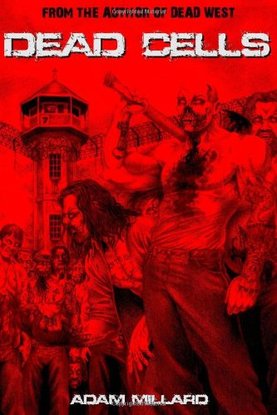 click to purchase AM: I was really proud of Dead Cells when it was finished. I think that was the first time I knew I had a chance of making a go at it. That was almost six years ago now, and a lot has happened since then. I’m looking forward to the next six years, and honing my craft even more. The great thing is, I know I have learned so much since I began writing. I’m no longer wet behind the ears, but I know so little in the grand scheme of things. It’s all that stuff I’m going to learn in the next five, twenty, forty years which excites me. I have a lot of stories to tell and, barring a major accident or debilitating disease, I’m going to be doing this until the day I die, and then when I’m dead and everyone goes out and buys my books, I’ll be given a posthumous library card. GNoH: Do you still read a lot? What have you read recently that really impressed you, and why? AM: I read every day, at least a hundred pages. I can’t go to bed without a book. If I didn’t have a book, what would I be doing? My wife and I would just lie there, staring at the ceiling, wondering why I haven’t got a book. Some of the best books I’ve read this year include Skullcrack City by Jeremy Robert Johnson (because it’s just damn awesome and weird and funny and different), Zero Saints by Gabino Iglesias (a gritty, fast-paced drugs-and-cohete crime novel with supernatural elements running through it), and Jigsaw Youth by Tiffany Scandal, which is just a beautiful heart-rending piece of work. I’ve just finished King’s Bazaar of Bad Dreams, too, which was great. And Mark Morris’s The Wolves of London (the first book in the Obsidian Heart trilogy) is fantastic. I would recommend all of the above. GNoH: You produce work at an incredible rate - have you ever had a problem with ‘block’? AM: I’m blessed that I have an abundance of ideas, too many to ever put down on paper, and also that I get to do this for a living. My problem is that I can’t work on more than one project at a time. I see authors, talented bunch of gits, switching between novels and short stories, slipping a novelette in there somewhere, but I just can’t do it. I think the longest period I’ve gone without writing since I started is three weeks, and what an awful three weeks it was, too. I have a pretty strict schedule and, being slightly crazy and something of a hermit - except when it comes to conventions - I seldom miss my targets. Discipline is important for all writers; sitting down day after day in front of that laptop and convincing yourself that you’re doing a job, that if the job isn’t finished, you’re not going to be able to carry on doing it, because nobody likes Half-Job-Harrys and nobody is going to buy half a novel, I don’t care how good it is. I tend not to think about how much work I’m putting out there; all that truly matters is the quality, and that people are going to enjoy it. Fortunately for me, most people do. GNoH: You talk about discipline - how do you balance being an editor and publisher and writer? What does a typical work day in the life of Adam Millard look like? AM: It’s tough. Most days I work eight to eighteen hours, depending on what needs to be done. First and foremost I like to get my own work out the way. I hit my word count and then move on to whatever else needs to be done (editing, design, accounting, articles, blogs, royalty statements). With a four-year-old son bouncing off the walls, I do a lot less than I used to, but that’s not a bad thing. We get to shoot one another with Nerf guns, and he throws sand at me while I weep in a corner, so I would say I’ve found a good balance between what I do and what I should be doing as a family man. Sometimes, my son and I like to pour Fruit Shoots into the laptop just to see who can get the loudest sizzle. I’ve lost many a good novel playing that game. Adam’s many, many books can be found at Amazon or via the Crowded Quaranetine website KIT POWERTHE HEART AND SOUL OF HORROR INTERVIEWS
Adrian Shotbolt
15/12/2015 15:35:53
Husband, father, publisher, writer, LEGEND. Comments are closed.
|


Archives
May 2023
|
 RSS Feed

|

|