

 Edward M. Erdelac is the author of ten novels including Andersonville, Terovolas, and the Merkabah Rider series. His stories have appeared in dozens of anthologies and periodicals including the Stoker award winning After Death, World War Cthulhu, and Star Wars Insider Magazine. Born in Indiana, educated in Chicago, he lives in the Los Angeles area with his family and a trio of felines. News and excerpts from his work may be found at http://www.emerdelac.wordpress.com Could you tell the readers a little bit about yourself? I moved out to Los Angeles in 2000 or so to pursue a screenwriting career and after writing a dozen screenplays, I had about as much luck getting them read as George W. had finding oil in Texas. When the local hospital conglomerate bought out my apartment building I wisely used the resettlement money to produce a full length feature film, Meaner Than Hell, which one guy on Youtube seems to have really enjoyed. I turned to fiction writing in about 2009 or so, churned out my first series and have averaged about a book and a half a year since through various small and mid-ranged publishers, then Andersonville last year, which was put out by Random House/Del Rey’s Hydra imprint. What do you like to do when you're not writing? I’ve got three kids at home, so I’m mainly raising them, but in the little free time I get, I have a lot of hobbies. Reading, gaming (both tabletop and what we called TV games growing up), movies. I hope to do a bit more traveling in the years to come, as I’ve always enjoyed that. Other than the horror genre, what else has been a major influence on your writing? I saw The Good The Bad And The Ugly in high school and that rekindled a love of westerns I’d had as a kid and forgotten about. Tore through a lot of western fiction in my teen to college years. Louis L’Amour, Elmore Leonard, Cormac McCarthy. I think fantasy was my first love in terms of reading. Tolkien, Howard. I like Mickey Spillane novels, and comics. Alan Moore. The term horror, especially when applied to fiction always carries such heavy connotations. What’s your feeling on the term “horror” and what do you think we can do to break past these assumptions? I think there’s a tendency for people to equate a love of horror with the black t-shirt, gorehound crowd. Friday The 13th stuff, slashers, buckets of blood and quivering sausage links of guts. Not that I don’t love that stuff once in awhile, but horror writers and fans get painted with broad black and red brush by the muggles I think. What do you to break out of that? I think it’s being done. You sneak it into the public consciousness by giving them first and foremost good writing, relatable characters, great stories. People want to be moved. I remember a couple years ago back when True Blood was a big deal. Everybody was watching it, and it was definitely a horror show, but people didn’t see it that way. Even the author denied being a horror writer. Not saying we deny what we are or be ashamed of what we produce, but I think, when we do it really well (and True Blood was pretty good in the beginning, remember), people don’t even realize it for what it is. I don’t think a lot of the Game of Thrones fans were fantasy nerds going in. Good stories, good presentation, they transcend drama, make people ignore or fail to recognize the conventions because they’re caught up in what’s unfolding. A lot of good horror movements have arisen as a direct result of the socio/political climate, considering the current state of the world where do you see horror going in the next few years? We’re gonna see a lot of dystopian future horror aren’t we? You’d think, but we’ve been seeing that already I suppose. I think cosmic horror is going to go mainstream in a big way in the next few years. The helplessness and paranoia lend itself well to what’s going on in terms of the trend towards oligarchy we’re seeing in world governments. Maybe somebody will remake ‘Society.’ What are the books and films that helped to define you as an author? Oooh that’s a big list, but a fun one to compile. The two books that made me want to be a writer were Call of The Wild by Jack London which Sister Marie read to our class in seventh or eighth grade and Simon Hawke’s novelization of Friday The 13th Part VI: Jason Lives. I was not allowed to see rated R movies as a kid and would pick up novelizations instead. Lots of Alan Dean Foster. But I read that in one sitting, mesmerized by the violence and description. Both of those books really transported and excited me. After that I got into Howard, lured by his name in those thunderous opening credits of Conan The Barbarian and the Frazetta covers. Tolkien, King’s short stories. Moby Dick was a tremendous work to me in college. It felt like the wellspring of everything I’d read up to that point, because I noticed so many turns of phrases I’d thought were more modern popping up in that. Its themes resonated with me. Lonesome Dove was a big one. John Irving’s A Prayer For Owen Meany. Cormac McCarthy’s Blood Meridian is still the most mesmerizing book I’ve ever read. Alan Moore’s From Hell affected me greatly, the mysticism and historical allegory, the hidden history, which is something I really enjoy writing. Movies, almost too many to mention. Lawrence of Arabia is my absolute favorite. I love its balance of the epic and the personal. The last shot of The Third Man is my all time favorite frame of film. Dawn of The Dead, The Haunting, Night Of The Demon, Winchester 73, Star Wars, Glory, On The Waterfront, Chang Cheh movies, The Whole Wide World. What new and upcoming authors do you think we should take notice off? Ashe Armstrong has some neat ideas in his Grimluk books, a weird western series about a demon hunting orc. It’s a fantasy/horror/old west mashup I wish I’d thought of. Charles Austin Muir. I shared space with him in Big Time Books’ 18 Wheels of Horror anthology. There’s a lot of good guys in there. Shane Bitterling. How would you describe your writing style? Robert E. Howard and Cormac McCarthy arguing over a bowl of Count Chocula. Are there any reviews of your work, positive or negative that have stayed with you? One guy, I think he was on Goodreads, wrote that he felt like everything he had ever read had been to prepare him for Merkabah Rider. That was something. What aspects of writing to do you find the most difficult? Just finding the right approach. I can formulate a story full blown in my head then be 4000 words into it before I realize I’m framing it all wrong, or following the wrong character. Getting started. Then as long as I can consistently make time, the rest is gravy. Is there one subject you would never write about as an author? If I said yes, I’d probably immediately feel compelled to write about it. How important are names to you in your books? Do you choose the names based on liking the way it sounds or the meaning? Very important and a little of both. These are the names by which I come to know these characters, so I’m pretty particular. I don’t like to reuse names and I’m not one of those guys who can invite a kickstarter backer to lend his name to a character. It feels false. Writing is not a static process, how have you developed as a writer over the years? It’s difficult to see growth when you’re staring at something all the time, but I think I’ve become steadily more concerned with legacy and import. What is this story saying about the world or about the people who inhabit it? Not to say everything has a weighty message, but I’ve become more and more interested in what I can bring across to people holistically through a story. What I have to say about my time on earth I guess. What tools do you feel are must-haves for writers? Empathy is the single greatest tool a human being can develop, and it’s doubly so for a writer. If there is a human alive on this earth in which you can’t find a single thing you can relate to, you have an emotional blind spot, and it’s going to come out eventually in some character. That character is going to feel untrue because something in you did not allow you to get inside them. Sometimes that means admitting to a dark something in you. That’s alright. That’s human. The second greatest tool is discipline and there’s no need to expand on that. Sit down and see it through to the end. What is the best piece of advice you ever received with regards to your writing? Joe Lansdale told me (well and a bunch of other writers sitting around the table with me) that writing is a muscle that must be exercised regularly or else it will atrophy. Getting your worked noticed is one of the hardest things for a writer to achieve, how have you tried to approach this subject? Oh I’ve tried a lot of things. A lot of bad things and some good things. I’ve joined fraternal organizations, spammed Facebook groups, I’ve insisted on eye contact at conventions, I’ve even, God help me, Tweeted. But ultimately, for me, it boils down to – I’ve had the most success just putting myself in people’s paths in some way. Just being myself, posting the occasional excerpt on my own FB feed. If you have passion it comes through, and it will be recognized. Readers can tell when I’m doing something I love. They remark on it. Just takes the right pair of eyes to catch hold and say to somebody, hey, this is pretty good. It’s a lot of luck, really. Nothing harder than getting people to take a chance on you. For many writers, the characters they write become like children, who is your favourite child, and who is your least favourite to write and why? I’m a terrible parent (metaphorically) because my favorite is always the newest, the cuddliest. I write a new character and think, oooo I’m gonna have a lot of fun with you down the road, watching you grow. I enjoyed The Rider and may return to him. I’ve been itching to do another Van Helsing novel. Right now I’ve got this Chinese cook, Wan Shu, who is very put upon, often out of his element, very fun to write because of his hangups. My biggest love right now is Zora Neale Hurston, the Harlem Renaissance writer and folklorist I fictionalized as a Mythos detective for a couple of Golden Goblin Press books. She’s really feisty and unlike anybody I’ve written before. There’s a book in her future, definitely. I wrote a novel a while back, Coyote’s Trail, a psychosexual revenge western about an Apache kid using a Mexican prostitute as bait to lure the soldiers who slaughtered his family out. One of the darkest things I’ve ever written, populated by a lot of unseemly characters. It was tough to get out. I’d say the prostitute’s half brother in that, Rogerio, this despicable guy who tags along for his own twisted reasons. I was glad to be rid of him. What piece of your own work are you most proud of? I think the best thing I’ve written is Monstrumfuhrer. Either that or a novella from my With Sword And Pistol collection, a gangbanger story called Gully Gods, which is almost universally disliked because people don’t seem to relate to the characters. But I think those two are the best things I’ve written. And are there any that you would like to forget about? Nah. I regret nothing. For those who haven’t read any of your books, which of your books do you think best represents your work and why? I want to say the Merkabah Rider series, which is about this Hasidic gunslinger looking for his master in the Southwest, because it’s a hidden history, weird western, and portrays the clash of cultures that is really central to a lot of what I write. But since it’s out of print (till next year anyway), pick up Andersonville, the story of a madman using the prisoners of the notorious Confederate POW camp to enact a ritual to swing the war for the South. If you don’t have an e-reader, then pick up With Sword And Pistol. It’s four novellas set in various times and places, historical and modern, and I think it represents the breadth of my work pretty well. Do you have a favorite line or passage from your work, and would you like to share it with us? “For that much gold I’d build a graveyard and fill it with your enemies.” From Once Upon A Time In The Weird West. Can you tell us about your last book, and can you tell us about what you are working on next? (Monstrumfuhrer) In 1936 Dr. Josef Mengele discovers Frankenstein’s lab journal and is tasked by the Reich Institute with recreating his experiments. In Krakow a pair of Jewish twin brothers find the letters of Captain Walton to his sister detailing the Frankenstein narrative in the attic of a bookstore. When they are captured and taken to Auschwitz KZ, they come to recognize the nature of Dr. Mengele’s horrific experiments and set out to escape and find the only being who will believe them, the only one capable of stopping him; the original Creature. I’ve got an Arthurian fantasy, The Knight With Two Swords, about the knight who loses the Holy Grail and his quest to avert a curse laid on him, but it’s up in the air with the publisher right now in terms of the release. I just finished a Wuxia-Western fantasy about a Chinese ranch cook discovering a three thousand year old sentient ginseng and having to hide it from a ravenous immortal and his tong, all the while keeping it a secret from his mostly oblivious cowboy employers. That’s called The Chilibean Joss, and it’s in the can and looking for a home. If you could erase one horror cliché what would be your choice? The brilliant Hannibal Lecter type puppetmaster psycho sitting in prison which the protags/cops absolutely have to consult to catch the latest spree killer/bad guy. I hate that with a passion. It invariably leads to the scenario of the guy trapping people in these elaborate scenarios so impossibly complex and rife with unbelievable contingencies as to be akin to playing guns with that kid down the street who insists on telling you you missed him every single time. What was the last great book you read, and what was the last book that disappointed you? Following Hadrian by Elizabeth Speller was really interesting. Fiction wise, I’m reading Drood by Dan Simmons, and it’s pretty good. I just finished reading A Wrinkle In Time with my daughter for the first time ever. After years of wondering about that winged centaur from the paperbacks of my youth, I thought it was extremely dull. What's the one question you wish you would get asked but never do? And what would be the answer? How’d you like to direct an adaptation of your novel _____ for the screen? Yes, would be the answer. 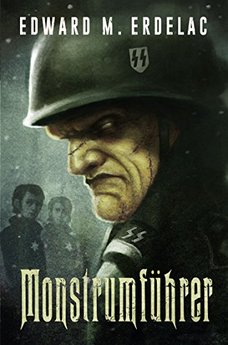 In 1936 Dr. Josef Mengele discovers Victor Frankenstein's lab journal in the attic of an Ingolstadt dormitory and is tasked by the Reich Institute with replicating his reanimation procedure.
While hiding in a bookstore in Warsaw, a pair of Jewish twin brothers, Jotham and Eli Podczaski, come across the letters of Captain Walton to his sister, detailing the ill-fated story of Frankenstein. When Jotham and Eli are captured by the Gestapo and encounter Mengele in the gray confines of Auschwitz KZ, they alone recognize the origin of his bizarre, sadistic experiments. Jotham hatches a plan to escape the camp and travel north, to find the only being capable of stopping Mengele from providing the Third Reich with a new race of undying stormtroopers; the only being on earth who will believe them ... Frankenstein's original creature. "Ed Erdelac once again proves a master of historical fiction, as well as seamlessly blending literature into reality." --The Horror Fiction Review Comments are closed.
|


Archives
May 2023
|
 RSS Feed

|

|