

 CAROLE JOHNSTONE CAROLE JOHNSTONE Carole Johnstone's short stories have appeared in numerous magazines and anthologies. She has been published by PS Publishing, ChiZine Publications, Night Shade Books, TTA Press, Apex Book Company, and Morrigan Books among many others. Her work has been reprinted in Ellen Datlow's Best Horror of the Year series and Salt Publishing's Best British Fantasy 2013 and 2014. Her debut short story collection, The Bright Day is Done, is available from Gray Friar Press, and she has two novellas in print: Cold Turkey from TTA Press, and Frenzy from Eternal Press/ Damnation Books. She is presently editing her second novel, while seeking fame and fortune with the first. Hi Carole, could you tell the readers a little bit about yourself? God, this feels horribly like a first date. Okay, well, hi Jim, I’m a thirty-something Scot who’s lived in north Essex since the late nineties. By day I’m a medical physicist/dosimetrist in an NHS hospital; by night and weekends I’m a writer. Occasionally I remember to be a good friend (generally when the ideas aren’t flowing). No kids, no pets; I’m entirely self-absorbed. What do you like to do when you're not writing? Nothing at all. I’m not being facetious. Outside of work and writing, I have absolutely no time for any kind of hobby at all. I read. I work out. I try to remember to be a good friend. What’s your favourite food? Bombay Mix. All kind of dried Indian snacks really: Pakkavada, Murukku, Namak Paara, Sev mamra - but Bombay Mix is the best. Not really a meal as such, I guess, but it’s tasty, lasts forever, and would undoubtedly survive a nuclear holocaust entirely intact. 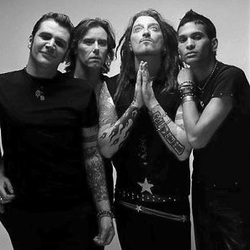 THE WILDHEARTS THE WILDHEARTS Who would be on the soundtrack to your life story? Crikey, that’s quite hard. In my student days, I was heavily into early/mid nineties grunge and heavy metal: The Wildhearts, The Manics, The Almighty, Jane’s Addiction, Pearl Jam, Pixies. They represent a time in my life when I was very happy, even though I didn’t have a clue who I was or where I was going. And *whispers* I’ve had a lifelong love affair with Def Leppard; every one of their songs, however good or bad, means something to me and reminds me of a thousand things, also good and bad. You get far less subjective (or maybe that’s passionate) as you get older. These days I’ll listen to nearly anything, and I’ll mostly enjoy it. I can’t write in silence, but I can’t hear other words either, so I have a big selection of classical music. Movie soundtracks are great; anything and everything by Thomas Newman is terrific. Certain pieces of music remind me of a story I wrote, or a character I made, or a frustration/triumph I felt. Music is incredibly important to me; it keeps me company and it keeps me sane. Do you prefer the term Horror, Weird Fiction or Dark Fiction? You know, I’ve been asked this question a few times and I’ve always said horror, because a horror story is a horror story; the simplest description is the best description. But...(and I hate myself for saying it), unless you’re Stephen King or Ramsey Campbell, horror is still such a hard sell outside of the indie presses and genre imprints. So sometimes, and I’ve never actually admitted this before, I’ll call something I’ve written Dark Fiction or Dark Fantasy; once even Contemporary, Dark Urban Thriller, whatever the hell that is. Who are some of your favourite authors? Right, I’m just going to give you a stream of consciousness list here, otherwise I’ll procrastinate and keep changing and rearranging it. Graham Joyce, Ray Bradbury, Clive Barker, James Smythe, Joe Hill, Stephen King, Gillian Flynn, Peter Straub, Michael Marshall Smith, Irvine Welsh; Denise Mina; Alexandra Sokoloff, Joseph D’Lacey, Elizabeth Hand, Joanna Briscoe, Nina Allan, Ray Cluley, Tim Lebbon, Sarah Moss, Sarah Pinborough, Paul Meloy, Tom Piccirilli, Gary McMahon, Gary A. Braunbeck. And breathe. Not all of them would be called genre writers, I guess, and this list is by no means exhaustive. Give me another five minutes and I could double it, triple it, quadruple it. What is your all-time favourite genre novel, and film? I hate naming favourites. Hate it. Mainly because I’m so bad at it. But alright, just for you, Jim: The two novels that ‘made’ me were The Fog and Misery. The Fog is not particularly well written; Herbert has certainly written far better, like Fluke or Nobody True. And Misery I don’t think is King’s best either, but its premise is cleverly simple and that nearly always works well. Neither novel is my favourite in terms of the writing or even the story (there are too many in that category to whittle down to one, so I’m essentially swerving the question completely), but they were my first introduction into a genre that I love, so for that they should stand; I’ve lost count of the number of times that I’ve re-read them over the years. In the same way that I read more horror than sci-fi, I watch more sci-fi than horror. I was pretty young when I first watched Aliens, perhaps that’s why it always stuck, because while I adore all of the Alien movies, that’s still the one I love best. Event Horizon is its only competition. The guy behind the counter of my local Odeon that was, stopped asking me what film I wanted to see while it was still showing. I adored it. Both films are very much horror films to me: they’re simple, they’re affecting, and again, they helped make me into the kind of writer - and reader - that I am today. Sorry, I told you that I hated naming favourites. Getting me down to two of each is pretty good going. If you could erase one genre cliché what would be your choice? I have a big problem with zombie hordes. Don’t get me wrong, I love zombie fiction (mostly), and I’ve written a few zombie stories myself, but there is no excuse for just rehashing Book of the Dead stuff now. I hate reading modern stories about the ubiquitous zombie: shuffling, moaning, rotting, dragging a broken foot and big axe, hungry for human brains - but you know, not enough to speed up a bloody bit. And this is the most annoying thing of all: how did they become a horde in the first place? You know, there has to have been a beginning: a patient zero if a pandemic, or at least a few of them in the event of the explosion at an x plant/government lab/evil genius’ lair. But by the time they are besieging a hospital/shopping mall/remote farmhouse, or shuffling around an apocalypse that they have created, there are hundreds, thousands, millions of them. But how? I mean they chomp on everything they kill. The ones that turn into zombies are the very bitten few that manage to escape the horde. Are there lesser spotter ‘worker’ zombies that go about biting and turning but never ever eating? Is there a just-turned-zombie best before date, after which you are no longer tasty? Old school zombies make absolutely no sense at all, and while I still love all that Book of the Dead stuff - I do - I get a bit cross when folk just rehash the same old clichés decades later. And I’ll reiterate: it Doesn’t Make Sense. Bet you’re sorry you ever asked the question. Which fictional character would be your perfect neighbour, and who would be your nightmare neighbour? I love interesting people who aren’t afraid to open their mouths and let their brains fall out. Neighbours generally ignore or annoy you, so it would be great to live next door to someone who was funny and engaging and honest and eccentric. A character that I have always, always loved is Patrick Randle McMurphy; I loved him even before Jack Nicholson played him to perfection. So, I’ll have Mac please (minus the potential psychopath bit), or Jack Nicholson in just about any character, if that’s allowed. As for a nightmare neighbour, they’d actually have a job beating the one I’ve got. But if pushed, I’d plump for Guy, the truly terrifying maître d' in Lunch at the Gotham Cafe. I have actually had more than a few genuinely awful nightmares about him. And all that Eeeee-ing would get really annoying really fast. If you could kill off any character from any other book who would you choose and how would they die? God, you have no idea how long I’ve thought and agonised over this question, but it’s actually really hard to answer. There are plenty characters that I’ve disliked, but generally that’s because I’m supposed to; because ultimately something pretty bad is probably going to happen to them eventually, and half the fun of reading a book is being almost certain that it will (if only reality occasionally played by the same rules). If I kill off any one of these characters, I kill the story too. The only kind of character that I can really pick is one who serves no real purpose at all, except to irritate me. So...I have to go with the one that I immediately thought of when I first read the question. Tom Bombadil. All that singing! Ring a dong dillo-ing. And what is he For? Absolutely nothing at all. He just exists to be annoying and to fill space on a page. And I’d happily throw him off a cliff. 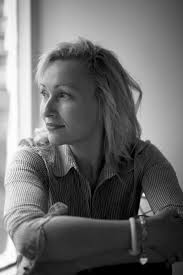 Sarah Pinborough Sarah Pinborough What do you think of the current state of the genre? I think it’s in a really good place right now, certainly a lot better than it’s been. I doubt horror as a genre will ever go back to the boom of the eighties, but that’s probably a good thing because we all know what happens to them eventually. Horror endures, I think, because love or hate it, it exists; it won’t go away. That famous Lovecraft quote: “The oldest and strongest emotion of mankind is fear, and the oldest and strongest kind of fear is fear of the unknown,” is always going to be true, always relevant. People want escapism, however dark, and while the new wave of chick noir and toxic marriage thrillers may not be your cup of tea, there’s no denying that they’re an improvement on sparkly vampires and hunky werewolves. They also help bridge the sizable gap between the horror genre and its potentially larger audience. And when I see writers like Adam Nevill, Joe Hill, Laird Barron, Sarah Pinborough, Alison Littlewood, Tim Lebbon, and Sarah Langan, among many others, writing unapologetic horror fiction outside of the indie presses and for audiences that might not even know their Mary Shelley from their Shirley Jackson never mind the rest, it makes me feel hopeful. What was the last great book you read, and what was the last book that disappointed you? Black Chalk by Christopher J. Yates is a fantastically dark read. It’s about a group of university students who get involved in what starts out as a harmless game of consequences and forfeits, but which swiftly becomes something a lot more dangerous. It was marketed as a thriller, but it’s a psychological horror full stop. The Never List by Koethi Zan, I didn’t enjoy. I don’t enjoy slagging off other books either, and it was certainly not badly written. I just felt like it didn’t deliver on its brilliant premise: that of a young woman struggling to come to terms with her horrific abduction and torture at the hands of a nasty sadist (is there any other kind?), who is - at the novel’s beginning - coming up for parole. How would you describe your writing style? It varies of course; few writers churn out the same kind of writing story after story, but I definitely favour narration over description. And I love writing about people: love studying them, working out what makes them tick. The story always comes first, of course it does, but if you create authentic and engaging characters they’ll move it along nearly without any help at all. Writing dialogue is my absolutely favourite thing, partly because I know that it’s one of my strengths, but also because it’s a great vehicle for show don’t tell, and one good conversation can tell you more about a character and their motivations than page after page of description can. Humour too. I think horror is much more affecting when sweetened. Horror is supposed to unsettle you, but a good horror story should also move you and make you think. Joe Hill is the king of it (ha!), and of course it’s very easy to cock up, to go too far, but when it’s done well, I think it elevates a horror story from average to great. What aspects of writing to do you find the most difficult? The promotional, laying yourself bare part of it. I’m terrible at it. All that self-promotion is anathema to most writers, I think, whose natures are generally introspective and self-critical. There you are, shut away in a closet for months on end, and then you’re expected to shout about your book from the rooftops. Or more likely in social media, bookshops, conventions, or *shudder* from a stage. Is there one subject you would never write about as an author? What is it? There is nothing I wouldn’t write about. At least if there is, I haven’t discovered it yet. What do you think makes a good story? Oh God, a million things. A lot of what I mentioned in the writing style answer. A story should move quickly enough to keep the reader turning pages; waffle and being a bit in love with your own voice is deadly. You need pace, mystery, and that horrible word, jeopardy. But it also needs to engage, to affect, to move, and that comes nearly solely from the characters. What a reader really craves in a story I think is that moment of connection, that moment of recognising something of themselves in a character or situation or reaction. There’s a brilliant Alan Bennett quote that says it much better than I can: “The best moments in reading are when you come across something - a thought, a feeling, a way of looking at things - which you had thought special and particular to you. And now, here it is, set down by someone else, a person you have never met, someone even who is long dead. And it is as if a hand has come out, and taken yours.” 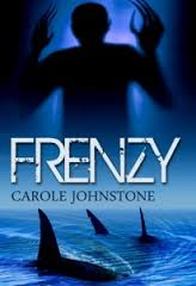 FRENZY BY CAROLE JOHNSTONE FRENZY BY CAROLE JOHNSTONE In your novella Frenzy we see eight survivors cast adrift in a life raft, how do you think you’d be if put in this situation? I’d be a pretty terrible life raft companion (that sounds like an even worse dating profile!) In fact, the main protagonist, Pete, behaves almost exactly in the way I probably would: he moans, he complains, he gets shit scared, and then he gives up. And then finally he remembers that he has a backbone. I never give up on anything, but everyone (including me) always thinks I’m going to. If the worst came to the worst do you think you could eat one of your fellow survivors? Absolutely. If the worse came to the worst, I think nearly every one of us could and would. What was the inspiration behind the book? Well, I’m shit scared of the sea. Not water necessarily (although I’m a bit of a doggy-paddler), but the big oceans terrify me - all those miles of no one knows what underneath you. Makes me shudder every time. Years ago, I read a book about the sinking of the USS Indianapolis in the Philippine Sea, July 1945. Of the 900 men who survived its sinking, little over 300 survived four days of shark attacks, dehydration, and exposure. I remember reading the survivors' accounts of what those four days were like to endure, especially psychologically, and I still remember them now, some word for word. 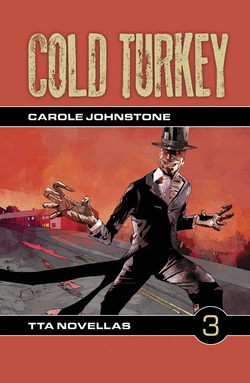 COLD TURKEY BY CAROLE JOHNSTONE COLD TURKEY BY CAROLE JOHNSTONE So Cold Turkey is this story based upon any personal experiences? The thoughts and struggles of the protagonist come across as being very personal. From the giving up smoking perspective, the official line is that I don’t. Anymore. Or that I’m not smoking today, although sometimes that’s a lie. If I think about never, EVER, having another cigarette again, I get a bit twitchy. And I hate that - that something is able to have such a hold over me, and that I’ve allowed it to. But in Cold Turkey, being addicted to smoking is really just a metaphor for the rest of Raym’s life. There’s a line that I repeated a few times throughout, something that a hypnotherapist says to Raym, and I believe that it’s a brutal truth for many of us - as a reader, it would definitely be my Alan Bennett moment: “Your character is such that when faced with life and uncertainty, you choose what is safe, even if it is something that you loathe.” It’s an entirely pointless way to live your life, but often it’s the easy way - or at least that’s the mask it hides behind. One of the things that I really enjoyed about the book was the use of genuine Scottish dialogue. Why did you choose to set this book in Scotland? Thanks, Jim! The simplest answer is because it’s where I’m from, it’s who I am. There’s a lot that is lyrical (and humorous, there’s no getting away from that particular draw for me either) about Scottish dialogue: its characteristics, vulgarities, and colloquialisms. Although a good proportion of my stories haven’t been set in Scotland, often when I’m writing dialogue, it’s all I can hear. There is always a chance when using local dialect and slang that the book may come across as being almost caricaturistic. How did you decide on how much dialect to use? I agree completely. It can also get a bit confusing and tiring for the reader, especially if they’re unfamiliar with it. Most of my characters don’t adopt much dialect, beyond a few key words or phrases. That way you can keep it sharp and distinctive, and particular to certain characters, for whom it becomes a part of their personality and/or charm. Were there any particular phrases you wanted to use in the book? Black affrontit is a great one, because it kind of does what it says on the tin; I think most folk would know what it meant without knowing what it meant, if that makes any sense? Calm yer water, sonny, naeb’dy’s deid, is another. It’s distinctively Scottish, and you can hear it, you know? You can hear the scornful, rolling-eyed dismissal of it. Yer tea’s oot was one that I came back to a lot, because its caveat is at the core of the story. Raym is forever careering towards disaster, and its meaning: your time’s up, you’re basically fucked, applies in both reality and metaphor. For years, I thought that the tea was actually T, as in Time, because obviously that makes a lot more sense. But I’m assured from a reliable source that it’s not. It’s tea. So what’s your problem with Dundee, Lana Del Ray and Poirot? Ah now, I should set the record straight. I have no issue at all with Dundee. I know lots of Dundonians (erm, one anyway). Poirot, I love. He’s a great character: a conceited, fussy, kind, loyal, deeply flawed philogynist and genius. Lana Del Ray however...maybe it’s because of a very long party with a Lana Del Ray obsessed DJ; maybe it’s because I’m not a bloke, but yeah...no. So that’s snog, marry, avoid covered, I guess. How important are names to you in your books? Do you choose the names based on liking the way it sounds or the meaning? To be honest, I just write down whatever name occurs to me as I go. Usually they fit. I’m sure that often I’ll have subconsciously thought of the name before I realise it. A lot of the time, I use real street names etc, because inventing new ones takes me out of the story too much. Often I’ll go back and change them once I’ve finished, but character names I rarely fiddle with. If you could lose an hour of your life what would it be? Well...I once had a colonoscopy. That’s my number two choice - you couldn’t prise number one out of me with a crowbar. What was the inspiration of The Tally Man, is he based on some local legend? Well, of sorts. If you consider the high school rumour that there was a tally van man who illegally parked up behind the fourth and fifth year bike sheds at lunch times, local legend. When you got to fourth year, he became less legend, more glorious reality. He sold a lot worse than just single fags, but I wouldn’t know about that of course. The Tally Man really was just a mash-up of everything that scared me as a kid: the Child Catcher in his weird wagon, Pennywise, the Joker, the Witches. He’s everything you instinctively want to outrun but never can. I love the cover of Cold Turkey, who did the cover and how much input did you have in its design? Warwick Fraser-Coombe provided the cover artwork, and yes, I was very much involved. He asked me what I wanted and then did it with bells on. I love his work in general: he illustrated every Interzone cover throughout 2010, and they were terrific. He illustrated one of my Black Static stories, The Pest House, and it too was brilliant, I loved it, so I was very happy when Andy told me Warwick would be designing Cold Turkey. He drew Top Hat, that’s it. With bells on. I loved the book, has there been much critical response to it yet? People have been very kind, yes - just like you (your cheque’s in the post). Andy Cox and I have been bombarding Facebook and Twitter with ARC reviews and blurbs, and all have been very positive. I’m extremely glad, because until something goes out in the world you can never be one hundred percent sure that it’s as good as you really, really hope it is. I won’t mention any here because that really would hit my self-promotional gag reflex. But should anyone be interested in reading them, they’re available on my website. You have a short story collection coming out soon from Gray Friar Press, can you tell us anything the collection? Surely. It’s called The Bright Day is Done, and is a collection of seventeen horror/fantasy/sci-fi stories: twelve previously published and five original to the collection, including the novelette, Gettin’ High. I’m really pleased with it, and can’t wait for it to come out (probably in the next month-ish). It also allowed me to write some very self-indulgent story notes, which ever since reading the first of Stephen King’s collections, I’ve been less than secretly obsessed with doing myself. When putting together a collection, do you pay any particular attention to the running order of the stories? Definitely. You want the stories to be different, their themes varied, but at the same time you don’t want to make the reader feel like he/she’s on a particularly ramshackle rollercoaster, with screws flying loose all over the place. It has to flow. I agonised a horribly long time over the running order. Do you have a favourite story in the collection? Guess what? I have two. The first and last, which is probably how it usually is. The first, Dead Loss, is about a bunch of angry Scottish trawlermen who catch something that they really wished they hadn’t. It was reprinted in Ellen Datlow’s Best Horror of the Year series from Night Shade. The last is the novelette, Gettin’ High, a creepy and hopefully moving story about a tower crane driver in Canary Wharf. I’ve heard you talk about a novel, can you tell us anything about it or is it still hush hush? I’ve actually written two (God, are you noticing a pattern?). The first is about an autistic girl and a maybe-zombie apocalypse, and the second is a contemporary, dark, psychological thriller (did you notice me covering all bases there?) My agent is currently trying to sell both. In a fairly recent blog post you mentioned that you had started a number of novels but put them aside as they were crap. What made this book different? Oh God, I knew that would come back to haunt me! I always try to be honest in blog posts, and recently I’ve also started talking about my life outside of my writing after reading Caitlin R. Kiernan’s brutally honest blog on livejournal. It feels a bit like quid quo pro: if you put up with my endless self-promotion and story-selling inventories, then I’ll tell you a secret or two. Anyway, yes, I have written a lot of terrible novels over the years. Mostly when I was starting out: all derivative if not downright plagiaristic. I still have them all, of course, and they all taught me something new, something worth knowing. I’m sure I read somewhere once that The Wasp Factory was Iain Banks’ tenth novel - if it’s not true, I’ve decided to believe it all the same. Novels are hard work. Short stories are a better apprenticeship I think. And you just always know when you’ve written something good; same way as you always know when it’s crap. The first novel that I wrote after spending a few years publishing and writing only short stories got me my first agent. You’ve had a number of stories published in Black Static, do you still get a real sense of achievement when you feature in one of the best horror magazines out there? Absolutely. I love Black Static. Andy Cox is a fantastic publisher. He barely edits anything, unless you’ve done something really daft. He lets your story speak for itself, which is actually quite rare. He was responsible for publishing my first ever short, and every time I appear in either Black Static or Interzone, I feel just as excited as I did that first time. I look forward to the story illo, to seeing what other writers I’ll be alongside - and the money is pretty good too! Who is your favourite character from your books and why? Argh, more favourites; you’re killing me. Probably Georgie, the autistic girl from my first novel, because it was both a challenge and a whole lot of fun writing about the world from her perspective. Sometimes it can be hard not to let aspects of yourself leak into a main character, but with Georgie that was never an issue. By the time I was less than a third of the way through the novel, I was her and she was me. More the former than the latter probably; often I’d find myself answering stupid questions the way she would: in a very literal, facile, and entirely uncensored way. I also wrote about a doghead called Vinnie in my short, Signs of the Times. I was very fond of him. So that’s two again. I’m incapable. How about the least favourite character? What makes them less appealing to you? This is like that what is your weakness question in a job interview. I’m going to look like a smug prat if I say I don’t have one. But the truth is that I can’t really dislike any of them. I created them for a reason, and even the baddies have a purpose, and hopefully an evolution. If I absolutely had to pick, I guess it would have to be a character that doesn’t really change or learn, even in the direst of circumstance; one who is entirely irredeemable. If only because that makes them ultimately less interesting. There’s a particularly nasty guy called Rick in a short story called Machine, who runs a particularly nasty amusement park. He’s pretty much a lost cause. What piece of your own work are you most proud of? Apart from both of my novels, Cold Turkey. It took a lot out of me, but I loved the story from the very beginning. And Signs of the Times is my favourite short story. When I got to the end of it, I knew that I hadn’t written anything better. God, I’m getting worse - four! For those who haven’t read any of your books, what book of yours do you think best represents your work and why? Cold Turkey. It’s certainly the most recent, and it probably does represent my writing and where I am at the moment, where I want to be. As a more literal summation, The Bright Day is Done. Yes, yes, I know. You said book. What's the one question you wish you would get asked but never do? And what would be the answer? Where do get your ideas from? Ha, no, I’m only joking. Please don’t ask me that one, Jim. Would you like a big fat advance and a three book publishing deal? That would do. Thank you, Jim. I feel thoroughly interrogated! That must have been the most in-depth and enjoyable interview I’ve ever had. Cheers FOR MORE INFORMATION ON CAROLE AND HER WORK FOLLOW THE LINKS BELOW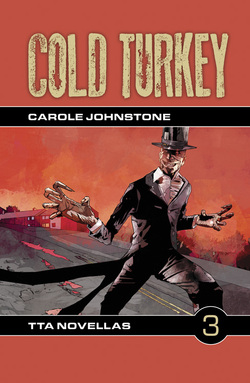 “I saw him Mr Munroe.” A sly look lit up Jimmy’s blinking eyes. “He’s always chasing you.”
Raym’s hand froze in front of his chest, creeping back up towards his throat again. “What?” “In a funny square van.” The kid blinked, blinked, blinked. He wooshed his hands either side of his body like he was starting a drag race, and Raym flinched again. “It’s got black tails – really, really looong ones, like party streamers!” All Raym wants to do is give up smoking. So why is his entire life falling apart? Why are new mistakes and old terrors conspiring against him? Why is he being plagued by the very worst spectre from his childhood? And why does giving up suddenly -- horrifyingly -- feel much, much more like giving in? Buy Cold Turkey by itself for £10 or subscribe to five TTA Novellas for just £30, post-free to anywhere in the world! “Carole has written out of her skin for this novella. How can reading something so dark and insidiously uneasy offer the reader so much pleasure? Cold Turkey is a hammer and Carole Johnstone will cave your skull in with it. Brilliant” —Johnny Mains “Carole Johnstone has the canny knack of making the real seem strange and the weird commonplace. In Cold Turkey, addiction and compulsion spirals downwards into imagined and real nightmares. Top Hat, a creation to rival King’s Pennywise, rides through the urban Scottish landscape that Johnstone has created with an absolute sense of place. Her laugh out loud humour balances her harshness and puts you off-guard before delivering the final blow; if you get in bed with the devil, he’s going to fuck you over at some point” —Priya Sharma “Cold Turkey is rich with nightmarish invention. Johnstone has created a very distinctive villain with the sinister top-hatted tally-van man, yet knows when to hold him back to let other horrors take centre stage. There’s an addictive quality to the well-paced prose that makes reading Johnstone’s stories a habit you’ll never want to kick, and this one’s so good it’s probably bad for you” —Ray Cluley PURCHASE A COPY HERE
Steve
29/4/2014 23:07:59
A fantastic interview. One of the best I've ever read Comments are closed.
|


Archives
May 2023
|
 RSS Feed

|

|