

AUTHOR INTERVIEW: JENNIFER BROZEK
8/12/2016
 Jennifer Brozek is a Hugo Award-nominated editor and an award-winning author. Winner of the Australian Shadows Award for best edited publication, Jennifer has edited fifteen anthologies with more on the way, including the acclaimed Chicks Dig Gaming and Shattered Shields anthologies. Author of Apocalypse Girl Dreaming, Industry Talk, the Karen Wilson Chronicles, and the Melissa Allen series, she has more than sixty published short stories, and is the Creative Director of Apocalypse Ink Productions. Jennifer is a freelance author for numerous RPG companies. Winner of the Scribe, Origins, and ENnie awards, her contributions to RPG sourcebooks include Dragonlance, Colonial Gothic, Shadowrun, Serenity, Savage Worlds, and White Wolf SAS. Jennifer is the author of the award-winning YA Battletech novel, The Nellus Academy Incident, and Shadowrun novella, Doc Wagon 19. She has also written for the AAA MMO Aion and the award-winning videogame, Shadowrun Returns. She is the author of The Last Days of Salton Academy, published by Ragnarok. Website: http://www.jenniferbrozek.com/ Hello Jennifer, could you tell the readers a little bit about yourself? J: I’m a happily married, Ingress playing, road tripping, Pokemon catching, cat servitor. I’m owned by four cats, 1500 books, and a Little Free Library in the shape of a TARDIS. I’ve been a fulltime author and editor for over ten years and I look forward to the next ten years. Could you tell us about gallivanting around the Pacific Northwest? Where are some of your favourite places and what is the appeal of them? J: As part of my Ingress and PokemonGO play, I end up hiking and visiting places all over Washington State. Some of my favorite areas include Windy Ridge, Lake Quinalt, Hurricane Ridge, Wellington Ghost Town, and Leavenworth. Each area has a distinct culture and interesting history to go with it. I learn so much about the world around me as I travel. All of it inspires me. Other than horror, what else has been a significant influence on your writing? J: I read a lot and I enjoy non-fiction books on how the world was created and why we do the things we do. To realize that every single thing around us has a creator, a designer, someone who specifically thought about the use of the item, fascinates me. History also influences me. There are mysterious happenings all the time. All of it begs to tell its story—fictional and otherwise. The other thing that has affected my writing is the amount of travel I did as a child. As a military brat, I lived all over the US and in Europe by the time I was 18. Experiencing all those different cultures and people has left its mark. Everyone has a story about what made them become a writer, what is yours? J: To become a professional author? I’m not one of those authors who always knew I would be an author. I enjoyed reading and writing. I started writing professionally after a friend of mine challenged me to stop being “just a dreamer” because he thought I had the talent to go all the way. I became a fulltime author in 2006 when I decided I’d had enough of the 9-to-5 life. Since then, I’ve never worked so hard to make so little. Such is the life of an author. Do you prefer the term Horror, Weird Fiction or Dark Fiction? J: I usually default to “dark speculative fiction” as a general description of what I write. I unpack that when I talk about each specific work. That’s when I will say “Horror” or “Dark Urban Fantasy” or “Space Opera.” Who are some of your favourite authors? J: That’s a tough one. I have a lot of favorite authors. Growing up it was Asimov, Heinlein, Mercedes Lackey, Steve Perry, Stephen King, Dean Koontz. Now, add in Seanan McGuire, Neil Gaiman, Mary Robinette Kowal, John Scalzi, Jay Lake, Jody Lynn Nye, and Paul Cornell. Honestly, there are more... like Ken Rand's book, The 10% Solution. I read a lot. Michio Kaku and Chris Hadfield also have some great things to say in the non-fiction arena. I think I learn something from every single thing I read. The author who started it all, of course... Susan Cooper. It was her writing that opened up the magic of reading to me. Without her, I wouldn’t be the author I am today. What is your all-time favourite horror novel, and film? J: Horror novel… it has got to be The Stand by Stephen King. I would say The Dark Tower series, but that is such a cross genre series (and more than one book). The Stand made me look at the world and other people in a different light. For horror film… it’s Night of the Comet. I was fourteen and it was the best, scariest, most wonderful film I’d ever seen. I wanted that kind of the end of the world to come. Bonus answer: the movie that scared me the most—so much so that I will never rewatch it—is Phantasm. How would you describe your writing style? J: Fast paced and entertaining. I write exactly the kind of books I like to read. I kill a lot of people—fictionally. You are a Director-at-Large of SFWA, and an active member of HWA and IAMTW, what does this involve, and what do these sort of organisations offer to a new or an established writer? J: Being on the board of SFWA is a job that involves a lot of details, paperwork, research, and forward thinking. We are always trying to make the organization better for our members as well as for all writers. Professional writing organizations offer authors three main things: Publishing industry resources, a community of peers who understand, and the opportunity to network. Becoming a member of SFWA and HWA was among the beginning of my career goals when I first started out. I’ve never regretted becoming a member of either organization. Not everyone gets to be a character in a comic, how did this come about, and how did you feel when you saw the final incarnation of you? J: I know Andy. I roomed with Casey. I read Andy’s comic, Casey & Andy, for a while and enjoyed it. Then, one night I dreamed of being in the comic. I emailed the dream to Andy and laughed about it. He put me in the comic and I was thrilled. Not everyone gets to be an international jewel thief, weirdness magnet, Queen of the Hunkites, who eventually gets married to the Quantum Cop. You started out as a software QA engineer, did this job help with your writing in any way? J: Yes. Breaking software taught me a lot about recreating logical steps, writing clear and concise instructions, as well as usability requirements in software that made me think about the world in new way. As well as your writing you have also written a large number of books in various RPG worlds, how does writing in someone else world differ to writing in your own worlds? J: Writing and editing in someone else’s sandbox is both easier and harder than working on your own original work. With tie-in writing, the heavy lifting of the universe building and rules is already done for you. The hard part is remembering the established details and matching consistency / tone while writing something that enhances and expands the established game world. Regarding your books they have a strong brand regarding the covers, is this something that you think is important for writers to have? J: Absolutely. People feast with their eyes before they feast with their mind. An eye-catching cover will draw a person in. It allows them to imagine what kind of story could be linked to the image. Once the image hooks a person, it is up the story, and the writing, to keep them. And do you feel in an ever increasing digital age this remains relevant? J: Yes. Without a doubt. Physical or digital, cover visuals still attract. The digital age adds in the complication of the cover needing to catch the eye as a thumbnail image as well as a full scale image. It tells the reader something about the story as well as the author and the publisher. Is it a clear, clean, evocative cover? If so, it’s probably a professionally created novel. With your editor's hat on, what do you look in a story when compiling an anthology? J: I want something written to theme that brings a new and compelling look at the subject matter. I want to be entertained. I want to remember the story after I’m done reading it and I want it to be a relatively clean manuscript. I want to publish your story. I just want it to be the kind of story I need. How do you deal with the slush pile? And what is the most common mistake that a writer makes when submitting to one of your anthologies? J: When I read slush, I read as often as the slush pile demands. Sometimes this is daily. Sometimes this is weekly. The most common mistake is not adhering to the guidelines. Especially if I’m reading for a themed anthology or magazine. So many authors see that there is an open call and just toss everything they have at it without regard for what I’ve actually asked for. I frequently have a specific “No X, Y, or Z” list on the call for submissions… and I still receive those kinds of stories. It’s frustrating. In your Melissa Allen trilogy, Melissa is a bi-polar, schizophrenic teenager. Was there a reason why you gave Melissa mental health issues? J: I did. I wrote Melissa so that teenagers like her could have a hero with the same struggles. I am on the Aspergers spectrum. A friend of mine has a daughter I watched growing up with mental illness. She never had a literary hero to identify with. So many teenagers and adults deal with mental illness every day and they are neither villains nor naïve innocents. They are just people trying to get by. And how did you ensure that your portrayal of her was sympathetic and never became just quirk to draw the readers in? J: I treated it like you would treat any other condition that needed daily meds that had drastic effects if you miss a dose. It is like migraines or gastric reflux. It hurts to miss a dose. People who have medical conditions are aware of their medicine, where it is, when they need to take it. So do people with mental illness. It was just one more thing to manage during the story. It was neither good nor bad. I showed some of the coping mechanisms that people go through. So many fans have written to thank me for my common sense/sympathetic portrayal of Melissa and her issues. It makes me glad to have written the series. In The Karen Wilson Chronicles, Karen gets drawn into a hidden world, what fantasy world would you like to get drawn into, and what world would you least like to end up an inhabitant of? J: I would love to be drawn into Susan Cooper’s The Dark is Rising series and, somehow, discover that I am an Old One. If not that, Seanan McGuire’s October Daye series and discover I’m fey who was cursed to be human for a lifetime. Though, admittedly, I'd probably have a hard death if either occurred. Actually, now that I think of it, I really wouldn’t mind being pulled into the Kendrick universe that Karen Wilson lives in. I never want to live in a world like The Walking Dead. No zombies for me, please. I know I’d die a hard, painful death there. Your latest book The Last Days of Salton Academy sees the world or at least part of it gone to rot and ruin, can you tell us what has happened? Or do we have to find out for ourselves? J: A bit over three months before, the “Outbreak” happened and people started becoming zombies. No one knows the who/what/where/how of the outbreak. Just that it happened and no help is coming. The book is set in a school, what was the reason for this? Have you used this setting to explore any issues faced by teenagers in a modern world? J: A lot of it has to do with where we all fit in society and what we all really want to do if the normal rules of civilization break down. How we cope with the loss of real structure and the safety net of an agreed upon code of conduct. Boarding schools are a bit like a bubble world outside of reality. They have their own social structures and language as well as the isolationism I was looking for to set my story. Plus, high school generally sucks and is filled with drama that I wanted to explore. It is an ensemble piece, did you have a checklist of character types before going into the novel, or did you create the characters to resolve sections of the narrative? J: The core set of characters are based on the idealized teenaged versions of my current close friends—that was so fun. Outside of that, I thought about the kids I went to college with and I filled out the ranks with them. For the teachers, I thought about teachers I have had in my life and took aspects of each and exaggerated them until they fit the stories I wanted to tell. Are there any reviews of your work, positive or negative that have stayed with you? J: At this point, no. I enjoyed every good review and I consider every bad review. It’s easy to let the bad ones get you down. But my brain is usually so full of the current / next thing I’m writing, I can’t remember it all. What sticks with me is when my peers tell me they like what I’m doing. Being nominated for a prestigious award stays with me—whether or not I win. Having a fan compliment me on social media brightens my day. Sometimes I will remember the odd compliment. When it comes to the negative stuff, I take the valid critiques and add them to my toolbox and remember it for the future, but I don’t let it get me down. I know, from experience, you can’t please everyone. What aspects of writing to do you find the most difficult? J: Revisions are the hardest for me. Not edits… those are expected. But a revision where I need to remove a character or rework a full plotline. Sometimes, it is needed and it hurts. It’s like doing surgery on the novel. You have to be detailed and diligent. It is too easy to miss things. Is there one subject you would never write about as an author? J: Rape. I will not write about rape. Neither as motivation for revenge nor to show how evil a person is. I will not traumatize myself or my readers with such violence. Rape has become a lazy trope and it is not worthy of me as a writer or of my readers who trust me to write good stories. What do you think makes a good story? J: Something that entertains as well as makes you think. It allows you to experience a viewpoint other than your own and makes you consider the world in a new light. A good story brings joy as well as a quiet enlightenment. How important are names to you in your books? Do you choose the names based on liking the way it sounds or the meaning? J: If it is a real world story, I tend to look for names that mean something for the character—motivation or personality. If it is a second world fantasy or science fiction story, I try to create names that sound interesting, are easy to say, and have a consistency to them—such as all male character names end in “s,” female character names end in “th” and all inter-sex character names end in “a.” How do you think you’ve evolved creatively? J: I threw myself at the ground until I missed. Then I flew. I’m still flying. What tools do you feel are must-haves for writers? J: A good vocabulary, a thick skin, an understanding of the rules of writing so you know when to break them with a purpose, the ability to read your own work aloud with confidence and to listen to the cadence of those words. Also, the ability to sit down and write. Even when you don’t want to. You must be able to finish what you begin. What is the best piece of advice you ever received from another author? J: There are two pieces of advice I’d like to mention. The first… I don’t remember who told me this, but it was “Write the stories you want to read because only you can write those stories.” Once I started doing that, I got better at writing and more people loved what I wrote. The second came from James Van Pelt and it was one of those leveling up moments of understanding. “When writing a short story, know the ending before you begin.” Well, duh. No wonder I’d always had a problem ending stories. Knowing the ending allows you to write towards it with a purpose. I don’t always know how I will get there, but I know where I’m heading. How do you market your work? What avenues have you found to work best for your genre? J: Where do I find the most connection with my fans? Online, it’s Facebook and Twitter. I do a lot of chatting on Twitter, answering questions, talking about my books (cats, family, etc…) and do most of my immediate engagement there. Facebook is for longer posts and happy announcements. I can interact with my fans over a period of time. Otherwise, it is attending conventions and talking face-to-face with them. This is where I get to talk and laugh with people. To answer questions, to give advice, to listen to their favorite parts. I love that. Who is your favourite character from your book and why? J: For The Last Days of Salton Academy, it was Shin Yoshida, the janitor with a sense of duty. He was my most functional adult. I gave him flaws and merits, expecting him to die quickly in the story. Early on in the story, his personality reared up and showed me his quiet, calm, determined mind. Every time I was going to write his death in, he did something logical and I was thwarted. I stopped trying. He really is the perfect support character. He’s my Samwise Gamgee. How about the least favourite character? What makes them less appealing to you? J: Professor Leeds. He was built to be a villain. When I wrote the novel two years ago, he wasn’t nearly as topical as he is today. He is a self-important, lazy blowhard who believes the world owes him something. For those who haven’t read any of your books, what book of yours do you think best represents your work and why? J: Top of the list is the Melissa Allen series--Never Let Me Sleep, Never Let Me Leave, Never Let Me Die. It is some of the tightest writing I’ve done and my heroes are exactly who I think they need to be. It’s a young adult sci-fi thriller series. Plus Never Let Me Sleep was nominated for the Bram Stoker award. Next up is Apocalypse Girl Dreaming, my short story collection. This shows the breadth of my writing—Weird west, horror, space opera, Lovecraftian fiction, urban fantasy, and a couple of my tie-in stories in the Valdemar and Elemental Masters universes. Finally, The Last Days of Salton Academy. This is young adult horror. It’s not the top of the list because it involves zombies and I really don’t like zombies. I don’t plan to write another zombie novel. (Of course, I hadn’t planned on writing this one. So, who knows?) Can you tell us about what you are working on next? J: I’ve turned in two tie-in novels and will be working on edits for both of those soon. In early 2017, I’m going to start a new, original teen horror series. I’ve created most of the world, written the outline and synopsis for the first book, and the paragraph synopsis for the next two books. I’m excited to get back to writing my own stuff. If you could erase one horror cliché what would be your choice? J: That purity/virginity is “good” and being sexually active is “bad.” Especially where women are concerned. Especially where there is a sense of worthiness in saving first and not the second. Consensual sex should not be punished. Yes, horror stories are the modern day fairytale. We have other warnings to give than whether or not a pair of consenting people should have sex with each other. Which fictional character would be your perfect neighbour, and who would be your nightmare neighbour? J: Honestly, most fictional protagonists would be terrible neighbors. Bad things happen to, and around, them all the time. I would hate to be collateral damage. Put a gun to me for an answer and off the top of my head, I’d say Fiji from Midnight Crossroad by Charlaine Harris. Fiji is a witch who likes to garden and has an intelligent cat. Cat people are generally good people in my book. What do you think of the current state of the genre? J: I think it is healthy. There is a resurgence of interest and respect in the horror genre in general right now. Some excellent work is being done in TV, films, and novels. However, you have to remember, like all genres, respect for the horror genre waxes and wanes. Right now horror is on a high and considered acceptable. Soon it will cycle and become the underdog again. Meanwhile, horror writers will just keep writing. It’s what we do. What’s the one question you wish you would get asked but never do? And what would be the answer? J: Question: “How much to option the Melissa Allen series for a movie trilogy or the Karen Wilson Chronicles for a TV series?” Answer: “Let’s have a conversation with my agent…” 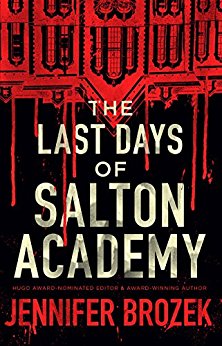 It's referred to as 'The Outbreak,' and it happened just over three months ago, casting the world (or at least this part of it) into a state of powerlessness and chaos. The Salton Academy has become a rare sanctuary for those few students who remained behind over fall break.
As winter approaches, cracks are revealed in the academy's foundations as it's discovered someone is stealing food, another is taking advantage of a captive audience, and yet others have banded together and are thinking about mutiny, even murder. One thing's for certain — a supply run must be made soon, or everyone will starve before winter's end. Oh yes, and then there’s the matter of the headmaster’s son and his undead dog… The Last Days of Salton Academy is a classic tale of horror in the spirit of Night of the Living Dead meets Lord of the Flies, featuring an ensemble cast and written by Hugo Award-nominated editor and award-winning author, Jennifer Brozek. Purchase a copy from Amazon UK Purchase a copy from Amazon US Comments are closed.
|


Archives
May 2023
|
 RSS Feed

|

|