

AUTHOR INTERVIEW : KAREN HEULER
12/5/2014
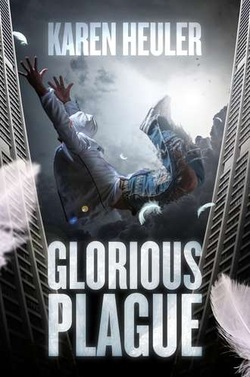 Karen Heuler’s stories have appeared in over 70 literary and speculative magazines and anthologies. She has published four novels and two story collections with university and small presses, and her last collection was chosen for Publishers Weekly’s Best Books of 2013 list. She has received an O. Henry award, been shortlisted for a Pushcart prize, for the Iowa short fiction award, the Bellwether award and the Shirley Jackson award for short fiction. Permuted Press just published her novel, Glorious Plague, about a beautiful apocalypse. Could you tell the readers a little bit about yourself? I’m a cross-genre writer—literary, fantasy, SF, and a little bit of horror. I’ve had over 70 stories published in journals and anthologies, and this is my sixth book. I read recently that every good writer has a theme they return to again and again, a kind of obsession. I think, for me, it may be the unreliability of reality. My characters often accept it without question when the everyday world begins to include unusual objects or events that change their lives profoundly. This can occasionally be something good, but in general it’s not good as we understand it. When angels and devils, say, walk the earth, my characters adjust. “Why?” is not a practical question for them. Do you prefer the term Horror, Weird Fiction or Dark Fiction? I like Dark or Weird Fiction. What is your all-time favourite horror novel, and film? I don’t think anything can beat The Haunting of Hill House, by Shirley Jackson. If you could erase one horror cliché what would be your choice? The stupid person who does exactly what you shouldn’t do—go down into the cellar, go up the stairs, open the door… Although I admit, it’s great to scream at them not to do, and it’s life-affirming to feel you’d never do something quite that stupid. What was the last great book you read? I just recently finished Jeff VanderMeer’s Authority” Loved it. I wish I’d written it. In fact, I might have written it and then been telepathically robbed of the story somehow. How would you describe your writing style? I’m literary. A lot of my writing includes references to something in the literary canon. I’ve figuratively tipped my hat to Dostoyevsky, Kafka, Proust, Fitzgerald, Austen. Sometimes it’s embedded in the title, or it’s invoked in a bit of dialogue that (nudge, nudge) leans on a scene in a book or story. I don’t know if anyone is noticing. Are there any reviews of your work, positive or negative that have stayed with you? Oh yes. Oh yes. What’s the most important lesson you have learned about writing? I think I learn a new lesson every few years, or few decades. Right now I’m learning that nothing is necessarily finished just because I think it’s finished. The right ending is not necessarily the first ending (and increasingly, not even the sixth ending). I can keep trying out endings but nothing should get sent out until there is no doubt that this is the ending, the right ending. Ah, but then I change my mind again. What aspects of writing to do you find the most difficult? Waiting is the hardest part. Waiting for the next scene to come together, waiting for the end to become clear, waiting for the acceptance note. Waiting for the next good idea. How do you think you’ve evolved creatively? I keep learning more and more by reading both classic and new writers. I love being surprised by a story, and it always renews my resolve to make my own stories just as surprising. Who is your favourite character from your book and why? Ultra Sophia. She rides elephants after the world collapses, and she creates a sort of army of women. How about your least favourite character? What makes them less appealing to you? Hmmm. Well, I tried to dislike Wrace a lot more than I ended up doing. He wants to take over Manhattan after everything falls apart (and he’s a counter to Ultra Sophia, since he builds up an army of men). He’s a minor employee who seizes the opportunity to be the big man, and that’s not attractive to me. But in fact, everyone gets the chance to be what they wanted to be—everyone gets a chance at their fantasy in this book. He didn’t do terrible things, he only played at doing them. Fame, fortune, or respect? I see no reason to be picky. For those who haven’t read any of your books, what book of yours do you think best represents your work and why? I think Glorious Plague has a lot of very cool stuff in it. The ideas in it have a great deal of power for me. Obsession; glory; the chance to be something new; the start of the new world. The way stories come to life. The way life turns into stories. When I drive over the George Washington Bridge (NY/NJ), I always see the people climbing and singing (I forget for a moment that they all die). Journey to Bom Goody, which came out almost a decade ago, is the next one I would say represents me the most. It’s about a man who takes generators and videos to the Amazon so the natives have a chance to look at our culture as much as he’s watched shows on PBS. He meets up with a woman who’s trying to collect cures before the shamans disappear. They find themselves on unexpected journeys. Can you tell us about your last book, and can you tell us about what you are working on next? Glorious Plague is about a beautiful apocalypse. An insect virus crosses over the species barrier. In insects, it causes caterpillars and other bugs to climb to the top of the plant and die. In humans, the impulse to climb is combined with a rapturous need to sing, and to find the right song. Those who survive have to figure out how to live in an abandoned city, and then strange things happen, but no one seems to think they’re strange at all. Except for one man. I’ve finished the first draft of what will either be a novel or a novella; I’m gathering stories into collections and sending them out; I’m working on finishing another long-term project and getting that one out there as well. Basically, I’m tidying up the children and sending them out to get jobs. THE GLORIOUS PLAGUE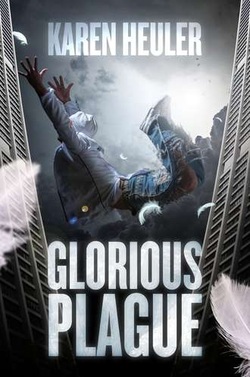 When a virus leaps the species barrier in “Glorious Plague,” by Karen Heuler, people all over New York and New Jersey start singing and climbing to the rooftops, to the bridges, to lamp post and road sign, steeple and water tower, singing gloriously, triumphantly, tirelessly—and dying. When it’s all over, Manhattan has to rebuild a new society, and it seems to be having a lot of help in the form of angels, gods, and walking myths. What’s real? And does it really matter? It does to Dale, searching for her missing daughter, and to Omar, an entomologist searching for the cure, if there is one, with little interest from those in the grip of the new order. PURCHASE THE GLORIOUS PLAGUE FROM THE LINKS BELOW
THE HORROR WEBSITE23/6/2014 19:36:11
I would like to thank you for the efforts you have made in writing this article. 23/6/2014 19:36:32
Interesting info, do you know where I can find similar information? 23/6/2014 19:36:55
17/8/2014 22:24:48
Hello,I love reading through your blog, I wanted to leave a little comment to support you and wish you a good continuation. Wishing you the best of luck for all your blogging efforts. Comments are closed.
|


Archives
May 2023
|
 RSS Feed

|

|