

AUTHOR INTERVIEW: LUKE T. HARRINGTON
13/12/2016
 Luke T. Harrington is an accomplished humor writer, with work that has appeared at Cracked, BuzzFeed, and other outlets. He recently made his fiction debut with Ophelia, Alive (A Ghost Story), in which a college student discovers she’s haunted by more than just her past. Author Rob Kroese called it “a white-knuckled ride into the mouth of madness”; author Brad Carter called it “a literary kaleidoscope”; Luke’s mom called it “a really good book.” Luke lives in Tulsa, Oklahoma, with his wife and two daughters. You can follow him on Twitter or Facebook, or visit his website. Could you tell the readers a little bit about yourself? First of all, I’m pleased to say that my debut novel, Ophelia, Alive (A Ghost Story) was recently published by Cincinnati-based published Post Mortem Press. It’s a psychological thriller about college, family, ghosts, and assorted Freudian creepiness. This is basically my debut to fiction, but I’m already somewhat estanlished as a humor writer, with pieces that have run at Cracked, BuzzFeed, and elsewhere. Over the last few years, I’ve spent most of my time writing acclaimed humor columns for a couple of Christian publications—one called “LOL Interwebz” for Christ and Pop Culture, and one called “Dumb Moments in Church History” for Christianity Today. Outside of writing, I’m basically just a stay-at-home dad to a pair of young daughters, so I mainly divide my time between cooking, cleaning, playing with my kiddos, and ignoring them to write while I blast “Cats in the Cradle” on an endless loop in my headphones. (Not really.) (But sorta.) What do you like to do when you're not writing? Between writing and chasing babies around, my schedule’s pretty tight, but my first love will always be music. I’ve been a singer/keyboardist for a number of short-lived blues bands, and I once composed half the music for a stage show entitled Canada!: The Musical? Other than the horror genre, what else has been a major influence on your writing? Shakespeare. Dr. Seuss. Ralph Ellison. Ozu. Pasolini. The book of Job. Over the Rhine. C.S. Lewis. Victor Hugo. Ray Bradbury. Your mom. The term horror, especially when applied to fiction, always carries such heavy connotations. What’s your feeling on the term “horror” and what do you think we can do to break past these assumptions? Man, I don’t know. I used to call my book “literary horror,” but then I realized no one wanted to read “literary horror,” so I started calling it a “psychological thriller” instead. Personally, I’ve always thought “horror” sounds classier than “thriller”—I thought that by using the word “horror” I’d be invoking Poe, or Lovecraft, or Shelley—but that’s not where most people’s minds go when you say it. They think, “Oh, this guy probably sits around watching Friday the 13th sequels all day.” (I can neither confirm nor deny that I sit around watching Friday the 13th sequels all day.) All that said, I kind of wonder whether horror fans really want to destigmatize the genre. Most of the horror fans I know really like their little subculture, and going mainstream always comes at a price. A lot of good horror movements have arisen as a direct result of the socio/political climate. Considering the current state of the world, where do you see horror going in the next few years? To be frank, I’m not sure the recent election of Donald Trump bodes all that well for horror—not because he has any specific plans to deport horror writers (that I know of), but simply because having such a cartoonish villain looming over the world is likely to make horror writers lazy. (Kevin Smith’s horror film Red State is a good case study for this—Fred Phelps, the film’s target, is already such an over-the-top weirdo that the movie just feels farted out.) I do hope I’m wrong—maybe we’ll see the same sort of horror renaissance that we got from Universal Studios during the Great Depression. That would be cool. What are the books and films that helped to define you as an author? Recently—after I had already completed Ophelia--I discovered the literary horror novel One Bloody Thing after Another by Joey Comeau, and my immediate reaction was, “Dangit, why can’t every book be exactly like this one?” I imagine that for the rest of my career, I’ll be fighting against the urge to write a book that just straight-up rips it off. Other books that have influenced me a great deal include C.S. Lewis’s Till We Have Faces, Ray Bradbury’s Fahrenheit 451, Ralph Ellison’s Invisible Man, and Norton Juster’s The Phantom Tollbooth. Movies that have inspired me include The Exorcism of Emily Rose, Dark Water, Citizen Kane, Rashomon, and Ratatouille. I’m eclectic like that. What new and upcoming authors do you think we should take notice off? As I mentioned above, definitely Joey Comeau. He’s already somewhat well known for his webcomic A Softer World, but I hope he returns to horror fiction soon. His book is like nothing else. Other books I’ve enjoyed recently have included Brad Carter’s Saturday Night of the Living Dead, James Watson’s A Window on the Door, and Kit Power’s GodBomb! How would you describe your writing style? It’s like if H.P. Lovecraft wrote a spec script for Gilmore Girls. Are there any reviews of your work, positive or negative, that have stayed with you? I’m pretty new to the fiction game, so getting anyone at all to look at my work—let alone review it—is a struggle. Still, there’s at least one review floating around out there that compares me to both Faulkner and Dostoyevsky, so that was nice to see. What aspects of writing to do you find the most difficult? This will probably sound awful, but the biggest challenge for me has been plot structure. When I started the book, I knew I was capable of writing some pretty good prose, but I discovered pretty early on that putting that prose into a shape readers would actually want to keep reading was more difficult than I had imagined. Now that I’ve devoted literal years of my life to studying how to craft a compelling narrative, I get really angry when I have to sit through a story that’s lazy or nonsensical (I’m looking at you, Kubo and the Two Strings). Is there one subject you would never write about as an author? Not in principle, but possibly just because I can’t write about it well. I’ve found that I’m really bad at writing about sex and romance, which is a pretty huge gap to have in your skillset. My first few drafts of Ophelia had a romantic subplot, and I ended up cutting it entirely because it was garbage. Oh well. Maybe someday I’ll crack the code on that stuff, and then I’ll go be the next Jane Austen. Or not. How important are names to you in your books? Do you choose the names based on liking the way it sounds or the meaning? Sometimes I totally overthink it and give my characters pretentious literary names like “Ophelia.” Sometimes I just pick a name at random. My sister got really mad at me when I accidentally gave a character the same name as her ex-boyfriend. Writing is not a static process; how have you developed as a writer over the years? It took me decades, but I’ve finally learned the value of revision. Anything worth writing is worth writing twice. Especially if you want someone other than your mom to think it’s good. What tools do you feel are must-haves for writers? Nothing. Seriously, just start writing words, even if you have to scratch them into the dirt with a stick. I spent way too much of my life daydreaming about having the perfect writing setup before realizing it was never going to happen. Now I just sit at my kitchen counter and tap away on my laptop. Just start writing with whatever tools you’ve got. There are plenty of good books out there about how to write—I found Blake Snyder’s screenwriting bible Save the Cat! pretty useful for learning the basics of plot structure—and you’ll probably also need a good coffeemaker. (I’m a Nespresso man, myself.) But seriously, don’t worry about what tools you have. Just start writing. What is the best piece of advice you ever received with regards to your writing? “Just write. Just get something on the page. You can fix it later.” I forget who told me that. Probably, like, a dozen people. Maybe it was Yoda. Getting your work noticed is one of the hardest things for a writer to achieve; how have you tried to approach this subject? I’d be lying if I said I had any clue what I’m doing in this department. I’ve managed to build up a bit of an audience online over the years, but since most of them know me as a humorist, a horror novel can be a hard sell to a lot of them. I’ve also held a few book signings, and I’ve submitted it to as many review sites and competitions as I can, but, y’know, that’s a process. Seriously, if some wise old writer wants to take me under his wing and show me the ropes to marketing myself, that would be great. Feel free! To many writers, the characters they write become like children. Who is your favourite child, and who is your least favourite to write for and why? Obviously, I’m pretty attached to the title-character-slash-narrator in Ophelia. You can’t spend that much time in someone’s head if you don’t like them. So far my least favorite character is one I created for my upcoming book. I based him on a fifteen-year-old me, and every time I tried to write a scene for him, all I could think was “Geez, this kid’s an asshole.” I ended up killing him off as soon as I could, and I’ve cut him entirely from subsequent drafts. What piece of your own work are you most proud of? I wrote a piece for Cracked a few years ago called “6 Filthy Jokes You Won’t Believe Are From the Bible.” It blew up the Internet for a couple of days, but I’ve never managed to duplicate its success. Sigh. Maybe someday. And are there any that you would like to forget about? I tried to write an epic poem about a trip to Mars back when I was in second grade. Right around the part where I wrote a line about how “Mars is made of candy bars,” I realized that my forcing of the rhymes had pretty much killed the narrative. For those who haven’t read any of your books, which of your books do you think best represents your work and why? Ophelia, Alive, because it’s my first and only book. (But it’s good!) (Probably!) Do you have a favorite line or passage from your work, and would you like to share it with us? I’m partial to this passage, where my character argues with her English professor about whether Freud was full of crap: “In this scene between Hamlet and Gertrude, we see there are geysers of repressed sexuality bubbling beneath the surface—” I raise my hand. “Uh—” he stops and gives me that deer-in-the-headlights look. Shock and disbelief because no one ever raises their hand, no one ever asks questions, no one ever says anything in this class. “I’m sorry, do you—do you have a—” “Yeah, uh—isn’t the Oedipal complex something that Freud just made up in 1910? How would Shakespeare have known about it 300 years before that?” It’s a softball question, something just to get things moving. But even this one makes him stutter. “Uh—yeah—well, Miss—” “Electra. My name’s Electra.” It’s a big class. I’m not risking anything at all by giving him a (hilarious) fake name. He raises an eyebrow, but he doesn’t question it. “Well, Electra, it’s true that Freud didn’t describe the Oedipal complex until 1910, but that’s not quite the same thing as saying the Oedipal complex didn’t exist until 1910.” “But Freud never provided any evidence for it, either—” I just interrupted him, not on purpose, but he jumped when I did it, and I’m trying not to laugh—“and modern psychology has discredited it. There’s no reason to believe in the Oedipal complex, and there never has been.” Heads are turning. This is fun. I haven’t been the center of attention like this in a long time. I’m hot and flushed, and I pull off my hoodie. “Um, well—you’re right about that, Electra, that mainstream psychology rejects the idea of the Oedipal complex, but it remains a recurring theme in literature—” “Yeah, but I mean, do writers keep using it because it’s a real thing, or just because they’re lazy writers?” (Note: guilty as charged.) Can you tell us about your last book, and can you tell us about what you are working on next? Ophelia is my first, but I’m already hard at work on a second novel, tentatively titled The Girl with the Ghosts inside Her. (I don’t know if I’m going to stick with that title, since titles with the phrase “The Girl” in them are already becoming kind of a cliché, but that’s what I’m calling it for now.) It’s less of a straightforward horror novel and more of a “dark urban fairytale” about a possessed girl, an enchanted village, and a disgraced televangelist. If you could erase one horror cliché what would be your choice? The “Don’t go in there!” moment—the thing where a character enters a creepy room for no reason at all, just to set up a Scary Thing that’s about to happen to them. A scare without believable characters and motivations is like a punch line with no setup. Give me stories about characters, not just scary things happening. What was the last great book you read, and what was the last book that disappointed you? The last book I loved was the short story collection Gutted: Beautiful Horror Stories from Crystal Lake Publishing. It’s a great little assortment that embodied a lot of what I hope to accomplish with my own fiction—stuff that breaks your heart while it stabs you in the gut. Brian Kirk and Christopher Coake both have stories in it that wrecked me. The last book that really disappointed me was All Hallows’ Eve by Charles Williams. He was a member of the famous writers’ group “the Inklings,” which included greats like C.S. Lewis and J.R.R. Tolkien, and he was the one in the group who wrote horror, so I was excited to finally read his stuff. I honestly couldn’t get past page 40, though—it was just a mess of impenetrable purple prose with no discernable plot. Maybe I’ll give it another try some time, but I really loathed it. What's the one question you wish you would get asked but never do? And what would be the answer? Q. Luke, which High School Musical movie has aged the least badly, and which gutter do you think Zac Efron is currently lying in? A. The second one, weirdly enough, and I don’t know, but I hope it’s a nice gutter. 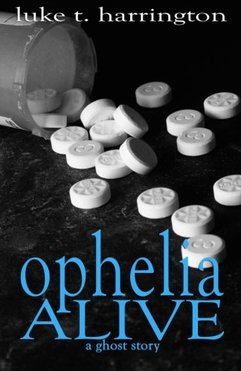 Trapped in the 5th circle of university hell, flat broke, then the bodies start piling up.
I should have sensed something wrong when my mortician sister offered me a job. And I should have known something was up when she talked me into taking those pills. At the very least, the hallucinations should have been a red flag. But now, here I am, standing over a half-eaten corpse. I can’t believe I didn’t see this coming. Noted humorist and Cracked and BuzzFeed contributor Luke T. Harrington presents his first novel, Ophelia, Alive, a thrillingly original horror opus of murder, drug addiction, Freudian psychobabble, and existential jeremiads. Crammed full of experimental prose, tenuous allusions to zombie movies, copious quotes from Shakespeare and Poe, and a bunch of weird stuff about sex and religion that will probably make you really uncomfortable, Ophelia, Alive is like nothing you’ve ever read before. Unless you’ve read Hamlet. It’s actually a lot like Hamlet. Comments are closed.
|


Archives
May 2023
|
 RSS Feed

|

|