

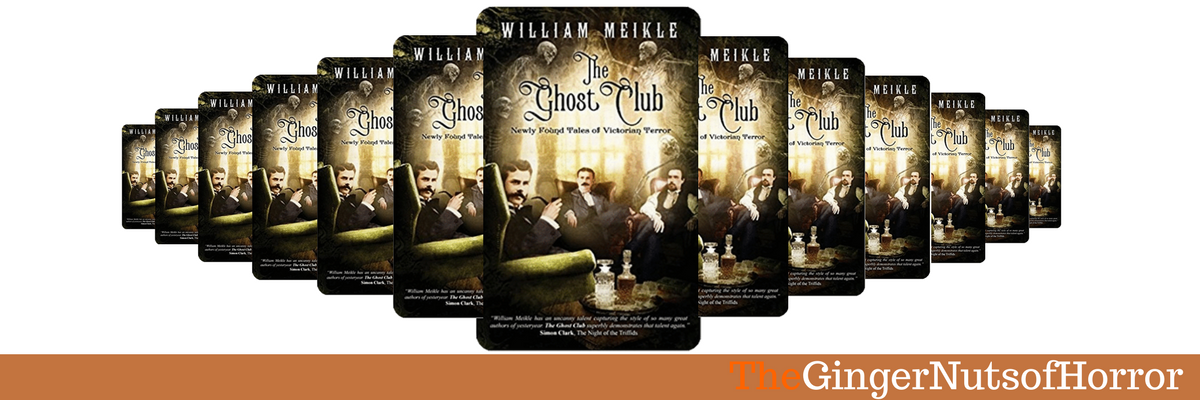
 Ginger Nuts of Horror is honored to have fellow Scot Willie Meikle feature for a special interview to mark the launch of his new collection The Ghost Club. Willie has been one of my favourite authors for more years than either of us probably care to remember . I came across his novel Island Life in the now sadly gone Waterstones in the east end of Edinburgh. A classic love letter to the Lovecraft Mythos, that contained all the elements that makes Willie's writing so engaging. Willie also holds a place dear in my heart, for it was Willie who first gave me the idea of setting up Ginger Nuts of Horror, whilst I was recovering from a nasty bone graft / wrist fusion. So here we are almost ten years later, and I could never have imagined running a website that has become so popular and successful. For that I will always be forever grateful to Willie. So please read on and please share this interview and purchase a copy of Willies book from the universal Amazon link at the end of the interview. Hello Willie, it's been 12 years since you sold your first appearance in a professional publication. Looking back on the day you had a mass signing at Blackwells in Edinburgh where you stood side by side with Charlie Stross, Ken MacLeod and Hal Duncan, do you think you have made it? Hello again, Jim. Nice to be back here. You're right, that day was a pivotal point, and made me think I could do better than hang about in the small press as I had been doing. Since then, in one way I have made it, in that I've since sold eighty professional short stories to great markets, and I've been supporting Sue and I on the writing since 2008. I've also got a lovely shelf of limited edition hardcovers of my work that make me very happy. But in my own mind I haven't quite made it on the novel front, not yet anyway. Sure, I've had books with some of the biggest of the genre publishers, and some of them sell relatively well. But others vanish without a trace, and the big breakout book eludes me, the one that would get me a mass market deal into all the shops and get talked about by everyone. I'm not sure I have one of those in me, but I'll keep trying. I thought I'd hit on something unique to me that might do it in the Sigils and Totems idea. Although it had me excited and BROKEN SIGIL in particular got great reviews, neither of the other novellas, or the SONGS OF DREAMING GODS novel have, as yet, caught the readers' attention the way I'd wanted. I've got one more novel and another novella coming using the idea and although I have many more ideas ready to go for the mythos, I'm not sure I'll write them, unless interest picks up. It was at that signing that you thought to yourself "that you could do this", how important do you think this attitude is to a writer? And what other attributes do you think are key to a writer's success? I was very cozy placing short stories in the small press to tell the truth, and had sort of resigned myself to the fact that I was destined to stay there, as I hadn't found a voice for my stories that would move them on to the next level. The "I can do this" thought definitely helped me push through that barrier. My story in the Nova Scotia anthology was looser than my usual work, more Scottish too, and that led me to write more stories where I just let it flow and let myself believe I was doing the right thing. So I think, to answer your question, it's more a case of trusting yourself to do it and getting the words out of your head and into the work. It was only when I stopped thinking too much and started doing that my output, and my quality I think, improved dramatically. Boiled down? Words are good. Lots of words are very good. Over the past 12 years, you have sold your work to some of the biggest names in genre presses, however, sadly this year has seen many of these presses, unfortunately, close their doors. What impact did this year have on your writing? It certainly knocked me back, both in confidence and in the bankbook. I had been loving, in particular, the quality hardbacks from Dark Renaissance, and the combination of lovely hardcovers and good ebook sales from DarkFuse, so when both of them folded, (and DarkFuse went owing me back royalties) I was a bit lost for a wee while. I considered, as I'm fast approaching sixty, throwing it all in for an early retirement. But I found I don't particularly want to do that, so I set about rehoming the lost babies and luckily have found new homes for them at Gryphonwood Press, Lovecraft Ezine, and Crossroad Press, all of which are small presses I trust to do the right thing by their writers. The sorting out process has meant that this year has had a lot of the admin / business end bollocks in it, which is a pain. Coupled with Sue being very ill and almost dying in the early summer, my head's not been in the game as much as it has been in the past. But I've managed to get some work done that should see fruition next year. I'm still really going to miss the limited edition hardcovers though. Looking forward what impact do you think these closures will have on the genre, in particular, how do you think we regain confidence in the genre once more? The DarkFuse one has had the biggest impact I've seen, as it wasn't well handled and left a sour taste in a lot of people's mouths, and bad blood across a swathe of social media. But I think the confidence is still there, with people like Journalstone still holding the fort, and the new wave of self publishers doing well for themselves. These things come and go in waves over the years and I'm sure we'll be back on the up soon enough. One thing that worries me is the power Amazon now have over nascent careers, in that, as the big boy in the market, they can take all your hard work away and stop any momentum you have dead in its tracks by simply switching off your listings. I think that's going to make a lot of people reconsider their use of Amazon as their sole point of sale, and that's going to have repercussions in the days to come. I'll certainly be keeping an eye on that. As for regaining confidence, that's a step at a time job. We need to write good books, and get them into people's hands. Same as it ever was. This year has also seen you and a fair few other writers who are held in high regard come under attack for writing what certain factions feel are less worthy texts. Why do you think that even now in this so-called enlightened age some people feel the need to shoot others down for just being successful? Because they're bawbags. That's the short answer, and the only one I really give any time to. As Brian Keene said, I'm not writing for them. Another answer is that they're crap at research and usually haven't read the work of the writer they're castigating. There's also the fact that some people have been up on pedestals for a long time and have just noticed they're not king of the dung heap any more, and I think it makes them fling shite for attention. Then there's the folks who see their dung-heap former king flinging shite and decide they need to join in. There's plenty of them around too, and they are also bawbags. Another answer, sadly in my view, is that a lot of people just don't get pulp fiction and think it's beneath them. That's their problem, not mine. During your time as a writer, the horror genre has changed, fractured and diversified to a point where most big name publishers don't know how to market it unless it has lovesick vampires or some other such teen-friendly protagonist, how do you as a writer navigate this new horror playing field? That's been a problem for years now. Some writers get over it by focussing tightly on a chosen subset of the genre and making a name there, whether it be in the weird, paranormal romance, bizzarro or splatterpunk. Me, I go for the scattergun approach. I write out of the horror genre quite a bit these days, and have been making strategic alliances with fantasy writers in things like the Veil Knights cooperative. I have been writing science fiction short stories to sell to the likes of Nature Futures and to a children's market in China that nobody has heard about but who pay better than anyone else I've ever published with. On the horror side, my own particular brand of a mixture of nostalgia and pulp is a tough sell in the most part. It's not helped by the fact that people know me for different things. Some, like Joshi for example, only know I write Carnacki pastiches, others know me only from the Sherlock Holmes stuff, others only from DarkFuse, or Dark Regions, or the Lovecraftian anthologies, or from Derek Adams, and some only know me as 'the pulp monster guy'. It makes marketing myself a bit of a nightmare at times, and I'm sure it has scared off more than a few potential leads over the years. You have previously said that one of the things you dislike about being a writer is the isolation, with that in mind why did you move to Newfoundland? We came over on holiday in 2005 and loved it. When my job in Edinburgh went tits-up in 2007, it was just when I was starting to get some serious pro-level story sales, and we knew we could get a house dirt cheap over here. So we sold up in Scotland, whacked some money in the bank, bought a house on the shore here, and I tried writing full time. It's been working so far in that we haven't starved. And as you know, I'm a country lad at heart, and have always had a hankering for the sea. I've spent 20 of the last 25 years near the water, and it's where I want to be. Plus there's the weather, which is spectacular in its variety, as is the wildlife. I've been close enough to touch moose, beaver, sperm whale, humpbacks, dolphins and orca, and bald eagles circle overhead most days. We even had two visiting polar bears last winter. The people are very friendly, mostly of Irish descent around here, and it's lovely and quiet, which suits me just fine. In this always switched on and hooked in era, do you ever feel truly isolated? That's been the good thing. My Facebook buddies, and that means you too, make sure that I'm never far away from a fine mixture of news and nonsense and gives me a small sense of being part of the wider community. I do get jealous when I see all of you at various cons having a good time. But looking out the window at our view usually sorts that out fast. As a Scotsman living away from the motherland, what do you miss the most? Family, mostly. My mum and dad are both in their eighties, and my sisters both have families of their own that are growing and multiplying without me seeing them. I need a decent book deal to come along and make me rich enough to afford our airfares back for a holiday soon. Apart from that, I miss real ale – there's not a handpump within 100 miles of me. And I miss bridies. And old stone buildings as it's all timber houses over here. So, a lovely peppery Forfar Bridie, and a pint or three of Harvieston's Bitter and Twisted with my auld ma and faither in St Andrews would suit me just fine about now. Scotland has always had a history of great storytelling, particularly with regards to stories filled with high adventure and derring do. What is it about the Scottish psyche that brings this out? Some of it is the countryside, the history and weather. All those lonely hillsides, stone circles, ancient buildings and fog are ripe for stories to be creeping about in. Then there's all the fighting. A country that's seemingly been at war with either somebody else or with itself for most of its existence can't help but be filled with stories of love and loss, heroism and betrayal. The fact that we've always been England's scruffy wee brother, and have been slightly resentful of the fact for centuries adds another layer – the wee chip on the shoulder and the need to prove yourself is always a good place from which to start an adventure. Added to that that we're a melting pot of Lowlander's, Highlanders, Islanders, Scandanavians, Picts, Irish, Dutch, English, Indians, Pakistanis and Chinese and everybody else who has made their way to the greatest wee country in the world, all with their own stories to tell and to make. And when it's raining and dreich, what better than to sit by a fire with a stiff drink and tell some stories? You can see a lot of influences on your writing but the ones, for me that are the most evident Doyle, Maclean, Barrie, Stevenson and Scott. Having grown up in an era where the likes of king and Campbell didn't feature in your formative years as a reader, what impact do you think these writers had on your writing style? As you say, my formative years were pre-King. I didn't start writing until '92 but my reading habits were voracious from the late '60s onwards. And yes, Doyle, MacLean and Stevenson in particular were all huge parts of that, Scotsmen who made their way in life as storytellers, and all in rip-roaring adventures. Doyle and Stevenson of course dabbled in the horror and supernatural genre. MacLean didn't but reading something like The Satan Bug, I think you can see that he'd have made a damn fine pulpy horror writer in different circumstances. All three of them have a way with character and action that speaks to me, probably that Scottish psyche thing again, and all three have followed me all the way from that early reading fifty years ago, and out into my own writing. You have written in many different sub-genres and styles, but you always seem the most comfortable with the historical weird fiction/occult detective genre. From your excellent Holmes versus the supernatural to you deeply entertaining Carnacki stories and your own brilliant Midnight Eyes files series of novels, what is it about this type of story that endears you to it? There's a couple of things that draw me to it. I discovered I like writing serial characters for one, and the occult detective genre is a perfect home for recurring characters that you can hang story hooks on and see how they react to different situations. Carnacki in particular speaks to me as he's got his wee drinking and smoking club of mates that come around and listen to his stories. Sitting around a fire drinking and telling stories with old pals is pretty much my idea of a good time, so writing Carnacki just reinforces that for me. Plus, as an ex-smoker, it lets me vicariously indulge in old habits. Again, my writing in this genre is a form of nostalgia for me, taking me back to the roots of my reading as a lad as I mentioned earlier, and the club story for Holmes and Carnacki. For Derek Adams, it's a different nostalgia, one for my student days in Glasgow, on the grounds of the old University, tramping the bars of Partick and Byres Road and walking the slightly seedy 70s streets of the old city. Derek lets me indulge the fantasy that I never grew up and moved on, so maybe there's a bit of J M Barrie influence there rather than the others. And what is the one thing that really annoys you about these type of stories? For one thing, you know there's never any ultimate fatal peril coming for either Carnacki or the Dynamic Duo in the Holmes' stories. I'll admit they're prone to coziness and predictability, and Holmes' general arseiness often annoys me even when I'm writing it, but for a lot of people that's the charm of them. And with Derek I'm trying to subvert that a bit with his sarcasm and humor. Cozy and predictable are two words not usually associated with Glasgow. Have we seen the last of Derek Adams and his Midnight Eye Files? Not at all. I had the Deal or No Deal novella last year, and there's a new one coming soon in an anthology OCCULT DETECTIVE QUARTERLY PRESENTS. I've also recently finished a "Derek meets the Mi-Go" story that'll be looking for a home. In the "file of things to make and do" there's a wee list of about half a dozen novel ideas for Derek that I hope to get time to get round to before I'm done. It would go faster if somebody gave me a big sack of cash, but I'm not holding my breath. He was sleeping for a while, but it looks like he's awake again. Like me, he's getting older now, and needs more kip between his drinking sessions. You have recently released INFESTATION, Russian Spy boats sweary Scottish heroes and things scuttling about eating everything in their path, this seems to be the most Meikleistic book of your career. Drawing on such greats as Alister Maclean, Saturday matinee movies and the landscape of where you live, what was the inspiration behind this story? You've mentioned a lot of it already. Severed Press approached me and asked if I was interested in writing a pulp monster book, and it was at exactly the right time for me to jump in to something escapist and fast moving that would keep me busy but not overwhelmed. As a big-bug novel, its antecedents are obviously 50s B-movies, Guy N Smith novels and, as it's in the Arctic, and with a British Special Forces team, the Alistair MacLean influence is up front and center. Plus, it's got giant, giant isopods, and I love those wee beasties. As I said, I wanted to do something fast – my better selling books have always been the ones that came out hot, like The Invasion, Crustaceans, The Valley, and The Hole. This one came out in a rush in less than a month, and it reads like a big silly monster movie on paper, which is what I wanted it to read like. I love it, and I hope my readers do too. While some might infer that your stories are pure adventure stories much of your work has A message between the lines, does INFESTATION have a message like the one in THE CREEPING KELP? As we've both got Biological Sciences degrees, you know that the conservation stuff creeps in here and there in my work. There a wee bit about the perils of drilling in the Arctic, which is something that I think is going to be a story in a few years time, and I've got a few things to say about friendship in there too but… Nah. It's just sweary Scottish soldiers shooting the fuck out of really big bugs. Next month sees the launch of your latest collection THE GHOST CLUB, can you tell us about this book? It's a simple premise. In Victorian London, a select group of writers, led by Arthur Conan Doyle, Bram Stoker and Henry James held an informal dining club, the price of entry to which was the telling of a story by each invited guest. These are their stories, containing tales of revenant loved ones, lost cities, weird science, spectral appearances and mysteries in the fog of the old city, all told by some of the foremost writers of the day. In here you'll find Verne and Wells, Tolstoy and Checkov, Stevenson and Oliphant, Kipling, Twain, Haggard, Wilde and Blavatsky alongside their hosts. Finding the right voice for each different story was a challenge in itself. There were times when I really thought that my pride was telling me I could do it, but that it was going to bite me in the arse if I thought I was going to get away with it. It's probably the most ambitious thing I've attempted, ever, and I might have overreached myself a tad, but the blurbs and feedback I've got from writers I admire like Simon Clark, Nancy Kilpatrick, Stephen Laws and Scott Nicholson suggest I've got something right :-) It's out on 9th December, in ebook and paperback from Crystal Lake Publishing. Your stories always seem to be best suited to reading next to a roaring fire with a glass or two of good spirit, what would be your ideal pairing of spirit for The Ghost Club? It has to be a single malt, and something not too fiery. I really love Talisker, but that's a bit too in your face for a long bout of either talking or listening. So something smooth and lingering. Highland Park is a contender for a good all-rounder, or The Glenlivet. But I'd probably go for an Ardbeg. I have fond memories of walking the road in the pishing rain to the distillery on Islay many years ago, and it's smoky and peaty and just right for Ghost Club stories too. The book is being published by Crystal Lake Publishing, what does a publisher like Crystal Lake bring to the table? Crystal Lake are small, but they're going places, as evidenced by their recent run of top-notch anthologies with some of the biggest names in the business getting on board. They're putting out good quality books with good quality work in them, and getting a name for themselves as a small press that's doing things right. They also did a fine job with my SAMURAI and Other Stories collection of reprints a few years back, so I trust them to do the right thing by me. Ben Baldwin's doing the artwork for the cover again, which is always a plus, and Joe seems to have a head for the business side of things, both in admin and promotion, that's going to stand him in good stead through his publishing career. The Book is being supported by a Facebook Book launch on Dec 6th, 2017, what can the attendees expect from the launch? There's a blog, podcasts, reviews and interviews tour that's up to over twenty stops, where I'll be talking about THE STONE TAPE, Scottish supernatural fiction, the influence of London on my work, my five favorite ghost stories and much more. I'll also be doing live readings from the stories on the Facebook Page, so there will probably be beer and silly voices and maybe even some singing. We're working on arranging some competitions and giveaways of signed books and stuff too. It's coming together nicely. Join us here à https://www.facebook.com/events/1980022735543624/ Have you done one of these before, and if so what are the key elements to make them successful? This is my first, so I'll answer this question once it's finished. J I'm interested to see if it has a significant effect on early sales of the book, but I think I'm going to enjoy it anyway, being a bit of a performer at heart. You have never been known to sit on your laurels, so what next for Willie Meikle? I mentioned earlier about forging alliances with fantasy writers – this has taken me into the writing of a big historic fantasy trilogy along with a name writer. We're two books in and I'll be working on the third this winter, then we'll be setting about finding the right publisher for it. I haven't tried anything like it since the Watchers trilogy more than fifteen years ago, and my writing has moved on a tad since then. It's been great fun so far. We've also got the VEIL KNIGHTS fantasy series to finish off, and although my novel in the series has already been published, as a collective we've got the big finish to coordinate and advertise coming up. There's that, and another book for Severed Press with the Scottish soldiers and another menace to face. I've got three new novels ( and a big batch of the DarkFuse reprints) coming from Crossroad Press, which includes THE BOATHOUSE, another in my Sigils and Totems works, RAMSKULL, a new Scottish Hammer horror tribute about satanism and bloody mayhem on a Hebridean island, and DEEP INTO THE GREEN, a Newfoundland based dark fantasy about miners delving where they shouldn't. One thing I'm quite excited about is a novella appearance in I AM THE ABYSS, a huge anthology from Dark Regions, mainly because I'm sharing page space with some great writers, and I get a double page color artwork from the great Les Edwards. I spoke earlier about feeling as if I'd made it? This helps. I've also had a whisper of interest about a new Victorian ghost story collection. Don't know if I have time for it, but you know me… I'll be 60 in January. I always thought I'd either be dead or slowed right down by now, but I’m still here, and it seems I still have stories to tell. Thanks very much for having me on. Willie 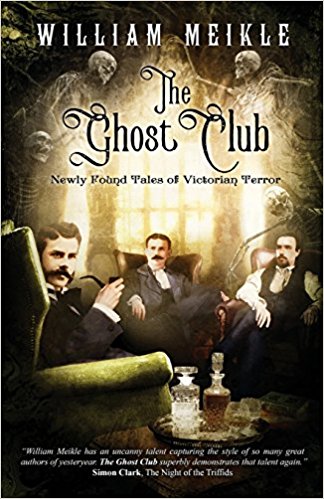 Writers never really die; their stories live on, to be found again, to be told again, to scare again. In Victorian London, a select group of writers, led by Arthur Conan Doyle, Bram Stoker and Henry James held an informal dining club, the price of entry to which was the telling of a story by each invited guest. These are their stories, containing tales of revenant loved ones, lost cities, weird science, spectral appearances and mysteries in the fog of the old city, all told by some of the foremost writers of the day. In here you'll find Verne and Wells, Tolstoy and Checkov, Stevenson and Oliphant, Kipling, Twain, Haggard and Blavatsky alongside their hosts.   GINGER NUTS OF HORROR'S 2017 GUIDE TO BUYING YOUNG ADULT FICTION
|


Archives
May 2023
|
 RSS Feed

|

|