

 Nick Scorza is a fiction writer and unrepentant daydreamer. He has worked as an English teacher in the Czech Republic, a construction worker, a bookseller, and many other things. He grew up in Washington, DC and currently lives in New York City. People of the Lake is his first novel. His short fiction has appeared in places like Beneath Ceaseless Skies and Podcastle. WEBSITE LINKS https://www.nickscorza.com/ https://www.amazon.com/Nick-Scorza/e/B07XWPCRRD/ref=dp_byline_cont_book_1 Could you tell the readers a little bit about yourself? I live in a little NYC apartment with my fiancee. I work in the communications office of a city government agency to pay the bills and write fiction when I can. I love to cook, and to travel (again, when I can). I agonize constantly about how many books, movies, bands, TV shows, games, comics, and podcasts I'm not keeping up with. To get the ball rolling and get everyone relaxed, here is a hopefully lighthearted question to break the ice, which one of your characters would you least like to meet in real life and have them complain at you about they way you treated them in your work. I don't want to spoil anything, but I'd least like to meet Jonathan Redmarch from my novel People of the Lake. I'm sure he'd be very cordial and well-spoken while he took me apart piece by piece. Other than the horror genre, what else has been a major influence on your writing? I've been a fan of science fiction and fantasy since I could read. It actually took me a while to get in to horror, I was an easily-frightened child. In my 20's I felt I had to buckle down and learn to write what's usually called 'literary fiction.' I didn't come back to genre until I turned 30, but I now love both “genre” and “literary” fiction. Jorge Luis Borges and Angela Carter, two of my all-time favorite writers, could write both at the same time in the same story. The term horror, especially when applied to fiction always carries such heavy connotations. What’s your feeling on the term “horror” and what do you think we can do to break past these assumptions? I sometimes catch myself telling people that I don't write “that kind” of horror, meaning horror that is overly violent or grisly. Then I get mad at myself, because that's such a subjective line, and it potentially cuts off so much good horror. Also, I think what puts some people off horror isn't necessarily violence, it's the way it can present the universe as uncaring or actively malign, and that can come from even the quietest horror. I think for me at least that's the core of the genre, that it presents a fundamentally unsafe and unknowable universe. I get that not everyone enjoys confronting that, but I think it's part of what makes the genre so important. A lot of good horror movements have arisen as a direct result of the socio/political climate, considering the current state of the world where do you see horror going in the next few years? I don't think it's an accident we've seen so many post-apocalyptic stories lately, and there still seems to be an appetite for more. I think we'll probably see more overtly political themes, which I think is fine as long as they're not simplistic. I think fears of social and environmental collapse also lead to cosmic horror as we question our place in the universe. I hope we're going to continue to hear more from more diverse voices, and I love what writers like Victor LaValle are doing these days to engage with everything that made writers like H.P. Lovecraft great while grappling honestly and meaningfully with their racism and other serious issues. Given the dark, violent and at times grotesque nature of the horror genre why do you think so many people enjoy reading it? There are so many ways to enjoy horror. For me, it's incredibly cathartic. I had terrifying nightmares as a child, but now that I've built up years and years of callouses, I almost relish the feeling of being genuinely scared. Certain kinds of fear, held at a safe distance, are a shortcut to what you could call a state of grace—and the only way some of us will experience something like that. When I was a teenager, it was more about daring myself to confront what scared me, but now I come hoping it'll break down all of my defenses. What, if anything, is currently missing from the horror genre? I don't feel like I'm widely-read enough to answer that, and if I knew I'd probably be trying to write it. In the past authors were able to write about almost anything with a far lesser degree of the fear of backlash, but this has all changed in recent years. These days authors must be more aware of representation an the depiction of things such as race and gender in their works, how aware are you of these things and what steps have you taken to ensure that your writing can’t be viewed as being offensive to a minority group? I did a lot of research for my novel, and I worked with a sensitivity reader. I think it's especially important when you're writing for younger readers, who have less life experience to compare representations in a book to, and are still forming their own identities. I'm sure I still make mistakes, but I try to always be open to learning and doing it better next time. Does horror fiction perpetuate it’s own ghettoization? I guess some lit-fic readers who would love Thomas Ligotti might not pick up one of his books because of the cover art, to think of one example, but it honestly bothers me more when people call something “elevated horror,” like it can't be great art and also horror. What new and upcoming authors do you think we should take notice off? I feel like I'm late to every party. I always tell myself I'm going to keep on top of the latest new voices in magazines, but instead I end up reading novels that have already been recommended to me many times over. Of course they're usually great, but I hope to have a better answer to this question very soon. What are the books and films that helped to define you as an author? I already mentioned Borges and Angela Carter, and I'll throw in Umberto Eco and Italo Calvino. Neil Gaiman's Sandman got me into horror as a teenager, which led me to Lovecraft, then Machen, and it kind of spread through me like a plague from there. China Mieville's fiction really expanded my horizons as far as what was possible in fantasy. Caitlin Kiernan's The Red Tree is one of my favorite contemporary horror novels. Are there any reviews of your work, positive or negative that have stayed with you? My first novel just came out, and I'm trying not to read reviews, at least not right away. What aspects of writing to do you find the most difficult? There's that famous Dorothy Parker quote – “I hate writing, I love having written.” There are days when you just feel like you have nowhere to go, but you have to keep going because otherwise you'll never leave that place. Then there are the days when you realize the house you built word by word isn't going to stand, and you'll have to move it all around or rebuild from scratch. Really I guess I'm saying it's all hard. Is there one subject you would never write about as an author? I would have to have a damn good reason to depict sexual violence directly on the page, and I'd be petrified of getting it wrong, so I don't think it's very likely I'll write about it. How important are names to you in your books? Do you choose the names based on liking the way it sounds or the meaning? I try not to get heavy-handed with my names, but I do try to make them feel right for a character, which sometimes takes some refining. Writing, is not a static process, how have you developed as a writer over the years? I feel like I'm a bit better at stepping outside of myself and assessing my own writing. One thing that helps me is to try to put myself in the mindset of someone I know, and how they would read and react to what I wrote. What is the best piece of advice you ever received with regards to your writing? Lots of the standard aphorisms for new writers, “show don't tell,” “avoid adverbs”, etc. are like training wheels on a bicycle – useful at first, but eventually you have to discard them. “Read deeply and widely” is one that always stays true though. To many writers, the characters they write become like children, who is your favorite child, and who is your least favorite to write for and why? I got pretty attached to Clara, the narrator of People of the Lake, but sometimes the characters we least expect grab us. There was one character in the novel I'm working on now I thought I'd have a terrible time writing, but she turned out to be one of my favorites. For those who haven’t read any of your books, which of your books do you think best represents your work and why? I've only got the one, so far, so I've got to say People of the Lake. Can you tell us about your last book, and can you tell us about what you are working on next? My first novel, People of the Lake, is about ghosts, twins (and cryptophasia, aka 'twin talk'), buried secrets, and messed up family history. My next project is a historical fantasy set in a magical Gilded Age New York, with secret societies, social unrest, sorcerous plots, and messed up family history (which I'm realizing might be a theme I'm drawn to). If you could erase one horror cliché what would be your choice? The standard tropes of the slasher genre kind of leave me cold. Nothing against them, I know lots of people love them, it just tends not to do it for me. What was the last great book you read, and what was the last book that disappointed you? I loved Victor LaValle's The Ballad of Black Tom, Paul Tremblay's A Head Full of Ghosts, and Nathan Ballingrud's North American Lake Monsters. I might sound like I'm trying to be too polite, but I genuinely can't think of a book I've been disappointed with lately. That probably means I'm just not reading enough. What's the one question you wish you would get asked but never do? And what would be the answer? No one's ever asked me where I get my ideas, so I've never had the satisfaction of saying I have more ideas than I'll ever know what to do with, it's turning any of them into something real and worthwhile that's the problem. 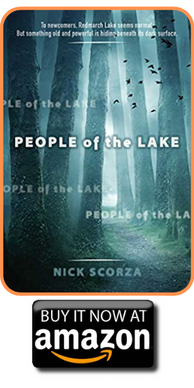 An enthralling, historically rich, small-town mystery in which a teen works with her deceased sister to solve an assumed murder.Sixteen-year-old Clara Morris is facing an awkward summer with her father in the tiny upstate town of Redmarch Lake. Clara's relationship with her parents--and with life in general--has been strained since she lost her twin sister, Zoe, when the girls were eight. As a child, her sister had been her whole world--they even shared a secret invented twin language. Clara has managed to rebuild herself as best she can, but she still feels a hole in her life from the absence of her twin, and she suspects she always will. She soon finds that Redmarch Lake, where her father's family has lived for generations, is a very unusual place. The townspeople live by odd rules and superstitions. The eerily calm lake the town is named for both fascinates and repels her. The town's young people are just as odd and unfriendly as their parents. Clara manages to befriend the one boy willing to talk to an outsider, but he disappears during a party in the woods. The next day, he is found dead in the lake under mysterious circumstances. The townspeople all treat this as a tragic accident. Clara isn't buying it, but she doesn't know what to do until she receives a mysterious note hinting at murder--a note written in the language she shared with her twin sister, Zoe.   Comments are closed.
|


Archives
May 2023
|
 RSS Feed

|

|