

|
Interview by Jonathan Thornton 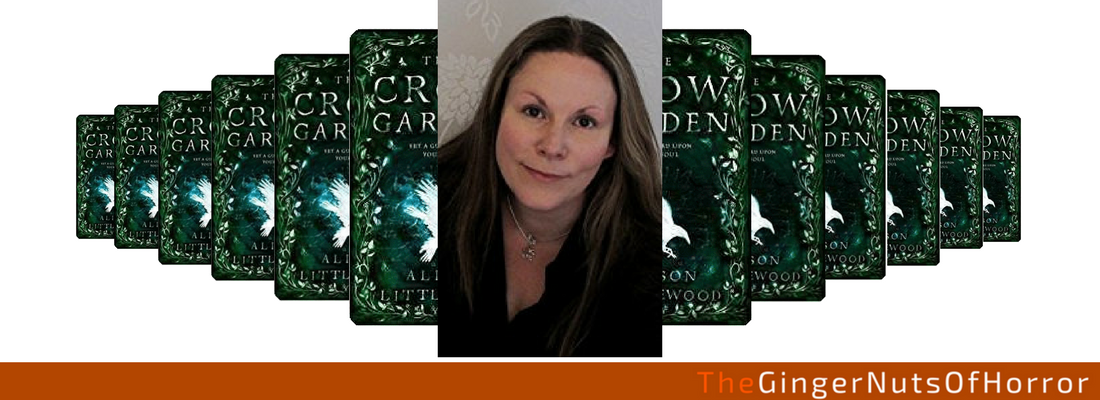 Alison Littlewood was raised in Penistone, South Yorkshire, and went on to attend the University of Northumbria at Newcastle (now Northumbria University). Originally she planned to study graphic design, but "missed the words too much" and switched to a joint English and History degree. She followed a career in marketing before developing her love of writing fiction. She now lives in a house of creaking doors and crooked walls in South Yorkshire, with her partner Fergus. She loves exploring the hills and dales with her two hugely enthusiastic Dalmatians and has a penchant for books on folklore and weird history, Earl Grey tea and semicolons. Alison’s short stories have been picked for Best British Horror, The Best Horror of the Year, The Year’s Best Dark Fantasy and Horror and The Mammoth Book of Best New Horror anthologies, as well as The Best British Fantasy and The Mammoth Book of Best British Crime. They have been gathered together in her collections Quieter Paths and in Five Feathered Tales, a collaboration with award-winning illustrator Daniele Serra. She won the 2014 Shirley Jackson Award for Short Fiction. Her website is at www.alisonlittlewood.co.uk. Your latest novel, The Crow Garden (2017), is out now in hardback from Jo Fletcher. Would you be able to tell us a bit about it? The Crow Garden is a tale set in Victorian times, and it's about a mad doctor who becomes obsessed with one of his patients. Mrs Harleston's husband has accused her of hysteria and she's accusing him of something much worse and saying that he's trying to put her out of the way to save himself from being accused. It’s set soon after the mania for mesmerism went across the country, so the doctor has her mesmerised and it unleashes dark forces – she begins to find a way out of a situation where she's completely out of control of her life. The Crow Garden explores the horrific real life history of the treatment of the mentally ill. Was this a difficult subject to write about? It was, but I expected it to be harrowing when I went into it, and that question of who's in control of people's lives really fascinated me and drew me into it. As a woman Mrs Harleston is very much in a paternalistic society, she goes from living under her husband's roof to an asylum that dictates where she lives, what she does and what she wears. I began with an image of a woman who starts to regain the upper hand - so that fascinated me. The history of care of mental patients and the treatments used was quite disturbing as well, although we have an image of Victorians locking their wives away in asylums, and actually there were steps taken throughout the century to make that more difficult. So Mrs Harleston had to be examined by two physicians before being certified insane, but since she’s claiming to have an ability to speak to the dead, she does give them grounds for accusing her. At the same time the book is looking at the spiritualism movement that swept across the country and asking, who's mad here? Is there an empirical line that you cross where you become mad, or is it a question of how many people you have on your side and how many people are buying into this? And that gothic tradition rooted in the madwoman in the attic from Jane Eyre (1847).... Yes indeed, that whole wonderful tradition of Victorian literature was very much in my mind as well. And I was reading into the history of the interest in the occult and the ‘marvellous’ as they would have called it, the Victorian spirit of inquiry. The fact that somebody like Sir Arthur Conan Doyle, who created the rational detective and was very much into scientific progress, could also believe that science might one day prove the existence of fairies . . . it’s absolutely fascinating. The Crow Garden, The Hidden People (2016) and Cottingley (2017) explore what happens when our modern rational perspectives come into contact with these beliefs from the past, whether they be the existence of fairies or discredited medical theories. Was this something that interested you? It was, and the fact that things like that could be seen as a part of science. Arthur Conan Doyle was very interested in spiritualism, and saw it as putting religion to a scientific test. So for him it was all part of a rational approach, whereas for us sitting on the other side of a century it seems absolutely crazy. I found it interesting that there was this sense of possibilities . . . and it wasn’t that long after the development of microscopes and the discovery that if people examined a drop of water they could suddenly see all these tiny ‘animalcules’, as they called them, living inside it. So there were tiny beings there that they’d never suspected existed – it was kind of a similar idea that they might be able to discover fairies in the air. What is it about fairy mythology that makes it so fascinating to us in the modern age? I think the longevity of them is because they're so evasive, and have been seen in different ways to suit different centuries. The Victorians liked to picture them as animal spirits, the flower fairies and so on, all very sweet and lovely. People were moving to the cities as part of the industrial revolution, and feeling as if they'd lost a golden age of the countryside. Fairies always seem to be part of a nostalgic vision of something that's being lost. But they have a darker side – going back further still there's a tradition of trickster fairies, where encounters with them might be perilous as well as beautiful, and the idea of changelings where they stole people away and replaced them with a doppelganger. That’s just so creepy . . . Which of course forms the central mystery of The Hidden People, has she been replaced, is everybody mad, or is there some kind of manipulation going on behind the scenes? That's it . . . once you start to suspect somebody, anything they do that’s out of character or any words you can seize upon can be taken as proof that they're not the person you think they are. The idea of living under the same roof as somebody but not being sure of them, and who they are, that unknowability, is deliciously creepy. Both novels use folklore and mythology to explore the constrictions around women's agency in the time they're set. What makes horror and the fantastical a powerful tool for exploring these issues? Well I think it goes back to history, and the use of stories or concepts of something like witchcraft as ways for someone who’s powerless in the world to gain some control. As a writer I used them as a way of evading patriarchal structures by using something that's outside the regular norms of society. How challenging was capturing the two distinct tones of the dialect of the townsfolk and the Victorian tone of Albie Mirral's voice in The Hidden People? I guess it was a challenge, but I really enjoyed the use of language in that book. I immersed myself in research but also in Victorian fiction to help create Albie’s voice – he speaks in a Victorian-esque way. The Yorkshire folk speak in an accent which, being from Yorkshire, I encounter quite a lot! I often meet people when I'm out walking my dogs who speak like that. I couldn't have set it somewhere else I don't think. It's based around a court case that happened in Ireland but I couldn't have carried it off with Irish accents – it had to be somewhere that was close to home, where I knew the voices. I did research some historical Yorkshire words because it's set in the past as well as in the countryside, so there were various challenges around the language, but interesting ones. Both The Crow Garden and The Hidden People make great use of their Victorian settings. How much work goes into getting the historical details right? An awful lot, but fortunately I became quite obsessed with it! The difficulty when I started out was that I didn’t know what I didn’t know. So I could be writing something about daily life that I assumed was right and actually things could have been done completely differently. So I read very widely – things about domestic life, about life in the city, rural Victorian life, Victorian farming, all sorts of things. Then there was the folkloric side, which I love reading about anyway . . . so I've got quite a book collection after all this! What was the thing you found while researching that surprised you the most? There were all sorts of interesting things. One that always sticks in my mind is about Victorian churchyards and funerals – churchyards could be actually very overcrowded and gravediggers could be chopping through half a body to make room for the next. There might be paupers' bodies stacked on one side, waiting till they had enough that it was worth digging the pit to bury them in. And so generally, women did not go to funerals in Victorian times, as is often shown in Victorian TV and film – Queen Victoria apparently didn't go to Prince Albert's funeral. Both Albie and Nathaniel are unreliable narrators, whose perspective prevents them seeing things the reader can... I loved playing with that, and it's very much deliberate. The stories are seen through the male character’s eyes because they had the agency and ability to go and start investigating and changing things around them, but at the same time they’re flawed characters. So the women are also viewed through that filter, but it's interesting when the reader can start to make their own judgements about who's in control of the situation, and are things really as they seem. I like to read books where the reader has to do some of the work and draw their own conclusions and really enjoyed that aspect of it. Path Of Needles (2013) explores the connection between fairy tales and the darker side of human nature. Where does this connection come from? Yes it combines crime with fairy tales – probably quite strange bedfellows! The thing is I was always obsessed with fairy tales as a child, but I find some of them more shocking to read as an adult. The Red Shoes for example, where a girl is punished incredibly harshly for thinking of her shoes while she's in church – forced to dance to the point of exhaustion, until she's begging someone to chop off her feet – it’s a tad harsh! Kind of a horror story for kids . . . but it didn't bother me when I was a child. And I started thinking, what if some of these things actually happened in the real world? What would be the result of that? And of course, quite often, the police would get called in . . . so I started with a girl’s body dumped in the wood, posed as she might have been in a fairy tale death. There are slightly strange things going on in the book too, as if fairy tales are coming out of the woods and pulling people into a magical world. Do horror and crime fiction fulfil a similar role to fairy tales in our culture? Possibly! For me, my writing certainly comes back to fairy tales. I love those stories where there's a little bit of magic somewhere in the world, so I guess the presence of the supernatural in horror – in a darker, more twisted way, it’s a reflection of that. Your writing has a strong sense of place. Is establishing a vivid atmosphere and environment important for making the horrific or fantastic elements effective? That's certainly something that interested me in Path of Needles, because it was very much about what if the fantastical was actually happening now. So I used settings that were around me at the time – I basically turned all the pretty areas south of Wakefield into body dump sites, sorry about that! And A Cold Season (2012) very much grew out of the landscape, because I was crossing the Pennines every day at the time and I was immersed in that place, so it very much became part of the book. The Unquiet House (2014) plays with the haunted house genre. Was this something you always wanted to write? Not especially – it was a book that seemed to take form organically. We were house-hunting at the time, and going into different properties and stumbling across some quite odd things. In one place I opened a door and found a cupboard with just an old suit hanging in it, which worked its way into the book. And we stopped off at a graveyard in Tong, near Bradford, where there are benches inscribed with biblical verse. One of them was "My God, my God, why hast thou forsaken me?" – What a thing to put on a bench! –and that worked its way into the book too. I thought it would be incidental at first but it grew into part of the plot. So the book was a process of discovery, one with various threads that were down to my subconscious to pull together! Your first novel, A Cold Season, deals with Satanic cults in a small village. What was the inspiration behind this? Well I was working in Saddleworth at the time, so the environment was very much part of it. I started writing it one winter when I was struggling to get home over the hills, so that was where a ‘cold season’ came in. That combined with thinking about what exactly would it take to make someone sell their soul, exchanging something eternal for something worldly. I didn’t envisage where it would all lead! So that was a bit of a surprise, just how much it took off? Oh absolutely. At that time I was drafting novels and treating them as learning exercises, trying to write a better one each time. It wasn't until A Cold Season, which I think it was my seventh, that I thought I’d polish this one up and maybe send it out somewhere. I never imagined it would get a mainstream book deal and then get into the Richard and Judy Book Club. It was wonderful but completely surreal, and still feels like it happened to somebody else! And it's the only one you've written a sequel to so far... Yes it is. And I was asked for the sequel, but the reason it came out three books later was because I didn't just want to write one for the sake of it. I wanted to give it some thought and make sure I had something that would make another book. So it is a sequel and gives an ending for those characters, but it’s also quite different. Was that a very different experience from creating everything out of whole cloth the first time? Yes it was, although there are new characters in it as well, and new places and things, so it had its own new beginnings! You also write short stories. Do you always know what length a story will be when you start it? Yes pretty much, because a short story is such a concise thing I tend to have quite a crystallised image of what it's going to be before I start. I've never really had that thing where one's grown longer and longer and longer until it’s something else. There are concepts I've used in short stories that fed into novels – Path of Needles, for example, but I tend to know what kind of size it's going to be. Your short story 'The Dogs Home' won the Shirley Jackson Award. What was that like? Fabulous! Because it was an American award it was especially nice to get a look-in, and really unexpected that it went on to win. The downside was that I couldn't get over to the awards ceremony. That would have been really nice, but yes, it was fantastic. And they are very different markets it feels, sometimes... Yes quite – there is quite a lot of overlap, obviously, and I do work with American editors as well which is one of the great things about the short story market. It does take you to different places and give you different experiences. You wrote Five Feathered Tales with illustrator Daniele Serra. Was that conceived as a collaboration from the beginning? It was, very much so. I met Dani in 2010 at Fantasycon – one of the lovely things that can result from conventions! He'd illustrated an anthology I was in so I met him at the signing. We stayed in touch since and he emailed me a couple of times and said, "Ali, how are we going to work together?" So we had an idea to do a mini collection with his illustrations, and the concept bounced around for a while and evolved into Five Feathered Tales. It was absolutely lovely to see him producing such beautiful illustrations around my work. You've also written Acapulcalypse Now (2015), set in Stephen Jones's Zombie Apocalypse world. What was it like writing in a collaborative universe? It was great actually. I mentioned it to Jo Fletcher, my regular novel publisher, and she said, "Oh, it'll be great, it'll be like a writing holiday." And that's exactly what it was. The concept of zombies overrunning a Mexican hotel was great fun – I'd been thinking for a while that I'd like to set a novel overseas. And Steve was great as well, he gave me a brief but also plenty of space to be creative within it, and he was really great to work with. So it was a lot of fun. What's next for Alison Littlewood? I'm working on another novel around fairies and folklore and changelings, but it's partly historical and partly stepping back into the contemporary world. So it's a little bit different again, though with some familiar themes. And it’s really rather dark! Thank you Alison Littlewood for speaking with us!    MONSTERS AND NUNS HAVE FUN WITH TIME LOOPS, IN HOSPITALS, CREEKS AND THE WOODS
|


Archives
May 2023
|
 RSS Feed

|

|