

FIVE MINUTES WITH AUTHOR IAN WELKE
22/4/2019
 Could you tell the readers a little bit about yourself? I’m a writer from Long Beach, California. I started playing roleplaying games in the late 1970s/early 1980s. This started with D&D which led to Call of Cthulhu, which led me and my library card to HP Lovecraft which opened the door to horror fiction for me. I was already a big reader of fantasy, Tolkien had already led to D&D, so I suppose there’s a circular path in there. After watching the original Cosmos, I wanted to be an astronomer, but when it came time for university, it was clear I wasn’t good at math, but I was good at literature and history, and I earned a History degree, specializing in ancient and medieval history. When I moved out of the house, I was lucky enough to have roommates who went to work at Blizzard Entertainment. They helped me leave my miserable delivery job that I had stuck with way too long due to my obsession with Neal Stephenson’s Snowcrash, and I started in the testing department at Blizzard. I worked there for eight years and got to work on games such as Diablo 1 and 2, Starcraft, Warcraft III, and much of the early testing on World of Warcraft. I then moved to Seattle for six years, where I was happy to get to work with great people, at a terrible company for part of it, and then got to work with great people at a great company on the game Torchlight. The games industry expects crazy hours, and I wanted to spend more time writing. I’d sold a couple short stories while I was living in Seattle, and when moving back to Long Beach gave me the chance to spend more time reading and writing, I took it. So far in addition to a handful of short stories, I’ve written three novels that have been published by Omnium Gatherum books: The Whisperer in Dissonance (2014) , End Times at Ridgemont High (2015), and Four Corners (2019). What do you like to do when you're not writing? Reading, movies, or in this era, television, I’m pretty obsessed with stories. Along the same lines I still play roleplaying games regularly, tabletop games less often but whenever I can. My other obsessions are: music, mathematics, whisky, cooking. Other than the horror genre, what else has been a major influence on your writing? Really all genres. I learned to read, I mean proper see it in your mind’s eye read, when I was a kid because my dad read us the Lord of the Rings, and I wanted to hear it again, but my dad was always working so if I wanted the story again I had to read it myself. Fantasy fiction has always been my favorite to get lost in, although I also think it has horror elements. At least when your seven, that chapter where the black riders come into Bree… I still get a shiver. Along with fantasy I grew up reading comic books and the classic science fiction writers, then Douglas Adams came along and Hitchhikers Guide joined Lord of the Rings as the books I’d reread whenever I needed cheering up. When I grew a bit older I discovered the hardboiled detective fiction, and I’m named Ian because my mother really liked spy novels (lucky for me I was born when I was, a year later and I’m pretty sure my middle name would’ve been Le Carre), so I think genre fiction has always been there for me. The term horror, especially when applied to fiction always carries such heavy connotations. What’s your feeling on the term “horror” and what do you think we can do to break past these assumptions? I know exactly what you mean. I’ve been in the HWA tent at the Los Angeles Time Festival of Books a few times, and a sizeable number of people turn away saying, “I don’t like horror” and the odd thing is, I think it’s a difference preconception for each of them, or at least one of a number of different preconceptions: some mean they don’t like vampire stories, others don’t want to read torture porn or slasher stories. The cause varies but the reaction is the same. I think the answer must vary as well. Certainly there are people who want to read the torture porn or slasher stories, etc. But I think most readers would be open to horror stories if they weren’t thinking of them as automatically being about that preconception. I think some of this can be accomplished with crossed genres. Or at least I think that the horror averse reader assumes that they’ll spend the entire story with the character miserable, and who wants to be immersed in that? Just scanning the book shelves behind my monitor for the “horror” books, I don’t think any of them do this. I think the majority of those stories are fun. Okay the characters might not be having joy all the time, but they’re unlocking a mystery, discovering something weird, in a plot that verges more on science fiction with some intense scary bits. Just scanning a few on one shelf, I see the Cody Goodfellow books, which are often manic hilarity mixed with horror elements, the Laird Barron books a few of which have legitimately given me nightmares but tend to be more psychological than the characters being endlessly tortured, Robert Jackson’s American Elsewhere is set in a town so interesting it’s fun to spend time in that setting despite the horror. There’s a line in Twin Peaks about “I’m having the most beautiful dream and the worst nightmare at the same time,” and I think the two pair weirdly well together. To sum up this ramble, I think there needs to be a way of describing the genre to the averse reader to ensure them that there will be fun and joy and not just page to page terror. A lot of good horror movements have arisen as a direct result of the socio/political climate, considering the current state of the world where do you see horror going in the next few years? The way the world is going at the moment, I fear that future books will have to be written in the mud with a stick. But yes, what to write given the state of things is something I’ve worried about. It started that I was writing a lot of dystopian fiction only to have to throw it out because by the time I finished the story, the thing I was going to warn about had happened, only worse and also somehow, a lot stupider. This is going to sound odd coming from a writer who has written three novels with apocalyptic elements, but I’d like to see some optimism in fiction, given that there seems to be none in the real world currently. The crazy part of my mind almost wonders if we caused this. Did we write so many dystopias that we inverse The Man in the High Castled ourselves? Have we metad the wrong direction? Unfortunately I don’t know if optimism is in my wheelhouse, but I think I’m going to try. What are the books and films that helped to define you as an author? I think I’m paralyzed by the possibilities for the answer to that question. I read so much and so often get totally carried away by stories. Since I’ve already mentioned a few of those stories in other questions, I’ll go with the Borges short story “Tlon, Uqbar, Orbis Tertius.” It’s a bit of metafiction about people who create a fictional world that starts to come into their reality because that’s what happens within their story. For a movie I’ll pick How to get Ahead in Advertising, although Chinatown or They Live or a whole bunch others are tempting. What new and upcoming authors do you think we should take notice off? I’m not sure at what the metric is on new and upcoming. Two writers I’ve met who I think are great horror writers are S.P. Miskowski and John Claude Smith. I look up to both of them, both for their prose and for their storytelling. Pete Aldin is an Australian writer with some great updates on werewolf and zombie fiction in particular. In addition to his excellent what if Tom Waits were a deity in a fantasy series books, Brent Kelley has actually written a dystopian novel that actually disgusted me, and I’m usually pretty jaded. How would you describe your writing style? The good thing about my writing style is it’s usually fast paced. There’s an Elmore Leonard line about cutting out the bits you’d skip over while you’re reading. Sometimes I do that too much, but fortunately editors have been kind enough to help. I guess that’s the best description of my writing style is I really can’t thank editors enough. Are there any reviews of your work, positive or negative that have stayed with you? I’m still at the stage where I’m happy to get any reviews. I guess the one odd thing about that… Some of the blurbs on my first book were so nice, I took them way too seriously. The early drafts of my third book took forever to write partially because I kept thinking about those blurbs and “oh god, now I have to live up to that!” What aspects of writing to do you find the most difficult? Focusing on one story to get it written and not getting distracted by the million other stories I want to write is a tough one. Writing the middle of a story can be tough. Usually I know the beginning and the ending, but sometimes they don’t connect as well as I think they will. Ooh. Time is a big problem. It takes me so long to write that things change and I forget things and… I guess really all of it is a struggle, or everything is a struggle except research. I always like researching, I only sometimes like writing. If there were a way to do the research and have the story form magically, I’d take it. Is there one subject you would never write about as an author? This is tricky, because answering the question is almost like writing about it. I think it’s unlikely I’d write a rape scene. There are other much better writers who can deal with this. I don’t think I could do it, and if I tried to write it I’d be terrified that I’d make some terrible mistake. How important are names to you in your books? Do you choose the names based on liking the way it sounds or the meaning? It didn’t occur to me to worry about the way things sound until I had to do readings and then I realized how much it matters. Names are very important. I try to make sure I research the name, where it comes from, what that says about the character’s background. There was a fantasy book I have since shelved (and been running as D&D instead) where every name was derived from a different language. Spent months researching those names, just to abandon the story, ah well. Writing, is not a static process, how have you developed as a writer over the years? I sure hope my writing has evolved in a positive way. One thing I’ve learned is that I need to write what I want to write. It seems obvious, but it took some learning. After my second book was nominated for a Bram Stoker Award, but didn’t sell a lot of copies, I started worrying too much about sales. I tried writing a book for what I thought would be a mass market, and basically lost a couple of years to writing a boring book that thankfully is now in the trash where it belongs. What tools do you feel are must-haves for writers? Everyone is different. For me the best thing I found is Scrivener. The way it helps separate a chapter from the main file, and a scene from the chapter, makes writing more manageable. What is the best piece of advice you ever received with regards to your writing? Everybody is different and what works for one writer might not work for you. Like everything else I do, I’ve read tons of books about writing. For me I really like Stephen King’s On Writing, Anne Lamott’s Bird By Bird, and Jeff Vandermeer’s Wonderbook isn’t just a great book for writers it’s one of the most beautiful books I’ve ever seen. But I think you need to treat writing advice as a buffet and select the parts you like or are very good for you and leave the rest for other people. Getting your worked noticed is one of the hardest things for a writer to achieve, how have you tried to approach this subject? I’m pretty sure I’m terrible at this, but I’m trying. I’ve put up a website, I’m on social media, I’ve done readings, attended conventions etc. At the end of the day I think I’ve written some good stories, but I think it’s going to take a great story in order to stand out and get the word of mouth going. Hopefully Four Corners will be that book, if not, maybe it will be the next. To many writers, the characters they write become like children, who is your favorite child, and who is your least favorite to write for and why? My favorite character to write was Dean, the stoner surfer from my second book End Times at Ridgemont High. His chapters and scenes were as close to effortless as I’ve found writing, and he made me laugh which seems insane since I was writing what he did and said. There’s never been a character I didn’t like writing, but if there were I’d guess it would be a character who fights a lot, or is the action hero in a group. For some reason I hate writing fight scenes. I’m going to have to get a lot better at this given some of the books I have planned, but at the moment it always feels like a chore. What piece of your own work are you most proud of? I did so much research for Four Corners and the ways that research (what didn’t get cut) found its way into the book still surprises me. Without giving too much away, there’s a scene where the protagonists find a lost diary of John Wesley Powell (the man who first forded the Colorado River despite having lost part of an arm in the Civil War). I think I got Powell’s writing style down, or came close to it anyway. I love this and the way that an incredibly varied array of history works its way into that book. And are there any that you would like to forget about? I have stopped and started too many stories to count. I guess the book that I wrote in between End Times at Ridgemont High and Four Corners, the one where I was trying too hard to please an imagined market rather than writing what I want, I should forget about. It still bothers me because I think there’s a good book in there somewhere, but it’s not what I want to work on and probably is better forgotten. For those who haven’t read any of your books, which of your books do you think best represents your work and why? I think either Four Corners or The Whisperer in Dissonance are probably pretty good representations of my work and myself. Sleep deprived, too much coffee, scattered and often manic… yeah that about sums me up. Four Corners might be better, I sure hope my writing has improved over the last six years, but also I think the book with all its research conveys my wish to acquire knowledge to the reader. I hope. Do you have a favorite line or passage from your work, and would you like to share it with us? I like this chapter ender from Four Corners: When he passed each of the places where his comrades had been, all he found was their gun belts submerged in a puddle of rain water. Over each puddle a spiral petroglyph had been scratched into the rock. Can you tell us about your last book, and can you tell us about what you are working on next? My latest book is Four Corners. It’s a story of a conspiracy running through deep time set in the American southwest. As the characters unlock the mystery they find weird esoteric libraries in the guise of abandoned buildings, learn how the conspiracy affected the disappearance of the ancestral Puebloans and later the Puebloan revolt, how a modern cult had run ins with the Wild Bunch, uranium miners, and a lost cult classic psychedelic 70s western… amongst other madness. There are two projects I’m really eager to start. One is a science fiction story in a fantasy setting. The other is a spyfi series I’d describe with shorthand as Sandbaggers in space. If you could erase one horror cliché what would be your choice? The thing about clichés, is it often seems like they’re there for a reason, especially with horror. I’d suppose some things are just conveniences for the writer, describing a character by looking in the mirror for instance and we could probably do without these (I know I’ve done that one, shame on me.) On the other hand, I think I probably overuse having my characters be sleep deprived for instance, but a) write what you know and b) I think it’s a good way to make their perceptions unreliable which eases the weird into the book. What was the last great book you read, and what was the last book that disappointed you? I just read two books I really liked. A Distant Mirror by Barbara Tuchman and Fire and Blood by George RR Martin. Both were histories, one fictional, but still. Both had a lot of great moments of backstabbing, treachery… I love the way Martin used a fictional historiography to make the sources of his book characters of their own. I don’t just highly recommend them, I recommend reading the two together. Another nonfiction book I recently read was an account of the commando raid on the heavy water processing plant in Norway during World War II. I didn’t care for the style of the writing I suspect. There were jumps between the raid taking place and the interviews in the 1970s that I found hard to follow. What's the one question you wish you would get asked but never do? And what would be the answer? Probably something to do with research. I’d probably have to admit that I have a research problem and need therapy for it. Thanks for letting me ramble on! ABOUT IAN WELKE Ian Welke grew up in the library in Long Beach, California. After receiving his Bachelor of Arts in History from California State University, Long Beach, he worked in the computer games industry for fifteen years where he was lucky enough to work at Blizzard Entertainment and at Runic Games in Seattle. While living in Seattle he sold his first short story, a space-western, written mainly because he was depressed that Firefly had been canceled. Following the insane notion that life is short and he should do what he wants most, he moved back to southern California and started writing full time. Ian's short fiction has appeared in Big Pulp, Arcane II, the American Nightmare anthology, and the 18 Wheels of Horror anthology, amongst other places. His novels, The Whisperer in Dissonance (2014) and the Bram Stoker Award Nominated End Times at Ridgemont High (2015), and Four Corners (2019) are all published by Ominum Gatherum Books. Twitter: https://twitter.com/mewelke Website: https://www.ianwelke.net/ The Whisperer in Dissonance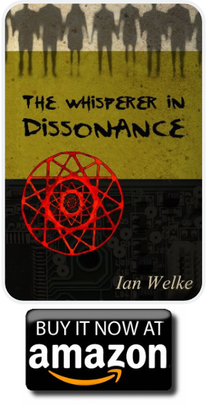 Annie sleeps in fitful spurts dreaming of an altered world populated by drone-like slaves and gangly masters. Her dreams leave her panicked and ragged as if she hadn’t slept at all. Is there a barely audible voice buzzing in the background hum? Or is the sleep deprivation driving her to delusions? “The Whisperer in Dissonance is a scary, disturbing novel that reads like a cross between H.P. Lovecraft and Philip K. Dick. I highly recommend it.” —Mike Davis, editor of The Lovecraft Ezine   Comments are closed.
|


Archives
May 2023
|
 RSS Feed

|

|