

 Damian Murphy is the author of The Academy Outside of Ingolstadt, Seduction of the Golden Pheasant, and The Exaltation of the Minotaur, among other collections and novellas. His work has been published on the Mount Abraxas, Les Éditions de L’Oubli, and L’Homme Récent imprints of Ex Occidente Press, in Bucharest, and by Zagava Books, in Dusseldorf. His latest collection, published by Snuggly Books in September of 2017, and the first to be offered in a paperback edition, is entitled Daughters of Apostasy. He was born and lives in Seattle, Washington. Could you tell the readers a little bit about yourself? I think the main thing to know is that I’ve been a practicing occultist for my entire adult life (about 25 years now). This absolutely informs every other thing I do. I’ve been told that my writing is “drenched in the occult”. A writer is supposed to write what they know, and I often feel that I know little else. Other than that, I’ve been obsessed with literature, art, and cinema for as long as I can remember. I have a persistent fascination with obscurity. I often stay awake into the unacceptable hours of the night playing very old electronic games on emulators that run on a PC. How would you describe your writing style? My writing explores aspects of the occult that, to the best of my knowledge, have rarely been explored or acknowledged in fiction (or in non-fiction, for that matter). I find myself wondering what it would be like if, say, Anaïs Nin or Andre Gide decided to write a short story or novella that’s thoroughly suffused in occult ideas and practices. This is most often where I start. Where it goes from there is another matter entirely. Many of my stories are concerned with the motifs of deception, trespass, and transgression. My characters are always sneaking around, doing things they’re not really supposed to be doing, crossing boundaries, eavesdropping, or committing minor acts of theft and vandalism. There’s a tendency for them to be rewarded for their illicit efforts, though the rewards themselves may be somewhat dubious. There’s a decadent streak that runs through almost everything I write as well, and an inclination toward fetish and obsession. Jean Cocteau once said that style is a matter of taking something complicated and making it simple. It’s essential to me, first and foremost, that the reader finds my stories to be easy and enjoyable, despite the fact that some very complex ideas run through them. Somebody once described my prose as ‘delicious’. This was a huge compliment to me, as that’s exactly the effect I’m aiming for. What piece of your own work are you most proud of? I go back and forth on which piece is my favorite. Currently it’s a toss-up between two pieces: ‘The Ivory Sovereign’ and ‘Seduction of the Golden Pheasant’. The former (published in Exaltation of the Minotaur) is based on the dark rides, or ride-through haunted houses, that proliferated (kind of) in the US and parts of Europe between the 1960s and 1980s. The best of these dark rides were a little odd, to say the least. I’m far more interested in rides like Flight to Mars, which spent time on Coney Island and in Seattle’s Fun Forest, among other places, than I am in Disneyland’s Haunted Mansion. In ‘The Ivory Sovereign’, an entirely different type of ride is imagined, an attraction found only in small towns across Europe and which are known as ‘Mystery Houses’. The protagonist of the story winds up wandering through the bowels of a Mystery House which may or may not have fallen into a state of malfunction. ‘Seduction of the Golden Pheasant’ is about a young woman that becomes obsessed with the images in her wallpaper. Charlotte Perkins Gilman’s ‘The Yellow Wallpaper’ was the starting point for that story, though it ended up going to a very different place: a stolen medallion, a masked party at a lavish chateau, an obscure (to the West) form of Taoist alchemy known as Mao Shan. To many writers, the characters they write become like children, who is your favourite child, and who is your least favourite to write for and why? This is definitely the case with me. So far, my favorite character is Theodora from ‘The Scourge and the Sanctuary’ (one of the stories included in Daughters of Apostasy). Theodora performs ritual operations on keys that she finds lying in the street, which she then slips beneath locked doors in order to gain access to what’s behind them. She uses Finnigan’s Wake for bibliomancy, sends periodic reports to a distant friend in which her arcane activities are described in detail, with certain omissions, and is an unrepentant, if very petty, thief. She has a poetic and slightly affected manner of speaking and thinking which I’ve adapted, with modifications, to many other stories. She serves as the prototype for several of my later characters. For those who haven’t read any of your books, which of your books do you think best represents your work and why? Daughters of Apostasy is a great place to start. It’s the first book of my work published in an affordable, paperback format, and collects four early stories along with a new novella, ‘The Music of Exile’. As such, it encompasses a fairly wide range of styles. What are the books and films that helped to define you as an author? I tend to be attracted to works of art that emanate a sense of mystery so compelling that I find myself thinking that I would kill to know more. There’s an art to revealing just enough—not too little, not too much—to compel a reader or viewer to explore a work at a greater depth, and to try to find patterns and connections in order to further understand something that remains partially concealed. Authors like Alain Robbe-Grillet, Bruno Schulz, Angela Carter, and Robert Aickman have long exerted that type of fascination on me as a reader. Gene Wolfe’s New Sun series has had a tremendous influence on the way in which I go about constructing a narrative (though some of his work has also led me to avoid writing stories that resemble elaborate crossword puzzles). Jean Cocteau and Marguerite Duras for their approach to style. Marcel Schwob’s Book of Monelle and The University of Chicago’s recent publication of The Nightwatches of Bonaventura both came as a revelations to me. What I take from film is largely a matter of style and atmosphere. Bergman’s Hour of the Wolf, Robert Altman’s Three Women, Cocteau’s Orpheus—the motifs and atmospheres presented in these films are so irresistible that I’m always trying to find new ways to introduce them into my writing. What new and upcoming authors do you think we should take notice off? Some of the best fiction that I’ve read throughout the course of my lifetime has been written in the last 20 years by little-known authors. To give only a few examples: Quentin S. Crisp, Adam Cantwell, Colin Insole, Justin Isis, Brendan Connell, George Berguno, John Howard—this is anything but an exhaustive list. There’s a man who goes by the name M Kitchell that writes insanely intriguing, and often very fractured, narratives. How important are names to you in your books? Do you choose the names based on liking the way it sounds or the meaning? I tend to switch things up from story to story. Sometimes I’ll choose a name that reveals something about the character or their situation that isn’t revealed elsewhere, while in other instances I’ll choose a name that just feels right for the character. In more than one instance, the name of a character has been used to provide a major clue to part of the subtext of the story. I recently named a character after the code-name for a gaming console from the late 1970s, with good reason. Writing, is not a static process, how have you developed as a writer over the years? There’s a feedback loop between reading and writing that can be exploited in order to allow a deeper approach to both. I’ll often return to my sources of inspiration after having written something based in them only to find that there’s even more there than I had previously thought. The act of exploring another author through writing opens previously unseen doors within that author’s work. Some books are like never-ending wells—you can keep going deeper and deeper into them without ever seeming to reach an end. Can you tell us about your last book, and can you tell us about what you are working on next? The last major piece I finished is ‘The Star of Gnosia’, which will be included in a book of the same name, along with some more early pieces, published by Snuggly Books in 2018. The story concerns three siblings in their teenage years, two male, one female, who are left alone for two weeks in their expansive Spanish manor. They decide amongst themselves to attempt to reach a state of Gnostic enlightenment, each according to their own techniques, within that brief space of time. Currently I’m working on a piece provisionally entitled ‘A Spy in the Panopticon’, the motifs of which include, as it states within the text itself, “an illicit broadcast, a receiving station assailed by high winds, a mechanized eye, a lethal signal, an invisible city and a geomantic conspiracy.” Do you have a favorite line or passage from your work, and would you like to share it with us? I will give a single sentence, from ‘The Hour of the Minotaur’, first published in The Gift of the Kos’mos Cometh! anthology, and which will be included in the Snuggly Books release of The Star of Gnosia in 2018: “To be fair, I must concede that I am not a reasonable man.” 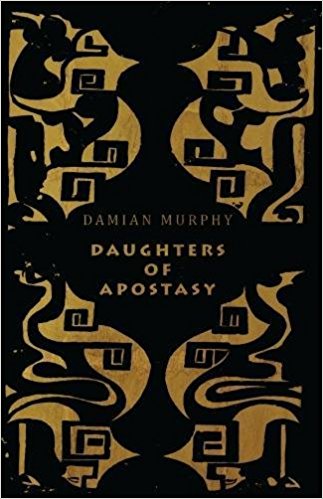 An act of trespass, the subtle topology of an opulent hotel, a lengthy composition involving an exiled abbess, a letter mailed to an unknown recipient, a border station concealed by inexplicable winds, an antiquated electronic game, a rite of passage modulated by a metronome, a Gnostic heresy, a ruined church, an employee engaged in illicit acts of passion: by these and several other devices do the daughters of apostasy seek to irritate the vessels of the earth. Strange wine may be distilled thereby, and thus might the obsessive aspirant perceive the tenets of a hidden doctrine.
In these five stories and novellas, the intrigues and stratagems of interlopers, initiates, poets, and bibliophiles are revealed in all their illicit splendor. By way of complex and labyrinthine routes do they come to obtain impossible relics not known even among the kings of the earth. Comments are closed.
|


Archives
May 2023
|
 RSS Feed

|

|