

 "Moody is as imaginative as Barker, as compulsory as King, and as addictive as Palahniuk." Scream the Horror Magazine 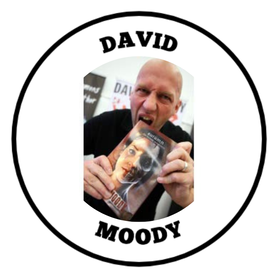 A pioneer of independent publishing, DAVID MOODY first released HATER in 2006, and without an agent, succeeded in selling the film rights for the novel to Mark Johnson (producer, Breaking Bad) and Guillermo Del Toro (director, The Shape of Water, Pan's Labyrinth). Moody's seminal zombie novel AUTUMN was made into an (admittedly terrible) movie starring Dexter Fletcher and David Carradine. He has an unhealthy fascination with the end of the world and likes to write books about ordinary folks going through absolute hell. With the publication of a new series of Hater stories, Moody is poised to further his reputation as a writer of suspense-laced SF/horror, and "farther out" genre books of all description. Find out more about his work at www.davidmoody.net and www.infectedbooks.co.uk. Could you tell the readers a little bit about yourself? Sure. I’ve been writing for an unfeasibly long time now (25 years). Hard to get my head around that, because it feels more like 25 minutes! My first book, Straight to You, was published in 1996 and (rightly) sank without trace. I then wrote Autumn, and rather than spend ages trying to find a publisher, I decided to give it away online. These were the early days of the Internet, before ebooks had taken off and before every new author started giving their work away – I’m so old school I literally used to email Word documents and pdfs to people! Autumn was a big success for me (half a million downloads in a relatively short space of time), and I followed it up with a series of sequels. Then I wrote a book called Hater and, somehow, a copy ended up on Guillermo del Toro’s desk. He bought the film rights and my world went crazy. What do you like to do when you're not writing? I wrote full-time for a number of years before rejoining the real world back in 2014 for the sake of my sanity (it can be harder than you think sitting on your own all day, every day, thinking about the apocalypse). But my writing commitments haven’t slowed, so my free time is currently negligible. That said, I love to watch horror and science-fiction movies – often the more obscure the better. I’m a big live music fan, and distance running helps me keep my mind and body in check. I don’t know what I’d do if I couldn’t run – it’s regularly where I do my best work. I’ve come up with some great plot twists while I’ve been out on the hoof. Generally, when I’m running is the only time I can think about something without being interrupted. Other than the horror genre, what else has been a major influence on your writing? This might sound like a cliché, but the biggest influence on my work is people. I think the survival of the human race is an impossible equation, and whenever I think we’ve seen everything, something else happens to take the craziness to a new level. If you’re in the market for writing a dystopian novel and you’re in need of inspiration, switch on the TV and spend a little time watching the rolling news channels and I guarantee you’ll see plenty that’ll set your mind racing! Regardless of your politics, I think anyone would be hard pushed to remember a time when the world has ever been more polarized. My Hater series takes that polarization as its start point. It’s weird – I wrote the first book back in 2006 and people were telling me back then how reflective it was of what was happening in the world at large. And with each passing year the books seem to have become even more prescient. It’s terrifying to think where we might end up as a species. The term horror, especially when applied to fiction always carries such heavy connotations. What’s your feeling on the term “horror” and what do you think we can do to break past these assumptions? That’s an excellent question. I’ve always really struggled with the label ‘horror’, primarily because I believe horror is more about a feeling or emotion than it is a genre. And I think because ‘horror’ has always had such negative connotations (because it’s easy to make a shitty, blood-soaked horror movie or write an exploitative, gore-filled book), people tend to look down their noses at you when you say you write horror. I get asked this a lot, and there’s a couple of things I usually say to make my point. First, think back to some of the most horrific books and films... have you ever read/seen The Road, Threads, or We Need to Talk About Kevin? They’re all utterly horrific, but the word horror is never once used in their marketing approach. Also, think about other genres – an example I often use is the Western. You know when you watch a Western that you’re likely to get gunfights in the mid-1800’s Americas. But when you tell a horror story... well that could encompass anything at any time in any place. I think a lot of the stuffiness and snobbery comes from the fact we’re often writing about the future rather than the past, and horror stories usually focus on the worst possible outcome. I was a guest at an event a couple of years ago and the panel was asked why anyone should bother reading the stuff we write. I said it’s because we’re trying to warn you what’ll go wrong with the world if we’re not careful. They just laughed politely... A lot of good horror movements have arisen as a direct result of the socio/political climate, considering the current state of the world where do you see horror going in the next few years? I think I’ve already touched on this. I think we’ll continue to see a surge in dystopian horror, given what a fractured society we live in right now. I think another theme we’ll see more in horror is linked to how connected/ interconnected we are now. Imagine the nightmare if the internet suddenly disappeared and people had to think for themselves! It doesn’t bear thinking about... I actually think the internet and its effects on us are fascinating. We seem to be losing individuality in search of what we see online: people follow ‘influencers’ like sheep, abandoning their own likes, dislikes, tastes and desires to fall in line with someone else’s. It’s all beginning to remind me of that classic Twilight Zone episode – Eye of the Beholder. What are the books and films that helped to define you as an author? The books which made me want to write horror for a living are absolute classics: John Wyndham’s Day of the Triffids, Richard Matheson’s I am Legend, and HG Wells’s The War of the Worlds. For me, this is the holy trinity of post-apocalyptic novels, each of which has shaped not only the books I’ve written, but also the genre as a whole. In terms of actually wanting to become a horror writer, it was James Herbert’s Domain which sold the writer’s life to me. I’d never come across a book before which had so much gore, violence and bleakness sandwiched between its covers, and it had a huge effect on me. My movie inspirations are vast, and it’s easier to narrow it down by listing my favourite directors: Cronenberg, Carpenter, Romero. What new and upcoming authors do you think we should take notice off? One of the great things about the explosion in independent publishing over the last decade or so is the huge number of new and upcoming authors who now have a voice and an audience. But, conversely, one of the worst things about the explosion in independent publishing over the last decade or so is the huge number of new and upcoming authors who now have a voice and an audience! There are so many books being published now that it’s hard to find the gems. A chap I’ll always name here is Rich Hawkins, and not just because he’s a friend. There’s a beautiful apocalyptic poetry to a lot of what Rich writes, and I’ve always been really impressed by the stuff of his that I’ve read. How would you describe your writing style? No crap. Straight to the point. I sometimes wish I could be lyrical and set new literary standards but, hey, it’s never going to happen. Instead I just want to tell stories that have an impact on people. That usually means paring down the text to the bare minimum. You won’t find beautiful imagery and layers of allegories in my books, you’ll just get what I hope are bloody good stories told through the eyes of interesting, relatable characters. That’s the plan, anyway... Are there any reviews of your work, positive or negative that have stayed with you? I think you have to read every review, no matter how good or bad. I always used to get particularly hung up on bad reviews (I think all authors do at some point in their career), and it’s all too easy to focus on the bad instead of the good. I’ve grown to think that a bad review is a good thing in some ways – it means you had enough of an impact on a reader for them to want to tell other people what they thought. There are a couple of particular review experiences which stick in my mind... My novel Autumn was filmed in 2008, and it’s fair to say, the film stank. It was made with the best of intentions and the cast was great (it starred Dexter Fletcher and David Carradine), but the folks behind the camera weren’t up to the job. I was asked to introduce a screening of the film in Belfast, and just before I walked out in front of the audience, I received a review by email which included an invoice – the reviewer was a solicitor, and he’d billed me for the time he’d spent enduring the movie! I guess you have to remember that a review is only one person’s opinion, and that was really brought home to me when I received two reviews of Hater within minutes of each other. I’m paraphrasing here, but the first review said ‘great book, crap ending’, whilst the second said ‘crap book, great ending’. You can’t please everyone, and receiving those reviews in quick succession really helped me realise that. What aspects of writing to do you find the most difficult? From a purely practical perspective, starting. One I’m typing, the words always just seem to flow. It’s sometimes hard getting going, particularly when you’ve got a bulging inbox or you’ve neglected your promotional duties recently. I also think it’s sometimes hard to maintain a focus on a piece of work, particularly when it’s long-form like a novel. It’s a massive investment of time and effort, and I’ve been guilty in the past of steering a book in completely the wrong direction. I have a couple of unreleased novels where that happened. I’m naturally an introvert, and so have a tendency to work on something in absolute isolation until it’s finished. Of course, the real danger there is that I might not realise I’ve written a crock of shit until it’s far too late... Is there one subject you would never write about as an author? No. How important are names to you in your books? Do you choose the names based on liking the way it sounds or the meaning? As an author, I collect several things. You just become attuned to them and can’t help picking them out of the ether and noting them down. One is ideas – be it a title or a character or a single line of dialogue; I keep a document in the cloud which I can access from my phone or tablet or computer and add to whenever inspiration strikes. The other thing I collect are names. I do love a good name! I tend to go for names which suit the character – I write about ordinary people most of the time, so often pick ordinary-sounding names. Occasionally I’ll go for a name because of how it sounds. Every so often, weird things happen with names. The main character in the original Hater series is Danny McCoyne. In the second Hater trilogy, which is told from the opposing viewpoint, the main character is Matthew Dunne. It wasn’t until I was well into writing All Roads End Here, the fifth book, that I realized the two leads have interchangeable initials! And if you’ve read the books, you’ll know that’s very significant. I think my favourite names are those you find in David Cronenberg films. The Fly is the example which immediately springs to mind – the three leads all have magnificent names. Where else could you find Seth Brundle, Veronica Quaife and Stathis Borans? Genius! Writing, is not a static process, how have you developed as a writer over the years? I’ve been thinking about this a lot recently, particularly in light of what I’ve written (and not written) over the last five years. Ginger Nuts of Horror was kind enough to feature one of my earlier novels – the 2014 re-write of my 1996 debut, Straight to You. The difference between both versions of the book are stark, and I think they came about for two reasons. Firstly, because I’d had more practice in the decades since I wrote the original, but more importantly, I’d grown as a person. I’m fully aware how pretentious that sounds, but it happens to be true. The book’s about a doomed relationship at the end of the world, and when I first wrote it I was young, free and single and I didn’t have a clue how relationships actually worked. When I came to write the second version I was married with kids and a mortgage and a heck of a lot more life experience. It made all the difference, and gave the characters in the 2014 version the depth and believability they were lacking first time around. Earlier this year I released a collection of short stories – The Last Big Thing – and that included three stories I’d specially written for the release. They were ideas which I’d had kicking around for years, but until late last year I wasn’t in a position to write them. They were informed by particular experiences, and I guess that’s the point. As a writer you’re constantly inspired by everything that goes on around you. That’s why when I turned into a hermit a few years back and wasn’t spending any time with other human beings, my writing dried up. I also believe that you learn from other creators, so I make it my mission to watch as many films and read as many books as I can. It’s not so I can plagiarise, it’s so I can learn! What tools do you feel are must-haves for writers? Headspace, patience, determination, and something to write with/on at all times! What is the best piece of advice you ever received with regards to your writing? I was lucky enough to meet James Herbert a couple of times, and he corrected me when I was talking to him about a book I’d ‘churned out’. He taught me not to be so dismissive of my work. From a practical point of view, the best advice I can share is a few rules which I set myself back in 1994. I’d been trying to write a novel for a while but hadn’t ever got further than a couple of chapters. I set these rules and made myself follow them from 1 January that year, and by May I’d written Straight to You. 1. Plan a chapter-by-chapter outline. 2. Write at least a page every day. 3. Never go back and edit until you’ve finished a full draft. Getting your worked noticed is one of the hardest things for a writer to achieve, how have you tried to approach this subject? You’re absolutely right, and as I mentioned in one of my earlier answers, I was fortunate to hit the market at a good time in 2001/2. The combination of what I was writing, along with the way I was promoting it, gave me an instant platform. But it’s the same with everything... people are always on the look out for what works, and when they find it, they copy it. Now the market is deluged with independently published horror novels, and it’s increasingly difficult to remain in the public eye. I do believe that the most important thing is to have written the very best book you can first and foremost, and you have to have faith that the market will find you. I think the challenges are increasing daily for independent publishers and authors, not least because of the changes we’re seeing in social media. The use of the word ‘social’ is a misnomer, because there’s nothing social about it anymore – it’s cold, calculated business. You want people to see your post? You have to buy their attention. It’s difficult, and is doesn’t come naturally (not to me, anyway). At the present time I’m trying to cover all bases, and the key way of doing that is to remain a hybrid author – one who publishes work traditionally and independently. To many writers, the characters they write become like children, who is your favorite child, and who is your least favorite to write for and why? I have to say that Danny McCoyne, the main character in my original Hater trilogy, has to be my favourite character. He really resonated with a lot of people. He also annoyed just as many! He’s an ordinary guy, wrapped up in the most extraordinary of situations. I love Danny. When I first wrote about him, I wanted to give him an incredibly soul-destroying job and I couldn’t think of a worse thing than to be working in the parking fines processing department of a local council. Fast-forward ten years to the time when I decided to return to the real world after writing full-time, and what job did I end up doing? You got it: I currently manage charging and enforcement policy for the largest charging authority in the UK! My least favourite character is Scott Griffiths from Strangers. I wrote Scott when I was at a real low ebb in my personal life, and I find it hard to go back and read the book again now. He’s a lying, wife-abusing, family-trashing shit, and though I was never guilty of anything like the things he did, I can read between the lines and see some of my own mental health issues being at the route of Scott’s inherent shittiness. It makes me go cold just thinking about it. What piece of your own work are you most proud of? Now that is like having to pick your favourite child! I’d have to say the Hater series as a whole just because of the impact it had and the sales it achieved. Equally, though, Autumn had a similar impact. It’s amazing that people still contact me on a daily basis to talk about these books which are both more than a decade old. And are there any that you would like to forget about? The original versions of Straight to You and Trust. And that’s why I rewrote both books entirely. For those who haven’t read any of your books, which of your books do you think best represents your work and why? Again, I’d say start with either Hater or Autumn. Both are the start points of long-running series which go onto show how I love to build worlds. I’m particularly pleased with the way I’ve expanded the Hater story with the second trilogy – it’s something readers are responding really well to. All of these books deal with the fragility of society and how, when the shit hits the fan, we stop complying with the rules and start acting on instinct. I’ve said it before and I’ll say it again, I just love writing about extremely ordinary folks who find themselves, usually through no fault of their own, stuck in the most extraordinary, life or death situations. Do you have a favorite line or passage from your work, and would you like to share it with us? Here’s a gem from the mouth of Danny McCoyne which a lot of readers picked up on: “Life feels like a game of Snakes and Ladders, but without any ladders.” And here’s a quote from Autumn which sums up my approach to post-apocalyptic stories. I’m not interested why these huge, cataclysmic events have happened, I just want to know what people are doing to survive them. “Surviving is one thing," he said quietly, his voice suddenly calmer, "but you've got to have a reason to do it. There's no point in living if you don't have anything worth living for.” Can you tell us about your last book, and can you tell us about what you are working on next? I’ve had two releases in quick succession so far this year. First was The Last Big Thing, a collection of stories which wouldn’t be out of place in The Twilight Zone or Tales from the Crypt. Also this month, the fifth Hater novel, All Roads End Here, was released by St Martin’s Press. I’m just working on edits for Chokehold, the absolute final Hater novel which is out in November, and for the first time in a long time I now have a clean slate. I’ve a number of ideas I want to work on, so it’s a question of finding the right one (ie the one my agent thinks will sell) and getting it written. If you could erase one horror cliché what would be your choice? There are so many... groups splitting up and going into dark places, idiots doing ridiculously risky things they wouldn’t normally do under any other circumstances... I love zombies (that sounds so wrong!) and in the Autumn series I actually did erase a number of clichés to try and make the living dead more believable. The infection in Autumn is in the air, and you either catch it or you don’t – that meant there’d be no people getting bitten and hiding the bite mark from everyone else in their group of survivors until they ‘turn’ at absolutely the worst moment possible... I also did away with flesh-eating altogether. I’ve just never been able to understand why zombies would eat? They don’t drink, sleep, go to the toilet... why would they eat? It makes no sense (not that reanimated corpses make any sense anyway). What was the last great book you read, and what was the last book that disappointed you? I tried really hard to read Justin Cronin’s The Passage, and I know this is an unpopular opinion, but I just couldn’t get through it. I thoroughly enjoyed Josh Malerman’s Bird Box, and I thought the movie was a decent adaptation. It’s been great to see that movie be such a success – it gives me hope for the genre and for the adaptation of Hater which has been edging towards the screen for over a decade now. Filming almost started in 2009, but things fell apart at the last minute as they often do. But we’re still working on it. I read the script at the end of last year, and it’s brilliant. What's the one question you wish you would get asked but never do? And what would be the answer? Why do you write? It’s simple enough, but no one ever seems to ask. My answer is because I have to. It may sound pretentious, but I have an infinite amount of story ideas rattling around my head, and I need to get them out. Plus, there’s genuinely no better feeling than when you write something and it has an impact on someone else. It’s also a huge power-trip! Being a writer allows you to a). make stuff up for a living, b). be in control of infinite numbers of characters and situations, and c). make the most amazing movies in your head with endless special effects budgets, perfect locations and a top-notch cast. It’s bloody hard work though. Links: www.davidmoody.net (main site) www.facebook.com/davidmoodyauthor www.twitter.com/davidjmoody www.instagram.com/davidmoodyauthor www.amazon.com/David-Moody/e/B001JSCGOU/ “Moody has the power to make the most mundane and ordinary characters interesting and believable, and is reminiscent of Stephen King at his finest.” —Shadowlocked “In his evocation of fear and unease and the speed with which he grips you, he brings to mind old Brit horror writer James Herbert. And that is some recommendation.” —London Lite “Moody is an inarguably talented author... one of the best horror authors of the new decade.” ―Bloody-Disgusting.com "British horror at its absolute best." —Starburst ALL ROADS END HERE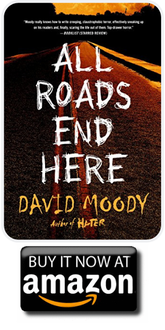 Set in the world of David Moody's Hater trilogy, All Roads End Here is the sequel to the "top drawer horror" (Booklist, starred review) One of Us Will Be Dead by Morning. It’s taken Matthew Dunne almost three months to get home. Never more than a few meters from the Haters at any time, every single step has been fraught with danger. But he’s made it. In his absence, his home city has become a sprawling, walled-off refugee camp. But the camp–and the entire world beyond its borders–is balanced on a knife-edge. During his time in the wilderness, Matt developed a skill which is in high demand: the ability to anticipate and predict Hater behavior. It’s these skills that will thrust him into a web of subterfuge and danger. As the pressure mounts inside the camp, he finds himself under scrutiny from all sides. He’s always done his best to avoid trouble, but sometimes it can’t be helped. The shit’s about to hit the fan, and this time Matt’s right at the epicenter. All Roads End Here is a fast-paced, and wonderfully dark story about humanity’s fight for survival in the face of the impending apocalypse.    Comments are closed.
|


Archives
May 2023
|
 RSS Feed

|

|