

GARY MCMAHON
21/3/2013
 As a special introduction to the series of interviews I will be running for the THIS IS HORROR event next Saturday in Edinburgh, and the series of mini interviews for The Night is Dark anthology, I am honoured to have Gary McMahon over for another enlightening chat. 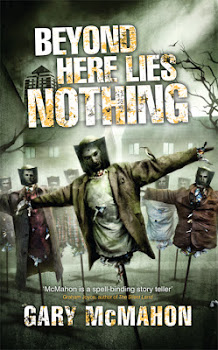 Gary McMahon was born in Sunderland in 1969 and has a lifelong love of genre fiction. His critically acclaimed short fiction has appeared in many magazines and anthologies. His first mass market novel was "Hungry Hearts", which was then followed by the Thomas Usher books ("Pretty Little Dead Things" and "Dead Bad Things") and the "Concrete Grove" series of horror/urban fantasy novels. His work has been nominated for the British Fantasy Award on seven seperate occassions. When reminded that he is still to win one of these, he gives a wry smile Hi Gary, how are things with you? Fair to middling, thanks. J How’s the running going? Was your new route as tough as you thought? I keep plodding onward…trying to regain past fitness glories. Every route is tough: there are no easy runs in life. Can you please give the readers a little bit of background information on yourself? I’m the author of seven novels, three short story collections and a handful of novellas. I’m originally from the Northeast of England, lived in London for a while, and now I reside in Yorkshire with my wife and son. I train at Shotokan karate, like running, and write about things that disturb, annoy or interest me. Can you remember what first motivated you to start writing, and has your motivation changed over the years? You know, I can’t even remember what first motivated me to write. I’ve always kind of had the idea that things aren’t quite real until I’ve written them down. I’ve always been a maker of lists, a complier of “mission statements”. I have this insane urge to write everything down…and to fictionalise real life events. And how would you describe your writing style? Intense, confrontational, confessional, terse… And what aspects of your writing do you think are the strongest and what do you think are the weakest aspects of your writing? I think I’m good with character and motivation. I’m probably not too good with crowd-pleasing endings, certainly at novel length – I like anticlimactic or ambiguous endings, but I seem to be in the minority on that one. Everyone else seems to prefer explosions or resolutions. Let’s talk a bit about the mechanics of your writing. How do you go about the writing process? Are you a plotter or do you go with the flow? It depends entirely on the project. Each story dictates its own method. Some I write organically, others I do an outline first and use that as markers to hit along the way. In your relationship your first publisher was there anything that surprised you? And was it anything that you believe is commonly misunderstood by new authors? No, not really. I knew what I was getting into, and that it would be long and bloody and I probably wouldn’t get back in one piece. As an author with a good history of publishing you must have had your share off odd reviews. Do less than flattering comments have an effect on you? No, I tend to take all reviews – good or bad – with a pinch of salt, to be honest. I’ve been lucky to have a lot of glowing reviews for my work, and if I started believing them I’d be in real trouble... I’m also not comfortable with flattery; I can handle antipathy (or even hatred) much better. I don’t even bother looking at my reviews on Amazon. I find the approval of my peers is far more important to me. If a writer I admire says they like my work, it feels like I might be doing something write. And without naming names, how do you feel when a genre magazine doesn’t seem to support horror novels. I found it really odd when a “proper” Sunday Newspaper gave one of your books a glowing review, yet a genre magazine didn’t. It pisses me off. Why review a horror novel if you don’t get on with horror, and why then mark it down for doing exactly what it sets out to do: disturb you, make you feel uncomfortable. Fuck that. It’s stupid. Your books have a reputation for being very dark and bleak, how much of your writing is reflection on your psyche? All of it. I’m actually a very gregarious, fun guy to be around, but underneath that I’m rather gloomy. I experience horrendous mood swings. I suffer from anxiety depression, which means that I worry about everything. I’m a nightmare to live with – just ask my wife. I think my fiction reflects all this. I do think the bleak tag is slightly ill-founded, though. There’s a lot of light in my work – you just have to be punished before you reach it. It’s been 14 years since your debut publication Neighbours in Nasty Piece of Work, did you think that all these years later you would have had this amount of success and high praise? I always hoped that things might go well – that I’d eventually be widely published. Praise doesn’t really motivate me. What drives me is the desire to examine my own life, through the lens of dark fiction. Success? I don’t think I’ve been successful in anything other than managing to get a few books published. Real success is staying published. Let’s see how that one pans out, eh? If you could back and do it all again is there anything that you would do differently? After those first stories were published back in the 90s, I took a long break from writing – several years, in fact. I wish I’d kept at it. I might have broken through a bit earlier, when the horror boom was still on, and made a bit of cash. People keep telling me that if The Concrete Grove had been published back then, it would have been massive. Other than that, I would start writing novels before I did, and I’d actively seek out an agent as soon as I could. I’ve done everything in an unplanned, haphazard fashion – I tend to live my life that way. Perhaps if I’d planned more, I’d have experienced some of that success you mentioned earlier… You took the familiar route of writing lots of short stories before tackling a novel, was this a deliberate decision? No. I just enjoy writing short stories. I don’t think we can control how, why, or what we create. We just follow the creative urge and hope for the best. If I did have any control over what I wrote, I would have started writing novels from the get-go and not bothered with the short stories. There’s no money in short fiction. But I love short fiction. Oh, how I love it. Was there a precise moment where you felt you were ready to tackle a novel? Yeah, there was. I had the idea for Rain Dogs (my first novel; the first one I’d ever written) and started to write it as a novella, then I realised that I could probably do it as a novel. It was an important moment for me: I was no longer afraid to try writing at that length. These days how do you decide on which to write, and how do you decide which of your ideas do you turn into a short story or a novel? With me, it’s all about mood and gut instinct. I have a lot of ideas. Some of them don’t work, others are abandoned before I even start writing them…but some of them continue to twitch after you think you’ve killed them. They’re the ones that stand a chance of becoming something substantial. You are best known for your Thomas Usher and Concrete Grove novels, but I would like to talk about Rain Dogs initially. Could you tell the readers what the book is about? Rain Dogs is about a man who is sent to prison for killing someone who breaks into his house. He’s a man driven by his own anger, his inability to control his rage, and this leads to him being separated from those he loves. When he comes out of prison, he tries to rebuild his life, to reconnect with his family. Then it starts raining. And it doesn’t stop raining. There’s something in the rain, hiding behind the raindrops. Something that’s coming after him, because of his past sins… Where did you get the idea of the Rain Dogs from? It occurred to me during a long rainy spell here in Yorkshire, when I was thinking about the lengths I’d go to in order to protect my family. Could I kill to keep them safe? Would I be prepared to do that? I love the description of what a Rain Dog is at the beginning of the novel. “some of us spend a lifetime trying to find our way home; we are the rain dogs, lost and stranded after the storm.” It’s a wonderfully evocative passage, how much time and effort did you spend on this? To be completely honest, I pinched that from Tom Waits. Not the wording, but the concept of what a Rain Dog is. The album Rain Dogs was a massive influence on the book – I listened to it constantly as I wrote. That passage sums up the entire theme of the book. It isn’t about monsters. It’s about someone trying to get home in a storm. It was recently re-released as an eBook, is this version the same as the original? Were you ever tempted to go back and polish it up a little? Oh, I did polish it up for the eBook release. I also reinstated a final chapter the original publisher asked me to leave out. It’s a prologue that ties up a couple of loose ends. The eBook edition is the definitive version. Let’s talk about your Thomas Usher novels. Even though the premise of a detective with supernatural powers doesn’t seem like a new idea, these books never fail to feel fresh, what is it about these books sets them apart? I’m not really the right person to answer this. I’m not even sure if anything does set them apart. All I know is, there’s a lot of crime fiction out there that uses a light dusting of the supernatural. I wanted to write a book (or series of books) that was 50/50 crime and supernatural horror. If there’s anything worthy about the Usher books, I like to think it’s the character of Thomas usher himself. You are about to release To Usher the Dead, a collection of short stories that happen before the events of the first novel. You promise some big reveals, particularly why he turned his back on his powers. Was this an easy decision to make? Did you ever feel this would lessen the power of the character? I wrote most of the short stories before I even thought about writing an Usher novel. Readers of Pretty Little Dead Things will already have read about what happened to make Usher turn his back on his ability – the story came as an extra feature in the paperback. Those stories were vital in the development of the character. He’s different in the novels. The short stories helped me discover his true voice. Is this the last we have seen of Usher? I hope not. I have a few ideas in mind: a novella, a third novel. It all depends on the publisher, really, when I get a chance to approach them (I’m too busy writing my current novel to even think about anything else). Because I don’t write full-time, there are limited hours in the day that I can devote to writing, which means that everything happens slowly. And now we come to the Concrete Grove. I can’t believe that, at the time of writing this interview, I only have 6 days to go until the final book is released. Do you feel the same mix of elation and sadness that I do when the final book of a series is released? Yes, I do. These books – this fictional world – have been part of my life for a long time. I’m sad to see it all go, but I’m also delighted to be able to turn my attentions to other things. I spent so long in the Grove that I started to feel like a prisoner there, just like some of the characters in the books. So what can we expect from this book? Will it all be tied up nice and neat or will we be left with some unanswered questions. I hope I’ve tied up any loose ends from the first two books, but I’ve deliberately left a lot of things hanging. The final chapter of the book leaves things wide open for that world to be explored in even more detail. By the end of the third book, everything has changed in a big way. Although the three novels form a trilogy, I always intended them to work as stand-alone stories. The first two books certainly work that way, but the third one, by nature of being the final instalment, works better if you’ve read the others first. I get the impression that these books are very personal to you, is this case? All my books are personal to me. I’m just that kind of writer: confessional. I have always wondered, especially with books such as yours that elicit big emotional responses from the readers, just how detached are you when you write them? Do you go through the emotions when you write, or do you become so engrossed in the writing that you go on autopilot? I’m completely emotionally invested in everything I write. That’s why I write: to engage my emotions, my imagination, and hopefully my intellect. It’s the only way I know. I don’t find writing fun. I enjoy it, but for my own complicated reasons. It’s more of a compulsion than anything that gives me pleasure. Can you tell us about any future projects? I have a short apocalyptic novel launching at the World Fantasy Convention in 2013: The End, published by Ian Whates’ NewCon Press. I’m currently working on a new novel called The Quiet Room, which is an expansion of a story of mine (What They Hear in the Dark) that was published a couple of years ago, as a chapbook. It’s my version of a haunted house story. Next up is another novel, this one a ghost story called The Bones of You, which has been commissioned by an acclaimed U.S. independent publisher. I’m also hoping to have a 25,000-word novella, Reaping the Dark, published next year by another U.S. publisher. Gary, as always it has been an honour, an education, and a joy to chat with you. Do you have any final words for the readers? Thanks, Jim. The pleasure is all mine, believe me. Final words? Yes: keep reading. Comments are closed.
|


Archives
May 2023
|

 RSS Feed

|

|