

 Could you tell the readers a little bit about yourself? I’m a writer, film critic and filmmaker based in Columbus, Ohio. Which one of your characters would you least like to meet in real life? I’d least like to meet Brian from the short story “Aggrieved” in the new anthology Incubate, not because I’d be afraid of him but because he’s terribly unpleasant. Other than the horror genre, what else has been a major influence on your writing? My family. My sisters, my husband, my son – they’re all such vivid, fascinating people. I love the way they talk and think, and I steal from them all the time for stories. The term horror, especially when applied to fiction, always carries such heavy connotations. What’s your feeling on the term “horror” and what do you think we can do to break past these assumptions? I love the term horror, but I respect the fact that a lot of people don’t. It does bother me when something that’s clearly horror – The Silence of the Lambs or Get Out, for instance – gets relabeled as “psychological thriller” because the people dishing out labels can’t deny its quality. That offends me, as if it’s impossible for something to be both horror and of high quality. But I do recognize that a lot of people go out of their way not to be scared, the world is scary enough and that’s not how they escape. For a lot of us, that is how we escape, or at least how we deal with things. A lot of good horror movements have arisen as a direct result of the socio/political climate. Considering the current state of the world, where do you see horror going in the next few years? I predict a lot of stridently, magnificently feminist horror – not unlike Incubate. The #MeToo movement awakened something and there’s been tremendous struggle to hold on to what little progress was made. Anti-trans legislation and attacks on women’s autonomy have turned the entire U.S. into hostile territory. All art, and horror in particular, reflects the culture of its time. Misogyny is hardly new, but it is so out in the open right now, it is such a violent attack, that it’s bound to be reflected in horror. Given the dark, violent and at times grotesque nature of the horror genre, why do you think so many people enjoy reading it? Because you survive it. No matter what happens to characters, and no matter what kind of horror you enjoy, the fact is that you, the reader, make it out alive. It’s cathartic and safe. What, if anything, is currently missing from the horror genre? New voices, which is what’s missing from every art form and medium. I love Poe, I love Stoker, but it’s hard not to feel like you’re reading the same story when every story you read came from the imagination of a heterosexual, middle aged white man. The adage is that there are only so many stories and they are constantly being retold, but maybe that’s not true. Maybe it just seems like it because, since Aristotle, we’ve almost exclusively heard stories told by men. I want to read stories that are wildly new to me – stories that speak to what I know personally, and stories born of experiences I have never had. What new and upcoming authors do you think we should take notice of? The writers in the collection Incubate – LCW Allingham, River Eno, Dale W. Glaser, Sydney Hodges, A.R.C. Mitra, Maureen O’Leary, Sofia Tantono and Ef Deal – are remarkable. Many of these women are veteran writers, but I want to call each out because I so enjoyed their work in this anthology. Samantha Kolesnik and Hailey Piper have written my favorite books of the last couple of years. Are there any reviews of your work, positive or negative, that have stayed with you? One reader said a story made him feel like he was peering through a back porch screen, witnessing something he wasn’t supposed to see. I loved that, (and also admired his ability to conjure an image). What aspects of writing to do you find the most difficult? I always struggle finding the balance between saying too much and not saying enough. Is there one subject you would never write about as an author? I think there is probably an angle you can take that respects every topic. I don’t know if there’s anything I’d forbid myself from writing about, but that’s the glory of horror. Anything you would not want to write about is likely horrific, so in this genre, you may be able to show that horror without exploiting it. I cannot imagine writing romance, though. Writing is not a static process. How have you developed as a writer over the years? When I finish something, I evaluate for myself what I did well and what maybe needs work. I tend to write dialog well, and I also tend to rely too heavily on dialog to tell the story because I do it well. So, this year I wrote one story with no dialog at all, to force myself to concentrate on other story elements. Then I wrote one in second person, which is to say, I wrote one that was exclusively dialog. I think I just try to make sure I don’t get lazy, don’t write the same thing or the same way each time. What is the best piece of advice you ever received with regards to your writing? Not to self-censor. Writing is hard. For me, it’s best to write exactly what’s in my head as it comes into my head without deciding if it’s valuable, if it’s mean, if it’s nasty or whatever. If it turns out to be too much, I can always edit it later. Which of your characters is your favourite? There’s a character in a film I wrote that I love the most. He’s a pastry chef who sings macabre versions of Christmas carols as he uses his culinary skills on hapless victims. He’s, to me, such a bizarre mix of cartoonish comedy and real terror that he makes me proud. Which of your books best represents you? Roost is, essentially, an autobiography peppered with fictional murders. It’s set in my hometown, in my childhood home, and populated with my sisters, parents, neighbors. It’s very me. Do you have a favorite line or passage from your work, and would you like to share it with us? Damn, nothing tastes as good as self-righteous indignation and cowardice. Can you tell us about your last book, and can you tell us about what you are working on next? Incubate, an anthology from Speculation Publication that contains one of my short stories, is the latest. The entire collection harnesses the rage inspired by recent orchestrated attacks on women’s autonomy, and in particular the attack on Roe v Wade, and I’m honored to be included. I’ve just finished a draft of a new novella about a horror movie festival judge whose own life starts to look like the movies she’s watching. I’m a massive, massive horror movie nerd, so it’s been really fun to write. If you could erase one horror cliché, what would be your choice? “The death of a beautiful woman is unquestionably the most poetical topic in the world.” Fuck that. Just fuck it right in the eyeball. God, I am so tired of that. What was the last great book you read, and what was the last book that disappointed you? I loved Samantha Kolesnik’s True Crime so very much. On the other hand, I just read one of Charles Bukowski’s last publications, a memoir of sorts from his final years illustrated by Robert Crumb called The Captain Is Out to Lunch and the Sailors Have Taken Over the Ship. I was underwhelmed, which surprised me because I love him. What's the one question you wish you would get asked but never do? And what would be the answer? Q: Where do you find reasonably priced, flattering women’s jeans with a 36” inseam?? A: I wish I knew. Incubate: a horror collection of feminine power In a ruthless world, we must become monsters to survive. A bitter woman terrorizes her husband’s perfect new wife. A predator stalks a college town, seeking a very specific type of prey. Found family can be the most unforgiving of all, when a mother, maid and lover fails to care for her boys. Girls go out alone at night, exhuming the lies their town propagates to keep them in line. A fussy baby and an ignorant husband leave a new mom feeling not quite herself. If it is divine to suffer, then revenge might be the sweetest reward. There are no limits to how far a girl will go to achieve perfection for the man she loves, if that love lasts an eternity. The hunger to become one’s true self must be fed… If women must be monsters, what kind of world will they give birth to? Hope Madden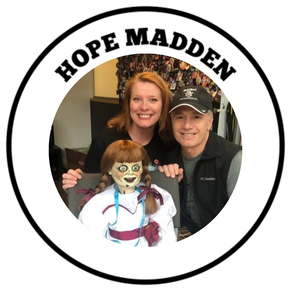 Hope Madden is a writer, filmmaker and film critic based in Columbus, Ohio. Her poetry and short fiction have appeared in numerous journals including Wild Goose Poetry Review as well as Z Publishing’s Best Emerging Poets: An Anthology. Her first feature film, Obstacle Corpse, was completed in 2022. Her first novella, Roost, also saw first light in 2022, publishing in March of that year from Off Limits Press, and her short story “Aggrieved” is featured in the 2022 anthology Incubate from Speculation Publications. Links Incubate https://amzn.to/3v1JtAu Roost https://amzn.to/3FAyG5b Maddwolf.com Twitter: @maddwolf Instagram: @maddwolfcolumbus the heart and soul of horror websitesComments are closed.
|


Archives
May 2023
|
 RSS Feed

|

|