

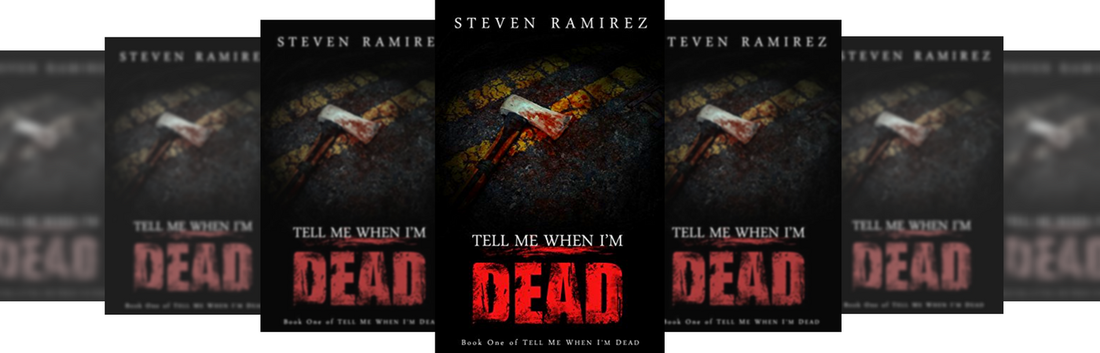
 Steven Ramirez began writing seriously as a sophomore in high school, concentrating on that time-honored vehicle of teen outrage and simmering hormones—poetry. Each week, he created these verses and “borrowed” the school’s copier equipment, which allowed him to distribute his work to the unsuspecting world. He still owes the high school twenty-eight bucks for supplies, so please don’t tell anyone. Eventually, Steven began writing screenplays, mostly because everyone else in LA is writing a screenplay. It’s the law—look it up. If you are not at least “working” on a screenplay, they banish you to South Orange County, where you can take up surfing. Come to think of it, they might have rewritten that law, but you wouldn’t know it visiting Starbucks. What set him apart, though, is that for a while he had an agent. He still didn’t sell anything, though. Agents are like lawyers. Unless there are crisp, new thousand dollar bills nailed to your forehead, they tend not to return your calls. Then came a fateful meeting with the Davids—David Rimawi and David Latt of The Asylum, the prolific studio responsible for ‘Sharknado.’ These fine gentlemen read Steven’s work and decided to take a chance. The result was the horror-thriller film ‘Killers.’ It was funny, bloody and action-filled, and featured a young Paul Logan, who has gone on to enjoy a nice movie career while Steven became old, embittered and … Wait, that’s somebody else’s life. Tired of hawking screenplays, Steven returned to short stories. Though over the years he had written several novels—none of which were published—he decided to try again and in 2013 published Tell Me When I’m Dead, a zombie thriller. In 2014, he followed up with the sequel, Dead Is All You Get, and is hard at work on the last book of THE DEAD SERIES trilogy. In addition to writing, Steven is a pretend musician, having written songs and played in bands since high school. He started on the accordion long before it was popular, then graduated to the piano. Thankfully, he decided to give up music and focus on writing. Could you tell the readers a little bit about yourself?
In college, I started writing screenplays. I did that for a number of years. If you live in LA, you sort of have to. I managed to sell one that was made into a feature film. At some point, I decided fiction was a better way to go. I’ve published a horror thriller trilogy called TELL ME WHEN I’M DEAD and have written another novel and a novella—both of which I hope to publish soon. What do you like to do when you're not writing? Well, I have a family I am devoted to. I love to read, and I also like to watch movies and television. Other than horror, what other things have been a major influence on your writing? Crime fiction has always appealed to me. If you think about it, often characters do horrific things when committing crimes. Usually, it’s out of desperation. Do you prefer the term Horror, Weird Fiction or Dark Fiction? I love the term Dark Fiction because it covers a lot of ground. When some people talk about Horror, they are imagining serial killers. Others prefer demons and the paranormal. And some think of fantasy. In my trilogy I chose zombies. Who are some of your favourite authors? There are many, but I will name a few I very fond of: Jack Finney, Richard Matheson, Shirley Jackson, and Patricia Highsmith. What is your all-time favourite horror novel, and film? For book and film, The Exorcist and Rosemary’s Baby. For film alone, The Conjuring and The Conjuring 2. How would you describe your writing style? Okay, this is where my ego enters the room. I’ve always wanted a reviewer to describe my style as “visceral and immediate.” Let’s go with that. Are there any reviews of your work, positive or negative that have stayed with you? Someone recently reviewed Book One of the trilogy and said, “Very nearly as good as Stephen King.” That means a lot to me because King is a master of the craft of writing. What aspects of writing to do you find the most difficult? I’m a pantser, so I never really know for sure where I’m going until the book is done. Every day is a discovery, which can be exciting or frustrating—depending on whether I get stuck. Is there one subject you would never write about as an author? What is it? Pedophilia. I might use it to drive a story, but I would never consider describing it in detail—it breaks my heart that it happens so much in real life. If you could kill off any character from any other book who would you choose and how would they die? Humbert Humbert from Lolita. I would love to imagine a scene where Charlotte actually survives the traffic accident and, having recovered, throws him into a wood chipper. What do you think makes a good story? For me, there’s nothing more important than believable, complex characters. They are what drive a good plot. How important are names to you in your books? Do you choose the names based on liking the way it sounds or the meaning? I am very big on names that sound interesting when spoken aloud. Sometimes, I choose a name that represents a theme in the book. It really depends on the story I’m writing. How do you think you’ve evolved creatively? I’d like to think that with each book my writing has gotten better. I learned a lot from writing screenplays, especially about pacing. Over the years, I’ve read books that seem to drag on and on. I keep wanting them to get to the point and find myself nodding off reading a character’s interior monologue. I try hard not to do too much of that in my books. I’m a strong believer in Elmore Leonard’s admonition: “When you write, try to leave out all the parts readers skip.” What tools do you feel are must-haves for writers? I started using Grammarly recently, and I have found it to be very useful. That’s not to say it’s a substitute for an editor. But it has taught me discipline when constructing a sentence. What is the best piece of advice you ever received from another author? Years ago, I had an opportunity to meet the late author Ray Bradbury. I had made a short comic movie that was shown at a festival he attended. He made it a point to come up to me and tell me how much he liked the movie because I wasn’t afraid to “take chances.” That has always stuck with me—and I do try to take chances in everything I write. How do you market your work? What avenues have you found to work best for your genre? Huge confession—I am terrible at marketing my own stuff. I use Twitter a lot and occasionally pay for ads. Horror is a tough market. Somehow, I think I would have an easier time if I wrote Romance. Who is your favourite character from your book and why? Dave Pulaski, the protagonist in all three books. Why? Because despite being so flawed, he goes from being a recovering alcoholic barely able to keep his life on track to a stone killer with heroic tendencies. How about the least favourite character? What makes them less appealing to you? My least favorite is the Mayor from Book Two. Though he plays the part of being the nice Catholic family man, he is an arrogant, self-serving devil who will do anything to “get ahead.” Even now as I write about him, I feel my blood boiling. Fame, fortune, or respect? Yes, please. Seriously, though, I would like to be respected as a writer. What piece of your own work are you most proud of? Book Three. In terms of style and pacing, I feel I really nailed it. I hope readers agree. For those who haven’t read any of your books, what book of yours do you think best represents your work and why? If someone were interested and could only read one book, then Even The Dead Will Bleed. Though it’s the third book in the trilogy, it can stand alone. Can you tell us about your last book, and can you tell us about what you are working on next? My last book is as yet unpublished and is called Chainsaw Honeymoon. It’s about a fourteen-year-old girl named Ruby Navarro who is on a mission to get her parents back together. She’ll need everyone—including a computer-generated, chainsaw-wielding killer—to help her. As you can imagine, the story is comic—bordering on satirical. If you could erase one horror cliché what would be your choice? That’s easy. The “Don’t Go into the Basement” trope. In real life, no sane person would go “exploring” when bad things are happening. Yet we always see this in bad horror movies. Drives me nuts. Which fictional character would be your perfect neighbour, and who would be your nightmare neighbour? Jim Dixon from Lucky Jim by Kingsley Amis. Okay, he is by no means perfect as a person, but I feel I would have a great time knowing him. As for a nightmare neighbor, I think Rose the Hat from Stephen King’s Doctor Sleep. It’s not so much the killing, but all those damned campers parked in the driveway. What do you think of the current state of the genre? That’s tough for me to answer because I don’t strictly read Horror, although I tend to watch a lot of horror movies. Generally, I would say that we seem to be running out of things to be scared of, so we return to the tried-and-true genres—ghosts, vampires, and zombies. I’m not a fan of torture porn and usually stay away from those things. For me, some of the best horror comes from authors and filmmakers who combine it with comedy. What was the last great book you read, and what was the last book that disappointed you? The last great book I read was True Grit by Charles Portis. I saw the Coen Brothers’ reboot and found it to be very true to the novel—unlike the original with John Wayne. As a professional courtesy, I don’t talk about books I dislike—unless the author is dead. In this case, they are very much alive. What's the one question you wish you would get asked but never do? And what would be the answer? “Did you ever sing in a barbershop quartet while in college?” Yes, yes I did. Comments are closed.
|


Archives
May 2023
|
 RSS Feed

|

|