

HORROR AUTHOR INTERVIEW : DAVE MATHEW
25/9/2014
 David Mathew works in the Centre for Learning Excellence at the University of Bedfordshire, UK, and as an independent researcher and writer. His wide areas of interest include psychoanalysis, linguistics, distance learning, prisons and online anxiety. With approximately 600 published pieces to his name, including a novel based on his time working in the education department of a maximum security prison (O My Days), he has published widely in academic, journalistic and fiction outlets. In addition to his writing, he co-edits The Journal of Pedagogic Development, teaches academic writing, and he particularly enjoys lecturing in foreign countries and learning about wine. He is a member of the Tavistock Society of Psychotherapists and Allied Professionals, Evidence Informed Policy and Practice in Education in Europe (EIPPEE), and the European Association for the Teaching of Academic Writing. He was also a member of The Health Technology Assessment programme (www.hta.ac.uk), as part of the NIHR Evaluation, Trials and Studies Coordinating Centre at the University of Southampton (2009-2013). Could you tell the readers a little bit about yourself? My name is David Mathew and Ventriloquists is my third published novel. I have also published a volume of short stories and next year will see the publication of my first academic book, Fragile Learning. I work at a university in a staff development team and I’m active in research into barriers to learning and psychoanalysis. In terms of fiction, I like to write what I hope will be powerful fiction, with a strong voice, strong characters and dollops of dark humour. That’s the plan, at any rate. What do you like to do when you're not writing? Reading is probably too obvious (though it’s true). I like watching films and especially listening to music. The list of acts that I listen to is as long as your arm, but at the moment I’m really into Swans, Iggy, Miles Davis, Tindersticks, Zeppelin and Coil. I recently got the ‘Awkard Pause’ album from Nurse With Wound and it’s hardly been off the CD player in the car. My dog’s not entirely sure what to make of it but I love it. I enjoy taking my dog for walks in new places; meeting friends for a pint; occasional trips to the theatre; eating out. I also try to keep fit but I’m not sure that ‘like’ comes into that. What’s your favourite food? If it’s a night out, I really enjoy Indian food. There’s something about an Indian restaurant that makes the experience more than a meal that you eat. There’s an ambience, a pleasure in the company shared. Or there should be any rate… Who would be on the soundtrack to your life story? What a great question! My first band – and everyone, I think, has a first band, a band that just feels right, a band that clicks with you (and you click with it) – was Showaddywaddy when I was a boy. I was born in 1971 and they were very popular in the UK when I was between eight and about eleven, twelve… Their Crepes and Drapes LP was the first record I ever bought (and I still own it, and I still play it a couple of times a year). Something from that would definitely be on my soundtrack but it’s hard to pick a favourite because it’s all one piece in my mind, almost. That’s how I absorbed it when I was a boy. After Showaddywaddy I got into Queen. Something from Queen, probably from A Night at the Opera, which is probably their album I like best. I’d also have Bruce Springsteen, Tom Waits, Coil, The Pogues… For my year in Cairo (the academic year 1994-95) I would have Mary Chapin Carpenter, Shane MacGowan and the Popes and Nick Cave and the Bad Seeds. These cassettes were rarely out of the machine. In 1995, in Poland, in listened to a lot of Elvis Costello and Ramones. In recent years, Miles Davis, 16 Horsepower, Tindersticks, Led Zeppelin… Do you prefer the term Horror, Weird Fiction or Dark Fiction? It really depends on what I’m writing (or reading). They don’t mean the same thing to me and any sense of preference would come out of the term’s suitability. Ventriloquists is very much a weird fiction book. Its predecessor, Creature Feature, was very much a sarcastic horror novel. So I don’t have an in-built preference for one term over the other. Who are some of your favourite authors? Stephen King, Martin Amis, Ramsey Campbell, Jonathan Carroll, John Updike, Vladamir Nabokov, Charles Bukowski, Sigmund Freud, Jacques Lacan, Paul Meloy, David Foster Wallace… What is your all-time favourite horror novel, and film? For sheer inspiration I should choose the first horror novel I ever read, which was It by Stephen King, which I got as a birthday present when I was fifteen (or it might have been sixteen). It still resonates, to this day. In fact, I’ve recently started to read it again. I like to read when I’m on my exercise bike, doing my 10K in the morning before work. It took some courage to pick up It again – I was nervous that I would think it dated or simply not very good. I am only on about page 80 but I’m loving it. It’s as good as it ever was. And it’s funny, I can remember it so vividly as I go through it. I think I read with so much more care and attention when I was in my teens than I do now. If you could erase one horror cliché what would be your choice? Werewolves. I think werewolves are rubbish. They’re my equivalent of the Pathetic Sharks in Viz. Which fictional character would be your perfect neighbour, and who would be your nightmare neighbour? Another great question! I’m struggling to think of a fictional character who would keep himself to himself (or herself to herself) but won’t keep borrowing my tools and not returning them. I’ve settled on Guy Clinch from London Fields (Martin Amis). He’s dull, he’s wealthy and his wife is so snobby that they won’t possibly expect me around for dinner. Perfect neighbour! A nightmare neighbour would be anyone noisy or popular enough to encourage lots of people to their door. Just about any character from anything by Irvine Welsh would fall into this category. What do you think of the current state of the genre? It seems to be healthier than it’s been in a while. I’ve never really moved in circles in which I can accurately gauge such things, but I know that publishers are accepting manuscripts that are by authors without a pre-established name. That’s got to be positive, hasn’t it? What was the last great book you read, and what was the last book that disappointed you? The last great book was David Foster Wallace’s Infinite Jest – one of the most astonishing things I’ve ever read. A thousand pages, dense as tarmac, crowded with voices, paranoia, pages of deliberate boredom… and then some of the best jokes you’ll ever read. His suicide was a tragedy; I think he was about 47 or 48. I was disappointed with Train Dreams by Denis Johnson. I’d heard so much about it and after I closed it (and it’s only a tiddler) I thought: meh. It was nominated for a Pulitzer Prize. How would you describe your writing style? It’s been called ‘muscular’, which I really liked. Otherwise, can I give you the quote that is on the back of Ventriloquists:? “With Ventriloquists, David Mathew has written the kind of fiction other writers love to read. Complex, erudite and original with moments of sudden linguistic hilarity reminiscent of Martin Amis in his pomp.” That’s from Paul Meloy – I love that. That sums me up nicely, I think. Are there any reviews of your work, positive or negative that have stayed with you? Keith Brooke reviewed Ventriloquists by saying: “David Mathew has always had a talent for getting inside the heads of damaged criminal minds and this novel shows those skills at their peak. Read this book and you'll be taken to some very disturbing places, in the borderland between the strange and the terrifyingly insane. It might just make you doubt the world around you. It might just make you doubt yourself... Uncompromising. Moving. Compelling. Ventriloquists gives a raw insight into the dream life of Gangster Britain and the fantasies of captive victims.” And I got some fantastic reviews for O My Days: “`What you do is, you learn indifference. You learn a new way of dealing with stimulus, and that new is thought of as indifference' That sound's like a strategy in a Samuel Beckett novel. But it's the shrewd advice of Billy Alfreth who is incarcerated in a Young Offenders Institute in the North of England. He is a pretty violent, ant-social guy who ruminates on his condition, the warders, fellow prisoners and visitors. Billy defends his reason by indulging in violent fantasies about his own crime and the imagined cruel behaviour of those around him. Intense narratives, within narratives, jostle for expression inside `O My Days' monologue framework. Yet the author's disturbing sense of mind control keeps pulling the book back from being a `mere' account of prison life into something bolder and more disturbing. I experienced an acute, often surreal, sense of an offender's pathology, with all its traps, humour and contradictions. `O My Days' is a tour de force of powerful writing. This book is not an easy read. It's demanding, gruelling yet always honest, insightful and finally moving. It explores areas that serious fiction really travels too. A quite remarkable novel.” “This is a great book. It is authentic and wise, sometimes funny, always intelligent. This is a writer who has been there, viewed with compassion, and reported back. There is a new mythos here, something that feels ancient and sand-blasted and unfathomable, but it is revealed within the most modern of contexts. Highly recommended.” “This is a great read. Mathew has a long pedigree as a short story writer and journalist, so I was intrigued to see what is, I believe, his first published novel. In this novel, he writes in the voice of a streetwise young offender and although Mathew strikes a good balance between authentic language and simple, good writing, it does take a few pages to get used to how this is told. But after those first few pages I was completely won over. The voice carries the authenticity of someone who has been there, seen it, done it: the author may not be a young offender, but he's worked with them in institutions like the one in this novel, and his experience shines through. O My Days is a gripping and scary novel, and it kept me reading far too late at night. Recommended.” “Who the hell is David Mathew? One talented and brave writer out of the UK, that's who. An accomplished name in the short story field that I'm hoping to see make a big splash in the States with his breakout novel O My Days (Triskaideka Books), a writer who's literary and surrealistic savvy evokes thoughts of such dark fabulists as Conrad Williams and T. M. Wright. Online, at the Urban Dictionary, "Oh my days" is defined as an expression used when in shock or in awe of something, when excited or surprised. But with Mathew's book, the term's more that of a lament--a decrying of a nightmarish situation, spiritually, mentally, physically, and geographically. And why not? The book's protagonist and storyteller, William "Billy" Alfreth, certainly has enough on his plate, being imprisoned at Delacotte's Young Offenders Institute for a brutal crime caught on camera, an act--despite any film to the contrary--that went down totally different in Billy's mind. Making matters worse, while being grilled by a visiting psychologist writing a thesis on "prison lingo," Billy's starting to lose it, with his estranged family, his girlfriend and baby, his money ... and with time: chunks of time, unaccounted for, with only one possible horrific explanation. Things are coming to a head, and Billy's going to get some answers. But in the looking, the price is going to be paid for in blood--lots. The real pleasure, though, is not in Mathew's plot, but in the story's unveiling. There are books and there are books. Some are fine reading fodder, but in the end, are simply passable fares, not unlike fast-food, or perhaps ten- to fifteen dollar plates, meals enjoyed for what they are, but quickly forgotten. Then there are those "fine dining" pieces of work, books that force a reader to want to sit in an easy chair and sub-vocalize every word, skimming nothing. Works that pack the whole punch with story/setting/character and literary-value. In O My Days Mathews delivers a first-person tale written in authentic prison voice that challenges a reader (especially American ones) to savor every word, every line, every page. This is not a work to be skimmed. I call Mathew brave because the established tone and slow-burn pace of his novel is not the most easily accessible. Rather, his character- and diction-driven tone require a reader's complicity ... requires the reader to join William "Billy" Alfreth on his nightmarish journey of discovery. Not every reader will have the patience to do their part in the partnership that O My Days requires. What's wonderful, however, is that for those that do, the payoff explodes in spades. Last word on the subject, remember: "No one kicks off in the Cookery class." Now, if you really want to find out why, pick up and read O My Days by David Mathew. You'll be glad you did, bruv.” What aspects of writing to do you find the most difficult? I can’t really divide it up – it’s all one big joyful experience, most of the time. You get the occasional example of mid-project doldrums, perhaps. But the only bit I actually dislike is typing it all up at the end. That’s really a drag. (I write with a fountain pen and then type it up when I’m happy with it.) Is there one subject you would never write about as an author? What is it? I can’t imagine that I’d ever find anything to say about the Holocaust that would be original enough to say in the first place or respectful enough not to hurt people’s feelings. The same would be true of fictionalised versions of any genocide, I think. If you could kill off any character from any other book who would you chose and how would they die? Metafictional assassinations! These are great questions! Unfortunately, I can’t think of a great answer right now. Who outstayed his welcome? What do you think makes a good story? An original plot, deep characters, snappy dialogue, vivid scenes… and something for the reader to learn as he goes through the pages. Not necessarily a fact to learn, but something about mood, pacing, timing, the reveal… How important are names to you in your books? Do you choose the names based on liking the way it sounds or the meaning? Names are very important to me. You’re going to be with these people for a long time if you’re writing a novel so it’s got to feel right. For me, it’s a very natural process – the names suggest themselves quite readily, usually anyway. I never choose names because of meaning, and I’m actually not that impressed when I read that a character named Simon Blackheart (for example) is a total bastard. It’s unnecessary. You can show us that he’s a bastard; you don’t need to give us a name that gives the game away from the off (well, not unless you’re writing a comedy, I suppose). How do you think you’ve evolved creatively? I’ve learned to condense things. That’s an important lesson, I think. Ventriloquists is 600 pages long, but if I’d been five years younger it would have been 800 or 900 pages long. With this in mind, perhaps I should go back to my favourite manuscript of mine, The Parry and the Lunge. Maybe (in retrospect) it really is too long. What tools do you feel are must-haves for writers? If you mean physical tools, then pens, paper, a dictionary, access to books (your own or a library’s), and of course a computer to type it all up. If you mean ‘tools’ in the sense of soft skills or gifts, then imagination, space and time are equally as important. What is the best piece of advice you ever received from another author? “Only make the cuts if you agree with making the cuts.” It was Dennis Etchison. I had interviewed him for Interzone in about 1997 or 1998, in London, and we were walking towards the bus stop together, back in the days when a fare was 50p and you still paid the driver with a coin in his hand. We were talking about a manuscript that I’d completed and which had taken a battering from a publisher’s reader. It remains unpublished. How do you market your work? What avenues have you found to work best for your genre? I would welcome any advice on marketing from any soul on the planet. It’s my blind spot. Who is your favourite character from your book and why? In Ventriloquists I really like Don Bridges, the birdkeeper on the estate. I think he tiptoes on that fine line between being creepy but keeping it contained. I keep his various secrets long, long into the book. I found his story delicious. How about the least favourite character? What makes them less appealing to you? I like all of the charcters in this book. Sorry about the cop-out answer. I even name one of the chapters ‘Lesser Characters’, in a kind of post-ironic manner, because while they don’t have much to contribute after that chapter, they are absolutely essential for certain plot connections to be made. I remember writing that particular chapter in Rome, where I was delivering an education and psychoanalysis paper at a conference. It felt like the purest thing to write. I couldn’t find my way into the heads of my other characters; they were too far away from me. But I was able to think about Molecule and the fellow that he calls Willy Womble. Fame, fortune, or respect? Respect. The other two might follow, I suppose, but while I don’t want to be famous, a few quid would be nice. What piece of your own work are you most proud of? The Parry and the Lunge – an unpublished manuscript. I’m told it’s too long. And I agree that it’s long but I don’t think it’s too long. But I’m not in charge! All I know is, I doubt that I’ll ever write quite that well again. I found something quite special when I was writing that. And are there any that you would like to forget about? Not really. There’s stuff that lingers in a drawer or a trunk and maybe it will see the light of day, or maybe I’ll stab it through its bleeding heart the next time I have a clear-out. For those who haven’t read any of your books, what book of yours do you think best represents your work and why? Ventriloquists sums me up best, I think. It’s a big story with a lot of characters, all colliding off one another. I found an appropriate voice and a geographical space to contain them all. I’m very pleased with it – and I like the jokes. (Does that sound too big-headed? Sorry if it does.) It’s dark and angry, with moments of sudden light. Can you tell us about your last book, and can you tell us about what you are working on next? The last book was Creature Feature, co-authored with M.F. Korn. It’s a sarcastic horror novel, in which we introduced tropes and even a number of horror clichés – and then played it absolutely straight. So, it can be read in two ways: as a straightforward horror novel about a town that is slowly going mad… or you can fill in the gaps and make it more of a game. It’s up to you: it’s your book to do with what you wish. What's the one question you wish you would get asked but never do? And what would be the answer? Q. “What would you like us to do with this Lottery cheque for six million pounds, David?” A. In the bank account, please. 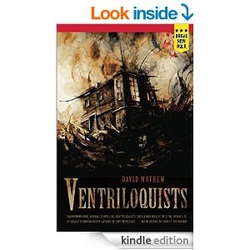 People in Bedfordshire are disappearing. Two teenagers are kidnapped from a rural train station. A baby is taken from an urban market. Another baby is stolen from an encampment of Travellers. Two burglars, who have never met, break into a village home and one dies, killed by a giant wave of sea water that appears from nowhere. All the while a strange man obsesses with making a movie...whatever the cost to those around him. Another man appears to care only about the beautiful birds that he keeps in a cage... But nothing is what it seems. Ventriloquists is a story about a man who discovers a liminal space between life and death. Around him bad people desperately try to defend their appearance of civility...but to what emotional and physical cost? What does it mean when kidnappers are kidnapped? Who are the puppets? And who are The Ventriloquists? FIND OUT MORE ABOUT DAVID AND HIS BOOKS BY FOLLOWING THE LINKS BELOWTHE HEART AND SOUL OF HORROR WEBSITESComments are closed.
|


Archives
May 2023
|

 RSS Feed

|

|