

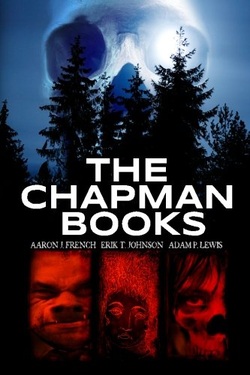
 THE CHAPMAN BOOKS THE CHAPMAN BOOKS Erik T. Johnson's work has appeared or is forthcoming in fine periodicals such as Space & Time Magazine, Tales of the Unanticipated, Polluto, Electric Velocipede, Structo, Morpheus Tales, Sein und Werden, and Shimmer; and anthologies including Chiral Mad, Chiral Mad 2, The Shadow of the Unknown, Box of Delights, Dead but Dreaming 2, WTF?!, and Best New Zombie Tales 3. A complete and regularly updated bibliography, blog, scrawling and doodles, and reviews of his work can be found by visiting YES TRESPASSING 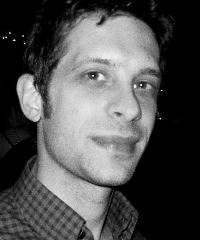 ERIK T. JOHNSON ERIK T. JOHNSON Could you tell the readers a little bit about yourself? I only write because I must write and only write what I must write. I think that's a cliché, but so what, there are clichés, that for me, actually touch the deepest core of my life in a meaningful way. There's no reason why the essence of my individuality shouldn't be just the same as that of everyone else. Essence isn't much anyway—It's details, details, the way they interconnect and form lattices and roads and constellations and the way, as an author, that you can take some details that would never, ever, ever touch, and make the reader feel as though they couldn't possibly exist without each other—That's what it's all about. Making Siamese Twins of falling snow and amniotic fluid, or a dead horse's penis and acts of reckless sledding. To give two examples. I am driven by a need to attempt writing fiction that is both idiosyncratic and deeply subjective, and equally comprehensible and enjoyable to read. A need to attempt the impossible, furiously and just because. To have it all, like a brat. To give it all, like nothing I know of . . . I know, however, I simply cannot achieve these contradictory ends. So I try to create the most explosive, noisy, colourful, protesting, fate-fighting failures I can. Each time I sit down to write, I feel like: "If this is IT, I might as well go out with a Bang to remember me by . . . Go ahead—try to jump across the East River, go ahead and drown, DO IT ! But don't just bloat and bob under the Brooklyn Bridge. Make sure that once in the water, the clothing sloughs off your corpse in stages, and discovered in a corresponding serial fashion: They find your shirt on a narrow strip of sand. Then your undershirt a mile downriver. The next day, it's your socks caught by a fishing line, and soon afterwards, your shoes wash up somewhere, followed by your pants snagged on a jetty. . . And then, finally, a week later they get the whole naked body near the sewage treatment plant. As though you weren't a suicide at all, but an accomplished striptease-artist." It's difficult to explain. Do you prefer the term Horror, Weird Fiction or Dark Fiction? If I had to choose, I'd pick Dark Fiction, as it is the most inclusive term and covers anything from William Faulkner to William Burroughs and Hubert Selby, from H.P. Lovecraft to Ramsey Campbell and Thomas Ligotti. Who are some of your favourite authors? Mervyn Peake, William Burroughs, Louis Ferdinand-Céline, Ambrose Bierce, Balzac, Georges Simenon, J.G. Ballard, Italo Calvino, Hubert Selby, Guy de Maupassant, Lovecraft, Thomas Pynchon, Cormac McCarthy, Thomas Ligotti, Victor Serge, Alain Robbe-Grillet, James Branch Cabell, Lord Dunsany, Arthur Machen, Nick Cave, early Clive Barker, Herman Melville, Ramsey Campbell, Werner Herzog, Stanislaw Lem, Poe, Samuel Delany, Mikhail Bulgakov, Fernando Pessoa, John F.D. Taff, Robert Aickman, Junji Ito, Edogawa Rampo, Jean Ray, Stefan Grabinski, Hanns Heinz Ewers, William Hope Hodgson, Clark Ashton Smith, Rainer Maria Rilke, Leonard Cohen, Flann O'Brien, James Thompson, Warren Zevon, Richard Matheson, Roland Topor, William Kotzwinkle, Richard Brautigan, J.K. Huysmans, Alan Moore, and so on, ad infinitum. Which fictional character would be you perfect neighbour, and who would be your nightmare neighbour? My perfect fictional neighbour would be Jesus Christ. He'd be very kind and forgiving, so I could keep tossing my garbage in his recycling bins, and every week he'd get a fine from the Sanitation Department, and every week I'd be like I'm sorry, and he'd just go I forgive you. And I'd say you're a real Mensch, you know that? Till next week! As for a fictional nightmare neighbour? I'll go with Satan—only because Republicans are real. And they are Legion. What do you think of the current state of the genre? I truly do not know. I read what I like across a diverse of range of authors and types of fiction. Some of them happen to be horror writers and my own imagination is naturally dark, but I am definitely not any kind of genre expert. My guess is it's probably strong, what with The Walking Dead being such a (deservedly) big hit, and there have been a spate of intelligent horror movies over the last several years (e.g., Pontypool, Lake Mungo, Lovely Molly, House of the Devil, The Inn keepers, Upstream Color, We Are What We Are, The Conjuring, Beyond the Black Rainbow, The Battery, Contracted, Resolution, and so on). What was the last great book you read, and what was the last book that disappointed you? The last great book I read was Blindness by José Saramago. It broke my heart almost as much as The Road by Cormac McCarthy (which is to-date the most emotionally powerful book I've ever read). Blindness was made into a movie that sucked. The last book that disappointed me was The Shining by Stephen King. I thought it was awful, so boring, lazy, with stock two-dimensional characters, way under-edited, and such a lame ending. The Shining, of course, was made into a movie that I think superior in every way to the book. How would you describe your writing style? Love-it-or-Hate-it. Get-it-or-Don't. Probably mostly postmodern. Decadent in the 19th Century sense of the word. Disturbing. Pathologically unable to take the easy way out. Uncanny. Pessimistic. Freckled with absurdity. Crude. Stupid. Precise, diffuse. Sometimes evocative in a lovely way. Foul-Mouthed and High-Falutin'. Michael Bailey, author (Palindrome Hannah, Phoenix Rose) and editor extraordinaire (Chiral Mad, Chiral Mad 2) once described my style as "Sticky but beautiful." That made me happy. On my website, however, I describe myself an author of FS/FHH (Funny-Strange / Funny Ha-Ha) fiction. I don't think it's the best term for my work, but for the moment, what the hell. Are there any reviews of your work, positive or negative that have stayed with you? Two in particular stand-out. D.F. Lewis called my story Water Buried "perfect" in his review of the British Fantasy Society BFS Journal 2010. I still can't believe it. The other one I saw on Amazon; a customer/reviewer called my contribution to the anthology Darker Than Noir "mind-blowingly good." That is so cool. What’s your favourite food? Mallomars. Who would be on the soundtrack to your life story? Iggy Pop, Leonard Cohen, Voivod, Nick Cave, Judas Priest, The Ramones, Gustav Mahler, Johnny Cash, Scott Walker's late works, Pink Floyd, Motörhead, Fugazi, The Circle Jerks, Tom Waits, Holy Moses!!!, Lou Reed, Slayer, Ace Frehley, Klaus Schulze, Tom Petty, Queen, Alice Cooper, Hank Williams, The Stooges, Black Sabbath, Beethoven, Cheap Trick, Link Wray, The Kinks, PJ Harvey, Townes Van Zandt, Joan Jett, Clutch, The Plasmatics, Nick Drake, Behemoth, Celtic Frost, Fantomas, Paul Westerberg, John Carpenter and Goblin soundtracks, and so on, ad infinitum. What’s the most important lesson you have learned about writing? It's sort of a double-lesson, about petty theft, and about not overlooking incredibly obvious, straightforward sentences: If you see something in another author's work that will significantly help you more precisely articulate whatever you're trying to express, steal it. BUT, much as in real life, you'll only get away with this if you limit yourself to taking only little things. An example: In the course of reading a whole series of the brilliant Belgian writer Georges Simenon's novels, I noticed a particular phrase popped up in every book, often more than once. It couldn't be more quotidian. Here's the phrase: "It was difficult to explain." I was like, Yeah, hey, waitaminute—those simple words can really nail it. Especially when it comes to people's motivations and feelings. Sometimes saying "Who knows why he did that" is more effective and believable than presenting a deep, detailed psychological portrait of a character. I have stolen this phrase from Simenon and use it, sparingly, but it can add a surprising amount of depth to a scene. OK, this may not seem earth-shattering, but it took me over 20 years to learn, and for a writer like me—who is practically obsessed with not imitating anyone—it was a big lesson. Basically, if you've developed your own voice, you won't be afraid to steal here and there, because it will come out sounding like you no matter what. What aspects of writing to do you find the most difficult? I do not buy into the Author-as-God of his/her own universe thing. That sounds fun and empowering. In my experience, being a writer is more like being possessed by some frustrated demon who always wanted to be a writer instead, but nobody took It seriously because the truth is he's a bit of a hack and should keep his day job. Sometimes it's difficult to get that demonic hack to believe in Itself. How do you think you’ve evolved creatively? Painfully and slowly I figured out what kind of writer I am, what I need to work on and what I cannot change; an example of the latter is that I had to accept that I am always at odds with myself, and can only find self-unity through my confidence that my inner conflicts will result in reasonably worthy fiction--if I let the self-struggle get vicious, ridiculous enough. What is the best piece of advice you ever received from another author? Somewhere along the road, someone told me that you have to be merciless with your editing and "Kill your darlings." Don't keep sentences and sections just because they're well-written and you think they make you seem like a great writer, if it doesn't help the story. It might have been my undergraduate Creative Writing teacher, Jenefer Shute, who is an excellent writer and mentor. But it might also have been an old friend of mine who I had a falling-out with many years ago. If it was him (and now I'm thinking yeah, it was that guy who wasn't an author at all) then that all the (now irrelevant) betrayal was worth it. Who is your favourite character from your book and why? When I began The Chapman Delirium, I expected to identify most with Perceval Raptus, the orphan who has been continuously dragged through the shit—literal, social, emotional, and metaphysical—since childhood, but who has the self-confidence to follow his larger Vision. But as the story developed, my favourite character became Doctor Nathaniel Fayteyant. He goes through a lot and changes in a meaningful way; I like how he took on a life of his own, with all the baggage that comes with it. How about your least favourite character? What makes them less appealing to you? I like all the characters, but in terms of least appealing morally, it has to be Colonel Horace Gravelspitz Hextly, "The Goat-King of Madison Avenue." He's the most sociopathic villain in a story where villains are in no short supply, and has an unpleasant habit of comparing his testicles to planetary bodies. It was a lot of fun to write Hextly. Fame, fortune, or respect? Fortune, definitely. If I could get rich on this obsessive activity we call writing, I really wouldn't care if anyone knew who I was or respected me. Who cares? Most people are like opinions—stinky assholes—with opinions! What piece of your own work are you most proud of? Definitely The Chapman Delirium in The Chapman Books anthology. It took me over a year to write, and I re-wrote too many times to count without tears. I put an enormous amount of myself into it, tried my very best, and I hope that comes through for even just a few readers. Sometimes I spent weeks getting one paragraph the way I wanted it. There's a little gallery on my website with scans of some drafts, showing how insane I get with editing. I like to consider these scratched out texts as minor works of art in their own right, some genre of rejection, itsy-bitsy crime scene photos. Or I'm just anal retentive. And are there any pieces that you would like to forget about? No. There might be some I wish I could remember. I bet there were good ideas scrawled on the inside back-covers of a few of my Choose Your Own Adventure paperbacks, thrown out in Middle School after I decided I was too mature for that stuff. Can you tell us about your last book, and can you tell us about what you are working on next? I'm incredibly grateful to Aaron J. French and Adam P. Lewis for their invite to join them as one-third of The Chapman Books. The Chapman Delirium is the longest piece I've had published to-date. As for the future, I have a few short stories coming out here and there, and I'm working on another novella for an anthology I'm very excited about. I can't provide details now, but as with The Chapman Books, I'll be appearing alongside some amazing writers I admire deeply. What's the one question you wish you would get asked but never do? Excuse me, I'm sorry to bother you, but how I can best leave you alone? 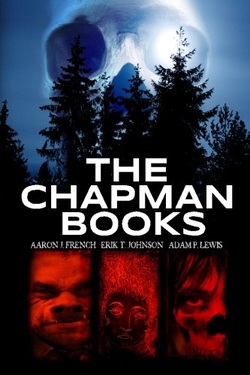 THE CHAPMAN BOOKS THE CHAPMAN BOOKS It's dangerous to be a doctor... ...Or a member of the Chapman family in this collection of three loosely tied together tales of the macabre by authors Aaron J. French, Erik T. Johnson, and Adam P. Lewis. Aaron J. French starts this weird progression with "The Chapman Stain," a kind of horrorized version of the nature vs. nurture debate. Is it genetics or is it demonic possession? The story moves quickly, with hints of both A Christmas Carol and The Exorcist lending touchstones to the proceedings. The story's end is a heady blend of spiritualism and gore. Erik T. Johnson's "The Chapman Delirium" is a euphoric, phantasmagoric trippy trip through the world of a patent medicine called Etcetracaine. Johnson's writing is, as always, mind-bendingly good, with passages you will read, stop, read again, then curse yourself for not having written. And finally, the Chapman Family's bad luck runs its course in Adam P. Lewis' "The Chapman Remains," a horrific tale of revenant corpses and life-draining ghouls. Lewis manages a shivery Fall of the House of Usher feeling throughout, which gives this tale of grave disturbance and...well...grave disturbances a nice depth. "Interesting to see what three talented authors can do with a shared-world theme, The tales are different enough to hold your interest completely, but tethered enough to each other that they lend some deeper, more twisted meaning to their companion pieces. Highly recommended!" --- John F.D. Taff, author of Little Deaths For more great interviews and reviews follow the links below HORROR AUTHOR INTERVIEWSHORROR NOVEL REVIEWSTHE HORROR WEBSITEComments are closed.
|


Archives
May 2023
|
 RSS Feed

|

|