

 MAYNARD AND SIMS MAYNARD AND SIMS It’s not everyday you get the chance to interview one of your horror heroes, let alone two of them at the same time. So when I got the the chance to interview Len Maynard and Mick Sims I jumped at it. Their books have always had a place on my all time favourite list. Len and Mick have been writing together for a long time. They met in 1964, aged eleven, at Ambrose Fleming Technical Grammar School in Ponders End, Enfield. They weren't friends immediately, that came later, when, aged 18, and they had left school and started work - Len as a lapidary in London and Mick for Lloyds Bank.They began to talk one night, in the bar of the Crown & Horseshoes pub in Enfield, went for a long walk after closing time, and a life time of friendship was born. They began writing in 1972 with short horror stories that were either Pan Horror type stuff or very atmospheric mood pieces. Their first sales were in 1974, with Curtain Call to London Mystery Magazine for £7 and a second story, Benjamin's Shadow to Hugh Lamb for his Taste Of Fear anthology. “Maynard and Sims. Those are the guys who write ghost stories and traditional horror, full of quiet and subtle effects, whose work you describe as 'atmospheric' because you're too old and self-consciously macho to admit they scared the crap out of you.” Peter Tennant Please welcome horrors greatest writing duo Maynard and Sims. Hello guys, how are things with you? Really good, thanks. We’ve both left the day jobs for long enough now to be thoroughly enjoying writing full time. So much is getting done, but so much more we want to do. Honoured to be asked for an in depth interview. Hope we can do the questions justice. There is always a funny guy and a straight man in duos, so which one of you is the Wise guy? Mick – Ernie Wise is that? I think I am the funny man with glasses but no one seems to get the joke – haven’t they read my stories? But seriously folks… I have just written a ghost story about an out of touch comedian and I’ve included several jokes in that to flesh out his character. Humour and ghost stories don’t often work but as part of a character I figured it was okay. In life I use humour as a mask to keep people at arm’s length as I am basically quite shy, to the extent of being anti-social. My nightmare is a ‘do’ with dancing and drinking and talking. Give me a solitary computer to write on, a book to read, or a garden to potter about in. Len – when I wrote Double Act I wanted to explore the dynamic of just that, the double act. What I found during my research was that the one the audience perceived as a clown, was actually the reverse and vice versa. We’re lucky in that we’re both as stupid as each other, so we break with the norm. Equally we’re both sensible when we want to be. As to which of us is the wise one, I’d have to say Mick. He’s the one who handles the business side of our partnership, thanks to his years of training in his previous occupation. 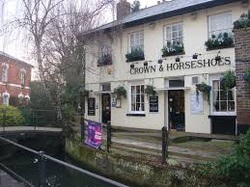 THE INFAMOUS PUB WHERE IT ALL STARTED THE INFAMOUS PUB WHERE IT ALL STARTED You have pretty much been lifelong friends, after meeting in school, but it wasn’t until a late night drink in a pub, where you were nursing not just pints of Guinness but a broken heart over a girl that your friendship was truly cemented. Looking back at that fateful night do you think you would have cemented your friendship without the intervention of the anti Yoko Ono? Mick – some things are meant to be I suppose. We were aware of each other at school but we weren’t really friends until that night in The Crown And Horseshoes in Enfield. The girl is still a friend – she provided us with the photographs we have used for our two thrillers Let Death Begin and Through The Sad Heart. We hope another photo she has taken will be used by Samhain for Stillwater, a ghost story novel out next March. Great phrase about the anti-Yoko. Len – we have always put the friendship first and the writing second. We all used to hang out in a large gang at that time – pub, swimming pool, concerts, that kind of thing. Weekend hippies the lot of us. Several couples were formed, came and went – happy carefree days. But to answer your question, yes, I think the friendship would have been cemented one way or another. The fact that it has lasted for more than forty years is testament to the fact that some things are just meant to be. Prior to this you were both in a band with Len playing bass, and Mick as the roadie. What sort of music did you play? Len - I had two bands running simultaneously. One was a covers band, the other could be described as “prog rock”, complete with odd time signatures and complex rhythms. Do you still play Bass Len? And are you still carrying Len’s stuff around Mick? Len – Not as much as I’d like. Time is the great enemy. But I can’t be bothered with the whole band thing these days. I never much liked it then and I have no time for it now. Juggling egos is not fun. So now it’s usually just me, plugged into an amp, wearing headphones and trying to master the bass lines of Rush or IQ (a much underrated “prog” band). It’s a fun way to unwind, with no pressure. Mick - it is more like picking up the pieces these days. I used to enjoy showing off at the bar of the pubs the band played in – ‘Four pints – it’s for the band.’ Nowadays the teamwork outside normal friendship is with the writing and we help each other out all the time. You both had a mutual love of horror and spent a lot of time perusing the local shops for horror books, but what I would like to know Len is what first prompted you to show Mick that hand written story? Len - I started writing in a kind of knee-jerk reaction to the fiction I was reading at the time. I certainly had no aspirations to become an author during my school days. I enjoyed writing the odd story for my English class and was given great encouragement by my English master Mr Wilson, but I would never have guessed then that I would be writing fiction for the rest of my life. I remember the story. I’d been reading my way through the Pan Horror series and one day just thought to myself, ‘I can write these.’ I found out rather quickly that writing publishable short stories was not as easy as I’d thought. That first story was really dreadful. But if it inspired Mick to write then it served a useful purpose. It wasn’t long after that you started to collaborate on stories. How did you collaborative process work in those days, and how has it changed over the years? Are there still the rows and pregnant pauses? Mick – It was a painful process to get to the fluent process we have now. Those early stories were all a learning curve of course. What I don’t think we realised at the time was that we were both not only learning to write – and all writers develop at different speeds – but we were also learning to write with another person. Those two things combined certainly made for a combustible mix. One way it would work was one would start a story, stop for a variety of reasons, hand it over to the other for them to finish. We then had a jointly written story. We decided very early on that each story should have one author voice – by which I mean more than just a style, although a cohesive style was important. Another way we did it was for one of us to completely write a story and then hand it to the other to edit, revise, as needed. That was when a lot of rows began. How dare he suggest changes to my precious story? We had a meeting place by the river, near the pub, and after a row, sometimes hours after, we would meet up there as if by pre-arrangement and come to an agreement about the story. Pregnant pauses were our speciality, with silence as a weapon. Over the years we have smoothed it all out. We are open and honest with each other, and no offence is taken when change is suggested. I have a voodoo doll of Len at home with enough pins left to carry me over the next few years. Taking it right up to the present day, when we write as many novels as stories, we each write the complete book/story and then hand it over to the other for revision which includes proofing, copy editing, as well as revising if we feel it needs it. With each book we spend days at the end reading it together, page by page, for grammar, continuity, repetition and other flaws we find. With the novels, each has been different. We find it is important that a book has a single voice – an author point of view, a narrative drive the reader can connect with. Luckily our styles have developed over the years into a single M&S style so there is never a case of anyone being able to see the joins. Although one reviewer did say they could – on a book one of had written alone. No wonder they couldn’t reply when I asked them where the joins were! We also got a review along the lines of – did it really take two of them to write this pile of **** - which was one reason behind the change of name to Maynard Sims. Len - We wrote as individuals for a while then realised that we would be competing for the same markets, so the sensible thing seemed to be to pool our resources. And we’ve been writing together ever since. Initially we would finish each others stories and argue about which version was better. We’d spend hours discussing a single word if we felt passionately enough about it. We used to brainstorm, sometimes for weeks on end. I remember one novel we planned early on in our careers was discussed at length and completely story-boarded - a process that went on for weeks if not months. In fact it took so long to plan we both ran out of steam on it and it was shelved. We refined the process after that. I think we have been writing together for so long now that we respect each other’s strengths and recognize each other’s weaknesses. God forbid it should ever happen, but if you were to divorce your writing partnership, do you have a list of potential writing suitors? Mick – no one would put up with him. Me – I mean me… We won’t divorce. We are like an old married couple but without the sex – like I said an old married couple. We have been in the same room while sex was occurring but there were women present as well. Anyway… moving swiftly on. Only death will stop the writing partnership and I already have Len’s eulogy written and edited. If and when one of us goes will the other carry on? I think so. Writing is in the blood now, it’s what we do. It’s hard work creating a story but there is no better feeling than when it goes well. Len – no suitors potential or otherwise. It sounds like we have a very cosy writing relationship, but that couldn’t be further from the truth. In fact it’s fiercely competitive, but in a good way. When I write something I want to blow Mick’s socks off. That’s the challenge. That’s why I think we’re very fortunate to have this partnership. Sitting alone at the computer, writing away with no idea who your potential reader might be must be a very daunting process. I read a writing tuition book years ago and in it the author said that you must write the book for “the anonymous reader looking over your shoulder.” I don’t have to do that. Mick’s the reader looking over my shoulder, and I figure if I can impress him then I must be doing something right. Your first story Curtain Call sold in 1974 for £7, wow that must have been rather a lot of money in those days? Mick – Google tells me it is the equivalent of £63.69 today. It was a 3500 story and I was at work then in Lloyds Bank and possibly on about £75 a week (?) so yes it was a great start. In fact, £/$ per word calculation it is one of our better sellers. That was a Len story that I took on and revised – so a true M&S joint effort. Curtain Call has subsequently appeared in a few of your collections, looking back at this story how do you think it holds up when compared to your most recent stories? Mick – it’s shit compared to a lot of our others. It’s a fairly formulaic ghost story, written before we had a true idea of what a good ghost story should be all about. When it was written we were only just discovering the ghost story collections that now form the nucleus of our shared library of genre books. We hadn’t read much Wakefield, Cowles, Munby, Caldecott, Rolt, Malden, let alone James. Len – It was still a whole lot better than anything we had written up to that point. I cringe now at some of the stories we produced back in those days and thank the literary gods they were never published. Thankfully the editors we submitted to then had better taste than us. 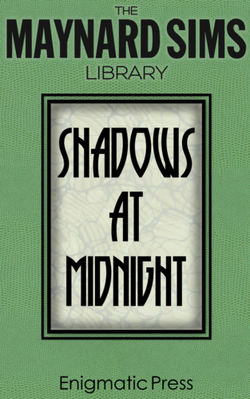 SHADOWS AT MIDNIGHT SHADOWS AT MIDNIGHT It might just be the rose tinted glasses that I’m looking through but it does seem as though there were a lot more outlets for genre fiction in 1970’s, certainly well-paying ones. Do you think it was easier to get published at the start of your career, than it is now? Mick – our first collection, Shadows At Midnight, was accepted by the first publishing house we sent it to. William Kimber & Co were publishing lovely hardback ghost story collections, and anthologies then, and we were lucky to have chosen the right market for our work. It was luck really. After that we should have written another traditional ghost story collection, but we were young and eager to experiment, so they rejected our second book offered to them. We should have been sensible and revised the stories and provided new ones so we had another marketable book, but we were stupid. In many ways I think it was harder then than now. The small press wasn’t around then, nor was self publishing of course. It’s true that all the main publishers had a horror line, and the number of anthologies coming out was phenomenal. There wasn’t, though, the range of markets that there is nowadays – no Internet for one thing. Len – We were very lucky with Kimber. James Turner – their main writer of ghost stories – had just died and they needed someone to fill his shoes. Unfortunately his shoes were much too big for us to fill at that time, so after Shadows we sank without trace. It’s much easier these days to get your work out there. Just harder to get paid for it. In a previous interview you mentioned that your writing has had four main periods. The first period was your Ghost Story writing period. Why did you gravitate towards the ghost story side of the genre? Mick – that was too glib a response to be honest – though our biography on our website extends that myth. It’s true we started with traditional ghost stories that are always classified as ‘in the M R James tradition’. But really we have never lost that affinity. A bit like Cliff Richard who has had hits in every decade since 100 BC we have written ghost stories ever since we began writing and getting published. The stories in Echoes Of Darkness are ghost stories but they aren’t as traditional as those in Shadows. And that has been the pattern with all the stories we have written. Some have been horror, uneasy stories, psychological – rather than recognisably ghost stories, but the atmosphere behind them has always been inspired by our love for the ghost story. Our most recent collection – A Haunting Of Ghosts – is pure traditional, even having a pair of refined gentlemen drinking port, smoking cigars, and playing chess as they tell stories to one another. Flame And Other Enigmatic Tales are more weird tales I suppose, as are the stories in Incantations. The Odd Ghosts are ghosts and strange tales. Len – I was late catching the reading bug. I grew up with comics and they were my main love – DC, Marvel, and the UK ones that seemed to be mostly about war and football. Why ghost stories? One of the first “books” I read was one of the Fontana Ghost story anthologies, and I was hooked – for life as it happened. What do you think makes for a good ghost story? And what would you say are your favourite ones? Mick – a good ghost story must have a reason why the ghost is doing their haunting. The human characters must be believable, have a flaw in their character, so that the haunting may derive from that flaw. Often the human character will be an innocent, and as such they create tensions in people and situations around them that leave a chink for the evil to slip through. A good ghost story must be believable, so the characters have to be empathetic and realistic. The setting has to be familiar so that even if the reader has never been to such a place they can recognize it in their minds eye. The ghost or haunting has to have a purpose that derives from either the character or the setting so that what happens appears inevitable and natural. Atmosphere is vital. The tale needs to be told quietly, without fuss, so that the merest shift away from normality is a cry or shout that something is wrong. Len – One of my all time favourites is Ringing the Changes by Robert Aickman. To me it’s just about as perfect as you can get in the genre. Another is Hawley Bank Foundry by LTC Rolt. I can’t even bring the plot to mind now, but I remember the chill it gave me when I read it. There really are far too many to mention, there were a lot of good ghost stories written in the period between the two world wars, and many of them were republished in the Fontana books. The horror genre is one that is rife with trends, that come and go, and yet the ghost story is one that always stays popular, why do you think this is? Mick – because death is eternal. Psychics can do great business because a lot of people believe their loved ones are waiting to communicate with them, they want to believe there is somewhere we all go after death. A belief in ghosts is a conduit outside of religion that people can hold onto. I talk to every blackbird couple I see because the male is my dad and the female my mother – crazy but that’s what I do. My wife believes her sister sends her a white feather at times of stress, and our daughter has found feathers when she has needed reassurance about something. These are all manifestations of ghosts in a way. The ghost story is a fundamental communication that has been passed from generation to generation since caveman times, and it is a very human story, as the ghost is most often a dead person’s spirit – as opposed to other forms of horror genre stories where the human character does not necessarily need to play a main part. Len – The ghost story bucks the trend because ultimately it deals with the most basic of human emotions – the fear of death. A great ghost story (even a not-so-great one) can scare the pants off us, but also offers us hope that there might be something other than this life. It’s a classic form of literature that some of the best writers in history have attempted with varying degrees of success. It’s a form of fiction that will survive long after trends like splatterpunk, steampunk, slipstream and body horror have come and gone. In your second period the pair of you wrote a lot, but you didn’t send much away for publication. Why was this? Mick – confidence, or a lack of it. We were in a period of transition in a way. We felt we had no more to say in the traditional ghost story manner, and so we looked round for other stories to write. I wrote a mainstream collection of stories about people and life, that Penguin were interested in but because they didn’t bite my hand off when I offered the collection to them I binned the stories. Immaturity? Certainly, but really I was so easily diverted that it only took a lukewarm response to believe that I was rubbish at writing. Len – I was writing longer and longer pieces and so the desire to try my hand at a novel was strong. I wrote novelised versions of many of our short stories, but they simply weren’t good enough. I was learning the craft and it was a long, and often frustrating, journey You said in the same interview that you destroyed 11 novels - that must have been a disheartening period? Has anything been salvaged from these novels? Mick - We actually wrote loads in that period – but chucked most of it. Two of our Samhain novels, Nightmare City and Stronghold, were heavily revised from novels written at that time. Which just goes to show that you should never throw anything away. We were never happy with much we wrote at that time so we were never confident enough to submit it. And the three thrillers we are bringing out this year – Let Death Begin, Through The Sad Heart and Falling Apart At The Edges, were all initially written in that period. What is being published is a bit like Trigger’s broom in that the novels have a new handle, brushes and everything but the core story is the same. Len – Trigger’s Broom – what a great title for a story. No, I’ve nothing more to add to that answer, apart to reiterate that it was a long and frustrating journey. What was it about The Hidden Language Of Demons that made decide to keep it? Mick – it was long for a start when we first wrote it as a novel – and we do hate to waste anything. It was also so very different from what we had written before. Harder, punchier, and so when we cut that down from the original 90,000 words to the 33,000 novella it became even more quick and edgy. The novella was then expanded back into the 100,000 novel Nightmare City – so again nothing is ever truly lost. It was also a story we really loved. We had originally story-boarded the core plot back in the 70’s as a planned sprawling novel that would be called The Web – before the www of course. We used quite a few of the scenes we had mapped out and the characters as well, although the finished novel was different to the first concept. Reading previous interviews it seems as though the pair of you have always been plagued with a sense of self-doubt. Do you think this feeling has actually helped you to become better writers, by stopping you from becoming complacent about your writing skills? Mick – it has been a constant companion. I am certainly driven by the need for perfection. I suffered from OCD as a younger man, still do to a much lesser extent. What that meant was that the idea in my mind for a story had to be translated exactly onto the written page. That is truly hard to do, and in fact rarely if ever can be achieved. You can’t put your hand in your head and draw out your thoughts in any physical way can you? So, I was always aware that my original plan was never realised in the finished story, so I was never satisfied with anything I wrote. That remains the case to this day. I’m driven to write the best ghost story I can. I’m happy with a couple we’ve done and the quest is to write one better than those. We always use a story such as An Office In The Grays Inn Road or At The End Of The Pier as our yardstick. Is it as good as… we ask each other, and I’m glad to say that ones we have written this year are getting there. Has it made me a better writer because I am constantly striving to do better? Yes, I suppose it has but it is extremely frustrating. I regularly consider others, peers, whoever, to be better than me. I am constantly waiting to be found out – you’re useless, stay behind for detention. We have had four agents in our time – never got any work from any of them – their fault? Of course not, it’s because I’m not good enough. I re-read stories I have written and am always amazed that I have written it – a lot of it I can’t recall having written at all. And I am usually pleasantly surprised that it is not as bad as I remembered. Then I think – hang on, if I’m not as bad as I thought, in fact I am quite good – so why aren’t I being showered with offers, money, women… but that way lies madness. Len – There is nothing more daunting than being confronted by a blank computer screen – it used to be blank sheet of paper, but time moves on – and the mind goes into some kind of panic. “What if I can’t do it anymore?” “What if the ideas aren’t there?” I think self-doubt is part and parcel of having a “creative” mind. I know a lot of writers and artists, and all of us have that strange monkey riding on our backs and sapping our confidence. And I think most of us feel that if we kill the monkey we’ll kill our creativity. It’s probably bollocks, but I don’t want to be the one to try it in order to find out. 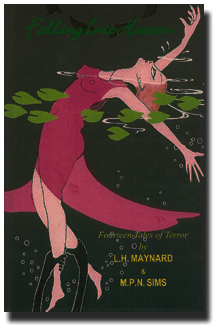 FALLING INTO HEAVEN FALLING INTO HEAVEN While your stories are rooted firmly in the horror and supernatural world, many of them contain elements of your own lives, especially if I am correct in thinking the stories collected in Incantations and Falling Into Heaven. Why did you add such a personal touch to these stories? Do you think these stories have more emotional depth? Mick – in many ways yes they do. Though even elements of the earliest stories were autobiographical. When we have experienced something in real life – death, divorce, childbirth problems, work issues, relationships, whatever it happens to be – it has been instinctive to put that into the experiences of our characters. We have even plotted a story around an issue that affected us in real life, making the character feel what we felt, perhaps act as we did, or more probably act in a different way to how we did – perhaps how we feel we should have acted. Life can be good and at times not so good, and if you write as an outlet for your emotions, it is natural that what you are going through will be reflected in the stories. By deliberately adding elements from our own lives into fictional stories it is both a way of dealing with whatever issue was involved, and of making a more ‘serious’ story than we might otherwise have been capable of. Len – This time it’s personal. Yes, you’re absolutely right. The Pain Collector was very personal. For a period in my life I was just that – the shoulder to cry on, the great listener – until I got to the same stage as the character in the story and had to say, ”enough. I’m full up”. Writing that story was cathartic. It was an emotion I had to get out of my system. Also by the time Falling Into Heaven was written I was two marriages down and two divorces up, and so there was a great deal of stuff both, conscious and sub-conscious, that I needed to remove from my mind in order to move on. Writing was both a great distraction and great therapy. I’ve always wondered how it feels knowing that you have bared your lives for everyone to read. Mick – although a private person I am quite open and happy to share deeper emotions with people, (like in this interview) albeit often through a façade of humour and sarcasm. If anyone recognises a truth about me from my stories I wouldn’t be embarrassed at all. I have written stories that are entirely a passage from something that has happened to me – it’s my way of looking at it and seeing how I feel about what’s gone on. When you write – and certainly when you submit for publication – in a way you’ve given up any right to privacy. What you are doing with most stories is baring your soul for the objective scrutiny of others. How they treat you is a thing you have no control over, so you can’t worry about it. Have the courage to change what you can change, the serenity to accept what you can’t change, and the wisdom to know the difference between the two. Len – to be quite honest, I’ve never really thought about it like that, though I am now. Ultimately I suppose I don’t really care how I’m perceived. Nothing comes directly from life without being tweaked first. That’s what you do when you dress things up in fiction. If you didn’t do that then everything you put down on paper would be a long, self-pitying whine, and I wouldn’t want to inflict that on anybody. I know writers who spend their lives in a never-ending examination of their own navels, but I think I’d end up boring the pants off myself, never mind our readers. Not content with just writing, the pair of you decided to set up your magazine Enigmatic Tales who first came up with the idea? Mick – Len did. We had been away as a foursome with our wives to Tenterden in Kent and in my room was a small press magazine called Black Cat Tales (I think). It was rubbish and the editor wanted a fee for submitting but there were some adverts in there for other mags. Nasty Piece of Work, Strix, Tales Of Grotesque and Arabesque, Terror Tales, SciFright, Penny Dreadful, Roadworks, and others. We had never seen any of them. Our third period was beginning but we didn’t have a clear direction. There it was. To hark back to an earlier question about work we destroyed – we had loads of stories we had preserved but which we were unhappy about. The word lengths varied but were 7-10000 in length, which was far too long for the guidelines. So we cut them down to the length they should have been all along – 2/3000 words – and most got accepted. We were off again. Then we had the idea of doing a magazine anthology ourselves and Enigmatic Tales was born. Then Novellas, Variations and Electronic. We applied for and got Arts Council funding which helped cover costs. We produced 300 quarterly and sold every one but still ran at a loss. What fun though, and friendships we made then still stand good today. It helped our profile of course. Len – that’s a difficult one to answer. It simply came up in conversation. I don’t know which of us suggested it first. Getting involved and publishing in the small press had kick-started our writing life, and Enigmatic Tales was our attempt to put something back and to give other writers in a similar position to us, a platform to get their work seen. The magazine was initially a roaring success, and you were flooded with submissions. Do you think the magazine helped to fledge the career of any writers still working today? Mick – oh I’m sure it didn’t do any harm. We published some great writers – unfair to names names as there were well over 250 stories published and well over 1000 in total that we read. We were lucky as well that as a friend, Hugh Lamb had some stories from forgotten masters of the genre that he hadn’t been able to use in his own anthologies – and he gave them to us with some nice introductions. Len – It would be flattering to think so, but we were sent stories of such great quality that I believe the authors would have made it without our intervention. Cream, as they say, always rises to the top. So why did you have to close the magazine down, and do you think you would ever like to do it again? Len – Quite simply, we ran out of money. We had always funded it ourselves, apart from the year when we got an injection of cash from the Arts Council, and we always ran at a loss. It wasn’t the most successful business plan in the world. Because we set the standards high – perfect binding, steadily increasing page length – production costs always outstripped revenue in. Also there was increasing pressure to pay for the stories – and quite rightly so – no one should work for nothing. And we were picking up some flack on the Internet for only offering payment in contributor copies. We just couldn’t do it and keep ourselves fed, and that’s no exaggeration. So we were out of pocket, working our butts off, getting slagged off for our efforts, and, and probably, most importantly, we weren’t getting enough time for our own writing, so we called it a day. Sad but necessary. We were tempted back to editing when Prime approached us with an invitation to edit Darkness Rising. We agreed to do it because now we had the backing of a “real” publisher, and I wouldn’t be getting up at four in the morning to typeset a magazine before trundling off to my day job. Again we grew each issue, until it finally became a hardback anthology. Mick can take over and say why we called time on that venture. Mick – after a couple of years the Arts Council changed their rules and we no longer qualified. We were running at a loss based on subscriptions and we had kept the price at £3 which for nearly 200 pages and almost 20 stories was too cheap. Add in postage costs, including to the States, and we couldn’t sustain it. We were also knackered. It is really hard work producing an anthology – and we were trying to do it four times a year. We read all the stories and at first gave a long reason for rejection. That is until we got a couple of rude letters back explaining how good their rejected story was and how stupid we were not to ‘get’ it. After that we moved to a rejection slip. Typesetting, marketing, distribution, artwork – we were producing as professional a product as we could but we were amateurs really, with day jobs. It all got too much. Really proud of Enigmatic though. Lots of writers got a start there, loads of Honourable Mentions, good stuff. And it was impacting on our own writing. We were then invited by Sean Wallace of Wildside and Prime Books to edit Darkness Rising. All the fun of editing without the hassle of production. We were again swamped with submissions – and remember neither of the magazines were paying markets, because we couldn’t afford it. DR ran for seven magazines followed by two large annual anthologies, the last of which was in hardback and never got the recognition it deserved. Again lots of writers got a leg up. Doubt we would do our own thing again but we are always ready to edit for anyone if we are asked. Currently we are working with Peter Mark May (great bloke) of Hersham Horror on an anthology called Dead Water. As well as being asked to provide a story we are reading and editing the other four stories and providing a foreword. We are always happy to accept editing commissions. 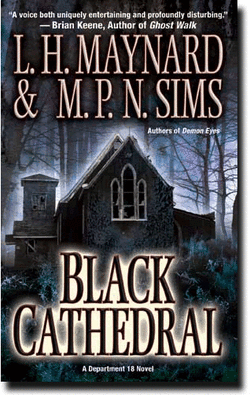 Let’s talk about your novels; the excellent Black Cathedral was my first point of contact with Maynard and Sims. It also introduced the world the fabulous Department 18. Was it really only five years ago since it was published? Len – I had to check that. Yes, just five years ago. It seems like much longer ago than that. Mick – I went to World Horror Convention in Chicago in 2002, Len couldn’t go. I helped Sean Wallace on his stand in the dealers’ room and met loads of great people. Len was writing a novel and I suggested to Sean, who had published three collections and two novellas of ours, that he might want to see it. To his credit he told me to offer it to Don D’Auria of Leisure. I wangled a meeting with Don and very nervously pitched a couple of novel ideas, none of which had been written. Very politely Don said to send across the first few chapters. We did and then waited for months. I politely chased and was told to send the whole book. We waited again and then we got a contract for our first novel – Shelter – which came out in 2006. So four years between pitch and publication. Patience really is a writer’s best friend. Don has been a faithful friend and supporter. Leisure published Demon Eyes followed by the two Department 18 novels, Black Cathedral and Night Souls. (All four books were then bought by Amazon Publishing when Dorchester/Leisure folded.) The book has a bunch of corporate types on a “management training “course where some rather nasty stuff happens to them. Since the pair of you have both worked in the corporate world you must surely have used this book as a cathartic exercise in killing of some people you really didn’t like? Mick – guilty. Len was in smaller work environment but I worked for a large bank and I’ve gone on the dreaded bonding exercises, the away days that are meant to be fun but rarely ever are. The management speak is a particular joy. Meetings where the same nonsense is repeated by speaker after speaker as if repetition of rubbish makes it acceptable. Yes I’ve come across some real arses in my forty years of corporate working and several of them have featured over the years. Only the names have been changed to protect the innocent – well me to be honest. Len – Oh, it’s always fun to kill people in books, especially if you’ve based them on someone you know and loathe. And the bonus is, if you do it on the page, it keeps you out of prison. Back when the book was first published there weren’t really that many novels that featured covert government agencies tackling supernatural incursions, what was the inspiration behind Department 18? Mick – well that was one – it wasn’t being done. Len – Watching the TV series Spooks was where the idea first reared its head. I loved the idea of having a fairly self-contained group of people, heading off to tackle these supernatural threats, much in the same way that MI5 dealt with spies and terrorists. And why Department 18 - is there a significance behind the number? Len - It was originally called Department 13, but researching on the Internet I think we found about three Department 13’s. We couldn’t find another Department 18, although I think a couple have surfaced on line since Black Cathedral. You may not remember this, and I can’t remember where it happened, but I recall that someone mentioned on a forum or a website that they thought the book was good but the ending was too quick. You replied to this with something along the lines of “a book ends on the last page how can it end quickly”. Do you remember this incident? Mick – sounds like the kind of smart-arse comment I can be prone to making. Better than fuck off you critical bastard. I did go through a stage of connecting with readers and reviewers and although I am really a lovely person deep inside I may have moaned on occasion that my masterpiece was being picked upon. I actually took one reviewer for a beer and I was very polite – never seen a review from them since now I come to think of it. Nowadays I always thank anyone who reviews or comments – good or bad – as it takes time and effort to commit thoughts to paper/the web and I respect people who do that if they’ve read my stuff. Black Cathedral was generally praised although the one criticism that popped up once or twice was that the ending was too abrupt. True enough. We were restricted for work length at the time by the publishers but we should have found a way round that. Len – Only vaguely, but I tend now to agree with whoever it was. I think they had a point. I’d love the opportunity to go back and expand it, but at the time we were constrained by the word length Leisure demanded. But then I have a tendency for my writing to bloat and if I’m really into a story I can go on and on. Luckily I have Mick to haul me back. As a side note, do you pay much attention to critical responses to your work, especially when now in this age of armchair warriors, armed with a keyboard and a modem? Mick – don’t some people put a load of old rubbish up? Reviews, whether good or bad, are just someone’s subjective opinion so they need to be viewed as such. I am only human so I do take it to heart if someone says a novel, scene, or story hasn’t worked for them. Yet I never believe the ones that ones that say the book is wonderful – not fully believe anyway. I do think the Internet can be a dangerous place. I have had friends who have suffered personal tragedies – children dying kind of thing – and sites set up for memorial purposes have been subjected to trolls. Sick and twisted. People like that always existed but now they have an outlet. They used to wander the streets dribbling and shouting incoherently – now they just blog or Tweet. Len – Everyone’s a critic these days. I’ll pay attention if I feel the criticism’s valid and well reasoned. But I pay no attention to semi-literate halfwits who seem hell bent on making a name for themselves as would-be literary critics, and there are more out there than you think. These are the people, who from sheer ineptitude or who think it’s fun and clever, will include spoilers in their reviews. They can ruin the books for other readers, and it’s heartbreaking when you’ve spent maybe up to a year crafting a piece of fiction, to see all your well thought out plot twists and surprises ruined by some idiot with half an hour to kill at their computer keyboard. Did you always set out to have this as the starting book in an on ongoing series? We’re going to see book five published this year aren’t we? Mick – Black Cathedral was just a third novel to begin with. Night souls was going to be a follow-up to Demon Eyes – a standalone book about sexual psychic vampires – but Leisure said they didn’t want that. They suggested Department 18 had legs so we turned it into book 2. Yes book 3 was a pure witch story – The Eighth Witch (whose cover has a picture of my daughter on it) Book 4 is out this August - A Plague Of Echoes. Book 5 is Mother Of Demons out August 2015. Department 18 did have its own website but some idiot hacked into it so we had to close it down. It has its own history and story in pages on our own site – www.maynard-sims.com Len – Yes. I always saw it as a series. There was a challenge and a delight in having an ever-revolving and evolving cast of characters. So many back stories to tell. I think our fiction has always been character-based. Department 18 gives us great scope to write about these people’s lives. For me, that’s the part of the books I love. Harry Bailey, Robert Carter, Jane Talbot and the others have become my family now and I’m very happy spending time with them. And yes, Mother of Demons is book five, but it won’t be out until summer 2015. A Plague Of Echoes is book four and that’s this August. The book along with a number of your other novels was published by Leisure. You must have been devastated when Leisure went under? Mick – it did seem for a while that we had lost an outlet for our horror novels. Their advances were okay, and their distribution was good as well. Then we were contacted by Don who had moved to Samhain and was starting a horror line there. We offered him Nightmare City, followed by The Eighth Witch and then Stronghold and with A Plague Of Echoes this year, and Mother Of Demons and Stillwater next we will soon have more out with Samhain than we did with Leisure. When Amazon Publishing bought the Leisure catalogue the authors were given the option to accept re-branding under them or get their rights reverted. We chose to re-brand and that meant we had our back royalties paid by Amazon – as they hadn’t been paid for a while under Leisure. We still get royalties now as the books are still selling on Amazon. Len – It was hard because we’d built up such a great relationship with Don D’Auria, our editor there. It felt like home, although we could see the writing on the wall when they stopped sending us the royalties that were due to us. When the axe finally fell, it was a bit of a relief. Some of their authors have flourished in the intervening years and others have floundered, how do you think you have fared? Len – We’ve been very fortunate. We saw Don had been asked to launch the horror imprint at Samhain, and he was happy to welcome us aboard there. This has enabled us to continue the Department 18 series, as well as publish our standalone horror novels. I’m particularly excited about Stillwater coming in March next year. It’s a return to the ghost story but this time at novel length. Mick – well we have never hit the big time but we have had everything we have ever written published so we are artistically satisfied even if financially we haven’t made much. Some of the ex-Dorchester authors have done very well, but I think that would have happened with or without the demise of Dorchester. As well as your horror novels you also write a number of thrillers, I’m fascinated by the initial period where a writer comes up with a germ of an idea then develops it into a full blown novel. Do the pair of you decide before you set out to write a book as to whether you are going to go down the horror or thriller route? Or is the path chosen as you develop the idea? Mick – for me the idea dictates whether it will be supernatural thriller or straight thriller. When we kick ideas around we might decide it would work as say a Department 18 novel, but more usually the plot comes fairly fully formed to a large extent and that will decide for us what genre route we go. Some days I get a rush of titles coming into my head and, strangely, that pushes an idea towards a particular genre. Certainly with short stories the title will come first – often from a song title or a line from a song – and that shouts to me that it needs to be a ghost story. Len – No. It’s usually a conscious decision to write either a thriller or horror book. When you get an idea for a book it quickly becomes apparent in what genre it’s going to fall. I know for me that sometimes I need a break from horror, and writing a thriller, although it’s just as much work, is something of a holiday. It gives me a chance to recharge my batteries and come back to horror with a clearer mind and fresher eye. Do the pair of you feel more comfortable writing in a specific genre? Mick – at different times over the forty years I have been more comfortable writing certain types of stories. At one point everything had to be a traditional ghost story. Other times it had to be a weird tale, or a mainstream ‘serious’ story. Nowadays I am much more flexible. Because there are two of us, and especially now when we have more time, we can be indulgent and write in different genres at the same time – one doing a thriller and the other a supernatural. These days I write a variety of genres. The thrillers have been a mystery, a crime, and an action. Under a pseudonym I have written an erotic romance, soon to be published. Here’s the Youtube video 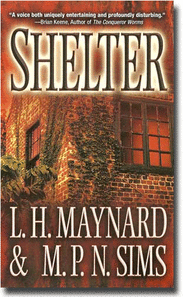 I’m midway through a ghost written ‘autobiography’ for a person who had an interesting life story to tell but didn’t want to write it themselves – that’s a fascinating experience, writing a fiction based on fact and getting engaged in a real life story rather than one featuring characters I have created. I’ve also written some ghost stories this year that I am pleased with and they will be in Volume 9 of The Maynard Sims Library next year. Len – When I’m writing horror I’m usually happy to be back in the genre. Equally I love writing thrillers, especially the Bahamas series, featuring Harry Beck. Again it’s a series character who’s become a mate of mine. Do you have a favourite book from your Leisure years? Mick – Shelter, Demon Eyes, Black Cathedral, Night Souls. I like them all for different reasons really. I suppose Shelter has a special place as it was the first. The two Department 18 novels I am most familiar with because I have used scenes from both of them in the Department 18 script that won the British Horror Film festival Best New Screenplay award last year. Enigmatic Press brought the script out – with one based on The Eighth Witch – as Two Screenplays. Len - Shelter. Not that I think it’s the best novel because it’s not, but after being published elegant, collectable hardbacks, I had an ambition to see our work presented as a fairly trashy-looking paperback with embossed lettering. Shelter ticked that box. While I love the Leisure books, I always thought that their covers were pretty awful, which is something you have addressed with your new line of books from Enigmatic Press. The new books look stunning. How involved were you in the design process for these books? Mick – yes the Leisure covers were an acquired taste. Not many people acquired it. With the Enigmatic Press books of course we have full control. Let Death Begin, Through The Sad Heart, both have photos by Bev Manders, our old girlfriend, and both covers have been designed by Len’s son Iain under his Iain Maynard: MAD Maynard Art and Design company. We meet up with Iain and tell him what we want, and he goes away and comes up with something far better. With Falling Apart At The Edges he designed it completely from vague suggestions from us. Obviously we give him the text. The eight The Maynard Sims Library covers were entirely his idea. In fact the idea for the collection was his as well. Working through Amazon Createspace and Kindle is easy (now we understand it all) and the results are really good we think. Next year we will be bringing out a Bahamas trilogy with the first book a revised version of Dark Of The Sun. The three books will be Touching The Sun, Calling Down The Lightning and Raging Against The Storm. We’re already chatting about the covers for those. Len – Never judge a book by the cover. Unfortunately people do. What else is going to tempt them to pick it up in the first place? So far with Enigmatic Press we have been very fortunate in securing the talents of Iain Maynard (my son). Who provided some stunning artwork on Enigmatic Tales and Darkness Rising. Apart from the original design for Let Death Begin which was handled by an outside source, all recent covers have been his. He gives us choices, running the ides by us, but that is the extent of our involvement. Leave it to the experts. I’d rather concentrate on what’s between the covers 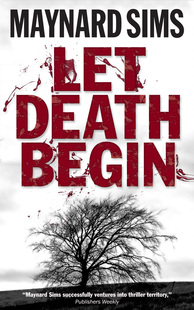 Let Death Begin, based on its back cover synopsis has me biting at the bit to start reading it. Can you give me any hints as to what I can expect from the book? Len – In my opinion it’s a good, solid crime thriller, with enough twists, turns and surprises to keep you turning the page. Of course, I’m biased, but looking at it as objectively as possible, I think it’s a fairly decent read. We’re lucky in as much that we have a cluster of regular readers – not family – who get the first look at our books, and they are very perceptive readers and also brutally and painfully frank. They don’t let us get away with much and we appreciate their honesty. So far the book’s been given the thumbs up. But as for the story, I’m not giving up any clues. If you like your crime books to be a bit hard-edged and not the cosy drawing room mystery, I think you’ll be satisfied. Mick – we did some promo work with Omnimystery about Let Death Begin. Here’s the blog link Here’s an excerpt link A year after being shot and left for dead by a clown, James Price finds himself drawn into a web of mystery and intrigue by the enigmatic Sara. How does the present danger connect to his past life? Can he solve the puzzle and stay one step ahead of the killers. Can he stay alive long enough to finally find justice? A web of revenge is all around. Here’s the YouTube video 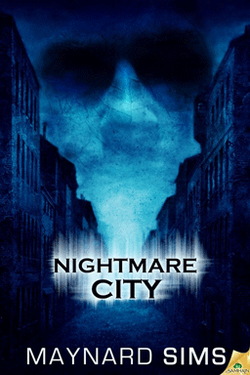 A couple of readers reviews - Excellently written, clever plot has you guessing wrongly from the start right up till the end... Loved the storyline.. Just want to read more of the same... Buy it you will not be disappointed... Can never wait to read a new Maynard Sims book and this did not disappoint. Great pace, could not put it down. Next please You are also working with Samhain Publishing. What does a publisher like them bring to the table in this day in age of self-publishing? Len – Legitimacy. Self-publishing has been sneered at and derided for years, certainly since we started writing. It was associated with vanity publishing and was seen as the last resort for those who had seen their work comprehensively rejected. That isn’t the case now. I think Timothy Mo was one of the first high-profile authors to eschew the usual publishing routes and decide to go it alone, and I can understand why. Traditional publishing houses had become increasingly dependent on university graduates with very fixed ideas about what constituted good fiction, and a kind of literary snobbishness came to the fore. Books were being commissioned that were deemed high art, but bore little relationship to the books people wanted to read. I lost count of how many times we were told that horror books don’t sell – most famously by one agent whose wife had just started their own horror imprint. Another old chestnut from publishers was that “people aren’t reading horror these days”. Well if no one is publishing it, people aren’t going to be able to read it are they? Publishers have grown increasingly out of touch with popular tastes thus the upsurge of self-publishing. But without any kind of quality filter the market is becoming saturated with dreck. The old adage that everyone has a book inside them has never been more true, but a lot of the time it should stay inside them and never see the light of day. Being published by Samhain Publishing helps us to maintain our standards. It’s a very good publishing house and Don, our editor there is one of the best in the business. But as I say, it’s legitimacy. We have been published by “proper” publishers, ergo, we must be good enough. At least, that’s the theory. Mick - It gives us the variety of different publishing platforms. We are, and always have been, traditionally published, but we can also self publish what we want and when we want. We have so many books coming out this year and next that we would keel over if we tried to do it all ourselves. Promotion, marketing, distribution, it’s hard work. Our horror/supernatural books are with Samhain, our romance novel (and the others I am going to write) are with a traditional publisher, our ghost stories catalogue are with Enigmatic Press, as are our thrillers. We have been lucky enough to get three requests this year for new stories and we are always delighted to be asked to contribute to an anthology. Those stories should then form the backbone of a new collection somewhere along the line, together with new stories. Nightmare City has three brothers who can control people’s minds. One uses the gift benignly, one is broken, and the other brother uses it for pure evil. If you had this power what path would you take? Len – Mind control. Wouldn’t that be fun? Mick – purely for the benefit of the human race. Sounds like a reply from a candidate from a beauty show but sorry the world is a mess and needs to change. Having a daughter and a granddaughter, and a wife, makes you very sensitive to evil and injustice. I’d change the minds of paedophiles, dictators, killers, torturers of people and animals, anyone who is cruel. Or just kill them, might be easier. As well as your standalone novels Stronghold and Nightmare City they are also publishing the latest Department 18 novels, have you ever considered getting the previous novels in the series republished with the same branding? Len – we are in a position now that the Leisure books are owned by Amazon Publishing. When Leisure went under, Amazon bought up our contracts, paid us the royalties owing to up, and took over the rights to the books. It would be nice to see them with the same branding, but I can’t see it happening any time soon. Can you tell us about The Eighth Witch - I’m sorry to say that this book passed me by? Len – Needless to say, it’s a witchcraft story, set in West Yorkshire’s Calder Valley, in a fictional village called Ravensbridge, and concerns a family of witches killed centuries ago, and the last remaining member of the family who will stop at nothing to resurrect her sisters. I think it contains some of our more extreme visions of horror and again, I’ve been told, and the reviews bear this out, it’s a real page-turner. 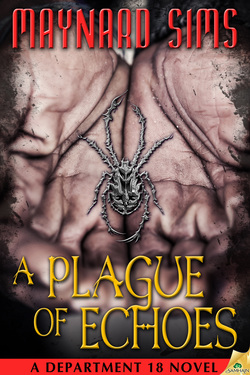 An evil stretching back centuries resurfaces in modern-day Yorkshire. Four centuries ago witch hunters killed the seven Yardley sisters. Now Department 18 must battle…the eighth witch! Four hundred years ago six of the seven Yardley sisters—all witches—were systematically hunted down and killed. The seventh lived long enough to give birth to a daughter. Now, centuries later, that daughter has resurfaced in the town of Ravensbridge, more powerful than her mother or aunts ever were. She has honed her powers, can change shape at will, and has only one ambition—to bring her family back from the dead to seek vengeance against the descendants of all who slaughtered them. Ravensbridge once lived in fear of the seven Yardley sisters, but they have yet to experience the terror of… the Eighth Witch. Robert Carter is on vacation. He should have known better. Evil never takes a holiday. Witches are a rather unused horror monster why do you think this is? Len – Witches, or witchcraft was very popular back in the 1960’s. Dennis Wheatley made quite a career out of it, but then it fell out of fashion. We thought its revival in novel form was long overdue. I couldn’t think of a significant witchcraft novel since the Stewart Farrar books in the 1970’s, so I thought why not? Mick – it seems to be a very British tradition, though long neglected. Witchfinder General and all that. Have you based the witches in the book on any specific legends and myths? Len – Not on any specific cases, but researching the Lancashire witches and witchcraft in general in that that part of the world, showed that there was a deep well to draw from. This year marks the 40th anniversary of your writing career, are you planning on doing anything special to mark it? Other than the publication of what sounds like the Department 18 novel you have been gearing up to write for a long time. The synopsis has got me doing a little happy dance? Mick – The Department 18 novel is A Plague Of Echoes. A Youtube video will be posted when the book is near its August publication date. The clock is ticking. In London, Department 18 Chief, Simon Crozier, is brutally stabbed and left for dead. Billionaire businessman, Pieter Schroeder, has laid his first card in a deadly, high-stakes game. The secret past of Department 18 comes back to haunt the present day. Whether Crozier lives or dies, whether Department 18 has a future, is in the hands of a few. In a battle against an evil both ancient and modern, Robert Carter and his team has to play the winning hand, where immortality is the ultimate prize, and death to those who lose. Enigmatic Press is also celebrating with The Maynard Sims Library. Eight uniform volumes of our entire catalogue of ghost and weird stories all available over a twelve month period on Amazon and ebook and paperback. Here’s the Youtube video The eight books are – 1. SHADOWS AT MIDNIGHT 2. ECHOES OF DARKNESS 3. INCANTATIONS 4. A WEAVING OF ANCIENT EVIL (Being the uncollected novellas The Seminar & His Other Son & The Hidden Language Of Demons) 5. WEIRD CRIES FROM THE SOUL (being uncollected stories) 6. FALLING INTO HEAVEN 7. GHOSTS & HAUNTINGS (being the collections THE ODD GHOSTS & A HAUNTING OF GHOSTS) 8. FLAME AND OTHER ENIGMATIC TALES And there’s a free sampler – A Taste – available as ebook or pdf if anyone wants it. Just email us. We are also celebrating by writing shed loads of new stuff. Four ghost stories already, (three by commissioned request) with a novella underway. The romance novel, the ghost-writing novel, the editing project, the third Bahamas novel. So busy but so enjoyable. And being asked to do this interview is a celebration as well. We were asked by Paul Kane for a blog for his site and it is always a pleasure to be asked to contribute something – as it happens so rarely these days. The secret past of Department 18, can you drop any hints, or do we just have to wait and discover this for ourselves? Len – I wouldn’t want to spoil it for the readers. Suffice it to say that in life, our heroes sometimes have feet of clay, and leave it at that. Mick – the back story, history and views of Department 18, including secret cases they have worked on are all held on www.maynard-sims.com and this link which I recently posted on Facebook was great fun at the time http://dorchesterpub.wordpress.com/category/news/ Looking back over the last forty years, do you have any regrets with regards to your publishing careers? And what would you say was the highlight moment? Len - I wish we had been this prolific thirty years ago, but unfortunately life gets in the way. I love the position we find ourselves in now. No day jobs and a fairly limitless amount of time to devote to writing. As for the highlight moment, that would have to be receiving the letter from William Kimber in 1978 to say they had accepted Shadows At Midnight. It was Christmas Eve and I had to drive up to Suffolk from Enfield that night in a real pea-souper fog. It didn’t matter. It was the best Christmas ever. Mick – I regret not taking the Penguin letter more seriously as that could have been a good collection of stories that might have been the basis of something. I wish we had followed up Shadows At Midnight with more ghost story collections for Kimber. I regret not being more prolific over the years - so many times I’ve allowed myself to get diverted by stuff. I wish we had had more belief in ourselves and had made us write more and submit more. I am often sorry we didn’t get a decent agent early on to guide us to higher levels of achievement. Sounds like a real sorry for myself idiot don’t I? Really I love my life. I wouldn’t want to be anyone else. We have deadlines with our traditional publishers but it isn’t causing any stress. With Enigmatic Press we drive the deadlines. I look after my granddaughter, I have lunch with my wife, I see my daughter all the time. I can write what I want and when I want. Lovely. I remember the early successes with fondness. The Curtain Call letter, the Hugh Lamb acceptance of Benjamin’s Shadow for his Taste Of Fear anthology, the acceptance letter from Kimber. I also loved WHC in Chicago which got us started on novels and a friendship with Don. I loved the Enigmatic days when we were producing something with passion. It was great when Shelter first came out. Appearances in Best Horror, some excellent anthologies, being asked to contribute stories or articles (we used to write articles/essays – blogs really for Mark Chadbourn when he ran At The World’s End site, and we’ve done essays for the BFS). Getting rare reader feedback is always a highlight. Scrolling the Internet and finding an article praising one of our stories. Making good friends through the years. Guys, this has been a total honour, thank you for agreeing to take part in this interview. Congratulations on 40 years of publishing. Do you have any final words for the readers? Len – really the honour has been ours. Well-researched, intelligent questions are always a pleasure to answer. Thanks, Jim. And to our readers I’d say, thanks for your support over the years, and keep reading. We’ve still got loads of stories to tell you. Mick – echoed by me. An interesting set of questions that show your love for the genre and knowledge of it. I am always happy to hear from anyone about our work. Maynard Sims is on Facebook, Twitter, Pinterest – everywhere really – and Len Maynard and Michael Sims are also on Facebook, Linkedin and other places separately. THE END TO PURCHASE BOOKS FROM MAYNARD AND SIMS PLEASE CLICK ON ANY OF THE IMAGES IN THIS INTERVIEWGINGER NUTS OF HORROR THE HEART AND SOUL OF HORROR WEBSITES3/6/2014 09:34:08
Very nice work by all concerned. Like listening in on a chat in the pub...
E Bentley
4/6/2014 00:58:28
Very entertaining and witty... Have read Let Death Begin.... It was brilliant...lots of twists and turns and hard to guess till the end... Waiting for the next book please! Comments are closed.
|


Archives
May 2023
|
 RSS Feed

|

|