

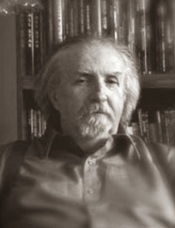
 STEVE RASNIC TEM STEVE RASNIC TEM It is with great pleasure and a huge honour to give to you for your reading please an interview with one of the true giants of the genre, Steve Rasnic Tem. Steve Rasnic Tem (born 1950) was born in Jonesville, Virginia, which is in the heart of Appalachia. He went to college at Virginia Polytechnic Institute and State University, and also at Virginia Commonwealth University. He got a B.A. in English education. In 1974, he moved to Colorado and studied creative writing at Colorado State University. He is married to author Melanie Tem. The couple have three kids and live in a large house in Colorado. Steve Rasnic Tem's short fiction has been compared to the work of Franz Kafka, Dino Buzzati, Ray Bradbury, and Raymond Carver, but to quote Joe R. Lansdale: "Steve Rasnic Tem is a school of writing unto himself." His 200 plus published pieces have garnered him a British Fantasy Award, World Fantasy and a nomination for the Bram Stoker Awards. 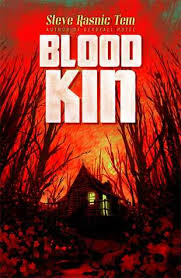 BLOOD KIN BY STEVE RASNIC TEM BLOOD KIN BY STEVE RASNIC TEM Hello Steve, thanks for agreeing to take part in this interview. Let’s get the basics out of the way first. I’m fascinated with names, what’s the derivation of your two last names? I was born Steve Tyler Rasnic. The Rasnics (at least the Lee County, Va. version), are all descended from Johann Ruehrschneck, a Hessian soldier brought to America to fight for the British in the American Revolution. He was captured as part of Cornwallis’s army at Yorktown, and marched across Virginia with the other prisoners. Somewhere along the way he escaped, married a local woman, and turned up again as “Jacob Rasnake.” As often happened, the name warped through their children and grandchildren—becoming variously “Resnick, Rasnick, Rasnake, and “our” version, “Rasnic.” “Tem” is another story. When Melanie and I were married we weren’t keen on the custom of the woman having to change her last name, and we didn’t want to hyphenate, so we decided to both choose a new last name to mark this new relationship. “Tem” comes from Atemu, an early Egyptian creation god who created him/herself through the process of naming. It’s also a Romany word for “country.” We added the name on to our existing names, so my full legal name is Steve Tyler Rasnic Tem. You’ve described yourself as a fearful kid, so why were you drawn to horror? It’s a strange impulse, isn’t it? One I think I share with a number of horror writers. I think it has to do with control—you go to the things that frighten you in order to control them better. As a writer you turn it into material, and in that way you draw it away from yourself. Another way to put it is that you write that stuff out of your system. Not just the overt horrors we can see or imagine, but also the sense that there are secret things in the world we don’t fully understand. Temperamentally, I’m a rather calm, peaceful person—the Gothic is not part of my lifestyle, my dress, or my minute-to-minute focus—my usual stance with the world is “amused.” I relegate the horror to my fiction—it’s not a part of my daily approach to the world. You grew up in a house without a lot of books, where did your passion for reading come from? School, initially, and the children’s classics set we had in the house. You pick up a book and you discover that there are worlds in there, endless entertainment. My own world seemed so narrow—a little house in a little town I almost never left. The only real sense of the outside world was through television—the nightly news was like views of another planet—it seemed to have nothing to do with us. Reading meant never being bored. I discovered that my grandfather still had much of my great grandfather’s library, and a cousin stored her “trashy” paperbacks at his house, and I eventually was able to access these books. And when our county finally got a public library I was in heaven. As an adult you started with science fiction, but fell out of love with it when you realised that the emotion in the stories was “carried by the reader” rather than coming from the story. Is emotional depth something that is important to you in what you read? I fell out of love with science fiction when I reread all the classics by people like Clarke and Asimov and Heinlein and discovered that the emotions I’d felt when I first read them in high school and junior high oftentimes weren’t in the stories themselves. They were good at triggering that sense of wonder, exciting something in me that made me fill in the emotional blanks in what were pretty much cardboard characters. As an adult, though, I felt that was making the reader do too much of the work—it was a limitation in what I thought these stories could accomplish. Later though, when I discovered some of the newer sf writers, especially the short story writers, I fell back in love with sf. And I’m still in love with it. Emotional depth is essential to me as a reader. I want stories to move me, to shake me, to make me rage and make me weep and make me laugh. This is truer the older I get—who has time for anything else? We only have a limited span on this planet. And on that note who do you like to read? And who was the last great author you discovered? I read a great deal. There are some writers who I try to read everything they’ve written, and I reread it when I have a chance—Faulkner, Salinger, Toni Morrison, Aickman, Ramsey Campbell all fall into this category. And there are writers for whom a new book is a great event, and I try to read it as soon as possible—Cormac McCarthy, Stewart O’Nan, Daniel Woodrell, Stephen King, Neil Gaiman, Adam Nevill, Dan Simmons, Caitlin Kiernan. The last great author I’ve discovered is Lynda Rucker—I did the introduction to her first collection The Moon Will Look Strange. She’s a tremendous short story writer. 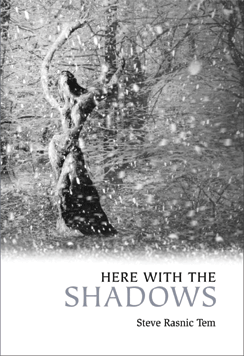 HERE WITH THE SHADOWS HERE WITH THE SHADOWS Horror has many different guises, is there a particular brand of horror you enjoy the most? I pretty much like all the forms of horror at some time or other. But since I admire most a superior facility with the language and the ability to delineate shades of emotion, I suppose the subtle ghost story is what I most enjoy reading, especially those early twentieth century British single author ghost collections. I compiled my new collection for Swan River Press, HERE WITH THE SHADOWS, with those collections in mind. I wanted to have my own version of such a collection. While at college you entered a graduate writing programme at Colorado State University, do you believe that writing can be taught, or must there be some sort of innate seed of talent that can be cultivated? I think you have to have a certain amount of talent to work with, a knack for creating stories—you also have to have a certain amount of drive, otherwise you’ll never finish anything. But beyond that, technique can be taught, structure, theory, the basics of good prose. Even more importantly, a good workshop situation can teach you how to be a critic of your own work, which is essential. You have to develop a sense of your own aesthetics, when you’re writing well and when you’ve gone off the rails, otherwise you’re going to be confused and distracted by other people’s opinions (especially in this age of Goodreads). You first story sale was to one of your heroes Ramsey Campbell, that must have given you a big confidence boost? Definitely. That was the first professional genre sale—there had been little non-genre stories in literary mags before that. I was very lucky in the people who took an interest in my work early on, who encouraged me, even calling me up to chat about this story or other, or to talk about writing in general. This all happened in the first year or two after selling “City Fishing” to Ramsey. It was thrilling. Some of the other people who were quite generous with their time included Alan Ryan, Charlie Grant, Roy Torgeson, Lin Carter, Stuart Schiff, several others. You’ve mentioned in previous interviews how widely you read. Do you think it is important that horror writers should read beyond the genre? And similarly do you think it is important that horror authors are aware of what came before them within the genre? I think reading widely beyond the genre is essential. You can get a rather distorted view of relative worth and the variety of storytelling techniques available to you otherwise. As for reading within the genre—I think it helps, but it’s not as essential I think, because horror isn’t an “idea” fiction in the same way that science fiction is. Horror is an emotional fiction, and you can understand how to build suspense and delineate fear from reading the right things in other forms of fiction. So you can bring a fresh eye and perspective to scaring/disturbing people without having much background in the tropes and traditions of horror—as long as you’re able to move the reader is what matters (for example, my wife Melanie has a general knowledge of horror fiction, but she’s never read deeply in the field). Of course, if you plan something ambitious using one of the standard horror tropes—vampires, werewolves, etc.—it’s important to see how it’s been handled previously, because then it becomes, in part, the exploration of an idea, and ideas have history. Horror is a genre description that is full of misconception, do you like describing yourself as a horror writer? I don’t shy away from calling myself a horror writer—I love all forms of it and I like writing all forms of it. But it’s also true I write other things, and to interpret my science fiction or my realistic Appalachian fiction through a horror lens is to distort it, to read it inaccurately. I also think that in general genre labels tend to distort and oversimplify what writers create—for a writer with any ambition the boxes don’t fit very well. So I suppose I’d say I’m proud to call myself a horror writer, even though the label doesn’t always fit my work easily. Some people may not be aware that you first started writing poetry; does being a poet have an impact on your prose writing? Poetry taught me to care about language and to care about concision, to be aware of the suggestive power of words and how words can sometimes mean multiple things. In many ways, I think I still revise like a poet—I rework the prose again and again to use fewer words and to maximize meaning. What aspects of writing to do you find the most difficult? The long hours sitting. As you get older stamina naturally decreases. How do you think you’ve evolved creatively? I think I write better now than I ever have in my life, just in terms of line by line prose ability. I’ve also gotten better at large structural issues, which is why I’m finishing more novels.  THE MAN ON THE CEILING THE MAN ON THE CEILING You have also written a number of books with your wife Melanie Tem, how did you go about working together? Was it an easy thing to do, or where there some heated discussions during the process? We fell into it quite naturally. We have similar aesthetics and we both are good at putting our ego aside—all that matters is writing the best possible story. I don’t think we’ve ever had a heated discussion over a piece of writing. And Melanie’s one of the best editors I know. It started with “Prosthesis,” a story for Asimov’s. I’d written the story most of the way through but didn’t feel I had the female protagonist right. We agreed she’d rework the character and we went back and forth from there. After that it became more formal. Back in those days I received a lot more anthology invites than she did, and didn’t have time to do them all. So sometimes we’d do a collaboration—either I’d start or she’d start the story following a brief conversation. Sometimes we’d take 2 different characters, sometimes we’d just alternate scenes—we mix it up quite a bit. Now the collaborations are bit more planned and deliberate, but the process is still essentially the same. 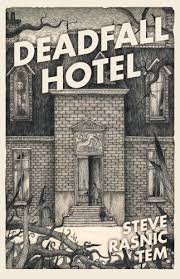 DEADFALL HOTEL BY DEADFALL HOTEL BY Leading up to your latest novel Blood Kin, let’s talk about your last novel Deadfall Hotel? Am I correct in thinking that this novel took you a number of years to write? 25 years (but no, not every day). An early version of one section, “Bloodwolf,” came out in Charlie Grant’s Shadows 9 in 1986. I really felt like I had something special with this book, which I believe is one reason I kept putting it off—I just wasn’t confident enough—and novels were still a struggle for me. I found the process tedious, and I missed the frequent frisson you get from completing a short story. Basically, I didn’t have a good novel process in place. It took me a long time to get that process in place, but it’s a much better book because of it. I’m very proud of that novel. The novel deals with some of horrors basic tropes, which is something you have in general stayed clear off. Why have you in general stayed clear of vampire’s werewolves and their ilk? Do you think that their power to shock has been diluted from over use? I’ve generally stayed away from standard tropes because I think they’ve been worked over in so many ways that any time you attempt to write about them you fall into certain predictable patterns of creation and story making—the weight of that tradition makes it hard for you to come up with something truly original. But I do get ideas from time to time using the standard figures which are quite hard to resist. In the case of Deadfall Hotel, I thought this was the last time I would ever write about those tropes, so this was my little send-off for them I suppose. I wanted to look at them with new eyes, and in a very different context than you usually see them. It gave me the opportunity to write a horror novel which was essentially about horror. Deadfall Hotel was probably the first of your books that was freely available on the high street in the UK. Did you purposefully seek out a publisher that could get your books on the shelves of bookstores? I write a number of things which I know are going to have a somewhat limited audience. I write other things which have the potential at least of reaching a larger audience. As I want the largest possible audience for the work I want to write, finding a good commercial publisher is the obvious choice. Jon Oliver at Solaris already knew my work and liked it, and happily we sent him the book around the time he was looking for more American authors. Accidental timing and luck play a frighteningly large part in a writer’s career. It worked out well, and I love the care and the design effort Solaris puts into their books. 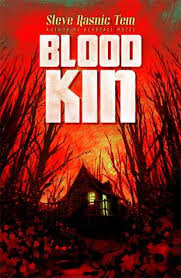 BLOOD KIN BY STEVE RASNIC TEM BLOOD KIN BY STEVE RASNIC TEM Which brings us to your latest novel Blood Kin. Can you tell the readers a little bit about what the novel is about? The story alternates between two points of view--the young Sadie Gibson in the Depression and her grandson Michael in contemporary southwest Virginia. The Gibsons are Melungeon, a mysterious mix-raced group discovered by early settlers in the area. But these Gibsons are even more different than those around them, with unusual powers of empathy even they don’t understand. Michael is at a crossroads in his life when he returns to the hills where he was raised to care for his aging grandmother. Sadie has an important story to tell him about ghosts and snake-handling and the Grans so that he can fully grasp what’s in the iron-bound crate beneath the kudzu vine in a nearby field. It’s crucial that he understand—their lives, and the lives of everyone in the valley depend on it, It has been described as a Southern Gothic novel, for those who are not sure about what that means, can you explain what a Southern Gothic novel is? Southern Gothic is a unique variety of gothic fiction taking place exclusively in the American South. All the trappings of the Gothic are there, but subtlety transformed, Americanized, if you will. Southern Gothic features eccentric characters, decayed or derelict settings, sinister undertones accompanied by such subthemes as poverty, racism, incest, crime and violence, etc. Blood Kin might also be classified into a further subgenre of Appalachian Gothic, which adds the additional element of a mountainous, more isolated setting. One of the more interesting aspects of writing this book was to allow these elements to transition into some at times more shocking horrific content. This seems to be the novel that you have been wanting to write for your whole career. You have been collecting notes for it since High school. Why did you decide that this was the right time to put it to paper? A major factor was that Solaris was interested in doing it. Another factor was that in terms of process I was at last ready to do it. And I was frankly getting tired of all these notes and volumes of research cluttering up my office. Age was also an element I’m sure. If you wait too long on a project you might get too old to finish it . . . The novel also feels like a very personal tale, featuring tales from your relations about growing up in the 1930’s, and even features a snake handling preacher similar to the one your dad used for odd jobs. Have you used this book as a cathartic exercise? Not so much catharsis as closure. I’ve been living with these stories and these characters for a long time now—it was time to get them out into the world. The book is steeped with fascinating and colourful characters, characters that feel real to the region. What’s the biggest misconception that you really dislike about Appalachians? Appalachia, like most areas of the world, is complex and contradictory. I suppose the most annoying perception I encounter is that everyone living there is ignorant and unsophisticated. Much of that impression would seem to come from the accent and the sometimes colourful way of speaking. I encountered it myself in college—some people just assume that if you have an Appalachian accent you must be stupid. I have to say that in my experience ignorance is a quality liberally distributed across the globe. Blood Kin is a novel of duality with the narrative being split between two viewpoints and two time periods. Was this something you had always intended to do, or did it arise as a way to deal with the stories themes? It was something I realized almost from the beginning. I knew this would be a story of generations, and of the slow decline of a small town. I also felt I needed to show Sadie at her most vulnerable so that the reader could fully experience the stakes involved. I could have told a smaller, simpler story, certainly. I could have told a classic tale of the Southern Gothic by sticking with Sadie in the past. Or I could have told a more typical contemporary horror story about a young man’s encounter with a monster in an exotic locale. And the risk is there will be readers who would have preferred that I’d written one or the other. But I always wanted to tell both stories, and so I did. I was fascinated by the Melungeons, until reading Blood Kin I was totally unaware of this group of people. Did you come across any fascinating insights while researching the novel? My own grandmother is thought to have been Melungeon. She grew up in the Blackwater area of Lee County Virginia, a heavily Melungeon area, and her mother was an Osborne, which is one of the standard Melungeon names in that region. She had Indian-like features and many of her children, including my father, had dark skin pigmentation. Race was a delicate issue where I grew up with very few self-identifying as non-white, and as far as I know she never discussed the subject. For a long time in Virginia Melungeons were classified as free persons of colour and weren’t allowed to vote. Some identified with Indians—one of my grandmother’s brothers lived for a time on the reservation. When you look at what the various Melungeon families have said about their origins you find an intriguing mix of mystery, secrecy, fantasy, and finally a great deal of pride. You see explanations that range from the theory that they were the remnants of Raleigh’s Lost Colony to the idea that they were actually Persian in origin. I gather there’s even a group in Turkey which identifies as Melungeon. For me, their story certainly inspires imaginative speculation. The book is due for publication in the UK at the beginning of March, how do you as a writer in America go about spreading word of the book in the UK? It’s a digital world now, and in any case personal appearances by midlist authors like me have never really made practical financial sense. I write guest blog posts and I let myself be interviewed by websites such as this one and I use social media as best I can—all in an attempt to facilitate more readers discovering the book. Word of mouth is important. Other than that, you hope for the best while you’re writing the next book. This year sees you being published in Crystal Lakes Horror 101, how does it feel to be share the page with a giant of the genre as myself? The Crystal Lakes project is an interesting one, and I’m always pleased to share the things I’ve learned over the years. So what does the future hold for you? Sometime over the next year PS Publishing will be bringing out a stand-alone novella of mine, In the Lovecraft Museum. And next year Centipede Press is publishing a giant volume of my uncollected horror stories—70 stories, 225,000 words. The title is Out of the Dark: A Storybook of Horrors. And currently I’m working to finish another long-developing novel project: Ubo. It’s about the history of human violence, Thank you Steve this has been an honour and a pleasure to have you pop over for a chat. 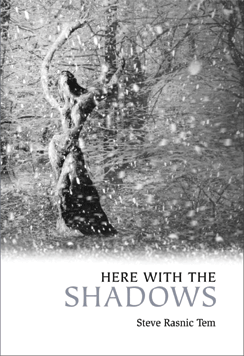 HERE BE SHADOWS HERE BE SHADOWS HERE WITH THE SHADOWS by Steve Rasnic Tem "Far better to choose an absence than to have an absence forced upon you." — The Slow Fall of Dust in a Quiet Place These stories by award-winning author Steve Rasnic Tem drag from the darkness ghosts that haunt us all. Between these covers lurk the spectres of grief, loss, and loneliness: a man discovers he is far from alone in his empty home, a forlorn wife is gifted with an unusual child, a contractor contemplates the sad message left by a grieving father, a blind woman discovers a spiritual manifestation at the edge of a forest, a spectral presence appears in a lonesome Colorado wheat field . . . Here with the Shadows is a volume of supernatural impressions and quiet vacancies, and in each story Tem reminds us that sometimes only a whisper separates us from the eternal. Contents Here with the Shadows A House by the Ocean The Cabinet Child The Still, Cold Air G is for Ghost Breaking the Rules The Slow Fall of Dust in a Quiet Place Inside William James Back Among the Shy Trees Seeing the Woods Smoke in a Bottle Est Enim Magnum Chaos These Days When All is Silver and Bright Telling Wheatfield with Crows Acknowledgements PURCHASE A COPY HERE For more horror author interview and horror novel reviews please click the links below HORROR AUTHOR INTERVIEW |


Archives
May 2023
|
 RSS Feed

|

|