

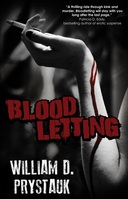
 An award winning screenwriter, filmmaker, and educator, I began writing stories in first grade when I still had hair. The short crime film I produced and directed, CASE #5930 is in post-production, and I hope to direct David McDonald’s horror feature, VINDICTA, next summer. An active member of the New Jersey Screenwriter’s Group, I teach English as an assistant professor at Kutztown University of Pennsylvania, and my guidebook on business writing will come out later this summer. When not writing, I’m busy co-hosting THE LAST KNOCK horror podcast on iTunes. I enjoy life with my wife, author and editor Ally Bishop, and our two puppies, Suki and Karma. I’m proud of my alternative music and horror movie collections, and the fact that I never leave any sushi behind. The hard-boiled crime thriller, “Bloodletting” is my first novel. Could you tell the readers a little bit about yourself? I’m an award-winning screenwriter, filmmaker, podcaster, poet, and educator who loves my wife, horror films, puppies, and tons of sushi. I also teach English at Kutztown University of Pennsylvania. What do you like to do when you're not writing? Photography because it’s almost instant gratification compared to writing screenplays and novels. And in the evenings, I want to indulge in at least one horror film. What’s your favourite food? Sushi! I want to hit the lottery just so I can have a sushi chef on call, 25/8. (Okay, I’ll use the rest of the money to save kids and animals – promise.) Who would be on the soundtrack to your life story? Nick Cave, Siouxsie Sioux, Jeff Buckley, PJ Harvey, Misfits, The Smiths, Joy Division, Elvis Costello, Ministry, Godflesh, Motorhead, Dead Kennedys, and Abecedarians – for starters. Do you prefer the term Horror, Weird Fiction or Dark Fiction? Each one has its own distinct definition, though they’re also open to debate. “Horror” suits the uncanny and monsters, and includes suspense, but “Dark Fiction” can incorporate horror and its attributes, or simply be a thriller (this is where we get into “Silence of the Lambs” territory because it’s technically not a horror novel or horror film). I don’t care for “Weird Fiction” because that can simply mean “quirky” and maybe even something comedic. Who are some of your favourite authors? Henry Miller because he taught me about being honest. F. Scott Fitzgerald due to the thematic value he conjured. Gemma Files for her depth of reference and intelligence. Matthew Stokoe for delivering the most disturbing and visceral material I’ve ever engaged. And Ellen Miller for giving the world only one novel before she died, “Like Being Killed”, which is as brilliant as it is riveting. What is your all-time favourite horror novel, and film? For the horror novel, I can play it safe and go with the broader definition of “dark fiction” but I won’t. Therefore, I’ll take Shirley Jackson’s psychologically profound “The Haunting of Hell House” (1959), which Robert Wise captured beautifully for THE HAUNTING film in 1963 with star Julie Harris. My favourite horror film is 1979’s ALIEN. I love the claustrophobia, character interaction, heavy atmosphere, music, and the feeling of hopelessness that permeates the entire narrative. Dan O’Bannon really rocked that script. If you could erase one horror cliché what would be your choice? Only one?! I’ve seen about a million horror films (slight exaggeration) that start with “five friends in an SUV” – and of course their cell phones don’t work, and when they stop at a gas station they all have to get out and rile up the creepy attendant. Sigh. I can’t take openings like that anymore. Which fictional character would be your perfect neighbour, and who would be your nightmare neighbour? Perfect neighbour: I’ll take Private Cooper from the British horror film DOG SOLDIERS. I know that beyond a doubt he’d have my back and never give up. He thinks fast on his feet, and he’d love my dogs. Nightmare neighbour: Pinhead from “Hellraiser.” Believe me, I love the guy, but I can imagine lights flashing, screams, and the opening of portals to other dimensions occurring around the clock – plus the stench from the house would force me to move. What do you think of the current state of the genre? The cliché-ridden madness in horror books and films needs to stop. NOW. Hollywood will unfortunately continue to bring us third-rate horror remakes because they want a great return on their investment, and they care little about new material even though there’s a ton floating out there and waiting to be developed. As for independent cinema, it’s great to see so many new and gripping stories (PONTYPOOL, ANTIVIRAL, RESOLUTION, JUG FACE, and A GIRL WALKS HOME ALONE AT NIGHT, for example) that rock the brains of horror fans. However, there are sadly far too many indie horrors built on the foundation of a weak and hackneyed story idea, followed by awful cinematography and bad acting. Sure, I know anyone can pick up a camera and go film a movie, but it doesn’t mean they should. Therefore, if independent cinema is going to save horror, and make it look amazing for those who think the genre is disposable and wasteful, then quality needs to be paramount – and it begins with the script. What was the last great book you read, and what was the last book that disappointed you? The last great book: “Schmuck” by Ross Klavan kept my mind ablaze. Granted, it’s not a horror, but an amazing trip about a radio talk show at the end of the turbulent sixties. The novel’s loaded with amazing characters, wild yet relatable situations, and each page is a captivating story in itself. The last worst book: “Damned” by Chuck Palahniuk. I enjoyed his “Lullaby” very much, but “Damned” feeds off all of his previous work: the jokes may be different, but he’s telling them the same way as in all his other works. I felt like I was reading “Haunted” again but with different words as if he played “Mad Libs” with his own story. Very disappointing. How would you describe your writing style? Julia Cameron said, “Writing is like breathing” and my desire is to bring that flow to the reader so they can have a fast-paced, rhythmic experience. In addition, I adjust sentence structure to match the tone of the scene and to maintain the proper atmosphere. Most important, if something exists in the real world then I’ll bring that gritty element to my writing to keep the story as visceral and as genuine as possible for the reader to indulge in an honest experience. Are there any reviews of your work, positive or negative that have stayed with you? Due to the novel’s subject matter of BDSM, it was great to hear from many people unfamiliar with the lifestyle to find the book refreshing. Some even stated that for the first time they understood what BDSM was all about. Even people in the lifestyle found that “Bloodletting” treated the subculture with respect. I’m glad I could bridge that gap for so many mystery readers. Others focused on the noir aspects of the tale, like screenwriter Ken Vose, who said “Bloodletting” is “Fifty Shades of Noir” and added that “I'm not sure what Raymond Chandler would have thought about Denny Bowie, or had Philip Marlowe say about him, but for my money Bowie is a worthy contemporary version of the classic private eye.” Another reviewer said that “Bloodletting” “…provides the missing link (in tone, content, and visceral impact) between William Friedkin's 1980 film CRUISING and Abel Ferrara's BAD LIEUTENANT.” The one that bothered me the most is from a reader who actually loved the book but thought my bisexual character was homophobic and transphobic. Denny isn’t, of course, but he does have some hang-ups I had already planned to explore in upcoming sequels as he matures. Gay and transgender beta readers had no issues with the protagonist, and it was sad to read that this person felt otherwise. What aspects of writing do you find the most difficult? I’m sure many writers would agree that finding time to write is the biggest pain. I’m currently working on two screenplays (a horror, and a dramatic science fiction) and two novels (a horror crime, and the crime thriller sequel to “Bloodletting”), and there isn’t enough time in the day. I had attempted to write “Bloodletting” in third person, but the story didn’t resonate. However, my main character really brought the tale to light when I rewrote in first person. This meant I had to sacrifice several scenes though the change made for a much better read. Thankfully, since I had adapted the novel from my screenplay, readers can find those missing elements in the original script. Is there one subject you would never write about as an author? What is it? I will write about anything if my characters take me there. Yet, I truly despise bigotry of any kind, whether it’s about ethnicity, race, religion, sexual orientation, or anything else. I couldn’t have a story focusing on any one of those elements for too long. Whenever I do introduce a biased character, he or she usually ends up getting killed in short order. I can’t even read books or watch films, like SELMA or BOYS DON’T CRY, because I freak out and get hostile. I did watch BOYS DON’T CRY, and it was enough to fill me with rage for days. I could never engage the film again. If you could kill off any character from any other book who would you chose and how would they die? Julie Stratford in Anne Rice’s ill conceived, “The Mummy, or Ramses the Damned” (1989). I hated the character so much I pleaded for her death, only to see her become immortal. She was such an idiotic ninny I wanted a train to flatten her – back up on the tracks and do it again. What do you think makes a good story? A solid and unique premise, strong characters full of depth, and a sense of atmosphere. Stock characters make me want to scream, and I hate any character that is solely “good” or “evil”. I want complex characters, whether protagonists or antagonists, that can capture my imagination. And although I have no problems with genre, I most often loathe when writers stick to the conventions and the neat little categories publishers and producers seem to want instead of breaking new ground. Maybe this is why “Bloodletting” is a hard sell. My protagonist is bisexual, a punk rocker, and a sadomasochist. Due to this, the rejection letters I had received from several publishers read more like letters of regret. They simply didn’t know how to market such a character – especially a young private detective who also hadn’t been a cop or a war vet. But they did praise the writing. Ultimately, three publishers sent me contracts, and I chose one. How important are names to you in your books? Do you choose the names based on liking the way it sounds or the meaning? I research names like a nutcase. I want them all to reflect the character, and they usually serve as thematic devices. For “Bloodletting”, I decided to give myself a break and have some fun. All the characters are named after alternative rock, goth, and punk gods. Since my detective is a punk rocker, I wanted to celebrate what he loved most in this world. How do you think you’ve evolved creatively? I spent many years of de-evolution, and ended up writing three forgettable novels. So I gave up the craft for three years. But “Bloodletting” wanted to be born, and I couldn’t keep it at bay. But instead of diving into another book and invite failure, I turned to screenwriting, and I promised myself that if the narrative didn’t work, I’d give up writing altogether. When I finished the “Bloodletting” script and read the ninety pages, I announced to the air, “It works.” The screenplay wasn’t perfect, but all the elements were there. With the help of the New Jersey Screenwriter’s Group after a table read, I made adjustments and revised. Soon after, the script became the Second Place Winner of the 2006 Screenwriter’s Showcase Screenplay Contest and was the first for mystery entries. Afterwards, I landed my first agent. Thanks to screenwriting, I developed a greater understanding of storytelling. The new novel I’m sending out to publishers and agents, “The City of Bloody Love: Red Agenda” won First Place at the International Horror and Sci-Fi Film Festival, was a Top-5 Finalist at Screamfest in 2008, and was a top finalist in two other open genre contests. I think I’ll write all of my novel ideas as screenplays first because they serve as a glorified outline. Writing the novel from the script is like colouring in the numbers. What tools do you feel are must-haves for writers? I don’t care what story idea writers have in their heads, or how unique the premise may be, but if writers don’t read often, understand craft, or grasp their writing weaknesses, the story will fall flat. Writers must realize that writing is not a solo venture. An editor and proofreader are the writers best teammates because those individuals want the story to succeed, and they can view the work objectively like the author will. This is why it’s important for every writer to hear what these qualified professionals have to say and follow through. This brings me to the final element: if a writer can’t accept or listen to criticism, that writer needs to find something else to do. What is the best piece of advice you ever received from another author? Read, read, read. How do you market your work? What avenues have you found to work best for your genre? Besides interviews like this and podcast interviews, I have an excellent trailer from Don Reimer with great narration from actor Owen McCuen (https://www.youtube.com/watch?v=TVNji_G-tSI). And thanks to dark fiction lovers on Twitter, who have insatiable appetites, many have retweeted or promoted my book with their own memes and fan art. Granted, there are many people to thank for this, but filmmaker Emilie Flory, writer and poet Gillian A. Gibson, author Fay Simon, and artist Dave Koenig have really gone out of their way to spread the word about “Bloodletting” via social media. And for that, I am beyond grateful as well as humbled. Right now, I’m working with my publisher to get the original script into the hands of production companies who have shown interest. Who is your favourite character from your book and why? Oddly enough, I like my lead, Denny Bowie. He’s flawed yet capable, and his heart’s in the right place – at least for solving the serial killings. I had wanted to create an alternative lifestyle guy with a brain who was also a bit confused about himself, and many readers have told me I achieved this, and that’s a relief. How about the least favourite character? What makes them less appealing to you? I have a very minor character that appears in only two scenes, though he’s clearly necessary for many reasons I cannot go into. I hate him because he’s a jerk on a grand scale. Every time I had to write his name, I cursed aloud. Regardless, I felt his presence through my main character, and I could tell this guy really annoyed the hell out of my protagonist as well. Fame, fortune, or respect? Ha! If I wanted fame and fortune, I would have churned out the tried and true. But I just couldn’t do it. “Bloodletting” is supposed to be off the beaten path, and the characters that inhabit the story take us down such a route. Therefore, I’d have to go with the latter, though in all honesty, I simply wanted to write a story to entertain mystery readers who wanted something a bit different from the same old, same old. What piece of your own work are you most proud of? My screenplay, RED AGENDA because for a horror/action/crime thriller, it captured the interests of many studio executives. At one point, thirteen different production companies wanted it, including a guy who had heard about the script at Sundance. Unfortunately, I had a lousy second agent, plus the economy collapsed, which meant Hollywood shut its doors to many new writers at the time. Regardless, the story is a blast and I hope a publisher picks up the novel. If so, it may still become a film after all. And are there any that you would like to forget about? Yup. I have a banker’s box of crap writing, but there are nuggets of gold in those pages even though they may be few and far between. Yet, if it wasn’t for that mini-landfill, I wouldn’t have had anything to build from to create better stories. As with everything else, practice leads to improvement. For those who haven’t read any of your books, what book of yours do you think best represents your work and why? Well, “Bloodletting” is the only novel out right now, though people can find my scripts, published short stories, and even poetry through other venues. But that book comes with many years of reading and writing experience. And since one of my pet peeves is lazy writing, readers should know that I interviewed many people, from a homicide detective and a private eye, to a nun and a water expert, as well as others, to make certain the story was as accurate as possible. Can you tell us about your last book, and can you tell us about what you are working on next? In “Bloodletting”, punk rocker and sadomasochist Denny Bowie, a “legwork guy” for a private investigation firm, is out to find the killer of five masochistic men and his childhood friend, fetish photographer Tommy Heat. He gets back with Penny Dallion, the Goth-girl of his dreams, and is enthralled by the hot and androgynous Erin Marr, his new boyfriend. While investigating Tommy’s murder, Denny discovers pictures missing from Tommy’s meticulous collection. These photos not only hold the key to the killer’s identity, but may also prove Penny’s involvement in the murders. Embroiled in New York’s vibrant S&M subculture, Denny revisits old haunts: fetish clubs in Greenwich Village to find the killer who’s a step ahead of him – and maybe right behind him. My upcoming crime horror, Red Agenda, is the first of the City of Bloody Love series, and Detective Keagan discovers that the vampire terrorist group Red Agenda is out for blood. Hell-bent on taking them out for good, he reluctantly teams up with vampire Alden Rinc as Philadelphia decays into fear and hostility. The hunt for their prey leads them into an underworld of bloodwhores and fangfuckers and exposes a plot to murder the president in three days unless Keagan and Rinc can stake Red Agenda once and for all – and keep the commander-in-chief off their menu. What's the one question you wish you would get asked but never do? And what would be the answer? This is the same question I ask people I interview on my THE LAST KNOCK horror podcast! I have no clue. Just kidding. Here’s the question: “Are you into the BDSM lifestyle?” When it comes to “Bloodletting” I know the places I’m talking about because I’ve visited all of them. Readers, whether they are into BDSM or the fetish lifestyle should know that I have used my previous experiences in the subculture to help craft the book. Most important, I make a clear distinction between “safe, sane, and consensual” BDSM and sadistic crime. All too often, fiction writers and filmmakers are exploit people in the lifestyle by presenting misinformation and caricatures. I was determined to avoid that. Thanks so very much for having me, Jim!
Follow the links below for more horror interviews and reviewsHORROR AUTHOR INTERVIEWSHORROR FICTION REVIEWSComments are closed.
|


Archives
May 2023
|
 RSS Feed

|

|