

HORROR AUTHOR INTERVIEW M.R. COSBY
3/5/2014
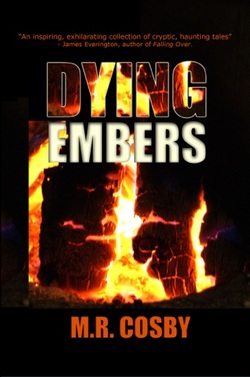 M.R. Cosby finds himself in the Eastern suburbs of Sydney, having somehow escaped (physically, but not mentally) from the gloriously grey Home Counties of his youth. He has had a lifelong interest in dark literature, having been exposed, by accident and at a tender age, to some copies of the Pan collections of horror stories. These, which were carelessly left on a windowsill by his departing father, became perhaps that parent’s most enduring influence upon his son. He began writing his memoirs some years ago, which, though still far from complete, provided the inspiration for his first collection of short stories, Dying Embers. To his surprise, several of the tales written for this collection were published in their somewhat embryonic states, which encouraged him to persevere. Cosby was for many years an illustrator and graphic designer, then became Creative Director of a large Australian publishing company. In this role he worked on a varied stable of magazines, often contributing to features as a journalist, which thoroughly whetted his appetite for writing. He is currently looking after his family and writing a novel. Could you tell the readers a little bit about yourself? I write short, dark fiction – mostly interpreting my own experience, and from my dreams. I try to find the strangeness in the everyday, and to expose the gaps that people unwittingly find themselves slipping through. I started writing in order to capture something of myself, to set it down and to make it permanent. My father died when I was young, and I know almost nothing about him. I don’t even have an example of his handwriting, and I often wonder at how so little of him lives on. I didn’t want to risk the same thing happening with my own children, hence a recent attempt to write my memoirs. From this effort came some rather autobiographical tales which, collectively, became Dying Embers. ‘Working from home’ means different things to different people. To me, it means encouraging my children to write dark fiction for their school projects; shopping for products which include no e-numbers; baking bread; making meals; doing the washing; changing the bed… and trying to write a novel. (Does Stephen King have these limitations?) I find I write most effectively (i.e. at all) either in my A6 Moleskine notebooks, or on my laptop, and ideally at a certain local café: but only when the children are safely at school! Robert Aickman once said that he never “made anything up”. He was suggesting that there’s enough strangeness in the world all around us, we just have to be observant enough to see it: much of my time is spent trying to do just that. What do you like to do when you're not writing? I try to run every day. It keeps you young, right? Well, sometimes it doesn’t feel like that when I’m trying to get the old legs to move in the first 20 minutes or so of my workout… What’s your favourite food? Food is a passion for me. I enjoy buying fresh produce from the market, and making something for the family to eat every day. I can’t think of anything I don’t like. However, as we are so spoilt here in Australia with fresh fruit, a beautifully ripe Queensland mango would have to be my choice! Who would be on the soundtrack to your life story? Having been brought up in England in the ‘70s and ‘80s, I find myself listening to music as dark as the fiction I like to read. Joy Division, Cabaret Voltaire, Bauhaus, Jesus & Mary Chain, Throbbing Gristle. On a lighter note, Captain Beefheart, Kraftwerk, Iggy Pop, Jobriath, Dr Feelgood, Half Man Half Biscuit, The Smiths, New Order, The Happy Mondays, The Stone Roses, The Charlatans, Orange Juice, Edwyn Collins… I could go on. Do you prefer the term Horror, Weird Fiction or Dark Fiction? My preference is Weird Fiction. Strange Stories does it for me even better. Who are some of your favourite authors? My biggest influence has been the incomparable Robert Aickman. Had I not read The Hospice as a callow youth, I probably would not be writing now. Also, among many others, Franz Kafka, Jean-Paul Sartre, Albert Camus, August Strindberg, Virginia Woolf, D.H. Lawrence, Arthur Koestler, Alan Moorehead, M.R. James, L.T.C. Rolt, John Metcalfe and Eleanor Scott. What is your all-time favourite horror novel, and film? Chants de Maldoror by Lautréamont (Isidore Ducasse) is the most horrific book I’ve read, and a lasting influence. I’ve enjoyed many horror films, but it’s not my favoured genre of viewing. Does Taxi Driver count? Or Eraserhead? Okay, now you’re twisting my arm! Carnival of Souls, then. Or even Seconds, the shocker starring Rock Hudson, with that ending in the operating theatre. If you could erase one horror cliché what would be your choice? Tight plots ending neatly don’t appeal. To me, a heavy atmosphere is the key, and I look for a growing sense of unease, leading to some kind of open-ended conclusion which leaves me intrigued in some way. Which fictional character would be your perfect neighbour, and who would be your nightmare neighbour? This is a very difficult question. Melmoth, from Maturin’s Melmoth the Wanderer would have to be a nightmarish neighbour. He sold his soul to the devil for a lengthy extension to his life; however, in the meantime, if he can persuade someone else to take his place in the pact, he is let off and keeps his own soul intact. I imagine he’d be forever extolling the benefits of a much longer existence over the garden fence of a weekend. How tiresome! The autodidact from Sartre’s Nausea would be the ideal neighbour; he’s so quiet, lives alone and is usually in the local library. No noise problems there. What do you think of the current state of the genre? For my kind of reading, it’s never been better. I love short story collections, and I’ve read so many recently, it’s been hard to keep up. I’m sure there will always be a place for the strange, the numinous, the unexplained and the horrific. It’s in the very fabric of people. Indeed, while there are great writers like Reggie Oliver, Richard Gavin, Rebecca Lloyd, Mark P. Henderson, Lynda E. Rucker, Steve Duffy, Angela Slatter, Anthony Oldknow, Mark Samuels, Rosalie Parker, Simon Bestwick, John Gaskin, James Everington, Jason A. Wyckoff, Mark Fuller Dillon, Simon Kurt Unsworth and Kaaron Warren around, the future looks secure. What was the last great book you read, and what was the last book that disappointed you? The last book I really enjoyed was The Long Retreating Day by Richard Gaskin, a collection of ghostly and strange tales. The prose is superb, the chills genuine, the occasional dry humour is finely judged, and the stories are complex and atmospheric. It’s another winner from Tartarus Press, and not to be missed by lovers of traditional ghost stories with a modern twist. I was however disappointed by Thomas Burke’s The Golden Gong and Other Stories. I so much wanted to appreciate it, but it was too dense, and too limited in its scope. One or two of the tales were effective, particularly the title story and The Bird, but I admit I gave up part way through. I do intend, however, to re-visit the book at a later date. How would you describe your writing style? I’ve found a voice that works for me, and my kind of writing, but I struggle with changing that voice, for example when there’s a secondary dialogue going on. That still takes some effort. My main concern has been to simplify the way I write, in order to make everything as clear as I can. I don’t want to hide behind any particular style of prose. Are there any reviews of your work, positive or negative, that have stayed with you? Well, Dying Embers has only had a couple of reviews so far, but luckily all positive! I am however looking to learn as much as I can about this writing malarkey, so I’m genuinely looking forward to criticism, as long as it’s constructive. I find it very exciting just to have my work out there! What aspects of writing to do you find the most difficult? Finding the time, for a start. Apart from that, my biggest difficulty is deciding for myself that what I write, or plan to write, has some intrinsic worth; that it means something to me, and that there’s a chance it might mean something to someone else. Once I’ve found an opening into a story that I’m happy with, I can usually let the rest take its course. Given time. Is there one subject you would never write about as an author? What is it? There are very few things about which I feel confident to write. I haven’t yet tried to tackle anything out of my comfort zone, so I can’t really answer that one! If you could kill off any character from any other book, who would you chose and how would they die? This is another cracker of a question. There are so many unsavoury characters, but if they were killed off, the stories they inhabit would lose some of their power. I for one would be happy to see the end of Daniel, the self-obsessed, seethingly misanthropic and suicidal banker who taunts the unsuspecting Mathieu throughout Sartre’s second masterpiece, The Age of Reason. He could die from loss of blood following an extended game of five finger fillet with a carving knife in a dark Parisian café, following a passionate argument about existentialism. What do you think makes a good story? This is such an enormous subject! I can’t pin that one down. However, let me think… For me there needs to be some kind of journey, spiritual or physical. I need to engage somehow with the protagonist, not necessarily to sympathise with him or her, just to care what happens to them. However, to me the most important aspect must be the atmosphere of the piece; I need to feel that there’s a menace lurking behind appearances. The plot is the least important aspect for me. Indeed, some if not most of my favourite tales have almost no plot at all (Sartre’s Nausea, his first novel which tells the story of a couple of days in which almost nothing happens; most of Aickman’s strange stories, which manage to convince the reader that something terrible may be about to occur… and then again, maybe not). I like my stories to be exclusively of the phenomenal world. I find that its careful placement in a mundane setting increases the power of any abnormal occurrence. Any ‘spooky’ intrusions need to have their roots set firmly in an unsavoury part of this world, rather than from another universe. I like perceptions to be played with. Can the protagonist’s judgement be trusted? In many cases the most powerful part of a story is what is left unsaid. How important are names to you in your books? Do you choose the names based on liking the way it sounds or the meaning? Names are most important to me. I agonise over them; in fact I can’t write confidently until they are decided upon. If I then have to change them (for example I changed the names of the protagonists in my story Playing Tag as they were too similar) it distresses me for some time! I enjoy calling my (male) characters by their surnames, in the manner of the old school ghost story; Banner, Pendleton, Brentwood. Sometimes I choose a name for its meaning. In Unit 6 one character is named Ted Eldritch… How do you think you’ve evolved creatively? I’ve tidied my act up and I have expanded my repertoire a little. To begin with, I was only comfortable writing about my own direct experience, and I was not confident enough to write clearly; I felt the need to hide behind convoluted sentence structure and long words. I’ve tried to strip this away and say what I mean as simply as possible. I’ve managed to persuade myself to be less restrained by my own natural (small c!) conservatism, and experiment a bit more. This has not been easy, but I’m getting there. What tools do you feel are must-haves for writers? An enquiring mind, a pen and notebook, some form of or access to a computer, an internet connection, an interested third party to bounce ideas off... and a decent café nearby. I’m fussy, so I can’t really get by without these things. However all you really need is a good brain, a piece of charcoal and some papyrus! What is the best piece of advice you ever received from another author? Keep writing. I tended to pore over one story to the exclusion of all else, until it was done. Now I push on with several projects simultaneously, switching from one to another as the mood takes me. This is an ideal approach for short stories. How do you market your work? What avenues have you found to work best for your genre? Marketing comes very hard for me. When I began what was to become Dying Embers it really was just for the amusement of family and friends. It never occurred to me there might be a wider audience. So I had to get up to speed with the social media thing, which is not really my thing at all. However, I have met so many great people through Facebook and Twitter that it really has all been worthwhile. Against the odds, I find I enjoy some parts of it now. With marketing, I try to keep it a bit interesting, such as posting small sections of my stories along with a creepy image, rather than say ‘buy my book’. It’s a very difficult area to come to terms with. It’s easy to wonder what the author should do, and to feel frustrated. Who is your favourite character from your book and why? I feel very affectionate towards most of the characters I create. They are all rather limited in some way, and I enjoy exploring those limitations in certain situations. I would probably choose Merewether from Abraham’s Bosom as my favourite. I can relate to him; he is rather bemused by the modern world, and shares my obsession with keeping as fit as his younger associates… but at the same time he knows not why he bothers. He sees the worst in things; there’s a fair piece of me in all my main protagonists, I must admit! How about the least favourite character? What makes them less appealing to you? It would have to be Hilton, the sleazy, sinister doctor from Necessary Procedure. He’s duplicitous; he says what he thinks you want to hear, while meaning the opposite. He must have an agenda, but what is it? I’m sure I wouldn’t willingly buy a used car from him, yet he may succeed in persuading me nonetheless. Fame, fortune, or respect? Definitely respect. I’m under no illusions about the money thing! I’m one of those people who has a horror of great success, I’m afraid. If a film is popular, I won’t watch it; if a book is a bestseller, it’s off my radar. Popular culture is really not my thing. I don’t watch television. Of course, if I have some reasonable success with my writing, I won’t shun it, but what’s important to me is to produce something which has some worth. Nothing else matters. What piece of your own work are you most proud of? I’m proud of everything I’ve written (just for the fact that I’ve written it!) but The Next Terrace (the opening story from Dying Embers) is special. It was my first stumbling attempt at fiction, and the fact that it has been massaged into shape well enough to successfully put across my feelings as well as its message still astounds me. It took the best part of three years, but with the help of firstly Helen Cosby, and most recently Stephen Ormsby (my editor from Satalyte Publications), it stands proud, ready to face the world at last. And are there any that you would like to forget about? The first tangled and convoluted draft of The Next Terrace! Unbelievably, it’s now half the length it was, and manages to say a whole lot more. For those who haven’t read any of your books, what book of yours do you think best represents your work and why? There’s only one so far; Dying Embers. Can you tell us about your last book, and can you tell us about what you are working on next? Well, Dying Embers is out there now, but I am half way through another. It too will consist of short stories, but I’m thinking they may all be linked in some way, through person and/or place. Thus a whole will be achieved, making it a kind of novel; although each ‘chapter’ would be a stand-alone story. What's the one question you wish you would get asked but never do? And what would be the answer? “So, Mr. Cosby, would you like to see the end of hunger and for world peace to begin this weekend, or next?” “Well, since you’re asking, how about this weekend? May as well get on with it, old chap!” 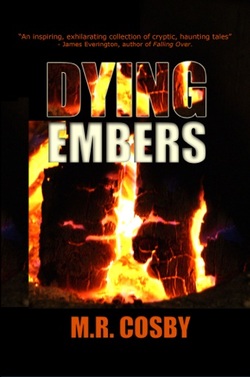 DYING EMBERS DYING EMBERS “My mind had created a monster in the next terrace…” Welcome to a world hidden behind the everyday. These stories of urban strangeness explore what is heard around the dying embers of the fire, once the heat has almost gone. An historic building holds a terrible secret from Letherby's youth. A passenger on an international flight finds out that he is not master of his own destiny. Rural Australia proves less welcoming than Preston had hoped, forcing him to confront his past. Pocock witnesses something calamitous on a river bank, which changes the course of his life. A network of warehouses provides for a remarkable, but shocking, transformation. An ill-fated property search leads to a strange form of retribution, and ultimately to a terrifying reunion. “A inspiring, exhilarating collection of haunting tales…” - James Everington, author of Falling Over “These are powerful, energetically written tales that are some of the finest I’ve read in the genre of dark fiction. The language is wonderfully imaginative and instantly thrusts the reader into the realms of slowly revealed decay. A must-read!” - Paul Hodge, Freaky Folk Tales PURCHASE A COPY HERE For more great interviews and reviews follow the links below HORROR INTERVIEWSHORROR BOOK REVIEWSComments are closed.
|


Archives
May 2023
|
 RSS Feed

|

|