

 The writer is not the infamous Stephen King antihero Mort Rainey, but the far more nefarious author of the novels Dark Shadows: Dreams of the Dark (with Elizabeth Massie), Balak, The Lebo Coven, The Nightmare Frontier, Blue Devil Island, and The Monarchs (forthcoming from Crossroad Press); five short story collections; and over 90 published works of short fiction (for a complete bibliography, click the button in the left-hand frame that says "Bibliography" and then run like hell). 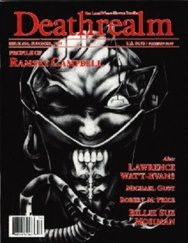 Hello Stephen, how are things with you? For an old-fart-in-training, I’m doing reasonably well. Maybe tomorrow I’ll be worse. Could you please give the readers a little bit of background information on yourself? I’m a 54-year-old divorced white male living in North Carolina, USA. I was married for 23 years but am now in the relationship I was meant to be for this life. By day, I work for a publisher of educational resources for teachers. I’ve been writing professionally, or at least semi-professionally, since the late 1980s, with over a hundred published works of short fiction, six novels, three audio drama scripts, a computer game manual, all kinds of miscellaneous stuff. If you have memory like a heffalump, you may recall I edited Deathrealm magazine for a decade (1987–1997). I’ve also edited several anthologies, including a compilation of tales from the magazine titled Deathrealms. These days, my output isn’t quite what it used to be, as I wish to devote my every energy to my relationship as well as to more vigorous outdoor activities — geocaching, first and foremost. The sedentary writer’s life had just about become my physical undoing, and I’m too young to be that old. Still, there’s no time that I’m not working on something, be it short fiction, novel, blog, review, interview… something. Why horror? What is it about the genre that holds your appeal? I grew up on scary movies, scary stories, and scary books. When I was a youngster, our house was surrounded by woods, and the noises from outdoors at night creeped me out — especially the cries of whippoorwills, which are downright eerie. I associated those with the images from so many of the horror and science fiction movies from the 50s, and early 60s. My imagination has always been vivid, which intensified some of those early fears to an almost debilitating degree. At around age five or six, I physically could not go into a pitch dark room; the door might as well have been bricked over. Once I became keen on writing, I decided to draw on those old fears and spread them around. I am generous that way. Is there anything about the genre you dislike? Badly written horror. When horror is bad, it’s horrid. It’s the worst thing in the world of words, I’m pretty sure. During my days of reading slush — mostly for Deathrealm as well as a couple of anthologies and as a “guest” editor for another publication or two — I became well-versed in the art of bad horror. In more recent days, I’ve sampled a few self-published works, just to see if the experience might be better than reading slush. Not really, no. I’m sure there’s some decent stuff out there, but by its nature — and its affordability — self-publishing opens the door for more dreck than ever to see the light of day.  Who or what would you say has been the biggest influence on you and your writing? Ian Fleming was the writer who made me want to write. In my teens, I read all the James Bond novels over and over again. I loved Fleming's way of mixing minutiae with compelling storytelling. It was H. P. Lovecraft who made me want to write scary stories — well, Lovecraft and about every monster movie I ever saw (see above). Contributing to Lovecraftian markets remains one of my favourite things, though I much prefer using the Cthulhu Mythos as a jumping off point to actually working within its confines. Individual writers are more difficult to pinpoint as influences. I suppose I would give T.E.D. Klein some special credit. Though he’s not been very prolific, his stories, especially those in Dark Gods, stirred my creative nerves on a very deep level. I’m fond of his manner of not spelling out every dramatic detail, thus leaving the reader to do a little work. That’s my preferred approach, and I expect I owe that at least partially to Klein. For better or for worse, I’m sure I am in some way influenced by every author I've read, from James Joyce to Alexandre Dumas to Manly Wade Wellman to Robert E. Howard to Marilyn (Dan) Ross. I expect this is true of writers in general. If you could give any book to someone who doesn’t read horror, in an attempt to change their mind, what book would you choose, and why? Two books: William Peter Blatty’s The Exorcist and its sequel, Legion. You may well know that, before he wrote these, he wrote comedy, and both novels feature numerous moments that are laugh-out-loud funny. The characters are as engaging as they come. And while both books use the supernatural as their backdrops and describe horrifying events in graphic detail, their real themes are human compassion and decency; they’re not just lurid stories of demon possession. The best novels of horror are, at heart, stories of human struggles and relationships. Monsters just make them more intriguing. Can you remember what first motivated you to start writing, and has your motivation changed over the years? Well, as I mentioned upward, it was Lovecraft who really made me want to infuse a sense of fear into my writing. I read his works when I was in college. Before that, in junior high and high school, I loved to write little science fiction stories — mostly inspired by Arthur C. Clarke and Godzilla. I was an aspiring artist in those days (I earned a bachelor of fine art degree from the University of Georgia), and, early on, I hoped to go into comic book writing and illustrating. I’m kind of glad I didn’t — mainly because I was not nearly as good an artist as I thought I was. I hope I’m a better writer than I sometimes think. As a rule, I love what I’m writing while I’m writing it, and then, once I’m finished, I hate it. Except when I go back to revise something for reprinting, I can’t read my older work. It gives me hiccups. It does keep me writing, though, because I want my next one to be better, so I might one day read it and breathe without undue upset. And how would you describe your writing style? I’ve no earthly idea. I try to produce reasonably decent prose, depth of character, colourful settings, imaginative plots, and frightening antagonists. Whatever style I might have, it is, to me, invisible. I hope that’s a good thing. I mean, my work is about story and character, told in a voice appropriate to the subject at hand, hopefully shy of noticeable affectations. Every now and then I’ll read some book or another that my peers have praised for its style, and all I see are intrusive mannerisms that pull me right out of the work. That’s at least partly subjective. For the benefit of your readers, suffice it to say my style is flingin’ flangin’ brilliant. Read my stuff. It’s stylish. And what aspects of your writing do you think are the strongest and what do you think are the weakest aspects of your writing? To expand a little on the above, I think my prose is comfortable to read. It’s neither terribly complex nor achingly simple. Based on regular feedback, I gather I’m able to generate a fair shudder when a shudder is intended. Readers seem to get the emotions I wish to convey, which I find gratifying. On the weak side, I often repeat words in close proximity and my eyes pass right over them when I’m proofreading. When it comes to my writing, despite my best efforts, I am a sorry excuse for a proofreader — though I can proof another writer’s work and pick out every flaw down to whether a comma should have been roman or italic. Over the years, some decent editors and copy editors have thwarted my best attempts to foist near-unintelligible crap on my readers. Other editors have been less conscientious. For my part in this, I feel obliged to apologize. Let’s talk a bit about the mechanics of your writing. How do you go about the writing process? Are you a plotter or do you go with the flow? From book to book or story to story, I don’t always do things the same way. I prefer to work from an outline, but I hate outlining. I often wish someone would up and do it for me, but no one seems foaming at the mouth to step in and save me. In general, I do outline novels (in some cases, it is required prior to sending a completed book to the publisher). An outline makes for a tighter, more streamlined writing process, though I use it more as a guide than a rigid, set-in-stone framework. I don’t outline short fiction, but in most cases I mentally create a skeleton for a story before I set to work on it. How do you edit? Do you edit as you write, or do you edit after each draft is finished? I probably edit more along the way than many writers do. It goes against conventional wisdom, but then half my life is like that. Occasionally, I get hung on aspects of the work that need embellishing or fixing. If I don’t take care of it right away, I obsess over it, which hinders my forward progress. Sometimes I may be aware that a passage needs work, but if I wait till later to address it, I end up forgetting about it (I am not a fastidious taker of notes) and, at proofing stage, read right over the problem. This makes the overall process a bit slower, but it usually eliminates more rigorous work on the back end. Conversely, there are times that the story is so hot that I am compelled to blaze through it and leave the polishing for later. The latter situation is somewhat less frequent. And how do you decide to stop editing? Either I become firmly convinced I have done all the damage I possibly can or my girlfriend, Kimberly, calls up to see if I would care to go out and drink some wine. When writing, what drives what? Do your characters drive the plot forward, or does the plot shape the characters? Both; every story is a symbiotic relationship between character, plot, setting — all the elements of fiction. The degree of emphasis on one or the other depends on the tale. In my best work, I think, events do force the characters into action, but then, as the drama unfolds, the characters become more a shaping force. As examples of this, I would single out my short stories “Other Gods,” “Demon Jar,” “The Gaki,” and “Beneath the Pier,” and my novels The Nightmare Frontier and The Monarchs.  I know this is a question that most authors hate, but what triggers the basic idea for your stories? I know that your story The Monarchs came about after you got lost in swamp…. Yeah, back in the days before I had a GPS, I opted to take a shortcut to Virginia from my friend David Niall Wilson’s place in Hertford, NC. I looked at Google maps on his computer and wrote out some directions, but I didn’t zoom in close enough to see that some of the roads didn’t go straight through — there were little jogs in one direction or another that ended up taking me by surprise. Thus, I ended up in some of the most desolate country I’ve ever seen. It wasn’t exactly deep swamp, but there were long stretches with no sign of human habitation. Yeah… shades of Lovecraft’s “The Whisperer in Darkness,” minus the mountain setting. It took quite a while before I got to where I needed to be, but the experience was disconcerting enough to get my creative nerves firing overtime. I tell you, the GPS is invaluable, but it does take some of the fun out of getting lost. Without launching into countless tales of personal experience, research, dreams, people, places, and things, I would probably have to say that memorable settings are the things that most actively stir my imagination. I love experiencing locations I’ve never been before, particularly those that are rich in history. Geocaching has been marvellous for this very thing. I do tend to emphasize setting in most of my fiction. Many writers ignore or underplay setting to the point it isn’t an integral part of the work, oftentimes to its detriment. Ever read Slob by Rex Miller? It ostensibly took place in Chicago — where I lived for several years — but there was not one ounce of local colour, nothing to persuade me that events were really happening there. Contrast that with Wayne Allen Sallee’s Chicago stories. Every scene he writes exudes a unique atmosphere that is Chicago. I think this comes through whether you have been there or haven’t. I set my first novel, Balak, in Chicago, in areas with which I was intimately familiar, and while I didn’t set out to emulate Wayne or anyone else, I think I succeeded in grounding the reader not in some nameless, arbitrary location, but in a real, nuanced place, so every other dramatic element rings that much truer. So, yeah. Settings. They do trigger. Your first published short story was “Smiert Galgalith.” That appeared in Haunted Journal magazine in 1987; however you started writing in the mid 1970s. How did you keep yourself motivated to write during this period? Well, the stuff I wrote during the 1970s was primarily for my own entertainment — maybe with the idea that it was “practice” for some vaguely envisioned goal. In 1974, when I was 15 years old, I wrote a film book of Godzilla vs. the Thing -- in those days before video, they were popular among fans — which the very late, very lamented The Monster Times published in 1975. In the very early 80s, I wrote a series of stories that I called collectively Night of the Firebeast, which was about fifty percent Lovecraft and fifty percent Godzilla. To be sure, it was nothing brilliant, but I probably had more fun with it than anything I had written to date. Sometime later, once my interest in looking for work in the comic industry began to wane, I decided to try my hand at more original short fiction. This was around 1984–85. I wrote several horror stories, including “Smiert Galgalith” and “The Gray House,” the latter of which I felt was actually pretty decent. I let several friends read them, and they encouraged me to submit the stories to some markets. Well, I listened to them, and, eventually, Haunted Journal accepted “Smiert Galgalith.” You must have been ecstatic when it was finally published? Well, I remember feeling satisfied but at the same time aware this was just a small press magazine with very limited distribution. It was meaningful but hardly profound. Whether I was beginning to develop aspirations for bigger things, I don’t really recall, but I saw that particular publication as nothing more than a baby step. Now, I’m sure I did grin real big, probably enough to damn near split my cheeks. It would be another five years until your first novel was published. Was it always your intention to write a novel? I suppose so. It seemed a natural progression after writing a slew of short stories. They’re very different animals, requiring very different disciplines. I figured if I wanted to make any meaningful inroads in the business, it would have to be with novels. I like writing novels well enough, but I do feel somewhat more passionate about writing short fiction. 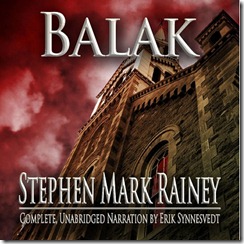 Can you tell us about the genesis of Balak? As I mentioned a ways back, I lived in Chicago for several years during the 80s, and I loved the atmosphere of the place — the rambling brownstones; the aging, sometimes abandoned factories; the labyrinths of streets and back alleys; the bar scenes; the unique way people talked. I found scads of places that oozed creepiness, especially some of the old gothic-looking churches. I found myself captivated by them, not unlike Robert Blake, Lovecraft’s protagonist in “Haunter of the Dark.” I’ve always enjoyed delving into history, including Biblical history, and sometimes I’d read the Bible just to mine it for material. I found the story of Balak in the Book of Numbers rife with possibilities for fiction. His name means “Devastator.” He worshipped “false gods.” Well, I got it in my head that his gods weren’t false; just “other.” So, what if those other gods mutated him, made him immortal... and perhaps insane? That could be ugly, in a very good way. So I dropped that bastard’s ass in Chicago and let him go to town. Thus was born a book. Did it feel odd that the novel you co wrote with Elizabeth Massie was published before Balak, even though it was written after Balak? Well, maybe, but I had also written a version of The Lebo Coven in 1994, and I actually received an offer from Zebra for Lebo before Balak was published and before the Dark Shadows novel was even conceived. Unfortunately, even then, Zebra was already on the rocks, and Zebra became a non-entity even before Lebo’s target publication date. 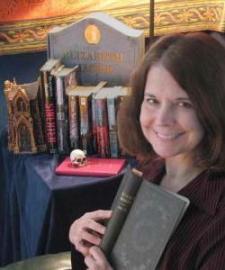 And how did you come to write with Elizabeth? I had met Elizabeth — Beth — Massie at a World Fantasy Convention in the late 1980s — probably 88 — and we discovered we had an awful lot in common. We had both gone to college at the same school in Virginia, though years apart (I won’t say how many), and we weren’t separated geographically by too many miles. We became good friends, and our respective families began getting together regularly. Like any of my friends, Beth had no choice but to have it drilled into her head that I was a knocked-out Dark Shadows fan since childhood. In early 1998, she called me up to inform me that HarperCollins was planning to release a series of novels based on the original Dark Shadows TV show, and, by the way, might I be interested in pitching a collaborative novel to them? After I stopped hollering to high heaven, I said sure, why not? We plotted and we pitched, and after a shitload of drama (not between Beth and me but between HarperCollins, Dan Curtis Productions, and us), we had ourselves a novel and a deal. The novel is based in the realm of Dark Shadows. This is a show that has a special place in your heart. What is it about the show that appeals to you so much? To a youngster in the late 60s and early 70s, Dark Shadows was absolutely magical. It had vampires, witches, werewolves, ghosts, zombies, creepy atmosphere, memorable characters, eerie music, the works. Jonathan Frid had so much charisma that — to many, including me — he became the quintessential vampire, overshadowing even Christopher Lee and Bela Lugosi. For the past year or so, I've been re-watching the complete series on DVD, and it's still engaging on many levels. At one end, it's the ultimate in silliness, and at the other, it's oftentimes brilliant. And what do you think of the remake? Personally I couldn’t finish watching it. I think I may be all Depped out. Hated it. Not because it wasn't like the Dark Shadows of old, which isn't even possible, but because, in the entertaining, well-produced-and-directed-movie department, it failed across the board. Recently you have been producing audio dramas based around the show. Do the mechanics of writing differ for an audio play compared to a writing a novel? Quite. Plotting one of the audio dramas is not unlike plotting a novelette, but composing the story in script format, focusing primarily on dialogue and limited narration, is distinctly different from your typical prose vehicle. It's not necessarily easier or more difficult, it's just different 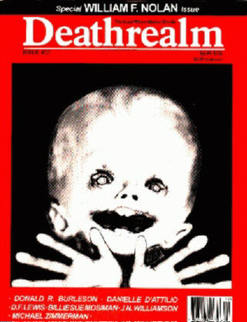 Between 1987 and 1997, you also set up and edited Deathrealm magazine. What made you set up the magazine? To explain Deathrealm, I have to step back a few decades. As you’ve no doubt inferred, I was — and am — a hardcore fan of daikaiju movies. In the early 70s, I began getting into fanzines that specialized in Japanese movie monsters, and I eventually determined that I ought to give this sort of thing a go for myself. In 1974, I created Japanese Giants, which was an 18-page, offset-printed rag that featured a filmbook of Destroy All Monsters, articles on Ultraman and Johnny Sokko and His Flying Robot, a bunch of photos and art, and a ton of fanboy love of the genre. At age 15, I was not exactly the great entrepreneur, but another fan, Brad Boyle, took them helm and kept it going for several years. In the early 1980s, my friends Ed Godziszewski and Bill Gudmundson, who lived in Chicago (and were the main reason I moved there), stepped up and gave Japanese Giants continued life. Together, we put out a near-professionally produced issue, with some comic and newsstand distribution. For me, it was a real introduction to the business end of editing and publishing. Later in the 80s, as my interest in horror broadened, I decided to build on my experience with Japanese Giants and give an honest-to-god horror magazine a shot. During this time, I had been picking up lots of small press magazines, and I had really taken a shine to Robert M. Price’s Crypt of Cthulhu. While it was a very different animal than Deathrealm, it served as a model for the kind of thing I wanted to do. Still, I can’t say I knew diddly about the finer points of fiction publishing, etiquette, all that good stuff. I was writing those horror stories I mentioned back there and decided to put one in Deathrealm and include the work of some friends as well as some other individuals I got to know from Crypt of Cthulhu. My friend Bill worked with Jeff Osier at Encyclopaedia Britannica and told me Jeff had written a horror story called “The Encyclopaedia for Boys.” I said I’d like to read it, and when I did, I was blown away. I pretty much had the first issue of Deathrealm made. Several subsequent issues included Jeff Osier stories, and they essentially put Deathrealm on the map. His work was excellent, and it attracted lots of critical attention. In short order, I opened the magazine to submissions from the world at large, and my life changed almost overnight. Eventually, Deathrealm did become a little fixture in the horror magazine field, with its ups, downs, deaths, resurrections, et cetera and so forth. It was quite a ride, that decade. The magazine was a great success, so it must have broken your heart when you had to stop producing it. I missed seeing it on the magazine racks. I did not miss doing what it took to get it there. Increasingly over the years, my role as editor became CFO, salesman, advertiser, and collections agent. Everyone wanted everything Deathrealm had to offer, but few wanted to pay for it — especially dealers and distributors. The last year or so of its existence, for every hour I spent editing the magazine, I probably spent ten trying to manage its finances. It was far bigger than a one-man job, but we couldn’t afford paid assistance. (When I say “we,” I’m referring to its then-publisher, Malicious Press, a partnership of author Lawrence Watt-Evans and screenwriter Terry Rossio.) When Fine Print Distributors went bankrupt — in 1996, I think — owing us to the tune of $12K-plus, it was a loss from which we really couldn’t recover. Had I not been at Deathrealm’s helm for a decade already, I probably would have done what it took to regroup and rebuild, but by this time, I was exhausted. I wanted to get some writing of my own done. Lawrence, Terry, and I rightly decided we would retire the magazine, and we phased it out with a plan. To my mind, Deathrealm had a good, decade-long run and went out maintaining the reputation everyone involved had laboured long and hard to build. Do you think editing Deathrealm helped you to develop as a writer? From the slush pile, I certainly learned a lot about what not to write, and the good work that published inspired me to try new things. So yes, it did. It also kept my name at the forefront of the horror business for a time. I do kind of miss the personal interactions it facilitated with other writers, editors, publishers, and artists. What was the biggest lesson you learned during this period? Don’t go off half-cocked. You returned to the magazine in 2004 with the anthology Deatrhrealms which featured stories from the magazine. How did you go about selecting the stories? I wrote in my introduction to the book that Deathrealms wasn’t a “best-of” anthology, and it really wasn’t. If something was published in the magazine, I already considered it a “best” story, and the idea of choosing favourites from this massive catalogue of work seemed almost an exercise in futility. What I tried to do was pick stories that maybe... just maybe... reflected the magazine’s prevailing atmosphere... its dark spirit, so to speak. I don’t even know if that’s an accurate description. Deathrealm had a certain character that was a weird melange of the Lovecraftian, the avant-garde, and the whimsical. In this age of digital and self publishing, have you ever considered republishing the magazine as a collected work? Obtaining rights to all those past works would be prohibitive, to say the least. People are forever asking me when I’m going to revive Deathrealm. I confess there are times that it’s tempting. And when I say tempting, I mean I’ve sat down and laid out pages for both digital and hard copy, broke into my old contacts list, designed new logos... and promptly come to my senses. A new Deathrealm would be an entirely different animal. It wouldn’t, couldn’t be the Deathrealm of old. If some spirited entrepreneur out there decided he or she wanted to revive the magazine with me as editor only, perhaps we could talk. I don’t foresee ever looking to rebuild it from the ground up myself. You have had a rich and varied publishing career, which has seen you ride the wave from the heyday of the late 1980’s through the famine of recent years, and you’re still going strong during this resurgence in the genre. What do you think has been your secret to success? Wow. I never think of myself as successful or unsuccessful. I simply, stubbornly write and seek opportunity. Sometimes it works out, sometimes it doesn’t. I don’t know that I have any more to say about it than that. 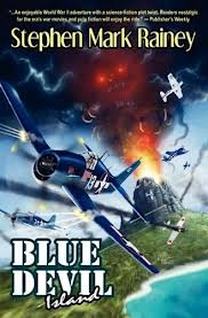 You first came to my attention with Blue Devil Island, thanks to a review from Dead In The South. Could you tell the readers what the book is about? As I’ve mentioned, I’m something of a history buff, and World War II aviation is an area of special fascination for me. For over a decade, I’ve participated in a couple of online WWII combat flight sims, which have a pretty high degree of realism. For several years prior to writing Blue Devil Island, I read a wide variety of first-person narratives by pilots who flew combat missions during WWII. Absolutely enthralling stuff, and I decided nothing would make a better book than combining WWII action with Lovecraftian horror. The novel is about a squadron of F6F Hellcat pilots stationed on a remote island in the Pacific in the latter months of 1943 who encounter an enemy a bit more menacing than the Japanese. While the book features lots of exhilarating action and — hopefully — a scary menace, it’s definitely a character-centered drama. While I was writing the book, I was in touch with a number of WWII combat vets, including my late father-in-law, who related many harrowing stories of their experiences, and some of them made their way into the narrative. The basic premise of the book, where a team of humans, discover a new, and dangerous race of humanoids, is a favourite one for horror fans. Why do you think this is? It’s that whole fear of the unknown thing. They’re almost human, but clearly not. How do we interact with them? Or does interacting with them automatically spell one’s doom? And yet horror stories set during World War II have up until now not been hugely popular. Do you think there is a reason for this? Well, that I don’t know. There’s certainly been some fantastic fiction set in WWII, be it horror or otherwise. F. Paul Wilson’s The Keep and William R. Trotter’s Winter Fire come foremost to mind. War stories don’t generally appeal that much to women, so I’m led to believe, but in the horror field, women make up a large percentage of its readership. Perhaps that has something to do with it. Do you have any plans to release it as an eBook version, my copy is getting a bit worn? Well, that’s not so much up to me as the publisher, which is currently Marietta Press. I’d definitely like to see it as an e-book at some point. We shall see. 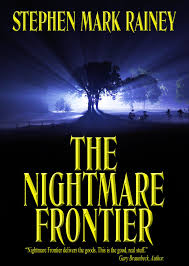 The Gaki & Other Hungry Spirits is a collection of your short stories. How did you go about selecting the stories for it? Is there a common theme that links them? Do you have a favourite story in the collection? As a collection, The Gaki is a bit looser than some of my others, such as The Last Trumpet and Other Gods, which are distinctly Lovecraftian. The Gaki features a wider variety of unrelated tales — though there are still a few in there that fall into the Lovecraftian category. It does include several very short, rather experimental tales. It also features more previously unpublished work than any of my other collections; about a quarter of the stories in it have never appeared elsewhere. As for favorites... well, I don’t think the story “The Gaki” sucks too terribly. In The Nightmare Frontier, you send the town of Silver Ridge into a nightmare realm, where the residents have to fight their way to our world. Many people will think this book is influenced by Lovecraft. Now I know Lovecraft has been an influence in your writing, but would I be correct in think that Roger Zelazny has probably been a bigger influence on the novel? You absolutely would. I’m a huge fan of Zelazny’s Amber series, as well as some of his other works. John Wyndham’s The Midwich Cuckoos also provided a little inspiration. There’s a particular creature in the novel, called a lumera, which I confess I find disturbing. I actually had a waking dream one evening in which I saw this horrific, glowing, centipede-like creature — four feet long, with a human skull for a head. It was that disturbing image alone that set me to plotting the novel. Of all the critters in all my books, that’s the one I probably enjoy most. At its heart this is a horror story with crazy monsters; however, it goes beyond this and looks at psychological aspects of the physical and emotional isolation of the characters in the story. Is it important to you that your books are than just mere horror stories? Yeah, this goes back to what I saying earlier, about horror stories being primarily about people. I consider The Nightmare Frontier a pretty fair example of characters both reacting to events as well as driving the action. I rarely go so far as to say I like or dislike characters I’ve created, but I do have some fondness for the cast of The Nightmare Frontier. Each character is essentially a composite of real people I have known, though each has his or her own distinct personality in the book. 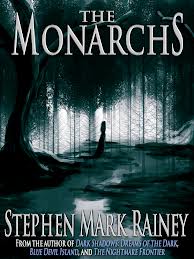 So let’s talk about your latest release, The Monarchs. We found out earlier about the inspiration for the book, but can you tell the readers what the story is about? It starts out not unlike an episode of Dark Shadows, with a young woman who has suffered a terrible personal tragedy seeking refuge with an old friend at a remote estate. However — in some respects rather like The Nightmare Frontier — she finds herself immersed in a world of people she cannot fathom and cannot escape. It’s the characters who are, in their way, responsible for a supernatural horror that mostly lurks in the background, at least until much later in the novel, when it comes forth and reveals what I hope is a surprising, not altogether comfortable relationship with certain individuals in the book. This sounds like a classic piece of Southern Gothic Horror — is North Carolina in The South? Please forgive my ignorance. Aye, it is. What would you say are the main themes of the book? It’s very much about the fragility of our existence, of believing we are secure in our personal circumstances, only to have that illusion of security stripped away — in some cases gradually, and in others suddenly and violently. It’s about people not being quite what they seem, sometimes for better, sometimes for worse, sometimes just other. And there’s a scary critter, too. In one review of the book TT Zuma of Horror World says, “ I can say that The Monarchs has one of the most exciting endings to a novel that I’ve read in the last year. You really shouldn’t pass this one by” What caught my eye was the bit about the ending. This must be one cracking ending. How much time did you devote to it? I don’t think I could break out a certain amount of time specific to the ending. This was one of those books that I plotted thoroughly in advance, and I had a good idea where it was going from the start. Of course, as I wrote, events, details, and characters evolved and morphed, but in general, it followed the outline reasonably faithfully. I do hope the ending is one that will linger in readers’ minds. How important are the endings of your novels? Have you ever considered going back and rewriting any? Endings are crucial in that they can reaffirm or undo everything you’ve presented to the reader over the course of the book. Endings can be beastly things because they often go out of their way to taunt you, slap you over the head, and even mop up the floor with you. Whenever possible, I try to conceive the resolution of a story or novel early on and, however fiercely it fights me, however slippery the little devil proves, remain true to my vision over the course of the writing. Sometimes things refuse to work out that way, which may be good or bad. As for rewriting endings, I can’t recall any examples of having done so, at least to any substantial degree. It doesn’t mean I haven’t; it just means I’m old, tired, and forgetful. The book is also available as an audiobook, with the fabulous Chet Williamson narrating it. Does it feel odd hearing someone else reading your book, even someone with such a captivating voice as Chet? It can be disconcerting because, when I hear someone else reading my work, I hear everything that’s wrong with it. Through a megaphone. It’s the same with the Dark Shadows audio dramas. The narrator’s performance may be wonderful, but to me this only accentuates the problems with the prose. Yes, authors can be their own worst critics, so perhaps my horrified reactions are overreactions. One can hope, anyway. Now, conversely, there are times the narrator does such a great job I can’t believe I wrote what he or she is reading. I wish the latter were a more common occurrence. Can you tell us about any future projects? I’ve currently got a couple of short stories in the works for specific anthologies, and I am part way through a novel about geocaching, which, as I have mentioned, is an activity I’m quite passionate about. I also have a tiny little role as a mad scientist in an indie movie called Invasion of the Killer Cicadas, which is currently in production in this area. It’s been both an honour and pleasure having you over for a chat. Do you have any final words for the readers of this blog? I quite appreciate the opportunity to carry on at length about my activities, past, present, and future. I urge your readers to visit my website www.stephenmarkrainey.com and/or my blog http://stephenmarkrainey.blogspot.com to check out my wares and see what I’m up to. I’m also active on Facebook and occasionally on Twitter. Comments are closed.
|


Archives
May 2023
|
 RSS Feed

|

|