

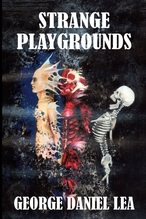
 Strange Playgrounds cover by Grace Burley Today's victim in this series of horror author interviews is George Daniel Lea. Whose debut collection Strange Playgrounds is now available from Dark Moon Books. Click Read more for a fascinating interview with the man himself. 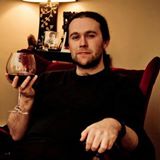 Could you tell the readers a little bit about yourself? My name is George Daniel Lea. I've been making and consuming stories in whatever medium comes to hand for as long as I can remember. I don't quite know how you'd categorize what I write; most of it ostensibly seems to fall under the heading of surreal horror, though it could just as easily be classified as dark fantasy, science fiction et al. I'm mostly interested in fiction which explores transcendence and transgression (or transcendence through transgression); subjects which allow us to explore forbidden internal territories; those places we generally avoid for fear of losing all we presume of who and what we are: may aim as a writer is to drag you kicking and screaming there and show you why you should love it. Do you prefer the term Horror, Weird Fiction or Dark Fiction? I'm not particularly concerned one way or the other: the problem with such categorizations, though useful from a book seller's perspective, is that they tend to pigeon-hole; creating expectations and perpetuating stereotypes that are largely, in my experience, untrue or simply not equal to encompassing what they profess to. Technically speaking, one might look at the great mythologies and oral traditions of Ancient Greece or Sumeria; Hell, even the stories of the Bible or Koran, and loosely classify them as this or that: the classification would ultimately fail to encompass or convey even an iota of what such stories actually contain and express about humanity. The same is true of fiction written by the still (or barely) living. Who are some of your favourite authors? Strap yourselves in; this is likely to be a long one. I adore Clive Barker; I came to his written fiction at the extremely tender age of 11 thanks to my Mother who, knowing me so well, handed me a copy of Weaveworld proclaiming: “This is a bit weird for me. You'll probably like it, though.” That and my subsequent explorations of the author's work fundamentally changed my world view of what fantastical and horrific subjects in written fiction are capable of. I also adore many of the enshrined classics: anything by Edgar Allen Poe; Shakespeare, Melville; Mary Shelley, the poetry of William Blake, Dostoevsky, Aldous Huxley, Phillip K. Dick and others too numerous to mention. With regards to more recent writers, I'm absolutely besotted with the work of Poppy Z. Brite, who writes texture and sensual experience in a way so vivid and elegant, you can practically smell and taste everything that her characters do. I've just finished reading her “restaurant” series of books and am mourning the fact that it's over (for now). What are you reading now? At present, my annual ritual reading of Barker's Sacrament, alongside a collection of H.P. Lovecraft's tales and some pulpy, science-fantasy stuff set in the Warhammer 40, 000 universe. How would you describe your writing style? Impressionistic. I tend to dislike writing from a broad or distant perspective: I'm more interested in the immediacy and intimacy of experience, so most of what I write tends to stem from the experiences of characters and their emotional/intellectual reactions there to. I also have a tendency to play around with established rhythm quite a bit: it's quite useful to be attuned to the established flows and rhythms of your classic narratives: once you've mastered them, you can begin to play around with them to subvert expectation and evoke reaction. And I'm all about evoking reaction. Often violent. Describe a typical day spent writing. Do you have any unusual writing habits? I ensure that I write every day and am extremely ritualised when I do so. It took me a long, long, LONG time to establish those rituals and to find what works for me, but it seems that the more ordered and regular you are: the more rigid you become with regards to your daily routine, the easier it becomes to get into the correct mindset whereby inspiration flows and gathers its own momentum. When at work (I work as a support worker for the mentally disabled), I tend to get all of my writing done in transition: when I wake in the morning, before I've had coffee, brushed my teeth or properly dressed; on the way to work on buses or grabbing breakfast in cafes. When not working, I ensure that I rise early, allow myself an hour or two to gather myself, then launch into the work. I tend to write in blocks of six pages: six pages, then I can have a cup of tea or coffee (maybe some toast or biscuits if I feel like it), then another six. Ten pages per day is my absolute minimum, though I had to build up to that point: when I first started out, I could barely manage four without exhausting myself. I've been doing it for so long now it's become spiritually and psychologically essential: I dread to think what would happen if I didn't have that outlet (oooh, there's a story in there). What's your favourite food? Difficult to say; I'm a bit of a foody by nature, and I love to cook: I enjoy different cultures and cuisines for different reasons, but I'd have to say, if I was told I could only subsist on one type of cuisine for the rest of eternity, there'd be no contest: it would have to be Indian, and I don't just mean curries et al (though there's an entire spectrum of traditions there to be explored): I mean everything the culture and its traditions have to offer: they are so various, so different from one another; so complex and delicious, it would take a lifetime to even begin scratching the surface. What's you favourite album? Kind of similar to food; my tastes in music are various and eclectic. The answer would change hourly rather than daily: sometimes, my tastes run to the classical or operatic: I want to be swelled by Wagner or Vivaldi; others I want 1980s pop dross or the amazing experimentations of Kate Bush. I don't tend to keep up with mainstream music these days: the last albums I paid any great attention to were Demon Days and Plastic Beach by The Gorillaz and Kate Bush's beautiful Fifty Words for Snow. What's the most important lesson you have learned about writing? That inspiration is cheap; every human being on this planet experiences inspiration on a regular basis, in their own idling imaginations or when they lay their heads down to sleep: what separates writers, artists and others who have found some medium for successfully expressing their inspirations is a great deal of hard work, usually resulting in a long, winding road strewn with the burning wrecks of past failures. You have to be willing to fail; to hate and lament what you've created enough to want to make better, and you get better by doing, constantly and consistently. Fame and fortune, or respect? All that really matters to me is that the stories are read as widely as possible. If I cared about fortune in particular, there are so many more lucrative areas I might have poured my obsessive energies into. It's also fairly clear from a cursory examination of what makes headlines and money at present that none of these things are guarantors of quality of work: only the work itself matters in that regard. Of course, a degree of fame (or infamy) is always a handy way of ensuring that your stories are received by the widest number of people possible, which is certainly a consideration: I don't think any of us would waste our time crafting and refining them if we didn't want them to be read; if we didn't believe that we had something important to communicate. What piece of your own work are you most proud of? I'd have to say the short stories collected in my recent publication, Strange Playgrounds: they represent a body of work I have been obsessing over for almost a decade, and serve as a handy example of the range of themes and subjects that consistently fascinate and inspire me. The book is currently available from amazon.com amazon.co.uk and Barnes and Noble Can you tell us about your last work and what are you working on next? My last publication was the short story collection, Strange Playgrounds; a series of extremely twisted and surreal tales all designed to evoke the most intensely visceral reactions in readers as possible. Though I didn't consciously realise it whilst writing them, each of the stories it comprises explores a different variation on the theme of transformation; metamorphosis via the (often painful) shedding of old lives and identities. It's a kind of celebratory autopsy of horror fiction; subverting and blackly lampooning its more conservative or finger wagging elements to provide something a little transgressive. Right now, I'm working on a number of TV and independent movie scripts, most notably a bizarre piece of work tentatively titled The Neverborn. I'm also trying my hand at some good old, pulpy science-fantasy mythologia in the form of a Warhammer 40,000 novel. You can find examples of my work via Dark Moon Books and get in touch with me either via my facebook page or my youtube channel Many thanks indeed for your time; it's greatly appreciated. 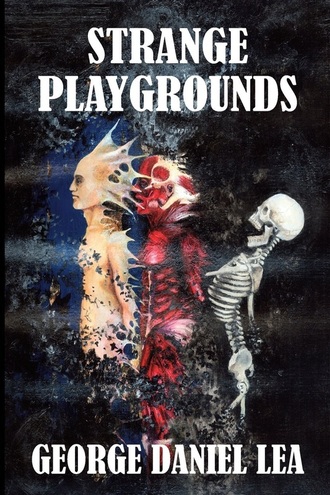 A vile waking... There are places we walk; cold and dusk-lit; places where the wind whispers, carrying echoes of forgotten games. ...a storm of sadism, more loving than any embrace or caress he'd ever known... There are places where we are naked; where the grass and weeds rasp across bleeding wounds, exposed nerves, their dew glistening red. ...we are all sick; some are simply sicker than most... Places where the silence cannot be broken, its insect chatter fraying thought, fracturing sanity. ...shadows swarming around their intertwined bodies, whispering, congealing... These are the Strange Playgrounds; places where we meet our murdered or abandoned selves, and join their desperate games. Come and play awhile. FOR MORE HORROR INTERVIEWS PLEASE CLICK HEREComments are closed.
|


Archives
May 2023
|
 RSS Feed

|

|