

 It’s very difficult, right now, to write something that isn’t political. And when people say they don’t do politics in their writing – well, even that is a political position, isn’t it? It’s active disengagement. And something you can only afford to do if you’re coming at writing from a position where your identity and place in the world isn’t already contested. Could you tell the readers a little bit about yourself? I’m a 40 year old dyke, relatively new to writing in the genre. I live in the UK with my wife and kids, and in between daydreaming about sea monsters and dystopian hellscapes, I run a consultancy - copywriting is a big part of my day job. Before that, I was briefly an academic and researcher. Why horror? What is appeal of the genre to you as both a fan and as a writer? Part of it I think is the imaginative freedom the genre gives you. Unlike, say, literary fiction or romcom, horror (and associated genres like sci-fi and fantasy) give you licence to imagine other worlds, other possibilities, other futures – dystopian or otherwise. But some of the best horror, for me, isn’t pure horror – but rather the stuff that straddles multiple genres and draws on horrific imagery and horrifying narrative devices and constructions to tell a fuller, more compelling story. As LBGTQ+ fan and writer of horror, how did you when you first became immersed in the genre and found that representation that you could identify was few and far between? I must have been 10 or 11 when I came across Stephen King, who was my first introduction to the genre. I have very vivid memories of staying up all night reading ‘Salem’s Lot, absolutely terrified but completely unable to stop. I was a big reader as a kid – aren’t most people who write? – and I was certainly aware that there wasn’t much of what we’d think of these days as positive representation in the genre. (The murdered gay men in It were as good as it got, from memory). But it wasn’t restricted to horror: I read my local library dry, and there was very little across the board for a gay kid in the Midlands to fix on, the way there is now. Armistead Maupin’s Tales Of The City were a bit of a revelation, though obviously not enormously horrific. And one particular story in Clive Barker’s Books of Blood – In The Hills, The Cities – put a male couple front and centre, albeit in a bit of a bleak way. There’s certainly wasn’t a relationship you’d aspire to! Beyond books, TV shows like Buffy and Dark Angel were pretty important in my very late teens and early 20s, as well as movies like Bound. Even now, though – when queer representation in other media proliferates by comparison – I struggle to think of many mainstream horror lit voices that do lesbian women and female relationships consistently well. How did you discover authors that wrote about characters that you could relate to? For the most part, I’m still looking! For lesbians, I think – and again this is a little depressing – fan fiction is, right now, the better imaginative playground, and there’s some absolutely fantastic writing in there if you have a dig around. Other than the horror genre, what else has been a major influence on your writing? As a genre, crime fiction – I write crime thrillers under another name (TC Parker is a pseudonym reserved for the darker stuff), and they’re heavily influenced by people like Val McDermid and Ruth Ware. I love Neil Gaiman, and China Mieville, and Terry Pratchett – all the usual fantasy suspects. But regardless, I love a plot twist – something you absolutely didn’t see coming. Whether it’s straight horror or sci-fi or bodice-ripping romance I’m reading – if it manages to blindside me, I’m sold. The term horror, especially when applied to fiction always carries such heavy connotations. What’s your feeling on the term “horror” and what do you think we can do to break past these assumptions? I think it’s useful shorthand to have some sort of generic categorization, if only for navigation purposes. But “horror” is such a broad church. I wonder if one way to break down some of the assumptions around what horror is and isn’t is to help people understand that fiction not typically categorized as horror – say, something like Kazuo Ishiguro’s Never Let Me Go, or even The Handmaid’s Tale – can have some absolutely horrific elements while still being ‘literary’ fiction (for a given value of ‘literary’), while horror can be as lyrical as a prose-poem or as well-plotted as a really good bit of detective fiction. Fortunately, I think readers are a lot more receptive now than they were to the idea of genre hybridity. A lot of good horror movements have arisen as a direct result of the socio/political climate, considering the current state of the world where do you see horror going in the next few years? Horror’s always been political, hasn’t it? Whether you’re talking about Caligari and the Weimar Republic, or 50s B-movie body horror and the Cold War, or 80s slashers and Reaganism. So I’d be very surprised, given Trump and Covid and climate crisis and the manifold other horrors we’re seeing play out at the moment, if there weren’t more overtly political dystopian narratives flying around. It’s very difficult, right now, to write something that isn’t political. And when people say they don’t do politics in their writing – well, even that is a political position, isn’t it? It’s active disengagement. And something you can only afford to do if you’re coming at writing from a position where your identity and place in the world isn’t already contested. LGBT+ and BIPOC people don’t have that privilege, unfortunately. What are the books and films that helped to define you as an author? Off the top of my head:
There’s also a lot of academic stuff that’s influenced the way I think about the world, which logically has influenced the way I write – but I’m not sure anyone wants to hear me bang on about Foucault. In recent years there has been a slow but gradual diversification within the genre, which new LBGTQ+ writers do you think we should be paying attention to? I read Sara Tantlinger’s To Be Devoured recently, and was hugely impressed. Would love to read more of her stuff. How would you describe your writing style? Plot-heavy and digressive. There are a lot of stylistic tics I need to police! Are there any reviews of your work, positive or negative that have stayed with you? I’m new to horror writing, so… not yet. Though I’m sure I’ll cry myself to sleep over them at some point, if and when they roll in. What aspects of writing to do you find the most difficult? Finding the time to do it at all. I have two kids and work more than full-time hours – so time to write is very much at a premium. Are there any subjects that you would never write about? Nothing I can think of… Writing, is not a static process, how have you developed as a writer over the years? I feel very much like I’m just getting started – so you might need to ask me that 5 years from now! What is the best piece of advice you ever received with regards to your writing? Two things:
Getting your worked noticed is one of the hardest things for a writer to achieve, how have you attempted to break through the barriers that are so often in place against LBGTQ+ writers? I don’t know that I have yet! But I’m very aware that I’m coming at this from a privileged position. I’m not young, or just out of university; I have an established career already, and write more or less for a living anyway, which won’t change regardless of how well or how poorly my books perform. So to some extent, getting noticed is a bonus rather than a necessity. I want people to read what I write, but not out of material necessity. That’s just me, though. There are many, many LGBTQ+ and BIPOC writers – writers far more talented than me – who are young, who aren’t established, who do desperately need material support. And for these writers, the old barriers and gatekeepers are still very firmly in place, at least when it comes to traditional publishing. The good news, I guess, is that indie publishing means that these writers aren’t dependent in the way they would have been, say, 20 years ago on getting an agent and a Big 5 book deal. The bad news is that they are dependent on recognition – on people knowing they’re out there, and paying for (not just reading) their work. So, if you have a platform: promote them, however you can! Many CIS white male authors use LGBTQ+ characters in their works, what’s the mistake that they make when trying to portray these characters? I’m reluctant to criticize, because so many straight, cis, white male writers now are trying – they’re well-intentioned in their constructions of queer characters, and they’re not just using them as props, or worse. Nobody who remembers the 80s and 90s will need me to tell them this, but we’ve come very, very far in terms of representation. That said: it would be good if authors, and media producers more generally, stopped killing lesbians in their fiction, or at least killed fewer of them. Characters dying off is inevitable in the context of a lot of horror narratives – but lesbians have been killed off in epic numbers across multiple genres for a lot of years now, and we’ve got a lot of ground to make up! So, if any cis white male authors are listening: maybe sometimes let your lesbians be the last ones standing at the end? Moving on to getting your work read, what do you think ins the biggest misconception about LGBTQ+ fiction? It used to be: that every story was a coming out story, in one way or another. And unfortunately there was some truth to that. Now, though… I’m really not sure. There are so many LGBTQ+ stories being told across platforms, and so many more people identifying as queer in public, that it feels less now than it did that LGBTQ+ identity is a monolith. There are as number of presses dedicated to LGBTQ+ fiction, do you view these as a good thing, or do you think they help to perpetuate the ongoing exclusion from mainstream presses? A good thing, definitely. Assimilation can be a very good and positive thing – but we need our indie presses, queer and otherwise! Do you agree with movements like this and things such as Women in Horror Month? If so how would you like to see sites such as Ginger Nuts of Horror tackle diversity? I agree 100%. It’s not about promoting women above men, in that instance – it’s about addressing a long-standing imbalance, in the same way that (say) Black Lives Matter or Trans Lives Matter exist as movements because some people, historically, have believed that they don’t matter, and this needs to be dragged into public view, dissected and rectified. As to what Ginger Nuts of Horror can do – the fact you’re doing interviews like this and asking these questions suggests you’ve already got a handle on it! The most common phrase you hear when people object to active movements to encourage all forms of diversity is “I don’t care about the sexuality, gender, color etc etc of the writer I only care about good stories” what would you like to say to these people? That diversity of background, identity and experience is what contributes in many cases to diversity of thought and imagination. So if you want new, interesting stories and fresh perspectives on existing tropes, it’s probably worth listening to people (BIPOC, queer and otherwise historically marginalized people) who haven’t had much of a voice in your genre previously. To many writers, the characters they write become like children, who is your favorite child, and who is your least favorite to write for and why? I like them all! Some of them are appalling human beings, but as long as they’re interesting, I’m interested in them. What piece of your own work are you most proud of? There’s room for improvement in all of it. But anything that’s out in the public sphere I’m generally happy with. For those who haven’t read any of your books, which of your books do you think best represents your work and why? Saltblood is my first horror novel – so it would have to be that one. Do you have a favorite line or passage from your work, and would you like to share it with us? It feels a bit narcissistic to quote myself, so I’m reluctant. But there’s a very mild allusion to TS Eliot’s Marina in Saltblood, so I’ll go with the opening lines of that instead: “What seas what shores what grey rocks and what islands/what water lapping the bow/and scent of pine and the woodthrush singing through the fog/what images return/O my daughter.” It’s just beautiful – the imagery and the lyricism, but also the feeling of the syllables, even when you’re not reading it aloud. Can you tell us about your last book, and can you tell us about what you are working on next? My last book before Saltblood was a crime thriller novel written and published under a different name. My next one is a sequel to that. But after that one, I’m hoping to get stuck into another bit of dystopian horror – a near-future detective thing about extreme body modification and sensory overload. I’ve got a couple of fragment chapters knocking around the hard drive, so we’ll see how they play out when I get to them. What was the last great book you read, and what was the last book that disappointed you? If I get all the way through a book, chances are I’ve enjoyed it. The last thing I read – in fact, re-read – was George R R Martin’s The Skin Trade, which was as good as I remember it being. (I’m not a fan of Game of Thrones, or epic fantasy more generally, but that guy writes bloody good horror). The last thing I abandoned was Caroline Kepnes’s You. There wasn’t anything wrong with it, exactly – I just didn’t feel like the target audience for it. If I’d read it at 20, I’d probably have felt differently. What's the one question you wish you would get asked but never do? And what would be the answer? “Where’s the best place to leave a review?”  T C Parker is a queer horror writer and researcher with a particular interest in folklore, myth and legend. She is currently based in the UK Amazon Author Profile: https://www.amazon.com/T-C-Parker/e/B08CGLZPFW?ref_=dbs_p_ebk_r00_abau_000000 Twitter: https://twitter.com/WritesTc 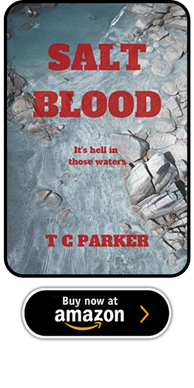 A remote island. A group of prisoners. And an evil as old as time.
Robin didn’t mean to break the law. Didn’t know at first what law she’d broken. And now she’s on her way to Salt Rock - a new-model prison for a new kind of criminal, way out in the remote Northern Isles of Scotland. On Salt Rock, she'll meet other prisoners like her – men and women from all over the world, spirited away from the lives they knew for crimes they didn’t know they were committing. She'll uncover the complex web of conspiracy that connects them all, confronting some of the darkness of her own past in the process. And she'll come face to face, finally, with an evil as old as the land itself. It’s hell in those waters. Comments are closed.
|


Archives
May 2023
|
 RSS Feed

|

|