

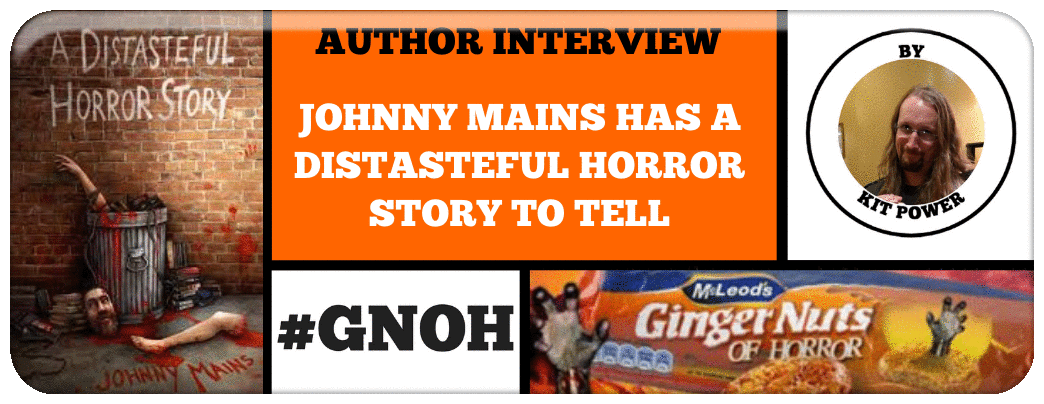
 On the eve of his debut novel release, author, editor, and living legend Johnny Mains sat down with Gingernuts of Horror to talk conventions, Best British Horror, and of course his long awaited debut novel, A Very Distasteful Horror Story. Gingernuts of Horror: Thanks for taking the time to talk to us, Johnny! How are you doing? Johnny Mains: Hello! All is good...at the moment! GoH: Let’s talk A Very Distasteful Horror Story. You’ve been in the writing and editing game a long time now, but this is your first novel. What finally prompted you to take the plunge with a long form book? JM: 2018 is my tenth anniversary of being a writer; my short story, ‘The Spoon’ sold to Charlie Black for his Third Black Book of Horror. In a way I thought the best way to mark the ten years was to try and get a novel published rather than another collection of short stories (although I am also working on a fourth collection as we speak). My longest work before this was a novella, called ‘The Gamekeeper’ which only came in at 33,000 words - Distasteful comes in at twice that length - so a short novel, but a novel nonetheless. What made me take the plunge was I left my job at Citizens Advice in 2016 due to a mental breakdown, and in the weeks that followed I locked myself up in the office all day tried to write short stories. I started and junked about ten, was drinking extremely heavily and felt utterly hopeless about it all until I started writing a pretty good short story about an author’s wife who has an affair with another author at a horror convention and the affair comes to light at same time a murder of a third horror author happens before their eyes. After I had written the murder, which only took three or four lines to describe, I couldn’t get it out of my head - who was that author, who murdered him and why? I took the decision to scrap the story I was writing; at that time I had hit 4,000 words on it, stupidly didn’t keep a copy, and began work on Distasteful within thirty seconds of deleting the tale. I had the voice straight away and wrote three thousand words in a single sitting, and read over what I had done and I got prickles on the back of my neck. I knew I had something - I didn’t know how it was going to end up at that point, it’s wasn’t till I got to 10,000 words that I knew I was going to go for the novel. GoH: So there was no advanced plotting for Distasteful? It’s a pretty twisty plot... JM: No, none. I went in absolutely cold, only knowing that there was a murder of a famous horror author. I started taking notes as I was writing it - and had hundreds of postik notes all lined up, but that was just to remind me of names, book and story titles etc - but I never plot anything, it takes the joy out of writing for me. There’s nothing more exciting than not having a clue as to what’s going to come next. I don’t know if automatic writing exists as pure state, but I’m astounded at what the mind can produce when you’re ‘in the zone’. I had to re-read the book a lot when I was writing it just to make sure I hadn’t repeated myself - I had, twice, but plotting means you know what you’re on about. I don’t, I just wing it and hope for the best. If I’m lucky, like with a few of my short stories, ‘The Girl on the Suicide Bridge’, ‘Aldeburgh’, and ‘The Joanne’, lightning strikes - if not, you get absolute gash, which probably amounts to 90% of my output. GoH: A Very Distasteful Horror Story struck me, in part, as a love story to the horror convention scene of the 90’s. Do you think that was a particularly special time, or do you think the horror scene is still vibrant? JM: I was never a part of the scene in the 90s - I arrived, rather unexpectedly in 2007, the eager fan wanting to contribute - and was a bit of a surprise to everyone that I hadn’t been a part until then because I was the full package, so to speak. The reason for that is I was a serious drug addict until 2004/5, was homeless on and off from the age of 17 - 29, so I didn’t have the ways or means to be part of the genre. The one thing that kept me going was books and I read thousands during that time and built up an enormous education with reading. It wasn’t just horror, but autobiographies, historical books, nature works, scientific journals - anything and everything I could get my hands on I would devour. It kept my mind fresh, even though I was constantly abusing it with mind-bending drugs. The horror scene - well there really isn’t one is there? You can’t call a scene a scene when it’s simply people chatting on facebook - or going back in time, you can’t have a scene when it’s a yearly convention and three or four meetings, there is a connective distance that can’t be closed. I would define a true scene as a constant organic happening, in person, contact that happens regularly, if not constantly - and throughout it people are creating, pushing, searching collaborating. That’s a scene. And scenes die out when people don’t contribute, or it evolves into something else, breaks off, splinters - but stuff is always being produced. But the book does express love for conventions, and I would have to say out of the few I’ve been to, the 2010 World Horror Convention, in Brighton and where I launched my first anthology, Back From The Dead, was the best convention or gathering I’ve ever been to in my life. GoH: What are your memories of that 2010 Con? JM: I met a lot of people who I had only been in touch with on the phone or email, Michel Parry and Richard Dalby, both now sadly gone into the ether - but to meet them in the flesh and have amazing chats, yeah, that was special. I also managed to get the largest gathering of Pan Book of Horror authors together which had never been done before and I ran an amazing panel where all of these authors and artists, who had all been so important to me during my formative years, were all together and that was just absolutely mindblowing. GoH:The novel also blends real people with fictional ones. How worried were you about including real people in this tale? Did you set any rules for yourself about you would and wouldn’t do with the real people you were writing about? JH: If people are annoyed that they’ve been included, tough. If I’ve met them at a public gathering where they are promoting themselves and promoting their work I think it would be disingenuous of them to be annoyed at being part of my book. If the roles were reversed, I would take everything with a good dose of humour, I’m confident enough to know who I am, so another person’s vision of me would just be that - however, I’ve been very kind to everyone whose names I’ve used- I’ve created single characters who I’ve squished together from an amalgamation of people I’ve met - and if they try to sue me, it means they’re owning up to being absolute arseholes, which is fine. I have no money, no assets. Sue away. I will say though that Carson Fisher, the murdered horror author, isn’t based on anyone alive - may fleetingly refer to a dead horror author, but that’s about it. I did ask Ramsey Campbell for his permission to include him in his book, but that was only because I wanted to do some very nasty things to him. Ramsey more than happily agreed and he doesn’t want to read what I’ve written till he gets the book for himself. GoH: The prison thread of the novel I found really atmospheric and claustrophobic. What research did you do for those parts? And what writing decisions did you make to evoke that sense of claustrophobia? JM: It’s no secret that I’ve spent time in jail. Or if it is, it’s an open one. However, I was always scared to admit it before because I thought it would harm any ‘career’ in real life. Now I’m self-employed I simply don’t give a fuck. Jail was a fucking horrendous place, someone tried to attack me in a shower with the sole aim of sticking their willy up me - luckily they ‘slipped’ and their jaw had to be wired. I was also threatened for my phone credit and that was a very, very close thing - I could have ended up with a serious injury, the bloke asking for my phone credit was much bigger than I was, he already had a murder to his name and I only got out of it by offering to write his family a letter as he couldn’t read or write. We became ‘friends’ - and I wrote letters for him or designed him Christmas cards for his children and he made sure that the rest of my time inside was quiet. As to writing decisions, I just close my eyes and I can transport myself back to the cell rather easily. I can never forget it, the experience is part of who I am - and I’ve never talked about it in depth to anyone other than the missus. We refer it as my ‘trip to Butlins’. GoH: Can you tell us a little bit about Effingham-on-the-Stour - a town that often crops up in your writing and seems to be on par with Castle Rock and Midsomer for supernatural awfulness and murder? JM: The market town is loosely based on Downham Market in Norfolk, it has a beautiful clock tower, market square, not too overwhelmingly touristy, and has one of the loveliest railway stations in the country. As to Effingham’s location, I’ve never wanted to exactly pin that down to a real county as I want the town to remain timeless and culturally vague. However, Effingham seems to be wherever I have lived in my life, so it’s in Suffolk, Norfolk, Scottish Borders, Devon and if my last short story is anything to go by, Serpent Bay, Effingham is only 4 miles from the bottom of Cornwall. I like the fact that it’s almost like Doctor Who and her Tardis, pops up whenever, wherever. I’ve yet to create a map for it, but there is a large central park with a bandstand, a wood that envelops one side of the town with a river and a mill on that side, some extremely steep hills (based on several in Redditch, Worcester), a posh end of town that’s one single road, and an old creepy house that’s on a hill that looks over the town. And a McDonalds. I’m fond of the town, it’s appeared in about 15 of my short stories and features heavily in the novel. And while Castle Rock is more than guilty of influencing the initial idea of Effingham - it’s amazing how it has now become as real to me as the city I live in at the moment and every time I write a story without knowing where it’s set and Effingham appears, I am genuinely happy. GoH: The cover art for the novel is superb! Who created that for you? JM: The artwork for the cover was done by the genius that is David Whitlam; I’ve known David for quite a few years now and his work is simply stunning. There is no other word for it. He did the cover for my British Fantasy Society anthology, The Burning Circus, and also the cover to my third collection, A Little Light Screaming. It was only right that he did the cover to my novel, he got what I was after and the finished work is pitch perfect. It has a very grungy feel, of the time, even though it’s digitally drawn. GoH: Moving on to your editing, talk to us about Best British Horror 2018! How did this come about? JM: Best British Horror was dropped by Salt without them telling me. I was preparing for 2016’s book, indeed I spent seven months reading material for it; don’t forget publishers and authors were sending me hard copies - and I happened to mention in a phone call to one of the owners about how good the BBH 2016 was going to be and that I wanted to use a Robert Aickman story to open up the book. It was then I was told that there wouldn’t be another book, horror wasn’t selling, but could they have a third Dead Funny book? I was absolutely heartbroken, and not to mention just a little bit fucked off - and it also happened around the time I got ill - so when I was looking for stability all I had was akin to a plank on a marble and I was standing on the plank trying to keep my balance. So, two years went by, and I was really missing reading what was being written by my peers and wanted to promote that work again. I wanted to re-launch Best British Horror; so I got in touch with Ian Whates who thought it was a great idea, and here we are - this year’s book is out and have already got the stories for this year’s book and there are some incredible stories in both 2018 and 19’s. I hope it’s a series we can keep on running and running - we owe that to all of the authors and publishers who do this for little or no reward. So please, readers, fans of horror - buy this book. Get behind it, support it. GoH: Talk to us about the process of reading all those anthologies and collections - it seems like a huge amount of work and also your thoughts behind what makes a best of, the trends, the authors… JM: Luckily I’m only reading stories written by people who are British or who live in Britain, so that normally gets rid of about 40/50% of the anthology contents straight away. I don’t read reprints and collections may have only two or three original stories - so the amount I read, whilst great, isn’t overwhelming. I would like to think I’m an intuitive reader/chooser of stories and with the three books in the series and 2019’s volume - so far, at least 80% of the tales have been chosen on that first gut reading. I don’t care who the author is, whether they or their stories are the talk of the town or as stylistically unfashionable as I am, I work solely on the impact of the story - what it does to me when reading, after reading and whether I’m still thinking about the story the next day. That selection process doesn’t always translate to how well the subsequent stories go together when I have them all chosen - and that’s when the hardest part of the process, for me, truly kicks in, to give the contents and the order the stories are read an appearance of effortless synchronicity. I read, re-read, re-read again in dozens of combinations, seeing what stories may have the same vibe, feel - moving them around so you’re not reading too many similarly-shaped stories too close to one another, that the middle of the book doesn’t feel to flabby - but to start the book off with the stand-out tale, then build up the rest of the book until the end story, which I personally feel is the most important tale of the whole the book. That, for me, is the true mark of whether an anthology will stick with you or not - that last burst of popping candy on the tongue. GoH: I understand you’ve also been branching out into commentary work. What movies have you featured on? And how heavily do you script your commentary tracks? JM: Yes! It’s all rather exciting. I’ve been writing liner notes for quite a while now, Michael Brooke has been the man who has nurtured the non-fiction part of my brain, and I had been badgering him to do one, never had the confidence to do one on my own; I didn’t have the first clue on how the process goes - and we recorded the commentary for Sidney Lumet’s The Deadly Affair and my all-time favourite Hammer film, The Snorkel. I then recorded my first solo commentary for Firestarter, based on the Stephen King novel and Michael and I recorded a commentary for Tyrone Power’s greatest film, Nightmare Alley. The research is gruelling, however when we’re together we just have notes and the film running silently and we bounce off each-other; he’s the straight man, I’m normally laughing at something I’ve found amusing, but it really works, and the people who write reviews about film commentaries have always been more than nice about them and us. Regarding the solo commentary for Firestarter, I wrote a script for that and followed it to the letter; when I tried to go off-piste and ad-lib, I screwed it up every time, because I didn’t have anyone riffing with me. GoH: You cover a huge amount of material on the Firestarter commentary, from detailed production information to historical context and stories of real-life spontaneous human combustion - how do you settle on what to include, and how to transition from subject to subject? JM: Alchemy. GoH: Lastly, tell us what 2019 has in store! What should we look out for from Johnny Mains, and what are you looking forward to? JM: Well, this year is a busy one - I’m working on putting together a Charles Birkin collection of ‘lost’ stories for Valancourt books and writing a biographical essay for it, finishing essays on Scarred For Life Volume 2, a massive essay on Nigel Kneale’s 1984, Best British Horror 2019, finishing off a Barry Pain collection, putting together a collection of ‘lost’ works by Theo Douglas (H.D. Everett), Finality of Ghosts - the last book of my trilogy of ‘lost’ ghost stories by women. Ongoing work on my Freaks book, finishing my Jason King novel and diving into research for a planned Cynthia Asquith biography. Also hoping to get some more commentary work, maybe write one or two short stories. So yes, busy!  Comments are closed.
|


Archives
May 2023
|
 RSS Feed

|

|