

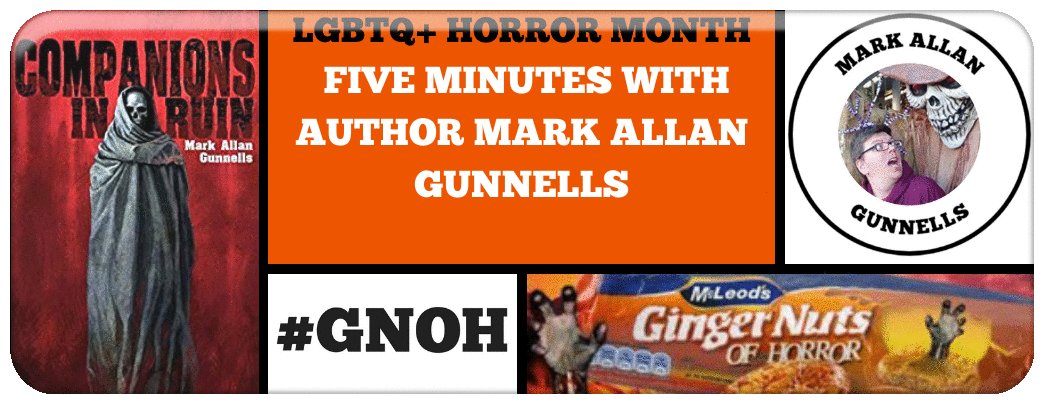
 Mark Allan Gunnells loves to tell stories. He has since he was a kid, penning one-page tales that were Twilight Zone knockoffs. He likes to think he has gotten a little better since then. He loves reader feedback, and above all he loves telling stories. He lives in Greer, SC, with his husband Craig A. Metcalf. Could you tell the readers a little bit about yourself? Well, the short and sweet version is I’m a man who loves to tell stories. Nothing brings me greater joy. I’m also a gay man, happily married to a man I always say isn’t the man of my dreams because he actually exceeded my dreams. Sometimes the question arises, are you a gay writer or a writer who happens to be gay? For me, those distinctions don’t matter. Both being gay and being a writer are such intrinsic parts of who I am that they meld together with all the other aspects that make me me that I don’t give it much thought to be honest. Why horror? What is appeal of the genre to you as both a fan and as a writer? You know, I’m not entirely sure I have a satisfying answer for that. Horror got its claws into me as a young ago, when I watched the original Salem’s Lot miniseries and even caught a bit of The Exorcist on TV. I found horror so thrilling, so captivating, that I was instantly hooked. Horror at its best has a real physical effect on the reader, and as I developed into a writer myself, I wanted to try to create that effect for readers as well. As an LBGTQ+ fan and writer how did you become immersed in the genre and find representation that you could identify was few and far between? I knew I wanted to be a writer before I knew I was gay. At least, before I accepted I was gay. As I came to terms with my sexuality, I was still writing stories with exclusively heterosexual characters. Partly because I looked around and there simply wasn’t a lot of representation. Most mainstream horror novels had no gay characters, and when they did those characters were usually used as punchlines or objects of horror themselves. There were also no high-profile gay writers in the horror field. Barker was prominent but he was not out at the time. Insiders may have known he was gay, but the general public did not so I felt alone when I scanned the horror genre. I honestly wasn’t sure there would be a place for me at the table. How did you discover authors that wrote about characters that you could relate to? Other than the horror genre, what else has been a major influence on your writing? As the 1990s unfolded, some gay voices did start to immerge in the horror field. For one, Barker very publically came out on the cover of Advocate magazine and released the novel Sacrament with a sympathetic gay protagonist. That made a huge impact on me, seeing that someone who was such a force in the genre was gay and unashamed and still putting books out by a major publisher and getting lots of attention. Then I discovered Poppy Z. Brite. Though at the time I didn’t yet realize Brite was trans, I did know that he used gay characters in all his work and he didn’t make those characters eunuchs but dealt very openly with their sexuality. Other than horror, the works of writers like Armistead Maupin and David Leavitt and even Rita Mae Brown influenced me at a critical stage, just seeing the way they created these authentic and dynamic gay characters. The term horror, especially when applied to fiction always carries such heavy connotations. What’s your feeling on the term “horror” and what do you think we can do to break past these assumptions? The thing that frustrates me the most is that sometimes the term “horror” is thought to mean low quality. Even among so-called fans, I will see comments like, “The plot didn’t make a lot of sense and the characterization was thin, but hey, it’s just horror.” That is why when a book or movie comes out that gets critical acclaim, people start bending over backwards to label it as something other than horror. Thriller or suspense or supernatural mystery. Because they seem to think if something is good then it can’t be horror because by definition horror can’t be good. That is utter bull, and I think the best way to combat that is for creators to keep creating horror with strong plot and three-dimensional characters, stories with layers and emotional power. We need to create such stories then not shy away from the horror label. We need to make quality work then be unashamed in calling it horror. A lot of good horror movements have arisen as a direct result of the socio/political climate, considering the current state of the world where do you see horror going in the next few years? I hope that horror continues to get more diverse. It is happening, but there is still a push back. Anytime someone brings up the fact that the majority of horror anthologies have TOCs that consist of primarily white straight men, people get in an uproar and say “It should only be about the talent.” Well, yes, but if you say that is happening but the majority still consist of white straight men, then you have to own the fact that you are saying you think white straight men are just more talented than women or racial minorities or gay writers. And I don’t think that is true. I think there is a lot of historical bias, both conscious and unconscious, we are still working through. Making the horror genre more diverse will only serve to strengthen the genre. New voices, new perspectives can take familiar stories and infuse them with an originality that makes them fresh again. What are the books and films that helped to define you as an author? The work of Stephen King really influenced me a lot in my formative years. The way he creates characters that feel like people you know, and settlings that are as familiar to you as your own backyard. He took horror out of the gothic castles and put it in the middle of downtown for me. It was the first novel I ever read that left me totally in awe and made me want to try harder as a writer to achieve something of that magnitude. And to be honest, the thing that probably has had the greatest impact on me as a writer is The Twilight Zone. I grew up watching both the original series and the 1980s incarnation, and there was something about the surreal nature of those stories, the subtle horror that didn’t beat you over the head with it but instead worked more insidiously, that defined how I came to view horror. In recent years there has been a slow but gradual diversification within the genre, which new LBGTQ+ writers do you think we should be paying attention to? There are some wonderful LGB TQ+ authors out there, some more well-known than others, that I think people should be reading. Number one on my list is Australian author Aaron Dries. His work is so emotionally raw and powerful and vivid, I can’t recommend him enough. Brandon Ford also puts out some very good horror novels and collections as well. Norman Prentiss and David Greske also come to mind. How would you describe your writing style? I have a very conversational style of writing. Straight-forward and simple, I guess I want the reader to feel they are just being told a spooky story by a friend. Are there any reviews of your work, positive or negative that have stayed with you? When I was first publishing short stories in ezines and small magazines, I had an editor tell me basically not to quite my day job. Not in those exact words but he said I needed to seriously consider whether writing was something I really wanted to do, because my energy might have been better directed elsewhere. That has stayed with me because it did not crush me; instead, it motivated me. Because despite the fact that this editor felt I had no talent, I knew writing was my passion and writing was what made me happy. And nothing was going to deter me from doing it. I also remember a lovely review the writer John R. Little gave to my collection Tales from the Midnight Shift. I did not know John at the time, but he gave such a generous review that it touched me greatly. What aspects of writing to do you find the most difficult? The non-writing parts are difficult for me. Namely, the self-promotional parts. It’s a tricky business. You need to get the word out, but too much and you become obnoxious. I find that a hard balance to strike. Are there any subjects that you would never write about? No. I feel like any subject is fair game in fiction. Not everyone will want to read every subject, but I would never let that dictate whether or not I explored a subject. Writing, is not a static process, how have you developed as a writer over the years? Well, I like to think I’ve gotten better. We all start out as sort of imitators, mimicking the writers we love, but as the years have gone by, I feel I’ve found my own distinctive voice. What is the best piece of advice you ever received with regards to your writing? To write what you love, to write what you are passionate about. Not to worry about market trends or things like that, but to just focus on the stories that bring you the most joy. Getting your worked noticed is one of the hardest things for a writer to achieve, how have you attempted to break through the barriers that are so often in place against LBGTQ+ writers? I’m not a household name, far from it, but I’ve been pleased to find that being openly gay doesn’t seem to have hindered me. When I first started publishing, I ran into some editors that did tell me being openly gay would hurt my potential career. I had some rejections that told me the “heterosexual male fanbase” of horror would not be interested in works with gay characters, especially if these characters were not gay in name only but actually had active sex lives. I had braced myself for such a reaction from readers, but I did not find that to be the case at all. I think those editors were underestimating the horror readers. Many CIS white male authors use LGBTQ+ characters in their works, what’s the mistake that they make when trying to portray these characters? Sometimes they overthink it. At the core of things, humans are all more alike than different. But sometimes I see CIS white males use gay characters in what I call “name only.” You know these characters are gay because there is a line that says they are gay, but then that doesn’t seem to have any effect on who they are. Being gay isn’t all that I am, but it does inform who I am. It’s like something Joe Lansdale once said about characterization. Giving a character a limp isn’t characterization, but how that character feels about the limp and how it effects his life…that’s characterization. Same with being gay. How has it effected the character? And yes, gay people aren’t constantly having sex like the stereotype suggests, but all humans have a sexual drive and ignoring that when you create a gay character seems kind of glaring to me. Moving on to getting your work read by unwashed masses, what do you think is the biggest misconception about LGBTQ+ fiction? That straight readers can’t relate to it. That was something those early editors made me fear, but I have gotten great feedback from straight readers who see the characters as more than just gay, but as fully realized humans. It’s a misconception in general that people only want to read about people who are just like them. There are as number of presses dedicated to LGBTQ+ fiction, do you view these as a good thing, or do you think they help to perpetuate the ongoing exclusion from mainstream presses? I’m of two minds. I don’t think there is anything wrong with it, the way there is nothing wrong with a women’s only or LGBT only anthology. It puts focus on a segment of the horror community that historically has had little focus on them. However, it shouldn’t become a trap where a gay author can ONLY publish in these markets. I had an editor tell me that once, that my work featuring gay characters should be sent only to publishers that specialized in this. Nothing wrong with those presses, but it shouldn’t be an either/or. And I do see mainstream presses opening more to gay horror authors. And here is the million dollar question do you agree with movements like this and things such as Women in Horror Month? If so how would you like to see sites such as Ginger Nuts of Horror tackle diversity? Absolutely agree. Like I said before, this kind of thing shines a spotlight on minorities that historically haven’t been represented much in the horror genre. That is important to gain visibility and traction. I think what Ginger Nuts is doing by highlighting LGBTQ+ for the month is a great thing, and I am glad to be a part of it. The most common phrase you hear when people object to active movements to encourage all forms of diversity is “I don’t care about the sexuality, gender, color etc etc of the writer I only care about good stories” what would you like to say to these people? I addressed this earlier. You can’t say something like that and then ignore the fact that the majority of the genre is still straight white males. If you are going to say you only care about good stories, do you then believe that good stories are written by all different types of people? If the answer is yes, then you should then question why there isn’t more diversity in the genre. If the answer is no, you are part of the problem. To many writers, the characters they write become like children, who is your favorite child, and who is your least favorite to write for and why? No parent will admit to having a favorite child, but I particularly enjoyed writing the character Emilio Gambrell who appeared in my novels The Quarry and The Cult of Ocasta (and also a supporting role in my novella October Roses) because I found him a fascinating character who changed a lot. I also had so much fun writing Jacoby in Outcast and Mama Metcalf in Where the Dead Go to Die because they were hilarious. I don’t really dislike writing any character. Even the wicked or annoying ones, they serve the story and therefore are never a pain to write. What piece of your own work are you most proud of? That’s another of those “favorite child” type questions. I am very proud of my short story collections, I have to say. Short stories are a particular passion of mine. Oddly I’m most proud of some of the ones that have gotten the least attention. I have two digital-only collections, Ghosts in the Attic and Curtain Call, that I think contain some of my best work. I also recently self-published a novella collection called Deviations from the Norm, and I think the vampire novella “The Unholy Eucharist” is one of my most ambitious works and I am incredibly proud of that one For those who haven’t read any of your books, which of your books do you think best represents your work and why? That is a hard one to answer because I write different types of stories even in the horror genre so that no one book I think can really represent me. In some ways, the collections give you the broadest view of my interests. So something like Flowers in a Dumpster or Companions in Ruin. Do you have a favorite line or passage from your work, and would you like to share it with us? I’ve always been proud of the opening line of my zombie novella Asylum. I think it is attention-grabbing and immediately lets you know what kind of story you are getting. It goes, “When the dead arose, Jimmy was going down on the balding accountant.” Can you tell us about your last book, and can you tell us about what you are working on next? My most recent release was Deviations from the Norm, which collects three novellas that take familiar horror tropes and hopefully give them fresh twists. I have a new collection and novel due out in 2019. I’ve been working exclusively on short stories for the past several months, but I’m about to start a new novel. What was the last great book you read, and what was the last book that disappointed you? I recently finished The Night Listener by Armistead Maupin and Driving to Geronimo’s Grave and Other Stories by Joe Lansdale and found them both quite wonderful. Also the newest books by Anne Rice and J.K. Rowling really delighted me. As for disappointed me, I honestly have the philosophy that I don’t tend to talk about the books that disappoint me because even then I know the writer put his or her heart and soul into it and don’t want to give any negativity. What's the one question you wish you would get asked but never do? And what would be the answer? No one ever asks me the first fictional character I ever fell in love with. And if asked, I would answer that it was probably Eddie Dean in King’s Dark Tower series. Watching him battle his demons with wit and charm really won my heart.  
Comments are closed.
|


Archives
May 2023
|
 RSS Feed

|

|