

 Could you tell the readers a little bit about yourself? I’m Julie Travis, 51 years old, born in West London but I’ve been living in West Cornwall for well over a decade. I’ve been writing horror fiction since the early 1990s. Why horror? What is appeal of the genre to you as both a fan and as a writer? I’ve been pretty obsessed with horror since I was a child and read every short story I could get hold of (usually fairly Gothic stuff, for instance Augustus Hare’s The Vampire Of Croglin Grange was a massive favourite) and watched Hammer Horror films fairly constantly. Perhaps part of the appeal as a fan was my belief in the paranormal and life after death. As a writer, I find the genre has given me the space to explore everything from mental illness to grief to dreams and folklore – and ‘other’ sexualities. Oh, and as the years have gone on my belief in the paranormal has only been reinforced by my experiences and grown stronger. As an LBGTQ+ fan and writer of horror, how did you when you first became immersed in the genre and found that representation that you could identify was few and far between? It was probably because of some of the films that were being released. I walked away from horror for a while, because so many of the films in the 1980s were misogynistic. I was not reflected there at all and it felt like the genre I loved was utterly controlled by Right-wing, anti-feminist men and nothing could ever change. How did you discover authors that wrote about characters that you could relate to? The band Coil introduced me to Clive Barker’s writing. They were friends with each other (and eventually collaborated on the original, unused, Hellraiser score) and that was enough to make me investigate his Books of Blood and other short stories (such as Coming To Grief). I was elated to find strong female characters and gay and lesbian characters. I wasn’t out at that time, but I knew why I was relating to them! Also Iain Banks’ The Wasp Factory was such a post-punk novel – and I remember a punk fanzine (Grim Humour) interviewing him – that it attracted my attention. There was hope after all! Other than the horror genre, what else has been a major influence on your writing? Music, I would say; I’m also a lifelong music obsessive and certain bands (such as the aforementioned Coil, Psychic TV and Lustmord, from the Industrial Music genre) were coming out with what sounded to me like dream soundtracks. A couple of what I would call Gothic bands (which pre-dated Goth) – early Siouxsie & The Banshees, Joy Division, Bauhaus, Sex Gang Children - also helped channel my darker thoughts. And dreams. Too awful or too amazing to ignore. The term horror, especially when applied to fiction always carries such heavy connotations. What’s your feeling on the term “horror” and what do you think we can do to break past these assumptions? Horror has often been seen as a kind of ‘cartoon’ fiction and there’s plenty of novels that would support that. I’m not sure how it’s viewed by non-horror fans – perhaps not very seriously. Then again there’s been a lot of articles in the mainstream press about contemporary horror so anyone who wants to be informed can be…I think this means I don’t really know; I lost touch with mainstream society a long time ago. A lot of good horror movements have arisen as a direct result of the socio/political climate, considering the current state of the world where do you see horror going in the next few years? It’s certainly good to see a response to the current state of things – I’m aware that there doesn’t seem to be much of that in, say, music…I’m hoping that there will be more diversity among editors and publishers, etc, as that will further expand the worldview in the horror genre, although there might be plenty of good stuff that I’m missing out on. What are the books and films that helped to define you as an author? Films – as a youngster Hammer Horror’s Dracula films scared the hell out of me and so left a lasting impression, as did The Hound of the Baskervilles (Nigel Rathbone version). Later on, the first Hellraiser film was a massive thrill – seeing Barker’s work in the flesh, as it were! I find it almost unwatchable now due to all its flaws and much prefer Nightbreed and The Lord of Illusion, but Hellraiser was around at the right time to be a huge influence. I won’t hide the fact that I’ve always wanted to make a film. Books – various editions of the Pan Book of Horrors and an assortment of horror anthologies. Enid Blyton’s The Magic Faraway Tree and Clive Barker’s Books of Blood, of course. Plus – not books but just as essential – numerous copies of The Fortean Times. And the Re/Search J G Ballard issue, which is full mostly of interviews, which have long been a huge influence and inspiration. In recent years there has been a slow but gradual diversification within the genre, which new LBGTQ+ writers do you think we should be paying attention to? She’s been around for a while, but everyone should be checking out the likes of Georgina Bruce. Reading her work makes me feel as if I’m dreaming. I wish I knew of more, but your LGBTQ+ month should take care of that! How would you describe your writing style? My natural style is simple storytelling although I’ve been told it’s cinematic – which is how I see my stories, so perhaps it’s a mixture of the two. My intention is to put the reader into an altered state, much as I am when I’m writing, in order to be absorbed into the tale and become part of it. Are there any reviews of your work, positive or negative that have stayed with you? I try to put the negative ones aside (constructive criticism can be very helpful but being told I was like Myra Hindley was a bit much) and these two positive comments will always stay with me: after reading an excerpt of The Ferocious Night (Storylandia) at the Penzance Literary Festival a few years ago, a woman told me that it made her feel better about her brother’s death. I was speechless at that. And a US army veteran messaged me about Trigger (Vasterian #2) – a very heavy story that almost no one has wanted to comment on – saying he’d been through some terrible times and had found it ‘reassuring’. How could I ask for anything more? What aspects of writing to do you find the most difficult? Focus. I’m on a fairly serious amount of medication and find it difficult to concentrate for long, but I’ve adapted by leaving a story on the table and going back and forth between it and doing other things. It seems to work. For some reason, I find it incredibly easy to focus while in the launderette, so I usually take a story there! Are there any subjects that you would never write about? Anything that didn’t feel ‘true’ – that I couldn’t truly relate to or feel empathy with. Or beautiful teenage vampires: yawn! Writing is not a static process, how have you developed as a writer over the years? I’m happy to admit my early work was clumsy and clunky, both in terms of technical ability and direction. I wanted to grab readers by the lapels and hurl them around. As my knowledge of, shall we say, spiritual matters, became more refined I found far more layers and depth coming into my stories and of course my abilities as a writer have improved so hopefully I’m getting things across better. Basically I feel I have control over how I write now, although perhaps not over the stories – they find their own way. What is the best piece of advice you ever received with regards to your writing? A few years ago I wrote to Sarah Waters and she was lovely enough to write back, telling me that I should have a three pronged attack – the horror etc press, the gay press and the mainstream press. She told me she was surprised that she’d never been put under pressure to ‘straighten out’, which I found reassuring. But the main thing was that she took me seriously when I said I was being overlooked because of my sexual orientation. Getting your worked noticed is one of the hardest things for a writer to achieve, how have you attempted to break through the barriers that are so often in place against LBGTQ+ writers? I’m not sure that I have managed to do this – I’ve noticed some stories involving Queer protagonists being all but ignored by reviewers. But perhaps it’s been a matter of perseverance, of continually trawling the ‘net to find publishers/editors who really get what I’m doing and aren’t fazed by my dykeness. I certainly haven’t been subtle in my approach! But I did spend over a decade in the wilderness, as it were, due to some of the homophobic attitudes I found within the horror/sf genre, including getting some abuse from a very high profile writer and it’s only in the last couple of years that I’ve felt able to engage with the community again and, I have to say, attitudes have changed somewhat. Many CIS white male authors use LGBTQ+ characters in their works, what’s the mistake that they make when trying to portray these characters? I should read some of this stuff to find out! I’ve been focusing on female Occult and Surrealist authors for several years now, so it’s rather passed me by. Moving on to getting your work read by unwashed masses, what do you think is the biggest misconception about LGBTQ+ fiction? The same as much of society’s misconception about LGBTQ+ people – that it’s only about sex. There’s far more to us than that; there’s an entire culture around being Queer. There are as number of presses dedicated to LGBTQ+ fiction, do you view these as a good thing, or do you think they help to perpetuate the ongoing exclusion from mainstream presses? They’re a good thing, same as presses run by and for other minorities. We need to do our own thing, be in control of our lives as much as possible. That doesn’t mean we can’t collaborate with the mainstream press. When I was on the gay scene in London it wasn’t because I was excluded by the mainstream; I preferred to be in Queer space. It certainly wasn’t perfect but we spoke the same language and it was safe space. And here is the million dollar question do you agree with movements like this and things such as Women in Horror Month? If so how would you like to see sites such as Ginger Nuts of Horror tackle diversity? Yes I do agree with these movements, because they’re necessary. I love the fact that GNOH is making a big deal out of having a LGBTQ+ month! Another method which I’ve found interesting is of a magazine like Nenonymous, which left the authors’ names off the stories, only revealing them in the next issue – although of course that wouldn’t change the subject matter of the stories. Perhaps there should be more of this kind of thing, focusing on different minorities. The far Right are, literally, on the march, so this is more essential than ever. The most common phrase you hear when people object to active movements to encourage all forms of diversity is “I don’t care about the sexuality, gender, color etc etc of the writer I only care about good stories” what would you like to say to these people? But do those ‘good stories’ involve the writer writing only about straight, white people? As mentioned above, I’m convinced that my story Pieces (Urban Occult) was virtually ignored because the central characters were a mixed race lesbian couple. I think many people just skim over a story that doesn’t reflect them. I probably do, too, but I’m actively trying to overcome that and understand as many experiences as I can. Also – and very importantly – minorities have been actively held back from succeeding in almost every part of society, so our voices need to be pushed forward and heard. To many writers, the characters they write become like children, who is your favorite child, and who is your least favorite to write for and why? Interesting question! Perhaps my favourite character is one from a very early published story, The Guinea Worm. Susan Curtis was a feisty woman who dared to find out who she really was. I‘d like to meet her some time. My least favourite is not any of the monsters I write about; King Leopold from We Are All Falling… was a petty and judgmental idiot who enjoys other peoples’ misery. Far too commonplace for comfort. What piece of your own work are you most proud of? Probably the story We Are All Falling Towards The Centre Of The Earth. I cried a lot when I wrote it and readers have been telling me they’ve cried when reading it. Much as I believe in love, I think it’s always doomed one way or another and that’s an absolute tragedy. For those who haven’t read any of your books, which of your books do you think best represents your work and why? Is it too obvious to say my latest collection? Basically because it represents years of grieving and change, and learning, too. It’s the most honest thing I’ve ever written. Do you have a favorite line or passage from your work, and would you like to share it with us? “Everything is a time machine.” Well, most things are, anyway. Personal objects especially are time machines – I remember seeing someone looking at photographs of her parents, who’d died a long time ago. Her body was still in the room but the essence of the woman had disappeared to a different time and place. And I mean disappeared. She just wasn’t there any more. Can you tell us about your last book, and can you tell us about what you are working on next? We Are All Falling… came about because a publisher I’d worked with several times, Wapshott Press wanted to publish my second short story collection in book form (the first, also published by Wapshott, had been a single author issue of their journal). Actually, it isn’t a collection in the usual sense, it was Waphott Press allowing me a vehicle for the stories I’d recently written and was working on. It was an incredible opportunity and hopefully they’re as happy with it as I am. As for the future – I worked on something this year that I can’t yet announce, but it was a great honour to be asked. Hopefully it’ll be published soon! But I’m also working on a new story, Sky Eyes, although I don’t know whether I’ll send it anywhere for publication yet; I’m trying it purely as a ‘magickal’ process and publication is way down the list of priorities. My main, current project is Dead Unicorn Ventures, a Queer arts group formed a few months ago here in Penzance. We’re working on a ‘zine – my first since the mid 1980s – that’s coming from a distinctly lesbian perspective, and a gig, with some amazing acts, is booked for next July. It’s important because there’s literally nothing happening for our community here, and Cornwall Pride was full of sparkles and unicorns (hence the name!) but nothing of any substance. We want more. What was the last great book you read, and what was the last book that disappointed you? Scented Gardens For The Blind by Janet Frame was just incredible. Frame struggled terribly with mental illness and that’s clear in the novel. It sent me to some strange places, to the point where a friend advised me to step away from it for a while. I got part way through The Dispossessed and ran out of steam. I felt awful, because I love what the book, and Ursula Le Guin, was about, but I found the actual story somewhat stodgy. I must read more of her work, though, as she was an extremely wise woman. What's the one question you wish you would get asked but never do? And what would be the answer? Q – what’s your favourite line on the London Underground network? A – it has to be the DLR. It’s mostly overground and travels across some really interesting parts of East London. And if you’re lucky, you get to sit in the front seat so you can pretend to be driving it. about julie travis Julie Travis has had her transgenre fiction (horror/Surrealist/dark fantasy) fiction published in the independent press in the UK and North America for the last twenty-five years. She was co-founder of the Queeruption international festival, has been an occasional album photographer for prog-rock/avant-garde band UNIT and is obsessed with stone circles, holy wells and burial cairns. Julie Travis began writing horror and dark fantasy fiction in the early 1990s, after a youth spent watching horror films, writing music fanzines and playing bass guitar in a punk band. We are all Falling Towards the Centre of the Earth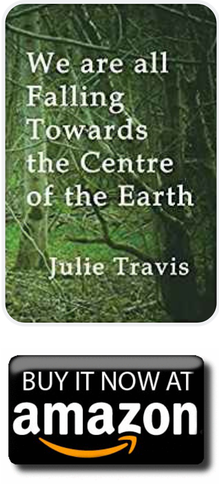 The second short story collection from British writer Julie Travis presents nine new tales of horror, dark fantasy and Surrealism. This is where you’ll find the landscape is a living thing, that monuments are built to the future and where Death is just the beginning. Enjoy contemporary fairy tales mingling amongst stories of escape from desperate times and a culture where difference is seen as a blessing, not a threat. "A feeling akin to sanctity… a reverence for the bleak and wild landscape… a kind of pantheism or Gaia worship. There’s a whiff of writers like Machen or Blackwood, echoes of Barker, a combination of ghost story and folklore." Peter Tennant, Black Static 
Comments are closed.
|


Archives
May 2023
|
 RSS Feed

|

|