

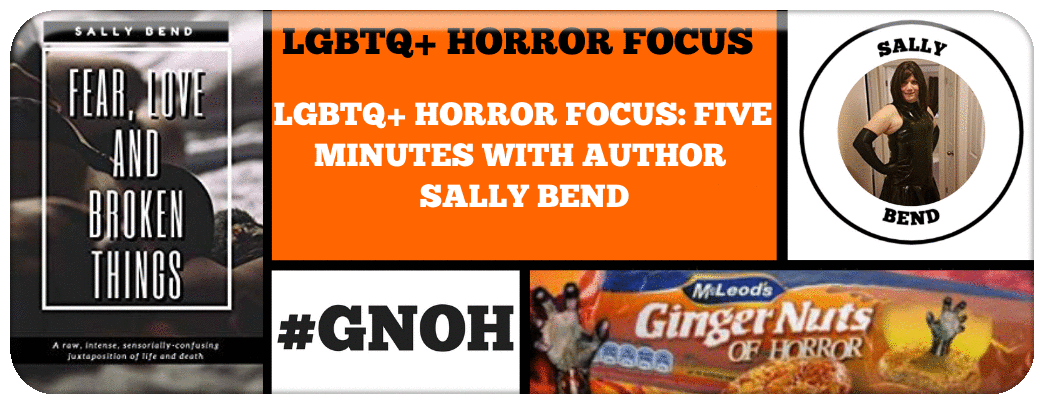
 Could you tell the readers a little bit about yourself? My name is Sally Bend, and I am a genderfluid author and reviewer of erotica, romance, and genre fiction. I love dragons and unicorns, ancient treasures and lost civilizations, monsters and tentacles, and dominant women and pretty boys. Why horror? What is appeal of the genre to you as both a fan and as a writer? Well, there are two parts to that answer. The first is that I cut my teeth on the horror genre, having begged my mother to buy me a copy of Stephen King’s Pet Sematary from the paperback rack at the corner store. The second half of that answer has to do with spending much of my life in hiding, burying my identity. I was so afraid of exposure that I practiced holding my emotions inside, lest they betray me, and I am sad to say I got rather good at it. Unlearning those habits has not been easy, but writing allows me the freedom to express myself, and nowhere are our passions and our emotions stronger – or more honest - than in erotic horror. As LBGTQ+ fan and writer of horror, how did you when you first became immersed in the genre and found that representation that you could identify was few and far between? Having grown up in the eighties, representation was there, but it was not positive. We were victims, targets of humor, sources of titillation, and sometimes even deranged killers. I remember watching Sleepaway Camp for the first time, feeling angry and shocked at the big twist – and sorry for Angela – while all my friends were hooting and hollering and making gagging noises. How did you discover authors that wrote about characters that you could relate to? It all comes down to one person – Clive Barker. It started with the BDSM themes of Hellraiser, continued with the outsider themes of Nightbreed, and reached its culmination (for me) in his masterpiece, Imajica. That was the book that opened my mind, not just to the magic of literature, but to the power of stories to capture, reflect, and celebrate the full spectrum of identities and sexualities, and to do so in a positive way. Other than the horror genre, what else has been a major influence on your writing? The other major influence for me has been erotica, starting with the fetish-themed science fiction and fantasy novels published by Nexus in the late 90s. Here were mass-market paperbacks that I could easily pick up at the bookstore in the mall, with characters I could identify with, relate to, and look to for validation. The term horror, especially when applied to fiction always carries such heavy connotations. What’s your feeling on the term “horror” and what do you think we can do to break past these assumptions? To be honest, I have never thought of the term “Horror” having any negative connotations, especially today. Twenty years ago, sure, it could have been dismissed as trashy entertainment, without literary value, but I think readers and critics alike are far more receptive to what it does well – and that is pick up on our fears, force us to confront our insecurities, and shock us into some sort of awareness. What I would love to see is publishers and bookstores pull back from the “Thriller” genre they invented to make softer, less disgusting horror more socially palatable. Put those stories back onto the “Horror” shelves and allow readers to explore the diversity of the genre from there. A lot of good horror movements have arisen as a direct result of the socio/political climate, considering the current state of the world where do you see horror going in the next few years? Yikes, I am not even sure I want to speculate on that, but I suspect we will see more stories about the monsters within, about the breakdown of polite society, about bad people doing bad things, and about how seductive evil ideas can be. What are the books and films that helped to define you as an author? Clive Barker’s body of work is, of course, huge – Hellraiser, Nightbreed, Imajica, Weaveworld, Sacrament, and so on. John Everson, Sèphera Girón, and Poppy Z. Brite all had an impact on me as well. Outside the genre, the fantasies of Mercedes Lackey, Lynn Flewelling, and Jacqueline Carey were all pivotal, with approaches to characterization and themes that I can only hope to someday emulate. In recent years there has been a slow but gradual diversification within the genre, which new LBGTQ+ writers do you think we should be paying attention to? Long Black Veil by Jennifer Finney Boylan is one of those books I eagerly thrust into people’s hands, a “Horror” novel from the “Thriller” shelf that is just amazing. Bryce Calderwood is an author I cannot recommend highly enough, an author who melds fetish with fear like no other. His take on vampires, especially, will make you forget anything romantic or sparkly. I recently had the chance to give the Dark Rainbow: Queer Erotic Horror collection a read as well, which put Julianne Snow, Lindsay King-Miller, and Lisi Damette on my list of authors to who we should be paying attention. How would you describe your writing style? My writing style tends to follow one of two avenues. The first leans more towards imaginative horror, with supernatural themes and a pulp sensibility. The second falls more under the umbrella of dark, realistic, visceral horror, drawing on real-life fears and familiar situations. Are there any reviews of your work, positive or negative that have stayed with you? Like many authors, I live and die by reviews. They are evidence that somebody read your work, and that it made enough of an impact for them to take a moment to write about it. The 5-star reviews are flattering, but it is the unexpected reviews from brand new readers that I find most encouraging. What aspects of writing to do you find the most difficult? I tend to procrastinate, driven by a fear of the blank page, so getting started is what I find most difficult. Once I get past the excuses, the stories flow, but sometimes that blank page is a hurdle. Beyond that, I struggle with titles, and I hate blurbs. Are there any subjects that you would never write about? Horror is an exciting genre because it offers us the opportunity to explore subjects we abhor and, quite literally, exorcise our demons. I would never glamorize homophobia, and I have no great love for organized religion, but a homophobic preacher could make for a fantastic villain. Writing, is not a static process, how have you developed as a writer over the years? I think the biggest evolution for me has been opening myself to feedback. It is one thing to publish a story and open yourself to the feedback of strangers, but it is another thing entirely to bare your soul for friends and colleagues. Learning to work with editors and beta readers has allowed me to develop my work in ways I could have never done on my own. What is the best piece of advice you ever received with regards to your writing? A good friend once advised me to write what I love, and love what I write. She reminded me that my passion will come through in the writing, so there is no need to exhaust myself trying to force the story into a niche. If it’s not natural or enjoyable for me, readers will pick up on that and they will feel the same dissatisfaction. Getting your work noticed is one of the hardest things for a writer to achieve, how have you attempted to break through the barriers that are so often in place against LBGTQ+ writers? Well, I started as a reviewer and an editor before getting serious about writing, so I already had a strong network of connections across publishers, authors, and social media. Getting mainstream exposure is still difficult, but networking within genre groups on places like Facebook and Goodreads has been huge. Many CIS white male authors use LGBTQ+ characters in their works, what’s the mistake that they make when trying to portray these characters? The biggest mistake is using LGBTQ+ characters as a costume or a cliché. To write them well, they need to have personality, emotion, and depth. There is absolutely nothing wrong with writing outside your own experience, whether it be gender, sexuality, race, social class, religion, species, or mortality. If we only wrote who and what we are, our stories would be familiar and boring. I think authors who make a genuine effort to relate a different experience are to be celebrated for their efforts. Moving on to getting your work read by unwashed masses, what do you think is the biggest misconception about LGBTQ+ fiction? I think the biggest misconception is that it is all about sex. You can write an immensely powerful story about a lesbian couple or a transgender protagonist and never even kiss, much less hold hands. There are as number of presses dedicated to LGBTQ+ fiction, do you view these as a good thing, or do you think they help to perpetuate the ongoing exclusion from mainstream presses? Not only are they a good thing, I think they are hugely important to ensuring that LGBTQ+ authors continue to have a voice. They present authors with a defined market where they can feel accepted, encouraging them to explore their voices without fear. There is often a tendency to hold back, to censor yourself when submitting to a mainstream press. A dedicated press takes away that fear, it allows us to take chances and stretch our boundaries. I think they have immense value for readers too. For mainstream readers, it is often an invisible line. It is a book cover, a title, and a blurb that catches their attention. They choose a book because it interests them or excites them – they could care less who the publisher is. For LGBTQ+ readers, though, dedicated presses make it easier for them to find stories with which they can identify. And here is the million dollar question do you agree with movements like this and things such as Women in Horror Month? If so how would you like to see sites such as Ginger Nuts of Horror tackle diversity? Oh, absolutely. I think any opportunity to showcase a different aspect of the community is fantastic. It creates awareness of new books and new voices and encourages readers to try something new. Women in Horror month and LGBTQ+ Horror month are both fantastic initiatives, but I think Ginger Nuts could accomplish just as much with a few dedicated weeks, or maybe even a branded day of the week. Not only would it avoid the risk of potentially overwhelming readers, but it would send a wonderful message by incorporating ongoing diversity. The most common phrase you hear when people object to active movements to encourage all forms of diversity is “I don’t care about the sexuality, gender, color etc etc of the writer I only care about good stories” what would you like to say to these people? My mother has a habit of qualifying her prejudices. She will bring up the fact that somebody is gay, Asian, Muslim, or whatever - facts that are completely irrelevant to the fact that they were buying fresh Italian bread - and then add “not that there’s anything wrong with that.” The truth of the matter is, if she really thought there was nothing wrong with that, and readers really did not care about race, gender, or sexuality, then they would not have brought it up. To many writers, the characters they write become like children, who is your favorite child, and who is your least favorite to write for and why? Oh, that is an easy one. Futanari Moans is my favorite, a character who straddles my public and private personas, embodying interests from both real-life and fantasy. She is so much fun to write about, over-the-top adventurous with pulp sensibilities. As for least favorite, that would most definitely have to be Mrs. Kay, the transphobic, holier-than-thou, zealot of a mother from my current work-in-progress, a full-length supernatural horror novel. What piece of your own work are you most proud of? I would have to say Fear, Love and Broken Things, my darkly erotic horror story from last year. It is some of my finest writing, with so many passages and images that still give me chills. For those who haven’t read any of your books, which of your books do you think best represents your work and why? It is so hard to pick a favorite child, but I would have to go with my twinned Alpha Transformation/Alpha Surrender stories. Imaginative post-apocalyptic horror, with solid world-building, complex characters, and supernatural themes. I am as proud of the characters as I am the writing, and I loved how my own “what if?” scenario played out. Do you have a favorite line or passage from your work, and would you like to share it with us? There is a passage in Fear, Love and Broken Things that I love, and which had my beta reader comment “Pardon my French, but holy f*ck that’s incredible.” In her mind, the spider was straddling her moist, dark hole, its eight legs tickling her with their teasing caress. She imagined it spinning a new hymen for her, a sparkling white web to catch a lover unawares, leaving them with a silken condom. With indisputable proof of her rebirth. Can you tell us about your last book, and can you tell us about what you are working on next? Fear, Love and Broken Things was my last book, and I think is some of my darkest, most polished, most mature writing. I spent a long time working on it, and I feel like the hours paid off. As for what’s next, I am working through what I hope will be my final rewrite of my massive supernatural horror novel, an atheist’s take on the afterlife, which tackles themes of love, faith, gender, and sexuality. What was the last great book you read, and what was the last book that disappointed you? I am midway through The Mirror Empire by Kameron Hurley, and it has absolutely blown me away. The last to disappoint me was a memoir about sex work that was far too focused on spirituality, and which was far too thin, without a comfortable flow to the storytelling. What's the one question you wish you would get asked but never do? And what would be the answer? I am rather shy and introverted, a very private person offline, so every question is a source of anxiety. Having said that, I am an open book, just not one that invites questions. 😊 ABOUT SALLY BEND Sally Bend is an author, editor, columnist, and reviewer. Although shy and polite (she is, after all, Canadian), she loves to boldly and boisterously express herself through stories that bend the binaries of gender and sexuality. Her fiction incorporates a wide range of styles, from dark horror to quirky erotica, with her favorite themes being the acceptance of gender identity and the exploration of submissive sexuality. When she’s not reading, writing, or wandering the forest, she can be found online at http://sallybend.com. Fear, Love and Broken Things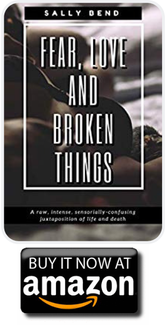 A battered woman, already pushed to the breaking point, discovers both her self and her sexuality in a seedy motel - where her indoctrinated fear of filth takes a heavy toll on her sanity, but ultimately proves to be the path to freedom . . . and perhaps even love. "Fear, Love and Broken Things" is 10,000 words of erotic horror that explores fear, love, and the redemption of broken things.   Comments are closed.
|


Archives
May 2023
|
 RSS Feed

|

|