

 Carmilla Voiez is a proudly bisexual and mildly autistic introvert who finds writing much easier than verbal communication. A life long Goth, living with two kids, two cats and a poet by the sea. She is passionate about horror, the alt scene, intersectional feminism, art, nature and animals. When not writing, she gets paid to hang out in a stately home and entertain tourists. Carmilla grew up on a varied diet of horror. Her earliest influences as a teenage reader were Graham Masterton, Brian Lumley and Clive Barker mixed with the romance of Hammer Horror and the visceral violence of the first wave of video nasties. Fascinated by the Goth aesthetic and enchanted by threnodies of eighties Goth and post-punk music she evolved into the creature of darkness we find today. Her books are both extraordinarily personal and universally challenging. As Jef Withonef of Houston Press once said - "You do not read her books, you survive them." Carmilla’s bibliography includes Starblood (Vamptasy Publishing, Dec 2018), Starblood the graphic novel, Psychonaut the graphic novel, The Ballerina and the Revolutionary, Broken Mirror and Other Morbid Tales. Her work has been included in Zombie Punks Fuck Off (Clash Books), Slice Girls (Stitched Smile), and Another Beautiful Nightmare (Vamptasy). Her website and blog can be found at www.carmillavoiez.com Could you tell the readers a little bit about yourself? My name is Carmilla Voiez. I’m openly bisexual and tend to write about bisexual characters in my stories. I live in Scotland and am a life-time Goth. One of the questions of my life has been how I fit into a binary gender. The short answer is that I don’t and I doubt many people do without some effort. That said I identify more-or-less as cis-female with wriggle room, and am currently dating a gender-fluid partner. I’ve been writing (mostly horror) since 2009, although I did have some poetry (no please don’t look it up) published when I was a teenager in Goth zines. My talents definitely lie in prose, believe me. I have a series of novels – Starblood, Psychonaut, Black Sun and Ribbons that follow the stories of a group of Goths based in Bristol, England (the town where I grew up). I have an urban fantasy novel with a queer protagonist – The Ballerina and the Revolutionary. And a collection of short stories – Broken Mirror and Other Morbid Tales. My stories have been included in Zombie Punks Fuck Off, Another Beautiful Nightmare, Slice Girls and Siren’s Call Magazine. Why horror? What is appeal of the genre to you as both a fan and as a writer? When you grow up different to everyone around you it is easier sometimes to walk a different path. I’ve been obsessed with magic, the Goth culture, and supernatural beings for most of my life. I find comfort in the horror genre for a number of reasons. I am highly empathic and I tend to internalise the pain of others, even those I have not met. Politics and current affairs are more horrific to me than anything I have read within the horror genre. Horror stories are small. The decisions made in them are rarely as wide reaching as even what mobile phone we buy. As such the horror can be managed and understood, survived. At the same time, as a writer, it allows me to address the big questions on a small level, in microcosm, which allows the reader to experience and understand the dilemma without feeling overwhelmed. As LBGTQ+ fan and writer of horror, how did you first becOme immersed in the genre and found that representation that you could identify was few and far between? The only horror/fantasy writer I read as I grew up who looked at a wide spectrum of gender and sexuality was Clive Barker. I consumed everything I could of his stories and I am sure they have influenced my own work. Outwith Barker it is woeful how underrepresented bisexual characters are. I now the reference is barely horror, but even where bisexual characters are a part of a story e.g. Willow in Buffy the Vampire Slayer, their bisexuality is erased and they are only shown as lesbian or straight depending on their current partner. When trans is shown in horror it is frequently associated with mental illness and danger. I desperately wanted to see more positive representations of diverse sexuality and gender expression in the genre. I have tried to show these in my own work and I do believe that indie horror is becoming more representative. How did you discover authors that wrote about characters that you could relate to? Finding non-feminine female characters and bisexual characters is an ongoing challenge. I jump on every recommendation I receive. Fantasy seems to deliver more variety and I love the books of Rosie Garland, Octavia Butler, Storm Constantine and Natsuo Kirino. Other than the horror genre, what else has been a major influence on your writing? Weird Tales, like those of Thomas Ligotti and Haruki Murakami, Magical Realism and Dark Fantasy. But I read across genres and am probably as influenced by Contemporary Literature. The term horror, especially when applied to fiction always carries such heavy connotations. What’s your feeling on the term “horror” and what do you think we can do to break past these assumptions? Horror is as wide a genre as fantasy or sci-fi, perhaps wider. Horror can be extreme violence (Splatterpunk) or a gentle sense of unease (Ghost Stories). We all have a dark side. Most might try to hide it, but it provides a great subject for literature. I suspect the problem might be that people who write horror mixed with other genres e.g. with elements of crime will call their work Crime or Thriller to avoid the negative assumptions that Horror evokes. In this way much of the variety in horror is obscured. A lot of good horror movements have arisen as a direct result of the socio/political climate, considering the current state of the world where do you see horror going in the next few years? Apocalyptic horror. Yes we’ve been on the precipice of disaster before, but the level of threat vs the willful denial of that threat feels unprecedented. What are the books and films that helped to define you as an author? That’s impossible to answer fully so horror wise I think To Wake the Dead by Ramsey Campbell and The Books of Blood by Clive Barker were both important to me and encouraged me to look into magic and psychology. The Wasp Factory by Iain Banks and On Beauty (and other work) by Zadie Smith influenced my style. On Writing by Stephen King influenced by process, as did studying with the Open University. I am not certain how influenced I have been by particular films, but I enjoy surrealism and visual language as encapsulated in the better films by Dario Argento and those of David Lynch. In recent years there has been a slow but gradual diversification within the genre, which new LBGTQ+ writers do you think we should be paying attention to? Sumiko Saulson, Lily Luchesi, Christopher Rice, Jewelle L Gomez, Matt Converse, Emma Johnson How would you describe your writing style? Frequently trippy, bisexual, magical, anarchist splattergoth. Are there any reviews of your work, positive or negative that have stayed with you? I’ve been accused of treating male protagonists like dogs. I cannot entirely agree with that criticism but my stories are told via a female lens. I’ve also been told that my work could either be the result of genius or madness. I think that’s my favourite. What aspects of writing to do you find the most difficult? Starting. Getting the initial idea that the story will revolve around. I know many authors would say editing, but I love that part. Are there any subjects that you would never write about? Not if I could find a way to cover them sympathetically. Writing, is not a static process, how have you developed as a writer over the years? My writing has become tighter as I’ve matured. What is the best piece of advice you ever received with regards to your writing? Keep writing and worry about the quality later. Getting your worked noticed is one of the hardest things for a writer to achieve, how have you attempted to break through the barriers that are so often in place against LBGTQ+ writers? I don’t think I have done that yet. Many CIS white male authors use LGBTQ+ characters in their works, what’s the mistake that they make when trying to portray these characters? Anyone who uses a stereotype as a character will fail to engage the reader. I don’t think that straight people can’t write queer characters, just like I don’t think women can’t write men, or vice versa. But a deep understanding of the character is always needed otherwise the book will be terrible. Moving on to getting your work read by unwashed masses, what do you think is the biggest misconception about LGBTQ+ fiction? That it’s going to be preachy-social-justice stuff when in actual fact you are just reading a story where one or more of the characters comes from a different background and has different experiences of the world. There are as number of presses dedicated to LGBTQ+ fiction, do you view these as a good thing, or do you think they help to perpetuate the ongoing exclusion from mainstream presses? I think they are a great thing. The only thing that will perpetuate the ongoing exclusion of the mainstream presses is if the agents/publishers/editors choose not to publish a book with LGBTQ+ characters. I would argue that most mainstream presses would sooner sign LGBTQ+ books than Horror books. And here is the million dollar question do you agree with movements like this and things such as Women in Horror Month? If so how would you like to see sites such as Ginger Nuts of Horror tackle diversity? Absolutely. I am always looking for new voices as a reader and new readers as a writer. Following the same pattern of existing movements makes sense and will allow for a greater reach. So Women in Horror in February makes sense as the hashtags will be active. Maybe include disability, translated work, and work by people of colour in these events? The most common phrase you hear when people object to active movements to encourage all forms of diversity is “I don’t care about the sexuality, gender, color etc etc of the writer I only care about good stories” what would you like to say to these people? You can have both. When you can read about people who aren’t like you, who think differently and have different experiences, why would you choose not to? For many writers, the characters they write become like children, who is your favorite child, and who is your least favorite to write for and why? I love and hate all my children. Freya from Starblood is my current favourite because she behaves so unexpectedly and I enjoy torturing the poor woman. What piece of your own work are you most proud of? Tricky question. I prefer my longer pieces to my short stories. I do love the Starblood series. For those who haven’t read any of your books, which of your books do you think best represents your work and why? Starblood – it includes my obsessions about magic and sexuality and also the personal struggles of being female while negotiating a place in the world. Do you have a favorite line or passage from your work, and would you like to share it with us? Satori does not want to step towards her. She is Star, but she is more and less than that. She is a dark goddess, mother to a demon child, terrifying in aspect, but at the same time she is destroyed, ravaged and broken. Yet he knows these things are surface. He feels a force behind them, brightness and strength. It frightens him. Can you tell us about your last book, and can you tell us about what you are working on next? Most recently I had a short story called Eat the Rich published in a collection called Zombie Punks Fuck Off. I am working on a fourth novel in the Starblood series and a third graphic novel, based on Black Sun. What was the last great book you read, and what was the last book that disappointed you? I am currently reading a Compendium of the Weird: 750,000 words of short stories in chronological order. It’s wonderful and it might keep me busy til Christmas. The last book that disappointed me was Balzac’s Cousin Bette. There was no characterisation at all and the plot belonged in a bad soap opera. What's the one question you wish you would get asked but never do? And what would be the answer? Can I make a television series from Starblood? The answer would probably be yes. https://www.facebook.com/Author.Carmilla.Voiez/ https://twitter.com/carmillavoiez https://www.pinterest.co.uk/carmillav/starblood-the-graphic-novel/ https://www.quora.com/profile/Carmilla-Voiez# https://www.goodreads.com/author/show/4893389.Carmilla_Voiez https://www.amazon.com/Carmilla-Voiez/e/B00AMZKZ5I https://www.amazon.co.uk/Carmilla-Voiez/e/B00AMZKZ5I/ 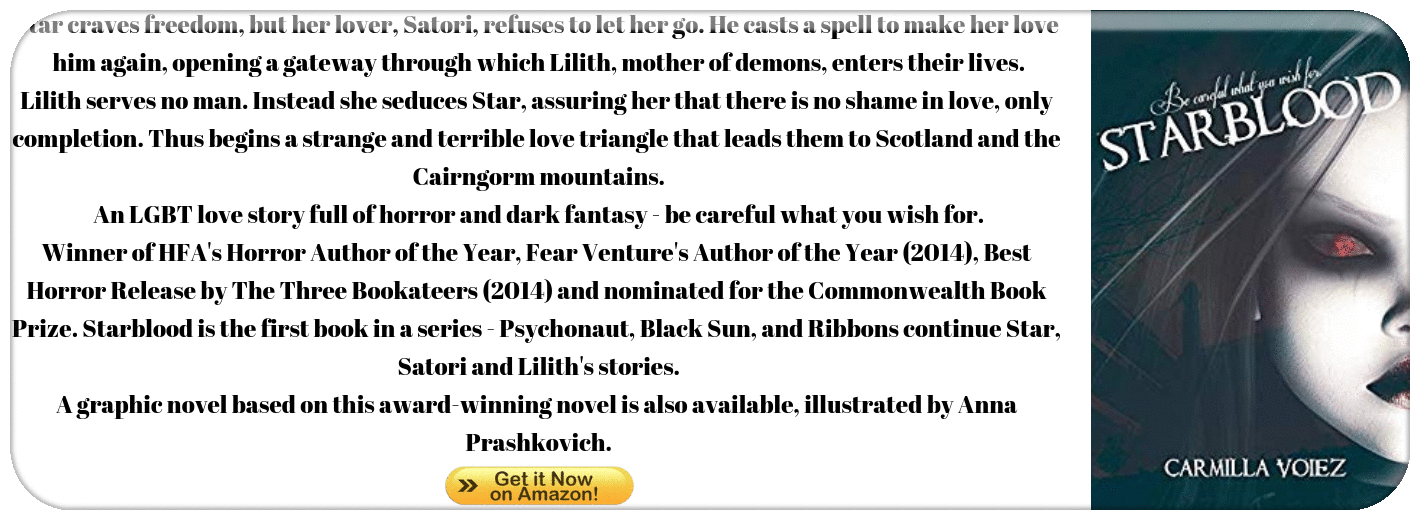   Comments are closed.
|


Archives
May 2023
|
 RSS Feed

|

|