

|
INTERVIEW BY JONATHAN THORNTON   Malcom Devlin's, You Will Grow Into It has just been released, and it is already receiving a number of rave reviews. Published by Unsung Stories, it contains ten stories, each a strange sort of coming of age tale. There are ghost stories without any ghosts in them, werewolf stories without any werewolves in them, a city that turns into forest, a barren planet with a peculiar sort of harvest celebration and a suburban street suffering a very personal and rather embarrassing apocalypse. Ginger Nuts of Horror's Jonathan Thornton, was at the UK launch of the collection, and managed to grab some time with the author for an exclusive interview about this must read collection. You've described the stories in your collection 'You Will Grow Into Them' as 'strange sort of coming of age tales'. What is it about the coming of age tale that both inspires you and makes you want to play with or subvert it? There's a universal quality to coming of age stories, I think, so I hope they can be relatable on that level. What interested me most was the idea that 'coming of age' is a continuous process, not a one-and-done switch that quickly and painlessly graduates children into adults. We get older and we keep finding ourselves in situations where we realise just how far we have to go. So while the first few stories in the collection are about kids having their eyes opened to a broader world, the protagonists get progressively older as the collection progresses, but they're still finding they have a lot to learn. In particular your stories seem fascinated with states of transition. Can you tell us why you find these so compelling, especially in regards to a source of horror? 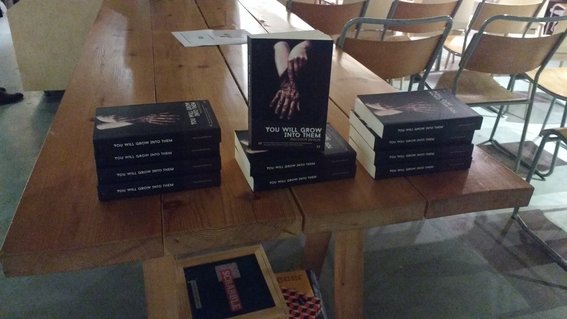 I think this ties into the previous question. Coming of age stories by definition are about some sort of transformation -- sometimes physical, sometimes otherwise -- and it's no accident that many 'body horror' stories serve as metaphors of puberty, growing old, degenerative disease and so on. I think there's potent material for horror there: the idea that your own biology might betray you, or that you might become something that might betray the ones you love. On the other hand, there are many examples in literature -- horror and otherwise -- of transformation being empowering or revolutionary instead, and taken together that's incredibly rich territory. Your stories rely heavily on suggestion and the power of the imagination rather than showing us the source of the Horror directly, from 'Dogsbody' which is set after the werewolf transformations are all over to the cross-hatch man in 'Passion Play'. How do you decide what to show the reader and what to leave to suggestion? This isn't always a conscious decision. I'm perfectly happy reading or watching stories which put the horror front and centre, and many of the stories in the collection started with an idea for some big horror set piece. More often than not, I end up whittling these ideas down to the bone or skipping them completely -- it's a weird thing, but the story around those moments often seems more appealing than describing the moments themselves. The original idea for Dogsbody, for example, would have started on the day of the event where all the werewolves (if that's what they are) changed. So in the very first draft, it was about a guy waking up in his office and finding himself tied to a filing cabinet, but the actual mechanics of that story didn't really interest me much. The idea that five years later, absolutely nothing more has happened but people still look at him kind of funny? That seemed a lot riper to me. The very British horror of the social awkwardness of it all. I think it's something that short fiction can do particularly well. This idea of distilling everything down to the most disquieting scene, but at the same time, implying everything that has gone on before and foreshadowing what will happen later. In some ways, readers' imaginations are brilliantly nasty things and worth exploiting. Explaining everything that happens can short-change them, I'd much rather wind them up and point them in the right direction. 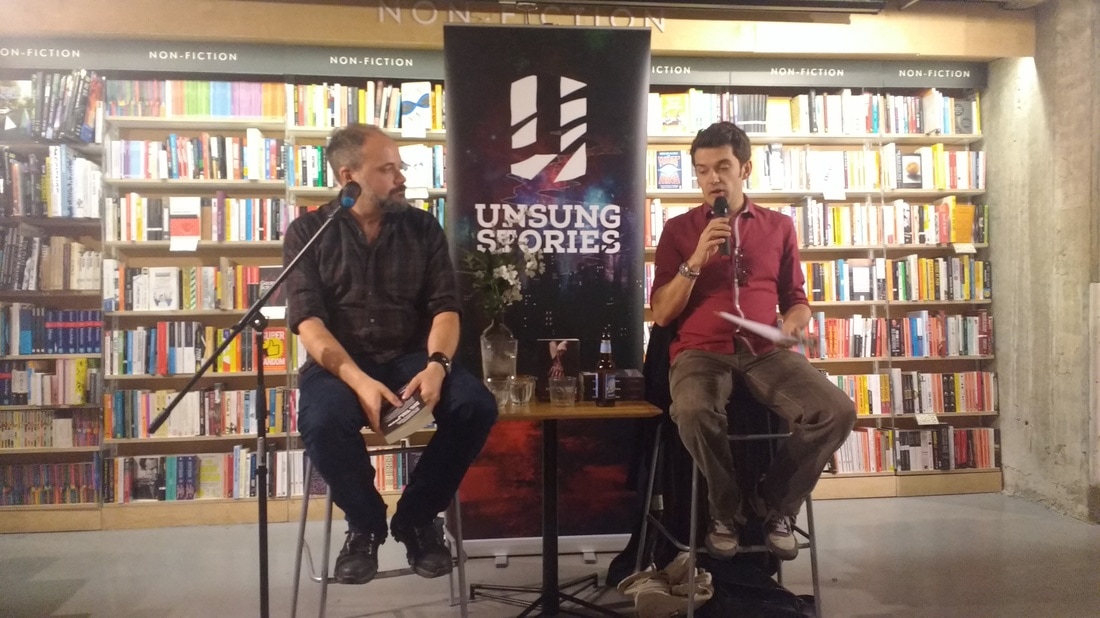 The collection is being published by Unsung Stories. What has your experience been like working with them? It's been great. Unsung have a wonderful line up already and I'm ridiculously lucky to sneak my stuff into the same catalogue as the likes of Aliya Whiteley and Oliver Langmead. George Sandison and Gary Budden have been incredibly supportive throughout, and while I always knew that Unsung Stories produce beautiful looking books, I was still floored by just how smart You Will Grow Into Them looks, inside and out. Your story 'Two Brothers' was published in the anthology 'Aickman's Heirs' (2015 ed. Simon Stranzas, Undertow Publications). Can you tell us a bit about Aickman's influence on your writing, and your experience writing for the anthology? Like many, I suspect, I came to Robert Aickman late, and mostly thanks to the championing from the likes of Jeremy Dyson and Mark Gatiss from The League of Gentlemen. I couldn't afford the beautiful Tarturus Press complete editions, but snapped up the Faber Finds reprints when they were published, wrestling with the pages spotted with OCR errors that, if anything, made the stories even stranger. To me, Aickman is one of those writers with a very unique grammar that is nearly impossible to replicate -- Kelly Link is another example there, no-one writes Kelly Link stories except Kelly Link. In some ways, Aickman doesn't really write ghost stories at all, he writes stories that happen to have ghosts in them and the conflicting tensions play merry havoc with the reader's expectations. Aickman doesn't so much wind his readers up and then set them loose, as abandon them somewhere familiar and yet slightly off, and then let them find their own damn way home. His stories disorientating, framed and lit from unexpected angles and they're often genuinely funny or absurd. The brief for Aickman's Heirs was very specific about avoiding pastiche, so in a lot of respects, Two Brothers is nothing like an Aickman story. I would absolutely say that most of what I write is influenced by his work in some way, but it's probably its own thing, and I hope it proves discombobulating in its own way. Stories like 'Breadcrumbs' and 'Her First Harvest' tap into some of the strangeness of the New Weird whilst harking back to fairy tales and Regency period comedy of manners respectively. Do you feel a kinship with writers like Jeff VanderMeer? How do these older forms influence your writing? I very much admire Jeff VanderMeer's work, both his fiction and the anthologies he edits with Anne VanderMeer, which are always thoughtfully chosen and brilliantly contextualised. Their New Weird collection is almost worth getting for the non-fiction alone. Also, through their small press and their anthologies, I was first introduced to the work of authors like Karin Tidbeck, Leena Krohn and Michael Cisco, each of whom upended my brain in one way or another and made other, less weird fiction look considerably more anaemic by comparison. I don't know if I would claim 'kinship' with any of them, that all sounds a bit forward to me, but the spores of their influence undoubtedly settled into some of the stories and made them stranger. Stories like 'The End Of Hope Street', 'Two Brothers' and 'Dogsbody' have strong elements of the British class system running through them, particularly about social stigma. Do you find this a rich source of ideas for horror stories? In some ways, I think it's a hard thing to avoid. If drama requires conflict, there'll never be any shortage of it in a stratified society. Sometimes I do write stories out of anger, although their initial spikiness often gets sanded down a bit as I rework them until they come across more as wearily disappointed instead. Hope Street is an interesting one for me, because it's the first time I've really seen the meaning of a story I've written evolve given the political climate. It was originally written before the EU referendum, but published afterwards. I've seen a number of comments suggesting that it reads like a post-Brexit story instead. This is alarming in one sense, given that it's not something I was really thinking about when I first wrote it, but quite satisfying in another, in that it's apparently robust enough to reflect more contemporary concerns. 'Songs They Used To Play', 'The Bridge' and 'Two Brothers' remind me of Philip K. Dick and Thomas Ligotti in the way they call into question our experienced reality, the way they portray our perceived world as a shadow of the real thing. Can you talk about why this is such an effective theme in Horror? I think one of the straight-forward things that makes effective horror is to first reconfirm any certainties the reader has, and then knock them down. In pretty much all fiction, there are assumptions made on the part of the reader -- there has to be really, otherwise every writer would have to explain every single detail every single time, and that's no fun at all. But those assumptions can be subverted. Those objects you thought were inanimate? They're not anymore. That kid you thought was the dorkiest girl in class? Turns out she's telekinetic. The doors are locked and you're alone in the house, so who's that standing next to the window? Our perception of reality is the big one, so it's always going to be fun to play with and undermine. Ligotti is an interesting example there, because he paints his worlds in such a way that the reader feels wrong-footed from the outset. A lot of the time, it's very hard to tell if he's subverting reality or just subverting your expectation that he will. To say the effect is dizzying doesn't quite do it justice. 'Songs They Used To Play' is a very timely look at the toxic nostalgia that's affecting so much of Britain at the moment, tied into the distortion of memory. Can you tell us a bit about what you were feeling when you wrote it? I was absolutely interested in how memory gets distorted, yes. There's a whole industry based on a particularly unctuous sort of nostalgia, from Keep Calm and Carry On merchandise to the The Great British Bake Off, and I can only see it growing post-Brexit as if the only thing we'll have left to offer the world is a blinkered re-packaging of the past. I was particularly interested in inherited memories, such as that oddly intangible sense of the "good old days", which are often cited by those far too young to know what days they were referring to in the first place. So it stems from the idea that most people are actually nostalgic about their own youth, yearning after a time when their own understanding of the world was considerably less sophisticated, and confusing that blissful ignorance with actual history. So, in Songs Like They Used to Play, the protagonist's own childhood is conflated (confusingly) with a reality TV version of British history, which has left him slightly out of sync with the world. I also think this has an interesting perspective regarding the 'coming of age' theme of the collection. The story is in the second half of the book, and already its protagonists are looking backwards and seeing completely the wrong things. So, your short story collection has just been published, and 'The End Of Hope Street' was nominated for the BSFA award. What are you working on next? I have a story called The New Man in the current issue of Interzone (#270), and I have stories in the new (or upcoming) volumes of Shadows And Tall Trees and Nightscript. I also have a story due in 2084, and by that I don't mean the year, I mean Unsung Stories' upcoming collection of dystopian fiction. Other than that, I'm working on something a little bit longer than I'm used to, so we'll have to see how that goes. 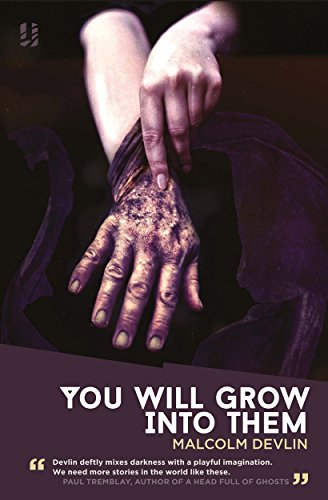 The world is a far stranger place than we give it credit for. There, in the things we think familiar, safe, are certain aspects. Our fears and desires given form. Moments that defy explanation. Shadows in our home. In Malcolm Devlin’s debut collection, change is the only constant. Across nine stories he tackles the unease of transformation, growth and change in a world where horror seeps from the mundane. Childhood anxieties manifest as debased and degraded doppelgängers, fungal blooms are harvested from the backs of dancers and lycanthropes become the new social pariahs. The demons we carry inside us are very real indeed, but You Will Grow Into Them. Taking weird fiction and horror and bending them into strange and wondrous new shapes, You Will Grow Into Them follows in the grand tradition of Aickman, Ligotti and Vandermeer, reminding us that the mundane world is a much stranger place than it seems.  Comments are closed.
|


Archives
May 2023
|
 RSS Feed

|

|