

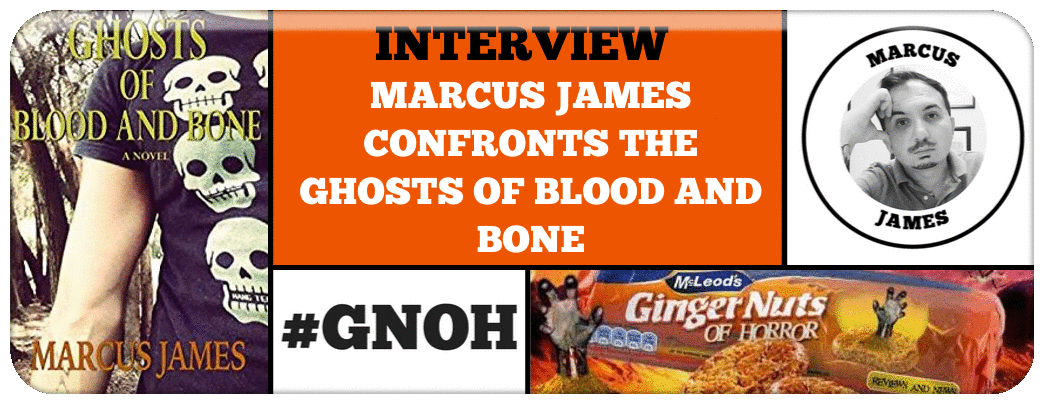
 Marcus James is the award-winning author of eight novels, including Blackmoore and Instructions in Flesh. He has contributed to several anthologies from Alyson Books, has been a contributor to the Seattle Gay News, and is co-host of the Queerly Spoken podcast. He lives in the Pacific Northwest with his Husband and Staffordshire bull-terrier. He is 35 years old. Links: www.facebook.com/MJameswriter www.facebook.com/queerlyspoken twitter.com: @MJamesbooks Instagram: @marcusjamesauthor website: www.marcusjamesbooks.com amazon author page: www.amazon.com/author/marcusjames Could you tell the readers a little bit about yourself? Sure thing. I’m the author of eight novels, and I’m most known for my Blackmoore Legacy series of which there are two novels, Blackmoore and Symphony for the Devil, along with a two-part prequel novella, Rise of the Nephilim and Fall of the Nephilim, and will be followed next year (hopefully) by the third book in the series, The Beckoning One. It’s a series focused on Trevor Blackmoore, who is seventeen in the first book, and who comes from a secretive family of rumored witches (which they are,) and all the complications that come from that. I am an out and proud gay man who writes horror and I co-host a podcast called Queerly Spoken, which is focused on curating the LGBTQ experience in all of its fantastic complexity. I love to cook, it’s a passion of mine for sure, and any excuse to drink champagne (which is pretty much all the time) I will find it. I live with my husband and my adorable Staffordshire Nikita. To get the ball rolling and get everyone relaxed, here is a hopefully lighthearted question to break the ice, which one of your characters would you least like to meet in real life and have them complain at you about they way you treated them in your work. Honestly, that would be all of my characters. I’m not easy on them, that’s for sure. But two specific ones come to mind. In my novel Blackmoore, there is a character named Christian Vasquez, who is a dick when you first meet him, but as the story goes, you see how really complicated he is, and his love for Trevor Blackmoore, which goes back a long way, gets used against Trevor by Christian, and in turn Christian gets it used against him. In the end, Christian redeems himself but things don’t turn out the best, and I think he would have a lot of bitterness towards me. Actually I’m sure of it. Often I feel him hovering over me with that bitterness. But he’s not exactly out of the picture. The other is Andy Stone, who is a character from Ghosts of Blood and Bone, my latest novel. This one is complicated because every single person in the novel is based off of real people, and Andy gets a raw deal, but she’s also not a really likeable person, and so though she would complain till blue in the face, I don’t really feel bad for her. Other than the horror genre, what else has been a major influence on your writing? Music. I write to music. I put together playlists for every book, individual songs for scenes and chapters, and certain songs end up assigned to particular characters. I am inspired more by music than anything else. Also, architecture, geography, the news. The works of Gore Vidal, Jim Grimsley, Edmund White, Michelle Tea, etc. great queer authors, both living and dead, who have chronicled the richness of our lives. In my work it has always been important to me to show that queer people can be heroes too. That young gay boys, no matter how butch or effeminate, can see that they can be heroes and save the world too. We aren’t weak or need to be rescued. Being an outsider is where our strength and resilience lies. Every person I write about teaches me something about survival, and in their worlds—worlds filled with breathing shadows—I get closer to understanding my own journey as a queer person and the experiences that bind us all together. No matter how individual our own personal journeys are. That’s the beauty of writing. That’s the power of literature; all the lives we get to inhabit. The term horror, especially when applied to fiction always carries such heavy connotations. What’s your feeling on the term “horror” and what do you think we can do to break past these assumptions? I love it. I think horror is amazing. Horror and gothic literature lives in the space of grief. Grief is a powerful thing. The constant sense of loss and a refusal to give up the ghost—whether that ghost is metaphoric or literal. It is a bleakness and a pain that gives the darkness life and keeps the dead from moving on. It is a genre that deals with the big things. Life. Death. Gods and Devils. Questions of morality, good and evil, and everything in between. I think that has always made people uncomfortable. Even in the slasher sub-genre, we have the concept of original sin—that thing that sets everything else into motion later on, and that always begins in a loss and grief of some kind. Horror explores the brutality of ourselves more than it shows anything else. Ghosts are everywhere in the horror genre. Whether they be actual vengeful spirits and beings, or people haunted by the ghost of experience and memory. They exist in the places we refuse to see, because those places are in the corner of every eye and within every shadow, and facing them means facing ourselves and that historically has made people uncomfortable because they don’t want to be reminded of how dark the night really can be. Do I think we can really break these apprehensive or negative connotations of horror? Probably not. It is getting embraced more and more, thanks to popular shows and groundbreaking films, but I think it’ll always have a stigma to fight against. A lot of good horror movements have arisen as a direct result of the socio/political climate, considering the current state of the world where do you see horror going in the next few years? More explorations of Us versus Them. The terror of being marginalized and oppressed in an increasingly fanatical, nationalist, religious world. We’re watching a terrifying seismic shift in the western/free world, where oppressive movements—these dark relics of the past—are gaining so much support and traction. Horror will do what it always does and does effectively; it’ll continue to shine the light on the worst of ourselves and continue to supply cautionary tales of what can happen when all of these things are taken too far. Horror has this amazing capacity, whether film or literature, to show us viscerally what the end of the road can look like if we continue to follow it, and often it makes us ask ourselves what our own capacity to hurt others, and what we do and do not value, really is. Given the dark, violent and at times grotesque nature of the horror genre why do you think so many people enjoy reading it? It’s a safe release. It’s the ability to explore our fears—to face what scares us and to have the assuredness of knowing that no matter how terrifying it can get, we can close the book and put it back on the shelf and get back to our lives, where by and large, the things we are reading about will never touch us personally in our real world. It can also help us cope with the terrible things that have touched us. It can sound weird for example, for someone who has had a loved one killed brutally, turn around and watch a bunch of slashers or for someone who has experienced the impact of suicide to then turn around and watch or read stories about angry, sad, lingering ghosts who took their own lives, but it can be a catharsis that no other genre can provide the same way horror can, because horror isn’t nice. It doesn’t sugar coat, it doesn’t fade to black. It takes you through all of it and we need that. What, if anything, is currently missing from the horror genre? Queer representation. Being a queer horror author, I can tell you this genre is historically a ‘white straight boys club’ even though women, LGBTQ people, and people of color are some of the largest and most fanatic consumers of horror, we find ourselves continually and systematically shut out of it. There is an uphill (more like a mountain) battle for queer authors, regardless of whatever genre they are writing in, to get the same kind of traction and to be embraced by readers the same way straight authors writing about cis-hetero main characters and focused stories receive. In the film industry, even amazing queer storylines get the short end of the stick, because the production quality is so low. Simply because the studios don’t want to touch it, they don’t think it’ll have a broad enough appeal/waste of money/can’t be “marketed properly” etc. so we have to rally and do what we can ourselves to tell our stories, but because of the quality of production and the ‘cheap’ feeling to it, it’s hard for even us to watch them. It’s really not the filmmaker’s faults, it’s just funding is a mountain with a summit that’s hard to reach. So many queer authors, especially in horror, have no other choice but to self-publish, because for all of our progress, a lot of publishers just don’t want to take on queer lit, especially when it’s horror. Writing memoir, coming-of-age, YA, stories of coming out, AIDS, these are the things publishers are more likely to take on when it comes to accepting queer novels, but horror? That’s just too weird. Even if the only thing queer about it is the character or characters themselves and not the story’s plot; it’s still too risky. In the past authors were able to write about almost anything with a far lesser degree of the fear of backlash, but this has all changed in recent years. These days authors must be more aware of representation an the depiction of things such as race and gender in their works, how aware are you of these things and what steps have you taken to ensure that your writing can’t be viewed as being offensive to a minority group? First, I don’t believe in censorship in art. Art is the enemy of censorship. Horror especially is the enemy of censorship. Horror is not safe. Horror is a place where all things can and should be tackled. I’m gay. I’m mixed. I write and explore the subjects and things that I know. If a character is African American or some other race or nationality, aside from mentioning it in character description, that’s about as far as it goes. I focus on who they are as people. If I have a racist character and they say something derogatory or offensive, well, that’s life. That’s the world we live in. obviously a character like that would more than likely be an antagonistic character, and would either evolve or something bad will happen to them. I have characters who are homophobic and heterosexist (obviously) and they say terrible and derogatory things, but again, that’s reality. I’m not advocating for or perpetuating those views, but I’m not going to leave out reality in order to ensure someone isn’t offended by the F-word or anything else. Parents calling on schools for bans on books like To Kill a Mocking Bird and Huckleberry Finn, these books, are not only a product of the times and our history that we shouldn’t be running from, but their authors were not racists nor did they advocate for the mistreatment and abuse of POC. This whole safe space, cancel culture thing—it’s not good. Shutting down opposing viewpoints, demanding everyone’s heads; bullying and attacking authors—it’s pathetic. I am gay. My responsibility, my mission as a queer person is to write about that. To tell stories that anyone can enjoy, but to do so through the lens of queerness. Toni Morrison famously said, that she writes outside the white man’s gaze, and when she’s writing, she’s writing to black people, free of having to explain anything to white readers about blackness. I write without the cis-hetero gaze hovering over me. I have a lot of straight-identified readers, and yet I don’t worry if they are understanding the things I am and am not referencing when it comes to the queer experience. For many queer people, growing up is a constant horror, and you spend your life terrified and hiding from everyone, and sometimes really awful horrific things happen to us—it did to me, and in horror that’s what I get to tackle, that’s what I get to approach and shed light on and explore. It could offend people or anger people who strive hard for this social media purity of ‘wokeness’ and I’m aware at any time that the mob could suddenly come after me out of the blue, but so what? I have had hundreds of cis-straight people call me a faggot from a passing car or walking down the street, I’ve been bullied and attacked everyday as a teen who was the only openly gay kid in school, and twice I’ve been gay bashed brutally and I was surprised both times that I somehow lived. I don’t fear mobs and I don’t bow down to them. Horror and art is dangerous. Literature is dangerous. It’s dangerous because it takes you places, and you may not always like where it goes or what it reveals. But unless the author and the work is openly advocating harm and destruction of other communities and groups, actively promoting oppression and enslavement as good things, then the rabble needs to shut up. Human life and people are complicated, messy, and so uniquely individual and we have no right to go after people with some litmus test of being woke. If you’re spending all this time harassing, stalking, dictating, attacking on social media, then you’re not living life and you obviously have nothing better to do and I feel sorry for you. Does horror fiction perpetuate its own ghettoization? For example Julia Armfield’s latest collection Salt Slow has a cover that most horror fans would walk past in a book shop, and is one that probably is not marketed as horror, does the genre’s obsession with horrific covers cause more harm than good? I think the only obligation of a great cover is that it reflects the story between it. I definitely think that means the cover should evoke horror or the gothic in some way. Salt Slow is definitely a book that based on the cover does not reflect those things, but from what I understand, it kind of crosses a lot of genres. If I saw it in the horror section, I think it’s lack of horrific imagery would actually pique my interest, if for no other reason than I would be like “what the hell is this noise?” so that may be to its benefit. Does horror create its own ghettoization? Of course it does. It’s horror. It attracts who it attracts and repels who it doesn’t. We also have this skewed definition of ‘literary’ fiction. Often what is given the badge of literary merit and considered intellectual is pedestrian realism. Coming-of-age-human-condition-the-struggle-is-real kind of stuff. Genre is often dismissed as childish/entertainment/escapism. Rarely do people explore what it actually means. A prime example is the misogyny accusation hurled at the slasher genre and yet, we have the mythology of the Final Girl, and that final character was made almost deity-like in horror mythos in Buffy Summers. The ultimate Final Girl. We understand that of all genres, especially in film, Horror uplifts and celebrates the strength and power of women and the feminine. It’s not about the casualties, it’s not about the women who are killed along the way, both men and women are fair game in horror, but nine times out of ten, the hero—the chosen one, is a woman. But horror has its stigma, as most genres do, and sadly, horror is considered as degrading and smutty as the worst porno for a lot of people. It doesn’t really get taken seriously. With films like Get Out, Us, Midsommer, The VVitch, etc. we’re seeing the same critics looking at the genre with new eyes, and I think they are now finally starting to see what we’ve all known about the genre all along. What new and upcoming authors do you think we should take notice off? Benjamin Hively comes to mind. His novel, The House the Devil Built impressed me as a debut, but by and large, I don’t read a whole lot of new authors unless we connect through social media or at a party or something. Drew Forest is another one. His book The Corpse Rooms was fantastic. Queer authors of horror are really exploring and doing fantastic things in their work, and more people—the cis-hetero majority—really need to start paying attention to the fantastic stories we’re telling. Just because it’s queer, doesn’t mean there isn’t anything you can’t relate to or identify with. What are the books and films that helped to define you as an author? How much time do you have? Let’s see… Interview with the Vampire (both film and book), The Virgin Suicides (both film and book), Dream Boy, A Density of Souls and The Snow Garden, Exquisite Corpse, The Value of X, Liquor, Prime, and Soul Kitchen, The City and the Pillar, Messiah, The Hellbound Heart, Candyman, Hellraiser and Hellrasier II, Valencia, Dark Shadows (1990), Original Halloween, Halloween II, and H20, Nosferatu (Both 1922 and 1979), Dracula (1931), almost every Hammer film, A Boy’s own Story, Stella Maris and Other Key West Stories, Little Reef, The Boy’s in the Band, Other Voices, Other Rooms, In Cold Blood, Haxen, The Tropic of Cancer, Less Than Zero, The Client, Midnight in the Garden of Good and Evil, Summer of ’84, Fantasia, Les Liaisons Dangereuses, Fashion documentaries… honestly, the list goes on and on. All of these things converged; blending with art, history, and defining and powerful songs and musicians to create the tapestry of who I am and what I write and explore. Are there any reviews of your work, positive or negative that have stayed with you? My novel, Symphony for the Devil, the second novel in my Blackmoore Legacy series was described by The Manhattan Book Review as descended from the same lineage that gave us Bram Stoker’s Dracula and Mary Shelley’s Frankenstein. That review confirmed to me that everything I had hoped to achieve with that novel was achieved and re-confirmed for me that I’m doing something right and what I’m meant to do. For years I was in such a dark place due to a terrible heartbreak, that I was unable to write anything. As a result my career was slipping away from me. I was honestly uncertain if I would ever write again. I kept telling people Symphony was a work in progress, but the truth was, I thought it would never be completed. But then I finally got the closure I had been waiting for, for years, and it opened up that part of myself again, and the rest of the book poured out of me and I got it finished, and it was so well received and my first signing event for it was a packed house. It was such an incredible thing to remember who I am and that I can touch people with my words. It is a bar that once set, I have fought to keep that standard for myself. The negative review that stuck out the most had actually nothing to do with the writing or the story telling or anything else, and I hesitate to call it a review because it was so absurd and therefore I’m not even going to name the review site or the reviewer. It was for my novel Blackmoore, the first in the series, and her issue with the novel was that the main character, Trevor Blackmoore, had not one, but two male love-interests, and for her, that was just not realistic for her since they were seniors in high school. Yet, she had reviewed other books with opposite sex love triangles set in a high school and loved them and believed them, etc. but when it came to a love triangle involving three boys, she just couldn’t wrap her head around it, and therefore gave it three out four stars. That’s the kind of ridiculous stigma and heterosexism that I was talking about earlier. The book wasn’t given a fair shake all because two guys were interested in Trevor at the same time. What aspects of writing to do you find the most difficult? Starting. Literally that first paragraph. I research and research so much that when it’s time to start writing I can convince myself I still have more research to do, even though I’ve read 52 books in prep for said novel, I can still feel not ready. Also, picking the voice. None of my novels sound the same. The voice and structure of Blackmoore echos that of 19th century Victorian gothic novels and penny dreadfuls, Symphony echoes the horror novels and sagas of the Gilded Age (1900-1920) like The House of Mirth and The Age of Innocence by Edith Wharton. For Ghosts of Blood and Bone, I re-read a lot of thrillers and contemporary American Gothic novels that I love and have always inspired me to get to the desk and start typing. A few examples are The Virgin Suicides by Jeffrey Eugenides, which I think is one of the most perfect books ever written, along with Exquisite Corpse by Poppy Z. Brite (Billy Martin), A Density of Souls and The Snow Garden by Christopher Rice, and The Silence of the Lambs by Thomas Harris. The voice—the language and syntax should reflect the kind of book it is. I love when readers of my books catch that. That each one sounds different and each books’ voice is intentional in that difference. These are the things that can drive me insane and cause stagnation. The fear of starting, the fear of being too ambitious, and then failing in that ambition. Is there one subject you would never write about as an author? Not really. I will probably never write a book with a straight male character as the central focus/main character. My straight male characters will probably always remain supporting because that’s a skin I can inhabit in small doses, but not for a whole novel. I just can’t connect with it and honestly I don’t want to. It’s the queer experience, particularly the gay male experience that I write about. It’s those stories and that lens that I am coming from and what I want to tell. But when it comes to actual subjects? No, there isn’t anything I won’t write. If it catches me and demands to be explored then I will. How important are names to you in your books? Do you choose the names based on liking the way it sounds or the meaning? No. The names come with the characters. When they show up, their name usually comes with them. Sometimes I do have to hunt for names because the character has shown up, but they are still in the distance, and I know I have them if I stumble upon names and they suddenly come into being. That’s when I know their name has been found. Writing, is not a static process, how have you developed as a writer over the years? Just growth. Each book is a constant evolution for authors. I started writing at a really young age, and I was submitting to publishers by the time I was fourteen. Obviously none of these things would result from anything, but it got me going early. I landed my first agent when I was 19 and my first publishing credit was at the age of 20 or 21 with Alyson Books which for two decades was like the Knopf/Random House of LGBTQ publishing, and I had a long career with them writing for their various anthologies, and I can see the evolution of my skills through all of those stories in all of those collections. As you get older and keep writing, the writing changes with you. It sharpens, you learn what works and what doesn’t, and with each story, with each novel, you continue to hone that skill. Reading voraciously and dissecting the books you love, their use of language, especially if they are books that inspire you to sit down and write are all ways of sharpening your skills and feeding your talent. What is the best piece of advice you ever received with regards to your writing? Never stop writing the book you want to write, and never stop exploring what inspires you and terrifies you, no matter how different or strange it can seem. Always maintain your integrity because readers will know if you don’t believe in the story you’re telling. So only write what you believe in. My strength is telling the story through the characters, and not just the plot and events. I get to all those things through the journey of the characters that these things are happening to. I don’t respond to novels with flat, one or two-dimensional characters. I thrive in description and emotion and it is through the people who inhabit my worlds that I most effectively tell the stories I want to tell. Learn what things are your strengths—where you excel the most—and use those strengths everywhere you can to write something that pierces the heart of what you care about to make readers care about it too. To many writers, the characters they write become like children, who is your favorite child, and who is your least favorite to write for and why? I actually call my characters the Boys. Even though, yes, there are female characters, it’s my male characters—the gay boys—that bring the others into the room with them. Out of all my Boys, my favorite is Trevor Blackmoore. We are very different, but in other ways, very similar. Trevor came into my life and changed it forever. When the time comes and our journey together is over, I think the pain I will feel—the loss—will be some of the most profound I will ever experience. As for my least favorite? I don’t really have one, honestly. If I don’t like writing about them then I just don’t. I have to understand all of my characters. I will say I have written about some vicious Boys and when I’m alone with them it can leave me in a dark place, but that only means that hopefully I’m translating that to you, the reader. For those who haven’t read any of your books, which of your books do you think best represents your work and why? Of all of them? The Blackmoore books and my latest, Ghosts of Blood and Bone. These are the books I would direct people to if they are reading me for the first time. They get to the heart of who I am and what I can do and do exceptionally well, and huge pieces of me are throughout them. Don’t read too much into that last statement though. Nothing irks me more than when people super impose me on the main protagonist. No matter what of my life finds itself in the narrative, they are not me, and a lot of those experiences have been modified from the facts of them. Do you have a favorite line or passage from your work, and would you like to share it with us? The last sentence from the prologue of Ghosts of Blood and Bone: “No one would forget this year. It would always be there in the back of their minds—the day they were forced to grow up, the day that killed them. That day in spring when flowers bloomed and school gods fell, their thrones left vacant and unattended. A day like none other.” Can you tell us about your last book, and can you tell us about what you are working on next? Ghosts of Blood and Bone is my latest, and to sum it all up, I will just give the tease from the publisher: “When four eighth-graders experience the sudden death of a school bully, they are drawn back together years later by the dark secret it involves and the terrifying force hiding in the shadows. Ghosts of Blood and Bone is a lyrical and haunting exploration of trauma, love, and the loss of innocence. This engrossing, ominous psychological horror-thriller will keep you on the edge of your seat and linger long after the book is closed. It is Christopher Rice’s A Density of Souls meets I know What You Did Last Summer. A smart and compelling entry into the slasher genre.” What I’m working on next is the third Blackmoore novel, The Beckoning One. It’s been a year and a half of research and three research trips and mountains of notes. The research process is very thorough for me and I probably do more research than I really need to, but it’s important to me that I get everything right. Even if two books worth of research on something culminates in a couple of paragraphs in the actual novel, the reader will know that everything available to learn about it has ended up there. If you could erase one horror cliché what would be your choice? Honestly, it’s just in film, and it’s the jump-scare. Especially the false jump-scare. You hear something, then a cat or friend appears, leaves, and then the real bad happens. It gets used so, so much. I’ve counted eleven of these in some films, and it has gotten used so often that now you can always spot when it is coming. Along with the “ah-ha, gotcha” ending. It makes it super predictable. I’m not saying get rid of them, but lordy, they need to be reduced and used more sparingly by filmmakers. What was the last great book you read, and what was the last book that disappointed you? The last great book I re-read in horror was Exquisite Corpse. It just guts you in the best possible way. The last great book I read for the first time, and that I’m ashamed to admit took me forever to finally get to id Mysterious Skin. I have already seen the film many times, but the novel wrecked me in a different way than the film did. It wrecked me in the best way. The last book to disappoint me? The novel I know What You Did Last Summer. It’s not a slasher. There is no body count, everyone is okay in the end. I get the story behind the author and what happened to her in her own life, and I understand why she didn’t like the film, as it was a skeleton of her actual book and she didn’t like slashers. The film was all of the bones of the book but not its meat. As a film, the book had to be turned into a slasher to be effective and to translate, and there is still so much meat there, just a different type. The book just sort of peters out and I kept waiting for the pay off. It builds and builds to what you think is the horror you’re going to get, but then you don’t and yay, happy ending. What's the one question you wish you would get asked but never do? And what would be the answer? Honestly, I have no idea. There’s a couple I would have listed, but you actually asked them. So thanks for that! Ghosts of Blood and Bone by Marcus James Bailey Nguyen has been dead for nine years, and yet, he still lingers. Chase Sheppard was Bailey's best friend, but something had always lurked beneath Bailey's surface; something dark and sadistic that had made him more than the average middle school bully, and had caused Chase to fear his friend and all that he was capable of. Between Chase and Bailey was Aaron Christopher--insecure, unpopular, friendless, and effeminate. An obvious target for any teens ire, but for a fourteen-year-old Chase Sheppard, everything about Aaron had captivated and drawn him in, and in Bailey it had created a poisonous fixation that would lead to a horrific accident involving him, Aaron, and a bathroom that only Aaron would walk out of alive.For nearly a decade Aaron has tried to move on from that horrific day, and everything that came before it. Now, a senior at Fairhaven University in Bellingham, Washington and a budding artist, Aaron has done his best to carve out a normal life for himself, making friends, and hanging with his roommates; getting by despite the ways he's learned to cope with the dead boy who, it seems, will never let him go. As if orchestrated by some greater, diabolical force, Aaron and Chase are brought back together suddenly, and the feelings that had hovered over them back when they were kids have not lessened in their effects, nor has the pull between them relaxed its grip .A taunting voice over the phone that sounds like Bailey, and a mysterious shape that begins to stalk Aaron wherever he goes, emerges from the shadows of a blood-soaked past that refuses to stay dead and buried. Ghosts of Blood and Bone is a lyrical exploration of trauma and the loss of innocence wrapped up in a blood-stained bow of human horror. This thrilling, ominous tale will keep you on the edge of your seat and linger long after the book is closed.   Comments are closed.
|


Archives
May 2023
|
 RSS Feed

|

|