

 NATHAN BALLINGRUD NATHAN BALLINGRUD Nathan Ballingrud is an American writer of horror and dark fiction. His first book, the short story collection North American Lake Monsters, was published by Small Beer Press to great acclaim. Awards and honors include a Shirley Jackson Award for his story “The Monsters of Heaven,” as well as multiple reprints in Year’s Best anthologies. His work has appeared in Naked City: Tales of Urban Fantasy, Lovecraft Unbound, andInferno: New Tales of Terror, among other publications. Hello Nathan how are thing with you? Very well, thanks. I’m very busy, and that’s a sign of good fortune. We will start with the basic getting to know you questions if you don’t mind. What are you three favourite books, albums and films of all time? I’ll offer the standard caveat: my favorites are in constant flux, and what I list today I might not list tomorrow. So rather than saying these are my favorites, I’ll say that they’re among my favorites. Books: In Our Time, by Ernest Hemingway. This is the book that cracked literature open for me, the one that broke my heart and put it back together again. It amazes me still. Ahab’s Wife, by Sena Jeter Naslund. I came to this one reluctantly, because I love Moby-Dick and I’m generally unmoved by modern day sequels to classics. But this is a moving, powerful, sprawling novel which casts light on the novel which inspired it as much as it stands proudly on its own. A huge, generous book. It’s a masterpiece. The works of Clark Ashton Smith. I am absolutely in love with the wild imagination Smith brings to bear in his stories - doors to Saturn, mad necromancers, thieves plundering ancient ruins. I’m an unapologetic lover of the old Weird Tales-style pulp stories, and a grateful reader of Lovecraft and Howard. Smith is my favorite, though, and always lights a fire to my imagination. Albums: The Wall, by Pink Floyd. This was the soundtrack to my life when I was in college. It was the first time I engaged with music on a profound level. (I was a late bloomer in so many ways.) Roger Waters is a genius, I think. His music hit me in much the way Hemingway’s stories did. It changed the way I thought about everything. Laid, by James. Beautiful lyrics, unabashedly passionate delivery, a bruised wisdom. It’s probably becoming clear by now that I love an unironic, honest delivery of art. This music played the first time I fell in love, and it helped me through its ending, as well. Living in Clip, by Ani DiFranco. A double live album by one of the best writers and most passionate performers of the modern day. This comes from her 90s period - stripped down rock - and it covers most of her best songs. It never tire of hearing it. Movies: Barton Fink, by the Coen Brothers. Perfect, pitch black comedy, which skewers the notion of the writer as a precious, rarefied being - a conceit I particularly loathe. Magnolia, by Paul Thomas Anderson. Raw, ambitious, self-indulgent. Another I can watch over and over. It has its flaws, but I’ll forgive flaws for true ambition any day of the week. A host of brilliant performances, but for my money, John C. Reilly steals the show. Cemetery Man, by Michele Soavi. A silly, over-the-top, yet strangely nightmarish horror film about the caretaker of a cemetery who must routinely dispatch the rising dead. Based on an Italian comic book Dylan Dog by Tiziano Sclavi, it’s another flawed but aesthetically ambitious project, evolving from a traditional narrative into dream logic, and layered throughout with gorgeous Gothic imagery. What is the most unusual job you have ever had? I’d have to say it was working as an offshore cook. Sometimes I’d work on the rigs, sometimes barges. It was shockingly dull work, interspersed with moments of profound beauty: siting on an empty helicopter landing pad in the middle of the night, seeing other rigs ringing the horizon in a ring of distant lights, watching sharks glide around the legs of the rig, standing at the railing of a barge lashed by a storm — I’ll never forget those moments. And I spent a lot of time in my head. I remember reading Henry Miller’s Tropic of Cancer, thinking of the girl I’d fallen for still at home in New Orleans, working in the bookstore. I was young. I felt everything hugely. What is your biggest fear? Failing my child, by far. I worry about all the ways I let her down. I worry about leaving her unprepared for the world. I worry that I don’t set a better example. That by being a single parent I’ve deprived her of something fundamental that she needs. I know these feelings are not unique to me, but they’re the only things that keep me awake at night. Luckily, she’s smarter and wiser and more clever than I ever was, and in my lucid moments I know she’ll transcend whatever failures I have. But I wish I was a better person than I am, for her sake. And now that you are a writer, do you still hold out hope for becoming an astronaut who also writes? Well, when they were asking for volunteers to go to Mars a while back, don’t think I didn’t give it some serious thought. In a recent interview you mention how important it is for writers to read widely. Why do you think it is important for writers to do this? Reading books is how you enter the great conversation of literature, and the more widely you read, the more wisdom you accrue, and the more worth listening to you become. Reading widely is how you experience the cultures of countries you may never visit, the perspectives of people you will never be. It teaches you how to think beyond the traditional constraints of genre, whatever that genre may be — from horror to crime procedurals to naturalism. Reading only one branch of literature is like spending your whole life in a small room, watching the world through a television set. It makes for a poor writer, and an impoverished life. Do you think that writers can learn as much about the craft of writing by reading badly written books, as well as from well written books? No, not as much. There are things to be learned, for sure; discovering how and why a work of fiction fails is valuable. But this is usually only true if the work in question has an ambition that it fails to achieve. No one will ever learn as much reading Tom Clancy or a Star Wars tie-in as they will Virginia Woolf, or Daniel Woodrell. What would you say are recommended books that all horror writers should read? I’m going to say something that’ll probably put me in a minority among horror writers, but I think horror is one of the genres for which its not necessary to read widely in the field before doing good work. In some ways it can be a boon, because you’ll be operating without a lot of received wisdom, which itself is a restraint. Before writing most of the stories in North American Lake Monsters, my horror reading had been pretty limited. I read Stephen King growing up, Robert McCammon, Clive Barker, stories by Poe and Lovecraft, some Kathe Koja, some Dennis Etchison. I might have read some others, but not enough that it really had a big impact. Most of my reading was in fantasy or realism. Realism is what I loved best. It wasn’t until the last ten years or so that I really started concentrating on filling in the gaps of my horror reading, catching up on Ramsey Campbell, Michael Shea, Karl Edward Wagner, and others. So I’d be reluctant to offer a prescription to younger writers. I would advise, more generally, to approach it like a broad canvas. Try to be conscious of the limitations you may be imposing on yourself without knowing; read across cultures and be gender-inclusive. Don’t worry so much about reading horror; read instead for incisive and honest human portrayals. Don’t worry so much that you have to read a specific work by a specific writer in order to acquire the magic key. You don’t. Read widely, write often. That’s all the alchemy you need. Out of all of the genres out there why horror? Is it because that horror has the power to look more honestly at the finer details of our lives and fears over other genres? Honestly, it’s because I don’t have a choice. Horror is the language of my imagination. Even when I try not to write it, it bleeds through. Life is short, the universe is cold. There’s nothing for us afterward. Our lives are punctuated by heartbreak, loss, and fear. Horror addresses that. It talks about that gulf under our feet, which will swallow us up, and which will swallow everyone we love. Horror takes all of that and drapes it in aesthetics, gives it a shape we can weigh and measure. It makes our fear beautiful. It seems to me that’s the best we can do with our lives; make some kind of beauty out of all this fear and grief. Writers are constantly dogged by their own sense of worth. Something which actually caused you to stop writing in your mid twenties. Are these feelings that still affect you today? Oh, definitely. I’m far more confident now than I was, but I’m still pretty sure I’m a hack, too. I look at stories I’ve written and all I can see are the rivets, the clumsy stitches. It amazes me anyone can find anything to recommend them, sometimes. I think a lot of writers carry that with them. A certain amount of that is a good thing. It keeps you honest, and it keeps you trying. Unless it kills your will to continue, and you stop writing altogether. Sometimes that happens too. What was the actual trigger that caused you to stop writing, and what triggered you to take up the craft again? Shortly after selling my first story to F&SF, back in the mid-nineties, I read a short story by Ernest Hemingway called “A Day’s Wait”. It’s a very simple story about a little boy with the flu who spends all day waiting to die, because he’s misunderstood the difference between Fahrenheit and Celsius. I was knocked sideways by that story. Up until then, I’d lived a pretty quiet suburban life; I understood immediately that I didn’t know anything about life, and that if I was going to be the kind of writer I wanted to be, I’d have to change that. I stopped, until I could get closer to the goal. It was maybe the only true epiphany I’ve ever had. You have had a lot of crazy jobs, working in a titty bar, a cook on an oil rig to name but two. Do you think these jobs have helped you to shape your writing in any way? Sure, though maybe not in the way people might think. I can draw from those experiences for character and setting, and have done so a couple of times. But their real value to me was in the way they helped me address the problem I mentioned in the above question. I was out of suburbia, and out of an academic setting. I was in the world. I listened to it. What’s funny, though, is that I finally understood that I was wrong about my fear that I didn’t know anything. Because I don’t care who you are or where you are, you don’t grow up without learning how life works. Most of the stories in my first book draw more deeply from my experiences as a son and a father than they do from anything I learned from working on an oil rig, or tending bar. Those experiences were necessary in that they gave me confidence. But my material had been there all along. A lot of your stories deal with the issues of masculine identity. How much do your fears and worries appear in your work? I work out a lot of my own fears in my stories. I’m shackled by weakness, I’m porous with self-doubt. I’m all too aware of the damage I’ve caused in my own life, and in the lives of others. I think you have to write about those things. You have to write about what shames you, because that’s where you get to universal fear, and universal pain. That’s how you connect to people. Either that, or I’m just a monstrous person. I guess both can be true. Can you us tell what was the hardest confessional moment in your work? I’d rather not. Throughout your writing career you have made us the reader look at protagonists with a more sympathetic eye despite their nature. How important to you is it that you create a protagonist that isn’t your typical “all American “ hero? A lot of the characters I write about hold views that I personally find unconscionable. I’m a political lefty, I’m a feminist, I believe in equal rights, I believe in subsidies for the poor. That being said, I’ve lived most of my life surrounded by people who disagree with me on some or all of those issues. Some of them have even been my friends. I get sick of seeing people like this treated like cartoon villains. Human beings aren’t lists of political bullet points, and writing them that way is pure laziness. We’re so tribalistic, so quick to condemn and to judge. I’m far more interested in finding the core of vulnerability in flawed or hateful people than I am in setting up easy targets for a conventional hero to knock down. No one can accuse you of being a lightweight author, have you ever wanted to just write a fluff horror piece? I don’t know that I want to write fluff horror pieces, but I have lately been trying to ease back on the emotional throttle a little bit. More because I want to try out different modes of writing than for any other reason. “The Atlas of Hell” is designed to be less weighty, maybe more fun. I wrote it to work as an engine, just to see how fast I could make it go. I think of “Skullpocket” as a lighter piece — it has ghoul children running around a state fair — though when I mentioned this to a friend recently, he reminded me that some kids get their heads peeled like oranges, so maybe it’s not as light as I think. It feels fun to me. I’ve been reading a lot of Clark Ashton Smith recently, and I get a little drunk on his galloping imagination. I’m writing a story called “Spider Kings of the Moon” which was born from a CAS bender. So the answer to your question is an emphatic “Maybe?” 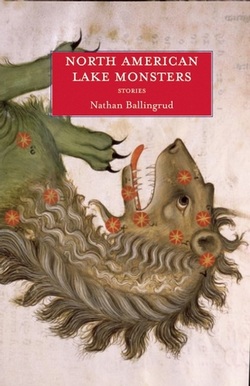 CLICK IMAGE TO PURCHASE CLICK IMAGE TO PURCHASE Your debut collection North American Lake Monsters is a modern masterpiece. How comfortable to you feel with all the well derived praise for this book? Well, thank you. I don’t know that that’s true, though. It’s dangerous to pay too much attention to that kind of thing. It feels good when you see it, but I put it out of my head as quickly as I can. More quickly than I do the criticisms, which tend to stay a bit longer. The fact is that social media can be a kind of echo chamber, and we all like to tell each other how good we are; but posterity isn’t moved by friendship or sentiment, and will, finally, deliver a harsher verdict for most of us. So I’m grateful for it, and I hope it’s true, but mostly I doubt it, and I do my best to put it out of my mind. And anyway, there’s nothing more obnoxious than a writer who buys into his own hype. How did you come to work with Small Beer Press for the release of North American Lake Monsters? And what came first the title of the collection, or the story of the title? I got lucky with Small Beer Press. I had assembled the collection already and sent it to another publisher, and was waiting for them to get back to me. I got an email from Gavin J. Grant a few weeks later asking if I had enough stories gathered for a collection. Luckily, the publisher I submitted it to allowed simultaneous submissions elsewhere. I contacted them and let them know I was going to let Small Beer look at it, they gave me their blessing, and a day or two later it was sold. It really took me by surprise, because I didn’t think Small Beer would be interested in anything quite that dark. Which proves the old axiom: give the editors a chance to reject your manuscript; don’t do it for them. The title story had been written some years earlier for The Del Rey Book of Science Fiction & Fantasy, edited by Ellen Datlow. The collection itself was going to be called You Go Where It Takes You at first, but we agreed that we wanted to give readers a clearer idea of what kind of book it was. North American Lake Monsters appealed to me because it sounds like a field guide. Although since the book has come out, I’ve had more than a few people express their dismay that it isn’t, in fact, a field guide to lake monsters. Oh well. The collection is a beautiful and powerful book, that on occasions brought a tear to my eye. How emotionally attached did you become to the stories, and where there any points where you felt that you couldn’t continue with a story? When I’m writing them, I’m wholly invested. I’d often have a lingering depression while writing them. It usually took me a few weeks of after completion for my mind to feel completely clean again. Once that happened, though, there was a complete break. The emotional attachment recedes to a sliver. The only hesitation I ever felt, when writing, was for the first one - “You Go Where It Takes You”. When it came to write the final scene, I stepped away from my desk and walked around for a while. My daughter was only two at the time. I went over to her — she was playing with some of her toys in the living room — and I picked her up and engulfed her in a hug. I told her I loved her. I felt I had to apologize to her for writing it, for even thinking of that story in the first place. And then I went back and finished it up. Ever since I read the book I felt that this was the book that could break the genre out of the literary ghetto. So many of the stories could have been written without the supernatural element. Did you ever consider writing the book without these present, as a way to gain a wider audience? You know, that’s been brought up as a criticism, too. “This story would work without the supernatural element. Therefore, you should take it out.” I never considered taking them out because these are the very things that I love about them. I love the monsters, I love the supernatural, I love the strangeness. I could have written “Wild Acre” to be about a bear instead of a werewolf and told exactly the same story — except then it wouldn’t have been a werewolf story, in which case why bother writing it at all? New Orleans features heavily in your work, what is it about the city that has affected you so much? Like Neil Young said of a different city, “All my changes were there.” New Orleans is the place I became an adult. It’s the place I first fell in love, got my heart broken, broke the law, feared for my life, built a family, made great friends, lost everything and found it again. I left it and went to New York, moved back in less than a year. I love that city as if it were a person. I’ve never felt quite as at home in any other place I’ve ever lived. The city exists in a kind of pocket universe separate from the rest of the world. It’s a throwback port city, with a history of slavers, pirates, emperors, revolutionaries, vodoun culture, and some of the greatest chefs, writers, and musicians the world has ever known. The mix of culture and of race rivals that of any great city, but it’s felt more intensely there because it’s so small. It was built on a swamp along a hurricane-haunted coast; it should not exist. The city knows this, and it thrives on it. It exists in a kind of littoral zone between fecundity and decay. Every day there is a day stolen from the grave — and you cannot forget about the grave in New Orleans, because they’re all above ground and situated in the middle of urban centers, like little necropoli. I have to be careful, because I’ll just keep going. New Orleans is where my heart lives, and may always be. 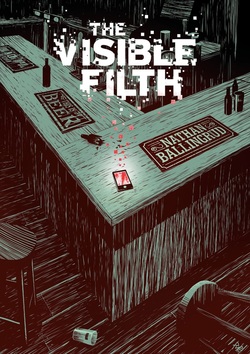 Click to Purchase Click to Purchase Your latest release The Visible Filth is not only set in the city but also has a rather nasty barman as the protagonist. Is any of the book based on your time as a barman in the city? Loosely, yes. Again, I don’t draw from direct experience, but the vibe and the culture of the place is drawn directly from my experience at The Avenue Pub. There’s a paragraph in there listing some of the odder characters that come into the place — the oyster shucker who sings Frank Sinatra, the woman who always took her clothes off before leaving — and most of them have real life antecedents. I dropped a few little things in there that are likes tips of the hat to people who used to frequent the bar where I worked; they’ll recognize those winks, but no one else will. And I consciously made Will, the protagonist, different from me. Whereas I’m a portly guy with questionable levels of social grace, Will’s a lean, confident young man, mostly indifferent to the internal lives of the people around him. But yeah, the energy of the place, the late night crowds, the weird ritual of the roaches — that’s all real. If we were to visit the city, what’s the one bar we should all hang out in? I’ve been gone for ten years now, so I’m not sure I know the answer to that one anymore. The place I worked was called The Avenue Pub, on St. Charles Avenue, and I’d be happy to steer anyone there. It’s not the same place anymore, though. The proprietor — one of the most decent men I’ve ever worked for — passed away some years ago, and his daughter has renovated the place. It’s more upscale now, a place where you can go for bourbon tastings and such. It makes Best of New Orleans lists now, I think. Not the hole in the wall dive bar it used to be. It’s good for the Pub, but it makes me a little sad for the place I loved. All things change, though. Molly’s at the Market is still going down on Decatur Street, though, and that’s a great bar. Igor’s used to be a good bar across the street; they’re probably still there. There’s a bar called Snake and Jake’s way uptown that had a great, dark atmosphere, strung with Christmas lights. Half Moon is terrific. They had great burgers back in the day; I hope they still do. Why so many cockroaches? They’re a fact of life in New Orleans, man. Great big horrible buzzards. They’re the most vile things in life, and no matter what you do and how often you clean, you’re going to get them in your home every once in a while. My ex and I once lived in this little shit-hole of an apartment that apparently had a nest either in the wall or under the house. We kept that place immaculate, but at night they would slip inside through little crevices between the wall and the floor. You could actually hear them walking around, they’re so damn big. Finally we learned the trick of chasing them instead of killing them; they would scurry back into the hole they’d come in through, and then we’d seal it up. But there were always more. We didn’t live in that place very long. The book uses modern technology as a means to look at our darker side of life. Do you think modern technology is a blessing or a curse? It’s both. Speaking of smart phones in particular, I’m now able to be content in the knowledge that my daughter is always able to contact me, or her mother, or emergency services if necessary. I’m able to have conversations with friends who live in other places. You know, all that good stuff. But there’s an obsessive quality that sets in, too. You find yourself checking it compulsively. It fractures your thoughts, makes getting down to those deeper layers of thinking more difficult. And it breeds suspicion. If you’re in a relationship, they can be a vessel for paranoia. Who is she texting? Who’s texting her? What if I looked? What would I find? I think that’s horribly corrosive. The poet Wendell Berry advised us to live a life without screens, and I think that would be ideal. One day, perhaps soon, we won’t have a choice. Maybe that’ll be for the best. The story is a perfect example of a highly atmospheric story. How do you go about layering on the atmosphere? it all starts with the character, for me. What is this character’s psychological state? How does he interpret his surroundings? That will suggest the language I want to use to describe it. You can convey a lot about the character’s mindset that way, without ever saying these things directly. This arranges the furniture in the reader’s mind in a particular way, it configures the shadows on the wall. When the characters start speaking and interacting, that psychological background is already in place. It helps to have an evocative setting — the New Orleans bar scene fits that bill, I think — but you can do this just about anywhere. Sometimes it’s fun to play against type. When I was asked to write a vampire story, I had to think about how I wanted to approach such a well-thumbed idea. I decided I wanted to write about a scary vampire, but to set the story as much as I possibly could in glaring sunlight on the Alabama coast. About as far from the traditional setting as you could get. “Sunbleached” came from that kernel. What does the future hold for you? I believe there is a novel in the works? Can you tell us what this is about? I have a couple novels in the works. One is set on Mars in the 1930s, one is a contemporary novel about an estranged father who kidnaps his child after a second moon appears in the sky one night, altering the world in strange ways. I’ve got a lot of short stories on the burn. I have this nagging idea for turning “Sunbleached” into a novel. A kind of unconventional idea for turning “Skullpocket”, a recent short story, into a larger work — a kind of biography of a city. Thank you Nathan this has been a huge honour, do you have any final words for the readers? Only that I’m incredibly appreciative of the reception North American Lake Monsters and The Visible Filth have received, and so grateful to anyone who ever told a friend, or wrote a review somewhere, or contacted me to tell me how they felt about it. In the small press, a book lives and dies by word of mouth, and I have been profoundly lucky in this regard. To all those people, I hope to honor your good will with good work. I’ll do my best. For more great interviews from the world of horror follow the links below HORROR INTERVIEWSFILM GUTTER INTERVIEWS
Adrian Shotbolt
20/5/2015 04:33:23
Great interview. The Visible Filth is fantastic. It is going to be in my top ten reads of the year for sure.
Michael Bishop
27/5/2015 11:42:29
Clear, honest answers to the interviewer's questions, Nathan, and an illuminating peek into your mind and motivations. Thanks for being so open and so straightforward. -- Mike Comments are closed.
|


Archives
May 2023
|
 RSS Feed

|

|