


I have known Michael Wehunt for a few years now, well before we took on his collection over at ST. I have been a fan from the beginning and can tell you with all honesty, he is one to be watching. He should be arriving any minute, most likely in those square-toed shoes of his....
JB: As you well know, I have followed your writing since its earliest stages. I have watched it mature and grow in splendid ways. Can you possibly break down for us a few steps of that evolution? A story like "A Coat That Fell," which I adore and still think has a resonating power but is shorter and in a lot of ways not as "grown" as your more recent material.
MW: Thank you, John, you big softie. You were one of my earliest trumpet-blowers, and I’ll always have a soft spot for you. Evolution… Well, most of the first year (when “A Coat That Fell” was written), I could unsurprisingly say I was learning how to write, since I’d never done it before. I had to figure out who I was, find my voice. Like anyone, I had to find the things I wanted to “say” to the world and the ways to say them. It’s almost assured that a new writer will be told that you have to write short, both in terms of not wasting words and in terms of being utterly unknown and thus having to make sure each story has a maximum number of markets to submit to. A lot of authors write primarily short-short stories for a long time, but I’ve always been interested in atmosphere, tension, dread, tone, those sorts of things that deserve a little time to build. Eventually I was able to stretch myself and play out more rope. And then there’s character depth/development. Certain stories cry out for more internal struggle, actions and thoughts and feelings that represent real people, which is something I can’t help but be drawn to. No matter how strange something I write is, no matter how cosmically horrific or inscrutable or mundane, I want very much to have flesh-and-blood characters dealing with those things. Often that’s where the horror is, inside us, and the uncanny only rubs up against it and in that friction shines a light on it. In real life we process information and stimuli, we have emotions and reactions of profound depth, and all of that can be deeply important to the overall story of what we’re doing, even if it’s deciding to take a nap because we’re having an awful day, or walking into the woods without a particular destination. I suppose if I’ve grown in these “splendid” ways you mentioned, it’s mainly just due to confidence in myself. And I could say that I started openly making a conscious effort to place horror and the human condition on very equal footing. Sometimes the balance isn’t 50/50, but taken as a whole, I think my body of work thus far is an attempt to…wed the weird fiction of Robert Aickman or the cosmic horror of Laird Barron with the strongly humanistic literary aim of Raymond Carver or Lydia Davis. I deeply love the profound, the beautiful beneath the ugly. The lifting up. I love powerful themes and I walk toward them. I think I’ve gotten progressively better at looking inside these things. They’re slowly getting closer to the foreground. JB: You are a southern author, you live in the south. Does that make you a "Southern Gothic" writer by default? Please explain for folks who are not sure what and how that particular frilly bonnet comes to be placed upon a writer's head. MW: I grew up in the South. I’m still here. It’s in my blood and it’s rich and salty. But I think that only makes me a little bit of a Southern Gothic author. So the answer is mostly no, I’m not by default. I went to Savannah, Georgia, on a school trip when I was fourteen, and part of our tour was seeing Flannery O’Connor’s house. When I think of that day—it was already summer hot and sticky in early May, I was looking up at that skinny house she’d lived in—it feels important, like the first time a key tried to slide into a lock. But I didn’t yet know her. I didn’t know that I would be reading her soon. On the other hand, I already wanted to be a writer, though I had decades of fear and not doing it in front of me. So I’m not sure how much of it is me wanting that moment to have import. How in love with her I fell in high school! Later I would read other Southern Gothic writers—Carson McCullers, William Gay, James Dickey, Joyce Carol Oates (she’s a damn Yankee but I secretly consider her to be Southern Gothic)—but at first it was all Flannery. I come from a very religious family, and I loved horror from a very early age, so I reacted strongly to her grotesque view of religion. How she had such a deep and abiding love for God and yet wrote about how awful people can be. There’s a stark conflict at work between the divine and the depraved. Read the first thirty pages or so of her novel The Violent Bear It Away and tell me it doesn’t have some of the most amazing weird fiction descriptions. That’s Southern Gothic, in my opinion: the grotesque, the yearning, the ugly epiphanies that resonate with profundity, warts and all…I could go on, but it’s a such a fertile ground. JB: This year has been a banner year for the "Weird Horror" end of the compound. Your collection, Greener Pastures, being a forerunner in that great strange surge. How do you feel about that? Does it make things easier or more difficult? I mean the more weird there is the harder it would be to remain weird, yes? MW: I agree that it’s been a wonderful year for weird horror, and that can’t be anything but good. As for Greener Pastures, it’s been wonderful being part of the “surge.” I suppose most authors have no real idea if their debut will fly or fall or quietly sit somewhere in the middle. Since I didn’t know what to expect, it’s easy to report that it’s done better than I could have dreamed. A cliché I’ve found myself parroting a lot lately is “A rising tide lifts all boats.” In this particular case, it’s even more apt, because a subgenre that’s easy to call “niche” has been experiencing a wider exposure lately, largely because of all these great authors making it worthy of borderline serious mainstream appeal. Niche or no, I find the weird fiction end of the horror spectrum to be more malleable across genres, and thus more useful as a mirror for ourselves and the human condition. You can do more with it, like Silly Putty versus a rubber ball. While some could say that when it gets harder to be weird, writers will get weirder and weirder, but it’s that malleability that will save the day. Fantasy, horror, science fiction, literary, even mainstream “safe” fiction might all get a little weirder—we’re certainly seeing it in Hollywood already—and that’s where I think the future is. And as far as horror goes, if what I write were to one day be called “regular horror,” I can’t help but think that’s kind of a success. JB: I'm not at all baiting any type of umbrage or glad-handing but as honest as you can be where do you see the horror genre currently? I mean, to me it's a strong as ever, especially with all of its tentacular pillars and subgenres going? MW: As I just mentioned, the exposure of horror has widened in the last few years. But to avoid too much repetition, I'll focus on horror as a whole in this answer and keep the weird fiction flavor out of it. I think horror is still burdened with the stigma of the ugly, sallow sibling in the speculative fiction family that's kept shut up in the basement so as not to embarrass science fiction and fantasy. The obsession with zombies seemingly continues. Serial killers tell us their terrible thoughts. Demons are summoned. The apocalypse will keep fascinating us because it feels more and more possible in real life. There will always be a place for "typical" horror, and there's nothing wrong with typical horror. There's always the risk of being seen as looking down my nose at it, which I'm not. There's genuinely great, exciting stuff in that arena, and I never push it aside. But I'm more drawn to the part of the Venn diagram where horror and "literary" overlap (and any pretension that necessarily entails), because as a reader, I get everything I want. I get to read exciting, expertly crafted prose, think of the world in new ways, and get creeped out. But there's been a resurgence in horror as a whole. Horror films with some legitimate weight and value have been made, by directors who have the intent of merit, and some of those films have been commercial hits and taken seriously. The Witch, It Follows, and The Babadook are the recent examples that are most commonly brought up because, in being moneymakers, they've further opened the doors for other films to see that horror movies can be good movies, period. They can care about composition and cinematography and thoughtfulness. But by no means are those the only examples. And this affects all aspects of the horror genre. If horror fiction is being taken more seriously, more thoughtful and richly talented authors will embrace it. For every A Head Full of Ghosts that finds great and wide success, for every internationally respected literary author like David Mitchell who dabbles in horror with The Bone Clocks and Slade House, more and more authors will see horror through a new lens and explore all the potential it has in new and exciting ways. They will inject it with literary freshness. Whether the current momentum continues is unguessable at this point, but the indications are there. Going back to stigmas, I think horror is still seen as such a white man's genre. There has been and will continue to be wonderful, literate horror (in all its permutations) written by straight white dudes carrying the old torches with dignity, but the genre is slowly catching up with the rest of the world and changing for the better. There's a little dialogue about the issue nowadays, and as long as more and more women and people of color fall in love with horror, with its possibilities, this is another huge reason, perhaps the hugest reason, that the genre can take enormous leaps forward, both commercially and artistically. Blood and guts aren't going anywhere, but neither are ghosts that still carry flesh-and-blood depth. JB: I've known you for quite a while, I know you are a man of eclectic tastes. Wow me with a book, movie and album that you feel would shock me to know you dig. MW: A book I’ve loved for many years that might not seem “me” is Youth in Revolt by C.D. Payne. It’s the funniest book I’ve ever read, and I think I’ve read it five times. It’s a domino chain of teenage scheming and disaster, cause and effect, that would make Shakespeare proud, in a juvenile but supremely clever way. It was made into an not-terrible movie several years ago with Michael Cera, but only a portion of the book was used. A movie I love that might shock you is Home Alone (and Home Alone 2: Lost in New York). Anyone who’s been friends with me on Facebook for a year or more won’t be shocked at all by this, but even I’m surprised by my weird love for these movies. Don’t ask me to explain it…I was a little too old for their target market when they came out, and I’m far too old now. So it’s not really nostalgia. All I know is they make me happy, and I watch both every Christmas. I have never seen Home Alone 3 and never will. An album I love that might shock you is Body Talk by Robyn, the Swedish pop star. I fell madly in love with her about eight years ago, even though most pop singers don’t have a single song I love. Robyn has something that resonates. She simply writes great songs. I listen to her very loud, and I sing along very badly. “Hang With Me” from 2010 is one of my all-time favorites. JB: Where do you see your writing going in the next few years, still mining the ore of quiet strange horror or possibly meandering all over the speculative map? I'm in for whatever you do. MW: I see myself writing a novel soon and searching for that thin seam right in the middle of horror and literary, to oversimplify using those broad terms. I want to see how many threads I can pluck out of that seam. It might break open on me, and I have an idea about what might gush out that could end up being beautifully wrong. Otherwise, I’m still learning about contemporary and classic weird fiction and horror (and weird horror) every day. I didn’t discover it for a very, very long time, so I’m catching up. Therefore I don’t see myself abandoning it anytime in the near future. And by this point, it’s in my blood, just like the South is. I do see myself further exploring different gradations of it, though. Playing with that balance. 70/30 or 20/80 instead of 50/50. That’s where the real passion is for me. It’s just a matter of which side of the forest I walk into. JB: Thanks for taking the time for this. MW: It was my pleasure, John. Thanks for having me. Be sure to eat your vegetables. Michael Wehunt is the author of Greener Pastures, a collection of weird and haunting tales, published by Shock Totem Publications and available through them as well as Amazon. 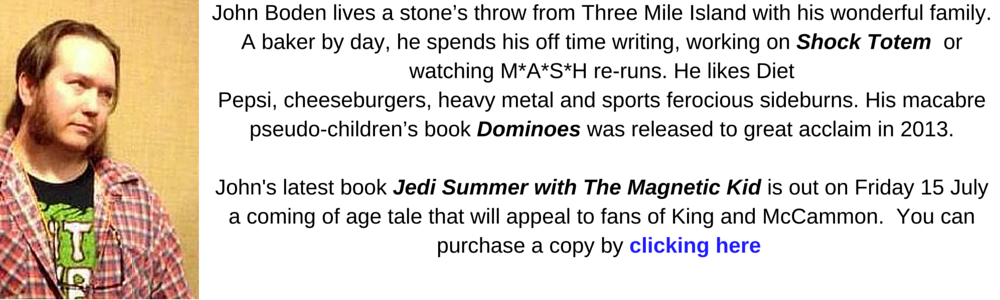
Comments are closed.
|


Archives
May 2023
|
 RSS Feed

|

|