

ON THE DAMNED HIGHWAY WITH NICK MAMATAS
18/1/2017
 Nick Mamatas. Author of a number of novels; Move Under Ground (Night Shade 2004, Prime 2006) and Under My Roof (Soft Skull Press, 2007), Sensation (PM Press, 2011), The Damned Highway (Dark Horse, with Brian Keene, 2011), Bullet time (CZP, 2012) Love Is the Law (Dark Horse, 2013), and The Last Weekend (PS Publishing, 2014)three collections; 3000MPH In Every Direction At Once (Prime 2003) and You Might Sleep... (Prime 2009), The Nickronomicon (Innsmouth Free Press, 2014); and the novella Northern Gothic (Soft Skull, 2001). He is also the editor of the anthologies The Urban Bizarre (Prime 2003), Phantom #0 (Prime 2005), Spicy Slipstream Stories (with Jay Lake, Lethe 2008), and Haunted Legends (with Ellen Datlow, Tor 2010). As part of his day job, he co-edited the Locus Award nominee The Future Is Japanese (with Masumi Washington, Haikasoru 2012) and Phantasm Japan (with Masumi Washington, Haikasoru 2014). His latest novel I am Providence, about a murder mystery at a Lovecraft convention is available from all good booksellers has been described as having sharp wit, biting but humane social commentary, and, for the romantics among us, a faceless narrator decomposing at the morgue." Matt Ruff, author of "Bad Monkeys" and "Lovecraft Country" We stand on the brink of whole new world order, how does Nick Mamatas feel going into what could probably be the most politically interesting era of the last few generations? Funny—I usually answer such questions with “Great!” and reel off all the hopeful political developments, but not this time. The elements of the farish left that had swings at bat have failed utterly, and the far right is being mainstreamed across the US and Europe. The good thing about the far right is that it never lasts long—you can’t run a civilization based on total myths and 18th century economics for more than a couple decades—but they tend to take a lot of people with them. It’s a frightening time. Anyone who isn’t already bamboozled by the far right cannot give them an inch. No devil’s advocacy, no seeking out the “reasonable” “alt-lite” figure. And no horseshoe ideology either. The far left is not kin to the far right. Anyone who is on the left needs to turn to their right and attack in that direction, not vice versa. There was a feeling among some of the current authors that periods of political upheaval and unrest can bring out the best in the arts? How do you feel about that viewpoint? I tend to agree, but only because everything has moved so far to the right that the liberal left dare not critique Obama, for say, bombing seven different countries in eight years with flying robots. The ascendency of the far right means that the center-left will be activated, whereas they have lately been silent. The center-left doesn’t make for the best artists, but as they have money, they make for the best consumers. And art needs consumers. Punk and zine culture needed suburban kids with money to send away for all the junk people made during the Reagan era. Underground arts cultures represent the rare transfer payment from the top strata toward the bottom. Ultimately, clever middle-class culture vultures take over and homogenize and mainstream the stuff, but there should be some decent arts action till about 2019. In a recent interview you stated that “I'm already the most hated person” in the fandom in this world of social media and heckling fish wives do you ever wish this wasn’t the case? Honestly, I never think about it. I’m much more interested in milieus where I don’t even get to be hated. Why am I never reviewed in Bookforum? You have never been one to shy away from heavyweight debates, and at times have been rather outspoken. Have you ever felt that being so open about your thoughts and feelings has hampered your writing career? No. The only thing that has hampered my writing career is my lack of interest in actually writing commercial fiction—series novels, novels of 80,000 words or more regardless of the needs of the content, novels about police or police-style supernatural organizations, sentimental short stories, didactic short stories, and fiction about the hilarious foibles of the neurotic bourgeois subject. I can only do me. Of course, my career isn’t stuck in its current position, but “breaking out” would require several things to line up—the right review in the right newspaper, an independent filmmaker with a bright idea and two million bucks, a solid tweet from a beloved idiot celebrity—to make things happen. On the plus side, I recently received the libretto to the chamber opera adaptation of my novel Bullettime from a fairly prominent composer and conductor. Eh, eh, chamber opera? You a big fan, then? Yeeeah. Has there ever been a situation where you wish you had just kept out of it? Nah. Growing up in 1970’s Brooklyn helped to shape you as a writer and the man you are today. How has Brooklyn changed since your childhood, and how would a later version Nick Mamatas would differ from this version? Brooklyn has changed entirely. Now-hip neighborhoods like Williamsburg, Red Hook, and DUMBO were largely industrial wastelands when I was a kid. (My father worked in Red Hook as a longshoreman; I got to see a fair amount of it.) The Italian-American population I lived among has been largely replaced by relatively recent Russian immigrants. There are kids living in Brooklyn today that don’t know what it’s like to switch on a kitchen light and see thousands of roaches scuttle out of sight. I suppose a later me would be more miserable, growing up in a fancier Brooklyn with more inequality, but who can say? Do you still want to be an astronaut? You know, I get dizzy after more than twenty minutes in a car. I’d rather just be an alien. You are often labelled as a horror writer, but your fiction transcends genre labels, does this need to pigeonhole writers hamper or help a writer? The not very satisfying answer is that it depends. I write a lot of different genres of fiction—my novels tend to be dark, and sometimes have common theme (zombies, Lovecraft) and so horror it is. That said, I’ve never published a novel via either a horror imprint or a horror publisher: Night Shade Books is the closest, but they were publishing SF and fantasy as well in 2004 when Move Under Ground came out, and in 2016 when both The Last Weekend and I Am Providence were released. Same with CZP, which published Bullettime. Dark Horse, which published The Damned Highway and Love is the Law, primarily does comics, and its other prose works included comical fantasy and variety of other work. Sensation and Under My Roof were published by independent publishers with left political leanings. My collection The Nickronomicon was published by Innsmouth Free Press, which is explicitly Lovecraftian, but Lovecraft was himself a science fiction/fantasy/horror writer, not simply and only horror. Does writing in different genres allow you to tackle different themes from different angles? For example http://amzn.to/2jYilvBI Am Providence is more of a mystery than a horror story, would you have addressed the themes of the book differently if you had written it as a horror novel? 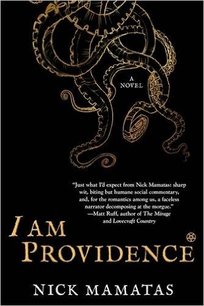 Yes, in a way I Am Providence would have to be less ridiculous were it played as a horror novel with mystery elements instead of a mystery novel with horror elements. To be consistently frightening or dreadful, the characters would need to be presented more seriously, so their dramas and deaths would be felt more viscerally. As a mystery, which is necessarily more realistic than supernatural horror, there was more room for both humor and philosophical meandering. In a horror novel, the philosophical bits are often concretized in the supernatural menace, which is a neat trick, but which also gets boring to me after a while. The book is set at a Lovecraft convention, ignoring all the usual and well-worn topics around the man and his writing, why out of all of the authors who have walked the earth is there this after death market of Lovecraftian fiction, why isn’t there a Stokerism for vampires, or a Shelleyism for reanimated corpse fiction? Shelley died in 1851, Stoker died in 1912. Frankenstein became very popular after its first stage adaptation, and Shelley rewrote the book to suit the conservative marketplace of novel-readers. Dracula was widely reviewed and reprinted, and then came film adaptations in the early twentieth century. So the books were famous, essentially, which means that a larger audience inspired a larger number of writers to mess with the material, or write parallel to it. Lovecraft died fairly obscure in 1937. His work was kept alive by close friends and allies who extended the work via fairly slavish imitation. Lovecraft hasn’t yet reached the sufficiently large and extraliterary (i.e., movie) audience necessary to blow the themes and forms wide open. However, we are on the cusp of seeing it happen now. Check back in thirty years, and we’ll be talking about science fictional anti-humanist existentialist dark fiction, or “siff-a-hee-duf” for short. The novel like a lot of your work plays with the notion of narrative with a third-person living narrator and first-person dead narrator, is there a reason as to why you like to play around with narrative structure, and what challenges does this bring up? I’m just a formalist. I love working with a wide variety of POVs—the first-person narrative of a famous person in Move Under Ground, omniscient first-person in Under My Roof, multiple POVs from the same character but in different universes in Bullettime, collective species-wide first in Sensation, and the like. I’m happy to read the more common third-person subjective POV that many popular novels use, but generally that just bores me to write. When I was young and started reading a lot, I always felt a startling burst of frisson when someone like Kurt Vonnegut would reveal a first-person narrator forty pages into a book, and I guess I am still just seeking that sensation. 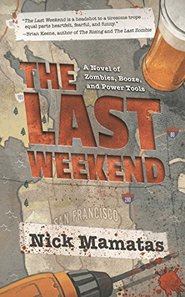 Like so many authors who dabble in the horror genre, you touched base with the zombie sun genre with The Last Weekend, it’s a bit like The Walking Dead isn’t it? That question must surely be one that gets your hackles up isn’t it? I’ve never seen The Walking Dead. Is it? I hope so! In 2015, at the ALA conference for librarians, we handed out of a lot of uncorrected galleys, and the all the librarians asked “Is this anything like The Walking Dead?” and since they seemed to want me to say “Yes” I did! Why go to a trade show for librarians to argue with librarians? How much thought went into the locations of the book? Was San Francisco a location for any particular reason? I live close to there; and it’s in California, where people in American fiction go to remake their lives; and its peculiar geography and history would make it somewhat difficult for zombies to gain a foothold. No big cemeteries, lots of big hills. One of the themes of the book is how we all have our personal take on history and how the truth of what happened is shaped by our own needs and beliefs. For example, America feels that the zombie apocalypse is only happening to them and the rest of the world is laughing at them, did you ever think when you were writing the book that here in 2017 this theme would be so apt? Sure did! I’m a total genius, after all. But surely we are always awash in history, being carried along by it like leaves in a gutter, so the theme of history’s contingency and ultimate unknowability is always going to be apt. But if you’re worried about Trump, definitely buy The Last Weekend, and then tell all your friends to do so. 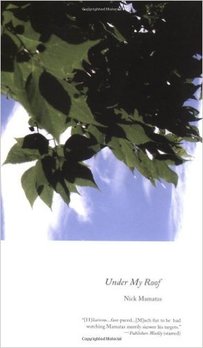 Following on from that Under My Roof has a character that builds a nuclear bomb and secedes from America, how does this idea appeal to you with the imminent inauguration of Trump? During the Bush presidency, I lived in Vermont, and the only semi-serious movement to launch the Second Vermont Republic was extremely interesting to me. I like political eccentrics, after all. Just after Trump’s election, the CalExit movement to separate California from the rest of the US started being taken very seriously. In some ways it makes a lot more sense—California has a lot more money. On the other hand, almost nobody would miss Vermont, while the US would fight to keep its West Coast on the map. The book was marketed as a Young Adult book, something I had no idea when reading it when it was first published. Did you set out to write it as a YA book? It wasn't quite marketed as anything, sadly, as the publisher’s distributor went bankrupt the week the book was to come out, and the publisher had taken out several loans from that distributor, so also found itself in a lot more trouble. (The loans themselves were a sign of the trouble.) It was rushed to print after being completed by interns and left to flounder with a generic cover. (My former literary agent jokingly suggested that the cover be used for my memoir of surviving ovarian cancer.) It did get very positive reviews—a star in Publishers Weekly, and several notices in major newspapers—and that kept it from being lost entirely. I set out to write it less as a YA novel and more as a parody of a middle-grade novel, but that joke really only amused myself. Lovecraft and Jack Kerouac are two authors that you have used in your fiction; we’ll skip over Lovecraft, but Kerouac, where did that come from in Move Under Ground? Some guy tried to hit on my friend, the writer Joi Brozek, and told her that he was writing a novel that was half On the Road and half “surreal realism.” So I decided to try it for real. Also Lovecraft and Kerouac have a lot in common: New England background, close friendships with other writers, suspicious sexuality, cult followings, intense relationships with their mothers, right-wing crank politics but substantial love from left or at least countercultural readers, and I thought that combining them would capture me a sliver of both cults. In fact, it captured a sliver of the intersection of the two cults, but that was sufficient to make the book a perennial backlist seller, at least in ebook, which I self-published after the paperback sold out and was not reprinted. 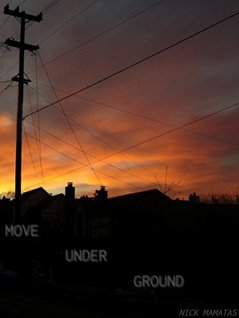 I’ve only ever read two of Kerouac’s books “On The Road” and “ The Dharma Bums”. I loved “On The Road” and was not overly taken by “The Dharma Bums”, and I think that was more down to the time in which I read it, where every cool hip cat student was quoting Kerouac. Does Kerouac have the same legacy in the States as he seems to have over here as the poster boy for really annoying poetry-spouting English grad students? Yes, exactly. But say what you will about annoying grad students, they buy a lot more books than virtually anyone else other than romance-fiction readers. And I’m not very romantic, so… 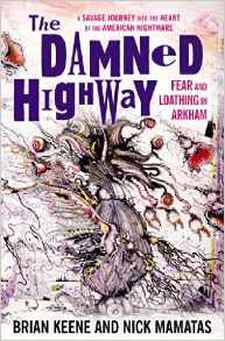 You teamed up with Brian Keene for The Damned Highway to bring to life another of America’s great writers Hunter S Thompson, who came up with the idea for this?
Me. It was me. Not Brian, me. I saw that Brian was doing a lot of collaborations and I wanted to do one with him because I thought we’d make a lot of money, so I pitched him the idea. (We made a fair amount of money.) He misremembers it as being his idea for some reason (not related to the amount of money we made, as we split it 50/50). I believe that Brian went all teacher's pet and reread everything that Hunter wrote and you more kind of winged it. Were you concerned about getting too caught up in finding and emulating Hunter’s voice? I read a lot of Thompson over the years, so was familiar with the voice. I didn’t reread anything in preparation for the book, except for the few pages from his collected letters, The Proud Highway. (More proof that it was my idea! I came up with the title The Damned Highway because I saw my copy of The Proud Highway on my shelf!) I wasn’t really concerned; I was just confident in my skills as a mimic. The book also touches on themes of dark forces are moving behind the scenes, are you some modern day Nostradamus? Yes. PS: go to the doctor and get a colonoscopy. You’ll thank me later. Is this the only time you have worked with another writer, and if so would you do it again, and who would be your perfect collaborator? I’ve co-written several short stories: two with fantasist Tim Pratt, one with performance poet Daphne Gottlieb, one with Lovecraftian writer Don Webb, one with writer and copy editor Eliani Torres, and one forthcoming with Molly Tanzer. I’ve also co-edited several anthologies. I like collaborating because I am lazy and like editing the work of other people more than I do writing. I’d like to collaborate with Terry Bisson because he lives nearby, is funny and a genius, and I think he’d spring for lunch. Thank you, Nick, for doing this interview, can you tell us about any future projects you are working on, and do you have any final thoughts? In October, my latest anthology, a hybrid cocktail recipe/short fiction title called Mixed Up will be released. It's co-edited by Molly Tanzer, who handled the recipe section. You should definitely buy one for every person you know, as it’s designed to be a “stocking stuffer” gift book—an octavo edition hardcover at a lowish price. We just handed in the manuscript last week, and I’ll surely be bothering everyone to pre-order copies soon. With the far right taking over, if you can’t fight back, you can at least drink heavily, and our book will help. It also includes stories by Jeff VanderMeer, Elizabeth Hand, Benjamin Percy, Jarett Kobek, and many other famous writers who either owed me a favor, or who wanted me to owe them one. I’m working on two novels, and even sold one of them in late November, but as the contract is not yet signed I can say nothing more than it is like Ash Versus the Evil Dead meets Xena: Warrior Princess meets every 1980s fantasy/horror film that takes place in Manhattan, and that it is also deeply religious as it explores pre-Schism Christianity. Comments are closed.
|


Archives
May 2023
|
 RSS Feed

|

|